XUNYOU-LINK 4G LTE WiFi Router
Official Store Deal
Expert Analysis Overview
The XUNYOU-LINK 4G LTE WiFi Router is a pragmatic connectivity solution engineered for users requiring reliable internet access in areas where traditional broadband is unavailable or impractical. This device acts as a bridge, transforming cellular 4G LTE signals into a robust Wi-Fi network, providing essential internet access where it is needed most. Its design prioritizes ease of use and broad compatibility, making it a valuable tool for bridging digital divides in various settings.
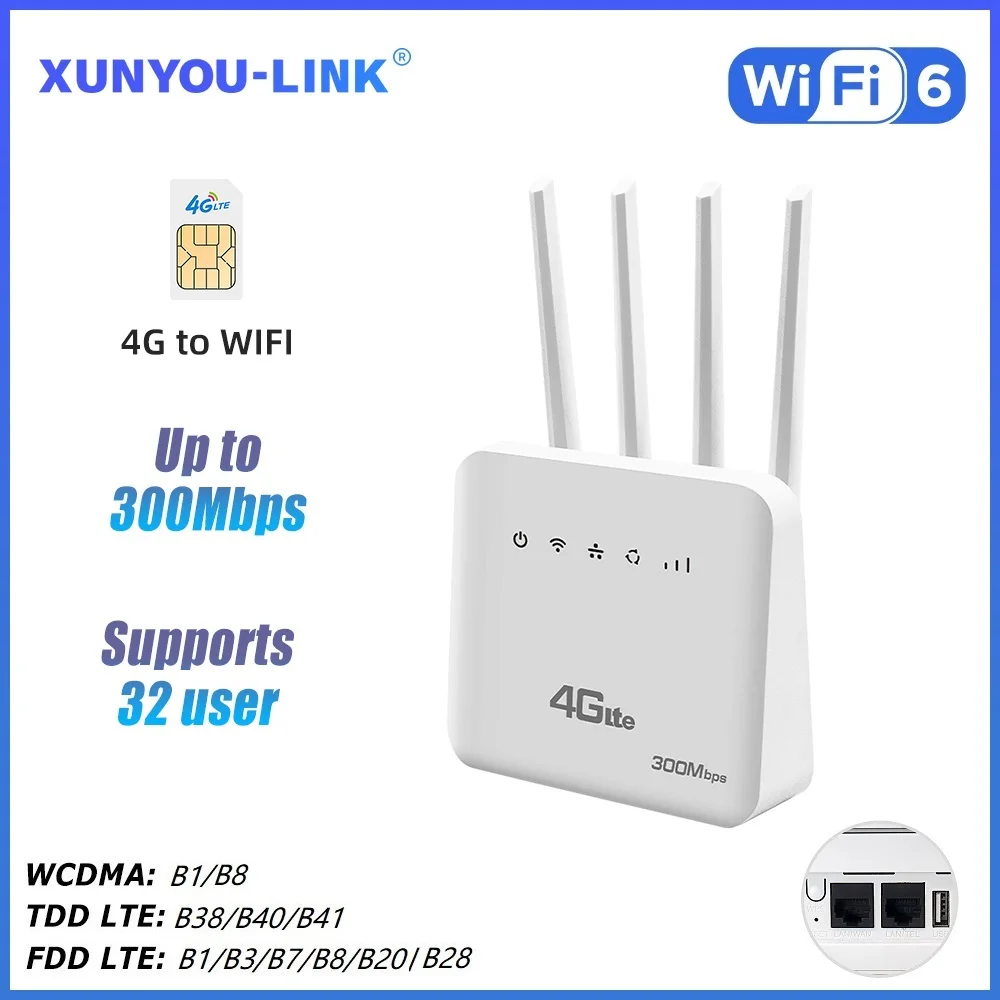
At its core, this router functions as a dedicated 4G LTE modem and Wi-Fi access point. It integrates a SIM card slot, allowing it to tap directly into cellular data networks. This capability is paramount for locations lacking fixed-line infrastructure, such as remote homes, temporary offices, or mobile setups. The device supports a comprehensive array of LTE bands, including WCDMA: B1/B8, TDD LTE: B38/B40/B41, and FDD LTE: B1/B3/B7/B8/B20/B28. This broad spectrum of band support is crucial. It ensures the router can operate effectively across diverse geographical regions, specifically Europe, Asia, and Africa, where these bands are prevalent. Imagine setting up a pop-up shop in a rural area; this router provides instant internet.
Compared to a standard mobile hotspot, this unit offers a more permanent and robust solution. It does not rely on a smartphone's battery or tethering capabilities, providing a dedicated and stable connection. The ability to simply insert a SIM card and power on the device simplifies internet deployment significantly.
This router is rated for up to 300Mbps wireless speed. While the packaging prominently displays "WiFi 6" branding, the 300Mbps throughput is more characteristic of WiFi 4 (802.11n) standards. This indicates that its primary strength lies in efficiently converting the 4G LTE signal into a usable Wi-Fi network, rather than delivering ultra-high local network speeds typically associated with advanced WiFi 6 implementations. For most internet activities, including browsing, streaming standard definition video, and video calls, 300Mbps remains perfectly adequate. It supports up to 32 simultaneous users. This is a significant capacity.
Consider a small office or a large family gathering. Each person can connect without significant slowdowns. This capability far exceeds what many basic mobile hotspots offer, which often cap out at 5-10 devices. The router manages the connected devices to ensure a stable connection for everyone. It is designed for shared access.
In contrast to single-user mobile dongles, this router transforms a single cellular data plan into a shared resource for an entire household or small business. This translates to a more economical and convenient internet solution for multi-device environments.
Signal strength and coverage are critical for any Wi-Fi setup. The XUNYOU-LINK router features four external antennas. These are not merely decorative; they are instrumental in capturing weaker cellular signals and broadcasting a stronger Wi-Fi signal. The physical design suggests these are fixed antennas, contributing to a stable signal without the risk of accidental detachment. The device includes a Signal Intensity Light on its front panel, providing immediate visual feedback on the quality of the incoming 4G LTE signal. This light helps in positioning the router for optimal performance, a simple yet effective troubleshooting aid.
Users can strategically place the router to minimize dead zones within a home or workspace. The external antennas aid in penetrating walls and obstacles, distributing the Wi-Fi signal more evenly. This helps ensure coverage in every room, reducing common frustrations with patchy connectivity. A well-placed router means consistent internet.
Unlike compact USB dongles that offer limited range, this router's antenna array and dedicated power supply allow for a much broader coverage area, making it suitable for larger rooms or even small multi-story dwellings.
The physical construction of the XUNYOU-LINK router is straightforward and functional. The casing appears to be made of a matte white plastic, which resists fingerprints and blends discreetly into most environments. The unit feels dense and solid, suggesting a durable build quality that can withstand regular use. Its dimensions are approximately 14.3cm in width, 12cm in height (excluding antennas), and 3.6cm in depth, making it compact enough for easy placement on a desk or shelf. The front panel features clear LED indicators for Power, Wi-Fi/WPS, Ethernet port status, LTE connectivity, and Signal Intensity. These lights provide at-a-glance status updates.
The rear panel reveals essential connectivity options. It includes an RJ45 Ethernet port, offering a stable wired connection for devices like desktop computers, smart TVs, or gaming consoles that benefit from direct network access. There is also a SIM card slot for cellular connectivity, a RESET button for factory defaults, and a Power Adapter input. A notable detail is the mention of a "Update USB Port," though its specific functionality for end-users is not detailed. The absence of a physical WPS button, as indicated by "Not Available" in the diagrams, means Wi-Fi Protected Setup would need to be configured via a web interface if supported at all.
The inclusion of an Ethernet port is a significant advantage over purely wireless mobile hotspots. It allows for a more reliable connection for critical devices, circumventing potential wireless interference or congestion. This versatility enhances its utility in various home and office setups.
Setting up the XUNYOU-LINK 4G LTE WiFi Router is designed to be intuitive. The process typically involves inserting a compatible 4G LTE SIM card, connecting the power adapter, and waiting for the device to establish a cellular connection. The front panel indicators, particularly the LTE and Signal Intensity lights, guide the user through this initial setup, confirming when a stable connection has been made. Once the cellular connection is active, the router broadcasts its Wi-Fi network, which can be joined using the default SSID and password usually found on a label on the device itself. This simplify setup for non-experts.
For more advanced configurations, such as changing the Wi-Fi name, password, or setting up network security protocols, access is typically gained through a web-based interface via a connected computer or smartphone. This standard approach allows for customization. The focus remains on getting online quickly and efficiently.
Unlike complex enterprise-grade routers requiring extensive network knowledge, this device is engineered for rapid deployment. Its plug-and-play nature for basic connectivity means users can get online within minutes, minimizing downtime and technical hurdles.
This router is an upgrade from simply relying on smartphone hotspots, which drain phone batteries and often offer limited range and device support. It provides a dedicated, always-on internet source. The ability to support up to 32 devices ensures that an entire household or small team can stay connected without compromising performance. Its wide compatibility with LTE bands across Europe, Asia, and Africa makes it a truly global solution for mobile internet needs.
Imagine a world where consistent internet access is no longer a luxury tied to geographical location. Picture a family enjoying seamless streaming and online learning from their remote cabin, or a small business maintaining critical operations even during a fixed-line outage. This router delivers that peace of mind, offering robust connectivity that keeps you productive and entertained, regardless of your location. It's the reliable backbone your digital life deserves, ensuring every device stays connected, every task gets completed, and every moment online is smooth and uninterrupted. This device ensures that internet access is always within reach, transforming any location with a cellular signal into a connected hub.
The Cellular Connectivity Gateway
At its core, this router functions as a dedicated 4G LTE modem and Wi-Fi access point. It integrates a SIM card slot, allowing it to tap directly into cellular data networks. This capability is paramount for locations lacking fixed-line infrastructure, such as remote homes, temporary offices, or mobile setups. The device supports a comprehensive array of LTE bands, including WCDMA: B1/B8, TDD LTE: B38/B40/B41, and FDD LTE: B1/B3/B7/B8/B20/B28. This broad spectrum of band support is crucial. It ensures the router can operate effectively across diverse geographical regions, specifically Europe, Asia, and Africa, where these bands are prevalent. Imagine setting up a pop-up shop in a rural area; this router provides instant internet.
Compared to a standard mobile hotspot, this unit offers a more permanent and robust solution. It does not rely on a smartphone's battery or tethering capabilities, providing a dedicated and stable connection. The ability to simply insert a SIM card and power on the device simplifies internet deployment significantly.
Performance and User Capacity
This router is rated for up to 300Mbps wireless speed. While the packaging prominently displays "WiFi 6" branding, the 300Mbps throughput is more characteristic of WiFi 4 (802.11n) standards. This indicates that its primary strength lies in efficiently converting the 4G LTE signal into a usable Wi-Fi network, rather than delivering ultra-high local network speeds typically associated with advanced WiFi 6 implementations. For most internet activities, including browsing, streaming standard definition video, and video calls, 300Mbps remains perfectly adequate. It supports up to 32 simultaneous users. This is a significant capacity.
Consider a small office or a large family gathering. Each person can connect without significant slowdowns. This capability far exceeds what many basic mobile hotspots offer, which often cap out at 5-10 devices. The router manages the connected devices to ensure a stable connection for everyone. It is designed for shared access.
In contrast to single-user mobile dongles, this router transforms a single cellular data plan into a shared resource for an entire household or small business. This translates to a more economical and convenient internet solution for multi-device environments.
Expanding the Wireless Horizon
Signal strength and coverage are critical for any Wi-Fi setup. The XUNYOU-LINK router features four external antennas. These are not merely decorative; they are instrumental in capturing weaker cellular signals and broadcasting a stronger Wi-Fi signal. The physical design suggests these are fixed antennas, contributing to a stable signal without the risk of accidental detachment. The device includes a Signal Intensity Light on its front panel, providing immediate visual feedback on the quality of the incoming 4G LTE signal. This light helps in positioning the router for optimal performance, a simple yet effective troubleshooting aid.
Users can strategically place the router to minimize dead zones within a home or workspace. The external antennas aid in penetrating walls and obstacles, distributing the Wi-Fi signal more evenly. This helps ensure coverage in every room, reducing common frustrations with patchy connectivity. A well-placed router means consistent internet.
Unlike compact USB dongles that offer limited range, this router's antenna array and dedicated power supply allow for a much broader coverage area, making it suitable for larger rooms or even small multi-story dwellings.
Thoughtful Design and Interface
The physical construction of the XUNYOU-LINK router is straightforward and functional. The casing appears to be made of a matte white plastic, which resists fingerprints and blends discreetly into most environments. The unit feels dense and solid, suggesting a durable build quality that can withstand regular use. Its dimensions are approximately 14.3cm in width, 12cm in height (excluding antennas), and 3.6cm in depth, making it compact enough for easy placement on a desk or shelf. The front panel features clear LED indicators for Power, Wi-Fi/WPS, Ethernet port status, LTE connectivity, and Signal Intensity. These lights provide at-a-glance status updates.
The rear panel reveals essential connectivity options. It includes an RJ45 Ethernet port, offering a stable wired connection for devices like desktop computers, smart TVs, or gaming consoles that benefit from direct network access. There is also a SIM card slot for cellular connectivity, a RESET button for factory defaults, and a Power Adapter input. A notable detail is the mention of a "Update USB Port," though its specific functionality for end-users is not detailed. The absence of a physical WPS button, as indicated by "Not Available" in the diagrams, means Wi-Fi Protected Setup would need to be configured via a web interface if supported at all.
The inclusion of an Ethernet port is a significant advantage over purely wireless mobile hotspots. It allows for a more reliable connection for critical devices, circumventing potential wireless interference or congestion. This versatility enhances its utility in various home and office setups.
Streamlined Deployment and Management
Setting up the XUNYOU-LINK 4G LTE WiFi Router is designed to be intuitive. The process typically involves inserting a compatible 4G LTE SIM card, connecting the power adapter, and waiting for the device to establish a cellular connection. The front panel indicators, particularly the LTE and Signal Intensity lights, guide the user through this initial setup, confirming when a stable connection has been made. Once the cellular connection is active, the router broadcasts its Wi-Fi network, which can be joined using the default SSID and password usually found on a label on the device itself. This simplify setup for non-experts.
For more advanced configurations, such as changing the Wi-Fi name, password, or setting up network security protocols, access is typically gained through a web-based interface via a connected computer or smartphone. This standard approach allows for customization. The focus remains on getting online quickly and efficiently.
Unlike complex enterprise-grade routers requiring extensive network knowledge, this device is engineered for rapid deployment. Its plug-and-play nature for basic connectivity means users can get online within minutes, minimizing downtime and technical hurdles.
The XUNYOU-LINK Advantage
This router is an upgrade from simply relying on smartphone hotspots, which drain phone batteries and often offer limited range and device support. It provides a dedicated, always-on internet source. The ability to support up to 32 devices ensures that an entire household or small team can stay connected without compromising performance. Its wide compatibility with LTE bands across Europe, Asia, and Africa makes it a truly global solution for mobile internet needs.
Imagine a world where consistent internet access is no longer a luxury tied to geographical location. Picture a family enjoying seamless streaming and online learning from their remote cabin, or a small business maintaining critical operations even during a fixed-line outage. This router delivers that peace of mind, offering robust connectivity that keeps you productive and entertained, regardless of your location. It's the reliable backbone your digital life deserves, ensuring every device stays connected, every task gets completed, and every moment online is smooth and uninterrupted. This device ensures that internet access is always within reach, transforming any location with a cellular signal into a connected hub.