XUNYOU-LINK 4G LTE WiFi Router
Official Store Deal
Expert Analysis Overview
The XUNYOU-LINK 4G LTE WiFi Router is a pragmatic, cost-effective mobile broadband solution engineered for remote deployments and small office/home office (SOHO) environments requiring robust cellular connectivity. This device positions itself as a critical bridge for locations lacking traditional wired infrastructure, converting a 4G LTE cellular signal into a local Wi-Fi network and offering a wired Ethernet port for direct LAN integration. Its design prioritizes accessibility and ease of deployment over advanced Networking features, making it suitable for users who need immediate internet access without complex configurations. The unit's compact form factor and integrated antenna array suggest a focus on portability and straightforward installation.
This router integrates a 4G LTE modem, supporting a range of FDD LTE and TDD LTE frequency bands, including B1, B3, B5, B7, B8, B20, B28, B38, B39, B40, B41, and WCDMA B1, B5, B8. This broad band compatibility is crucial for international deployment, ensuring connectivity across diverse carrier networks in regions like Europe, Asia, and Africa. The device functions by accepting a standard SIM card, establishing a cellular data link, and then broadcasting this connection as a local Wi-Fi network. This is its primary function.
The cellular modem's performance, while not explicitly detailed in terms of LTE category, is designed to provide stable internet access. For users in areas with unreliable DSL or cable, this offers a viable alternative. The router's ability to maintain a consistent cellular link directly impacts the overall user experience, particularly for streaming or video conferencing. Compared to tethering directly from a smartphone, a dedicated router like this offloads the processing and battery drain from personal devices, providing a more stable and persistent network presence.
Regarding wireless performance, the router advertises "WiFi 6" alongside a "300Mbps" throughput specification. This presents a technical incongruity. True Wi-Fi 6 (802.11ax) is engineered for significantly higher data rates, often exceeding gigabit speeds in optimal conditions. A 300Mbps rating is more characteristic of Wi-Fi 4 (802.11n) operating on a 2.4GHz band with 2x2 MIMO. While the device may incorporate some foundational Wi-Fi 6 protocols for improved efficiency in dense environments, the stated 300Mbps ceiling indicates that its raw throughput capabilities are aligned with older Wi-Fi standards. This is a critical distinction for network architects. The four external antennas are intended to enhance signal reception and broadcast range, which is beneficial for maintaining stable connections across a small to medium-sized area. Signal integrity is paramount.
The XUNYOU-LINK router supports up to 32 simultaneous device connections. This capacity is substantial for a device in its class, accommodating a typical SOHO setup or a small gathering of users. The ability to connect numerous clients, from smartphones and Tablets to IP cameras and smart home devices, without significant degradation in network stability is a key selling point. Each connection consumes bandwidth. The router's internal processing unit manages these connections, allocating resources to prevent individual devices from monopolizing the network. This is a fundamental aspect of network management.
Beyond wireless connectivity, the inclusion of an RJ45 Ethernet port provides a crucial hardwired connection option. This port allows for direct integration with a desktop computer, a network-attached storage (NAS) device, or a secondary access point, bypassing potential wireless interference and offering maximum stability for critical devices. For applications requiring guaranteed bandwidth or minimal latency, such as VoIP or security camera feeds, the wired connection is invariably superior. The physical port adds significant utility. This dual-connectivity approach enhances the router's versatility, allowing it to serve as both a primary internet gateway and a local network hub.
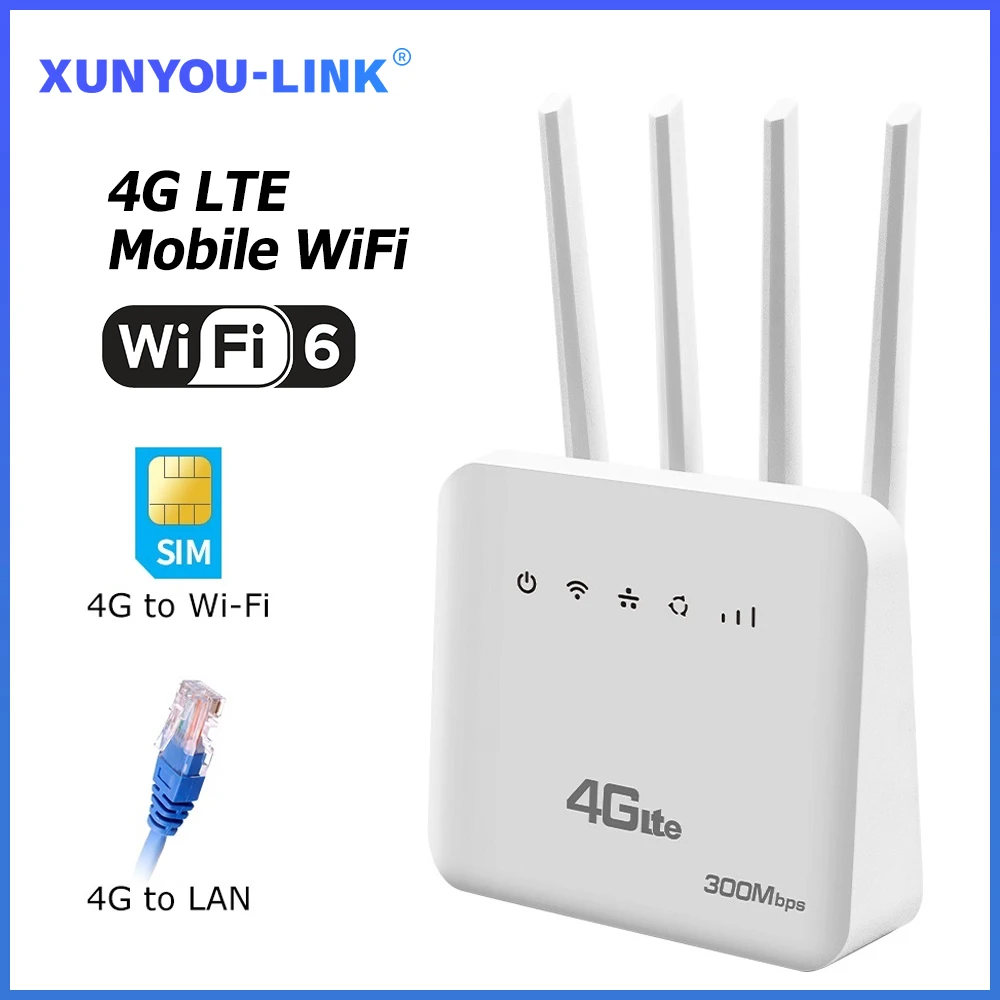
The router features a minimalist, all-white plastic enclosure with four fixed external antennas. The dimensions are approximately 14.3cm in width, 12cm in height (excluding antennas), and 3.6cm in depth. This compact footprint allows for discreet placement in various environments. The plastic construction feels reasonably robust for an indoor device, though it lacks the premium tactile feedback of higher-end networking equipment. The front panel incorporates several LED indicators: Power, Wi-Fi/WPS, Ethernet Port Status, LTE, and Signal Intensity. These indicators provide immediate visual feedback on the device's operational status and cellular signal strength, which is invaluable during initial setup and ongoing monitoring. Clear indicators are essential.
The rear panel houses the SIM card slot, a reset button, the RJ45 Ethernet port, a USB port (labeled for updates, suggesting potential for firmware upgrades or diagnostics), and the power adapter input. The absence of a dedicated WPS button, as noted in the visual documentation, simplifies the front panel but removes a common convenience feature for quick device pairing. This implies a more manual approach to Wi-Fi configuration, typically via a web interface. The SIM card slot is easily accessible, facilitating quick installation or swapping of cellular providers. The physical layout is logical.
While specific details on the router's firmware are not provided, devices in this category typically run a proprietary, Linux-based operating system. The user interface is generally accessed via a web browser, allowing for basic network configurations such as Wi-Fi SSID and password management, DHCP settings, and potentially some basic firewall rules. Advanced features like VLAN tagging, VPN client/server functionality, or granular QoS (Quality of Service) controls are unlikely to be present at this price point. This is a functional limitation. The mention of an "Update USB Port" suggests the possibility of firmware updates, which could address bugs or introduce minor feature enhancements over time. However, expectations for extensive customization or third-party firmware support (e.g., OpenWRT) should be tempered, as such capabilities are usually reserved for more enthusiast-grade hardware.
For most users, the default configuration will suffice. The primary goal of this router is to provide internet access. Its strength lies in its simplicity and direct functionality. Network administrators seeking fine-grained control over traffic shaping, port forwarding, or advanced security protocols will likely find the native firmware restrictive. However, for its intended purpose of basic internet sharing, the streamlined interface minimizes setup complexity, a significant advantage for non-technical users. Simplicity is often key.
The XUNYOU-LINK 4G LTE WiFi Router excels in scenarios where traditional wired internet is unavailable or impractical. This includes remote homes, temporary offices, construction sites, mobile kiosks, or as a backup internet solution. Its ability to support up to 32 devices makes it suitable for small businesses or families requiring shared internet access. The broad frequency band support ensures its utility across various geographical locations, making it a versatile travel companion for those needing consistent connectivity. This broad compatibility is a major asset.
From a value perspective, the device offers a compelling proposition by converting a cellular data plan into a multi-device Wi-Fi hotspot with a wired LAN option. This eliminates the need for multiple data plans or the constant draining of smartphone batteries for tethering. The cost-per-use, especially for shared data plans, becomes highly efficient. While the 300Mbps Wi-Fi speed might not satisfy bandwidth-intensive users, it is generally sufficient for typical web browsing, email, and standard-definition streaming, aligning well with the practical speeds offered by many 4G LTE networks. The device provides essential connectivity.
Imagine a small business operating a pop-up shop in a location without fixed-line internet. This router provides instant connectivity for point-of-sale systems, inventory management, and customer Wi-Fi, all from a single SIM card. Picture a family on a road trip, where multiple devices need internet access for entertainment or navigation; this unit creates a personal hotspot for everyone. The XUNYOU-LINK 4G LTE WiFi Router delivers fundamental network access where it is most needed, offering a practical and reliable solution for staying connected in a mobile-first world. It simply works.
Cellular Backhaul and Wireless Performance
This router integrates a 4G LTE modem, supporting a range of FDD LTE and TDD LTE frequency bands, including B1, B3, B5, B7, B8, B20, B28, B38, B39, B40, B41, and WCDMA B1, B5, B8. This broad band compatibility is crucial for international deployment, ensuring connectivity across diverse carrier networks in regions like Europe, Asia, and Africa. The device functions by accepting a standard SIM card, establishing a cellular data link, and then broadcasting this connection as a local Wi-Fi network. This is its primary function.
The cellular modem's performance, while not explicitly detailed in terms of LTE category, is designed to provide stable internet access. For users in areas with unreliable DSL or cable, this offers a viable alternative. The router's ability to maintain a consistent cellular link directly impacts the overall user experience, particularly for streaming or video conferencing. Compared to tethering directly from a smartphone, a dedicated router like this offloads the processing and battery drain from personal devices, providing a more stable and persistent network presence.
Regarding wireless performance, the router advertises "WiFi 6" alongside a "300Mbps" throughput specification. This presents a technical incongruity. True Wi-Fi 6 (802.11ax) is engineered for significantly higher data rates, often exceeding gigabit speeds in optimal conditions. A 300Mbps rating is more characteristic of Wi-Fi 4 (802.11n) operating on a 2.4GHz band with 2x2 MIMO. While the device may incorporate some foundational Wi-Fi 6 protocols for improved efficiency in dense environments, the stated 300Mbps ceiling indicates that its raw throughput capabilities are aligned with older Wi-Fi standards. This is a critical distinction for network architects. The four external antennas are intended to enhance signal reception and broadcast range, which is beneficial for maintaining stable connections across a small to medium-sized area. Signal integrity is paramount.
Network Topology and Device Capacity
The XUNYOU-LINK router supports up to 32 simultaneous device connections. This capacity is substantial for a device in its class, accommodating a typical SOHO setup or a small gathering of users. The ability to connect numerous clients, from smartphones and Tablets to IP cameras and smart home devices, without significant degradation in network stability is a key selling point. Each connection consumes bandwidth. The router's internal processing unit manages these connections, allocating resources to prevent individual devices from monopolizing the network. This is a fundamental aspect of network management.
Beyond wireless connectivity, the inclusion of an RJ45 Ethernet port provides a crucial hardwired connection option. This port allows for direct integration with a desktop computer, a network-attached storage (NAS) device, or a secondary access point, bypassing potential wireless interference and offering maximum stability for critical devices. For applications requiring guaranteed bandwidth or minimal latency, such as VoIP or security camera feeds, the wired connection is invariably superior. The physical port adds significant utility. This dual-connectivity approach enhances the router's versatility, allowing it to serve as both a primary internet gateway and a local network hub.
Physical Design and User Interface
The router features a minimalist, all-white plastic enclosure with four fixed external antennas. The dimensions are approximately 14.3cm in width, 12cm in height (excluding antennas), and 3.6cm in depth. This compact footprint allows for discreet placement in various environments. The plastic construction feels reasonably robust for an indoor device, though it lacks the premium tactile feedback of higher-end networking equipment. The front panel incorporates several LED indicators: Power, Wi-Fi/WPS, Ethernet Port Status, LTE, and Signal Intensity. These indicators provide immediate visual feedback on the device's operational status and cellular signal strength, which is invaluable during initial setup and ongoing monitoring. Clear indicators are essential.
The rear panel houses the SIM card slot, a reset button, the RJ45 Ethernet port, a USB port (labeled for updates, suggesting potential for firmware upgrades or diagnostics), and the power adapter input. The absence of a dedicated WPS button, as noted in the visual documentation, simplifies the front panel but removes a common convenience feature for quick device pairing. This implies a more manual approach to Wi-Fi configuration, typically via a web interface. The SIM card slot is easily accessible, facilitating quick installation or swapping of cellular providers. The physical layout is logical.
Firmware and Configuration Potential
While specific details on the router's firmware are not provided, devices in this category typically run a proprietary, Linux-based operating system. The user interface is generally accessed via a web browser, allowing for basic network configurations such as Wi-Fi SSID and password management, DHCP settings, and potentially some basic firewall rules. Advanced features like VLAN tagging, VPN client/server functionality, or granular QoS (Quality of Service) controls are unlikely to be present at this price point. This is a functional limitation. The mention of an "Update USB Port" suggests the possibility of firmware updates, which could address bugs or introduce minor feature enhancements over time. However, expectations for extensive customization or third-party firmware support (e.g., OpenWRT) should be tempered, as such capabilities are usually reserved for more enthusiast-grade hardware.
For most users, the default configuration will suffice. The primary goal of this router is to provide internet access. Its strength lies in its simplicity and direct functionality. Network administrators seeking fine-grained control over traffic shaping, port forwarding, or advanced security protocols will likely find the native firmware restrictive. However, for its intended purpose of basic internet sharing, the streamlined interface minimizes setup complexity, a significant advantage for non-technical users. Simplicity is often key.
Application Scenarios and Value Proposition
The XUNYOU-LINK 4G LTE WiFi Router excels in scenarios where traditional wired internet is unavailable or impractical. This includes remote homes, temporary offices, construction sites, mobile kiosks, or as a backup internet solution. Its ability to support up to 32 devices makes it suitable for small businesses or families requiring shared internet access. The broad frequency band support ensures its utility across various geographical locations, making it a versatile travel companion for those needing consistent connectivity. This broad compatibility is a major asset.
From a value perspective, the device offers a compelling proposition by converting a cellular data plan into a multi-device Wi-Fi hotspot with a wired LAN option. This eliminates the need for multiple data plans or the constant draining of smartphone batteries for tethering. The cost-per-use, especially for shared data plans, becomes highly efficient. While the 300Mbps Wi-Fi speed might not satisfy bandwidth-intensive users, it is generally sufficient for typical web browsing, email, and standard-definition streaming, aligning well with the practical speeds offered by many 4G LTE networks. The device provides essential connectivity.
Imagine a small business operating a pop-up shop in a location without fixed-line internet. This router provides instant connectivity for point-of-sale systems, inventory management, and customer Wi-Fi, all from a single SIM card. Picture a family on a road trip, where multiple devices need internet access for entertainment or navigation; this unit creates a personal hotspot for everyone. The XUNYOU-LINK 4G LTE WiFi Router delivers fundamental network access where it is most needed, offering a practical and reliable solution for staying connected in a mobile-first world. It simply works.