Wio Tracker L1 Pro LoRa Meshtastic Node
Official Store Deal
Expert Analysis Overview
The Wio Tracker L1 Pro LoRa Meshtastic Node is a highly capable, compact communication device engineered for off-grid connectivity and advanced IoT applications. It represents a significant upgrade for enthusiasts and professionals requiring reliable long-range data transmission where traditional cellular networks are unavailable. This unit integrates a powerful nRF52840 microcontroller, a robust LoRa radio, and precise GPS, all housed within a functional 3D-printed enclosure. Its design prioritizes endurance and user interaction, making it a compelling choice for remote deployments. This device is more than just a gadget; it's a foundation for resilient communication.
The Wio Tracker L1 Pro leverages a Semtech SX1262 LoRa module, operating across the 862 MHz to 930 MHz frequency spectrum. This wide band support ensures regional compatibility, a critical factor for global deployments. LoRa, or Long Range, is a low-power wide-area network (LPWAN) modulation technique. It allows for incredibly long-range communication with minimal power consumption. This device is designed to function as a Meshtastic node, transforming it into a powerful tool for peer-to-peer communication. It is highly efficient.
This implementation translates directly into real-world utility for users operating beyond the reach of conventional infrastructure. Imagine coordinating with a team during a backcountry expedition. Or perhaps monitoring remote sensors in an agricultural setting where cellular service is nonexistent. The Wio Tracker L1 Pro facilitates real-time message sending and data exchange. It requires no internet connection. This independence from cellular or Wi-Fi networks is its defining characteristic. Users gain unparalleled freedom in communication. Message delivery is robust.
Unlike standard short-range radios, which often suffer from limited range and lack data capabilities, or satellite communicators with high subscription fees, the Meshtastic protocol running on this LoRa hardware provides a cost-effective and resilient mesh network. Traditional walkie-talkies offer only voice communication. Satellite communicators often come with prohibitive recurring costs and slower data rates. This device, however, enables a self-healing network where each node can relay messages for others, extending the effective range significantly. It offers a distinct advantage. The mesh is dynamic.
The LoRa technology itself employs chirp spread spectrum modulation. This technique makes it highly resistant to noise and interference. This robustness is crucial for maintaining communication integrity in challenging RF environments. The SX1262 transceiver is known for its excellent link budget. This translates directly into greater range and penetration through obstacles. Signal integrity is maintained.
The Meshtastic protocol further enhances this capability by implementing robust message encryption and a sophisticated mesh routing algorithm. Messages hop between nodes, finding the most efficient path to their destination. This ensures privacy and reliability. The network adapts dynamically to changes in node availability. It is a smart system.
Compared to basic point-to-point LoRa modules, the Meshtastic firmware on the Wio Tracker L1 Pro provides a complete, ready-to-use communication platform. It abstracts away the complexities of network management. Users can focus on communication, not configuration. This simplifies deployment dramatically. It is user-friendly.
At the heart of the Wio Tracker L1 Pro lies the Nordic nRF52840 microcontroller. This is a highly regarded system-on-chip (SoC) known for its low power consumption and robust processing capabilities. It integrates a powerful ARM Cortex-M4F processor, ample flash memory, and Bluetooth Low Energy (BLE) connectivity. The nRF52840 provides the computational backbone for running the Meshtastic firmware. It also handles GPS data processing and user interface management. Performance is excellent.
This powerful microcontroller enables complex operations and seamless data handling. For a PC builder, understanding the core processor is paramount for any embedded system. The nRF52840 is a workhorse. It ensures that the device can efficiently manage concurrent tasks, such as maintaining the LoRa mesh, acquiring GPS coordinates, and updating the OLED display. Its integrated BLE also opens up possibilities for smartphone integration. This allows for easier configuration and expanded data visualization. Data flows smoothly.
Compared to simpler LoRa modules that often rely on external microcontrollers, the integrated nRF52840 offers a complete, self-contained solution. Many entry-level LoRa boards might use less powerful MCUs, like an ESP32 or an older ATMega. These often necessitate additional components for full functionality and struggle with power efficiency. The Wio Tracker L1 Pro's choice of the nRF52840 means higher performance. It also means greater flexibility for developers looking to customize firmware or add new features. It is a solid foundation. This is a smart choice.
Complementing the nRF52840 is the integrated L76K GPS module. This module provides precise location data, a crucial feature for a tracker device. The L76K is designed for reliable satellite acquisition. It offers accurate positioning even in challenging environments. This is vital for navigation and location sharing within the Meshtastic network. Location is precise.
The inclusion of a dedicated GPS module transforms the Wio Tracker L1 Pro from a mere communication device into a comprehensive tracking and navigation tool. Users can share their precise coordinates with other nodes in the mesh. This enhances safety and coordination for groups. Imagine a search and rescue operation where real-time location updates are critical. Or perhaps simply keeping track of family members on a large property. Location awareness is key. Safety is improved.
Unlike many basic LoRa nodes that omit GPS to cut costs, the L76K integration here provides a significant value add. Generic LoRa modules often require users to integrate a separate GPS unit, which adds complexity, bulk, and power draw. The Wio Tracker L1 Pro offers this functionality out-of-the-box. This streamlines deployment and reduces the overall component count for a finished system. It is a smart design choice. Integration is seamless.
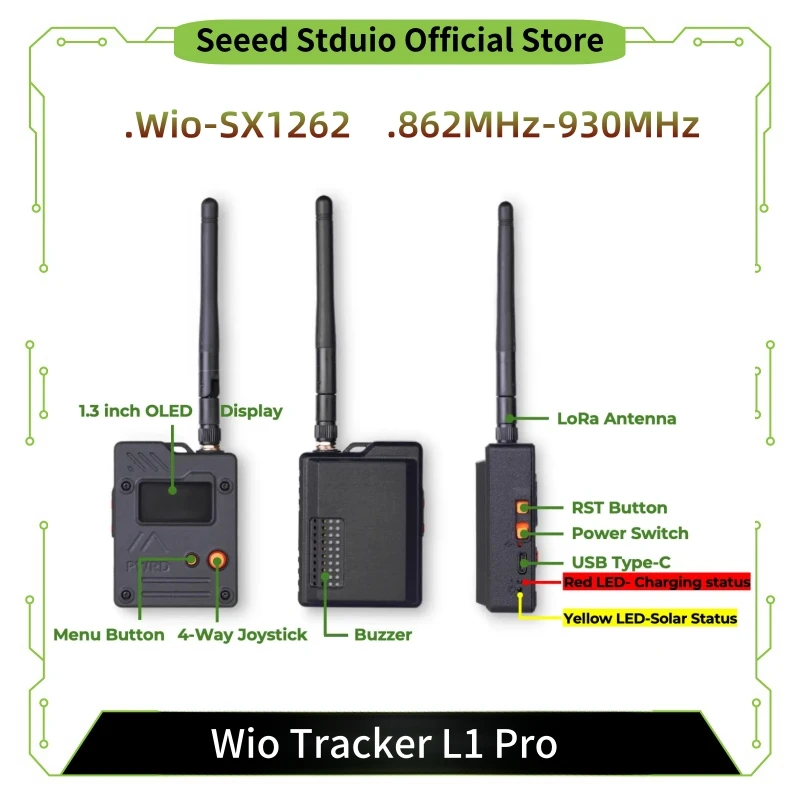
User interaction on the Wio Tracker L1 Pro is facilitated by a 1.3-inch OLED display, a 4-way joystick, and a dedicated menu button. The OLED display, while compact, offers crisp, high-contrast visuals. This is essential for readability in varying light conditions, from dim interiors to bright daylight. It presents critical information such as signal strength, battery status, messages, and GPS coordinates. Information is clear.
The display's clarity ensures that users can quickly glance at essential data without fumbling. A small screen demands efficient information presentation. The high contrast of OLED technology excels here, providing vibrant text against a dark background. This is crucial for quick decision-making in dynamic environments. The joystick provides intuitive navigation through menus. It makes operation straightforward. Readability is excellent.
Many minimalist LoRa nodes completely forgo a display or rely solely on basic LED indicators. This often necessitates a connected smartphone for any meaningful interaction, which can be inconvenient or impossible in certain scenarios. The Wio Tracker L1 Pro's integrated OLED and joystick provide a self-sufficient interface. This allows for basic operations and information retrieval directly from the device. It is a significant convenience. No phone needed.
Further enhancing the user experience are the 4-way joystick and menu button. These physical controls offer tactile feedback. This is superior to touch-based interfaces in rugged conditions, especially when wearing gloves or in wet environments. The joystick allows for easy scrolling through options and selecting menu items. The menu button provides quick access to settings and functions. A dedicated RST button is also present for quick resets. Control is intuitive.
These physical inputs are invaluable for field use where precision and reliability are paramount. Operating a device with gloves on can be challenging with touchscreens. Touchscreens become unresponsive in rain or extreme cold. The robust joystick and buttons ensure reliable interaction regardless of environmental factors. This design choice reflects a practical understanding of outdoor use cases. Precision control is always available. It is very practical.
In contrast to devices that rely on complex button combinations or external apps for control, the Wio Tracker L1 Pro's intuitive joystick and menu button simplify operation. This reduces the learning curve for new users. It also enhances usability under stress, such as during an emergency. The physical controls are a clear advantage. User comfort is prioritized.
An integrated buzzer provides audible alerts. This is a simple yet effective component. It can signal incoming messages, low battery warnings, or other critical notifications. The buzzer adds another layer of feedback. It ensures users are aware of important events even if they are not looking at the display or if the device is in a pocket. Alerts are immediate.
Audible alerts are vital for situational awareness, especially when visual attention is directed elsewhere. In noisy environments, a visual cue might be missed. The buzzer ensures that critical information is conveyed, enhancing the device's reliability as a communication tool. It keeps users informed without constant monitoring. This improves safety.
Many small electronic devices omit a buzzer to save space or cost, sacrificing a valuable feedback mechanism. However, its inclusion here demonstrates a commitment to comprehensive user feedback. This makes the Wio Tracker L1 Pro more effective as an alert system, ensuring no critical message goes unnoticed. It's a small but impactful addition. Feedback is comprehensive.
Powering the Wio Tracker L1 Pro is a substantial 2000 mAh rechargeable battery. This capacity is critical for a device designed for extended off-grid operation. The product claims up to 5 days of operation. This is an impressive figure for a device with an active display and GPS. Efficient power management is clearly a design priority. Endurance is key.
A large battery capacity directly translates to prolonged field deployments without the need for frequent recharging. For a PC builder, understanding power draw and battery life is crucial for any portable system. This device's endurance means less downtime. It also means greater reliability in remote locations, minimizing the need for external power banks. Users can depend on it. Uptime is maximized.
Many smaller LoRa modules or development boards come with minimal battery capacity, sometimes as low as 300-500 mAh. Some even require external power banks or continuous tethering to a power source. The Wio Tracker L1 Pro's integrated 2000 mAh cell positions it as a truly standalone device. This eliminates the need for additional power accessories. It simplifies the overall setup. Self-sufficiency is high.
Charging is handled via a modern USB Type-C port. This reversible connector offers convenience and broad compatibility with contemporary charging solutions. The presence of a red LED for charging/emergency status and a yellow LED for solar status indicates thoughtful power management features. The solar status LED strongly suggests potential for integration with solar charging panels. Connectivity is modern.
USB Type-C is the current standard for portable electronics, offering robust physical design and higher power delivery capabilities compared to older standards. It ensures fast and efficient charging. The status LEDs provide immediate visual feedback on the device's power state. This is invaluable for monitoring battery health and charging progress. It removes guesswork. Charging is efficient.
Older devices often rely on micro-USB, which is less durable, less convenient, and prone to damage. The adoption of USB Type-C aligns the Wio Tracker L1 Pro with modern hardware expectations. This enhances its longevity and user experience, making it compatible with existing chargers and cables. It is a forward-thinking choice. Compatibility is broad.
The yellow LED indicating "Solar Status" is particularly noteworthy. While a solar panel is not explicitly included, this feature strongly implies built-in solar charging capabilities or at least compatibility with external solar solutions. This is a game-changer for truly indefinite off-grid operation. It extends the device's utility significantly. Power is sustainable.
For remote deployments, especially in areas without grid power, solar charging is indispensable. This LED provides crucial feedback on the effectiveness of any connected solar solution. It allows users to optimize placement for maximum charge, ensuring continuous operation. This feature underscores its design for endurance. It's a smart addition.
Compared to devices that offer no indication of external power input, the solar status LED provides valuable diagnostic information. This allows users to confirm that their solar setup is functioning correctly and efficiently. It maximizes uptime in the field, reducing the risk of unexpected power loss. This is a practical and intelligent addition. Monitoring is easy.
The Wio Tracker L1 Pro is housed within a 3D-printed enclosure. This choice of manufacturing method offers several advantages, including rapid prototyping, cost-effectiveness, and the potential for customization. The dimensions are compact: 181 mm in height (including antenna), 56 mm in width, and 26 mm in thickness. This makes it highly portable. Form factor is small.
The compact dimensions ensure the device is easy to carry and integrate into various setups, such as backpacks, vehicle dashboards, or fixed installations. For a PC builder, understanding physical constraints and available clearance is vital for any project. This unit fits comfortably in a pocket or attaches easily to gear. The 3D-printed nature also suggests a community-driven approach. Users might find or create custom mounts. Integration is flexible.
Unlike mass-produced injection-molded cases, a 3D-printed enclosure can sometimes imply a slightly less refined finish or potentially lower impact resistance for extreme conditions. However, it also means greater flexibility for design iterations and specialized versions. This is a trade-off often accepted in the open-source hardware community, prioritizing adaptability over industrial-grade ruggedness. Customization is possible.
The visible texture of the 3D-printed material is evident in the images, showcasing the layer lines characteristic of the manufacturing process. While functional, it might not offer the same premium feel as a smooth, molded plastic. However, its primary purpose is protection and housing for the sensitive electronics. The design incorporates all necessary cutouts for the display, joystick, buttons, and USB-C port. Functionality is key.
The enclosure's design is practical and purpose-driven, effectively protecting the sensitive electronics from environmental elements and minor impacts. The precise cutouts ensure all interfaces remain accessible and usable without obstruction. This is fundamental for any portable electronic device that needs to be operated in the field. Protection is adequate.
Many DIY LoRa projects often end up in generic project boxes, which frequently lack proper ergonomic design or dedicated cutouts for specific components. The Wio Tracker L1 Pro's custom 3D-printed enclosure provides a much more polished and user-friendly package. It elevates the overall product experience, making it feel like a complete device rather than a prototype. It is well-integrated.
The integrated LoRa antenna is a standard whip antenna. It is detachable, which is a common and practical design choice. This allows for easier transport, reducing the overall height, and provides the potential to upgrade to a higher-gain antenna if specific range requirements demand it. The antenna connection appears to be a standard SMA or RP-SMA type, ensuring broad compatibility. Modularity is a benefit.
A detachable antenna offers significant flexibility. Users can replace it if damaged, extending the device's lifespan. They can also experiment with different antenna types, such as directional or larger omnidirectional antennas, for optimized performance in specific scenarios. This modularity is a benefit for advanced users. It allows for fine-tuning the radio link. Tuning is possible.
Fixed antennas, while simpler, limit user options and can be a point of failure if bent or broken. The Wio Tracker L1 Pro's detachable design empowers users to customize their setup and adapt to various environmental challenges. This is a valuable feature for those who understand RF principles and seek to maximize their communication range. It provides an upgrade path. Options are open.
The Wio Tracker L1 Pro stands out due to its strong value proposition, particularly within the open-source hardware and Meshtastic communities. Priced at $45.67, it offers a feature set that often requires combining multiple components, each with its own cost and integration challenges. The integration of nRF52840, LoRa, GPS, and an OLED display into a single, ready-to-use unit is highly efficient. This reduces the complexity and cost associated with building a similar system from scratch. Value is high.
This device offers significant long-term value. Building a comparable system from individual modules would involve sourcing components, designing a custom PCB, and fabricating an enclosure, a process that is both time-consuming and expensive. The Wio Tracker L1 Pro provides a pre-assembled, tested solution. It saves both time and money for the end-user, allowing them to jump straight into deployment. The initial investment is quickly recouped. Efficiency is paramount.
Compared to generic LoRa development boards, which often require extensive wiring, soldering, and external components to achieve similar functionality, this device is a complete package. It minimizes the barrier to entry for those interested in Meshtastic or LoRa-based IoT. The integrated nature means fewer points of failure, greater reliability, and a cleaner overall setup. It simplifies the process. Integration is key.
The device's compatibility with the Meshtastic ecosystem is a major draw. Meshtastic is a rapidly growing open-source project that provides robust, off-grid communication capabilities. The nRF52840's popularity also means a vast developer community. There are abundant resources for custom firmware development, examples, and community support. This fosters innovation. Community support is strong.
An active community ensures ongoing support and feature development, meaning the device's capabilities will continue to evolve and improve over time. Users benefit from continuous improvements and new functionalities, often driven by community contributions. The open-source nature means transparency. It allows for peer review and customization. This is a powerful advantage. Development is continuous.
Proprietary communication systems often lock users into specific hardware and software, limiting flexibility and future options. The Wio Tracker L1 Pro, by embracing open standards and communities, offers unparalleled freedom and adaptability. This ensures the device remains relevant and adaptable to new use cases and technologies. It future-proofs the investment. Freedom is empowering.
The "Seeed Studio Official Store" branding further adds to its credibility. Seeed Studio is a well-known entity in the maker and open-source hardware space, recognized for producing quality components and development boards. Their products are generally well-supported. They often have extensive documentation and active forums. This provides peace of mind for buyers. Brand reputation is solid.
Purchasing from a reputable store ensures product quality, reliability, and access to technical support if needed. This is crucial for specialized hardware where troubleshooting can be complex. It reduces risks associated with generic sellers who may offer inconsistent quality or no support. The brand reputation is a strong indicator of reliability. Support is available.
Many generic electronics lack proper documentation, community support, or consistent quality control. Seeed Studio's involvement suggests a more robust ecosystem and a commitment to the maker community. This empowers users to troubleshoot, customize, and innovate with confidence, enhancing the overall user experience. It is a trusted source.
The Wio Tracker L1 Pro LoRa Meshtastic Node is a meticulously designed piece of hardware. It addresses the growing need for reliable, off-grid communication and tracking. Its blend of a powerful nRF52840 microcontroller, long-range LoRa radio, precise L76K GPS, and intuitive OLED display creates a highly functional and versatile device. The substantial 2000 mAh battery ensures extended operational periods. The modern USB Type-C port and solar status indicator underscore its practical design for field use. While the 3D-printed enclosure offers a balance of cost-effectiveness and customization potential, users seeking extreme ruggedness might consider additional protection. This device is not merely a component; it is a fully integrated solution. It empowers users to build resilient communication networks and deploy advanced IoT projects with confidence. It is a complete package.
Imagine venturing into remote wilderness, knowing you can still send and receive vital messages, share your precise location with companions, and monitor distant sensors, all without a single bar of cellular service. Picture the peace of mind that comes from having a reliable communication backbone during an emergency, or the satisfaction of deploying a custom IoT solution that seamlessly transmits data over kilometers. This device provides the freedom to connect where others cannot, offering a tangible advantage in exploration, security, and innovation. It is a tool that expands your capabilities. It offers true independence.
Core Communication Capabilities: The Meshtastic Advantage
The Wio Tracker L1 Pro leverages a Semtech SX1262 LoRa module, operating across the 862 MHz to 930 MHz frequency spectrum. This wide band support ensures regional compatibility, a critical factor for global deployments. LoRa, or Long Range, is a low-power wide-area network (LPWAN) modulation technique. It allows for incredibly long-range communication with minimal power consumption. This device is designed to function as a Meshtastic node, transforming it into a powerful tool for peer-to-peer communication. It is highly efficient.
This implementation translates directly into real-world utility for users operating beyond the reach of conventional infrastructure. Imagine coordinating with a team during a backcountry expedition. Or perhaps monitoring remote sensors in an agricultural setting where cellular service is nonexistent. The Wio Tracker L1 Pro facilitates real-time message sending and data exchange. It requires no internet connection. This independence from cellular or Wi-Fi networks is its defining characteristic. Users gain unparalleled freedom in communication. Message delivery is robust.
Unlike standard short-range radios, which often suffer from limited range and lack data capabilities, or satellite communicators with high subscription fees, the Meshtastic protocol running on this LoRa hardware provides a cost-effective and resilient mesh network. Traditional walkie-talkies offer only voice communication. Satellite communicators often come with prohibitive recurring costs and slower data rates. This device, however, enables a self-healing network where each node can relay messages for others, extending the effective range significantly. It offers a distinct advantage. The mesh is dynamic.
The LoRa technology itself employs chirp spread spectrum modulation. This technique makes it highly resistant to noise and interference. This robustness is crucial for maintaining communication integrity in challenging RF environments. The SX1262 transceiver is known for its excellent link budget. This translates directly into greater range and penetration through obstacles. Signal integrity is maintained.
The Meshtastic protocol further enhances this capability by implementing robust message encryption and a sophisticated mesh routing algorithm. Messages hop between nodes, finding the most efficient path to their destination. This ensures privacy and reliability. The network adapts dynamically to changes in node availability. It is a smart system.
Compared to basic point-to-point LoRa modules, the Meshtastic firmware on the Wio Tracker L1 Pro provides a complete, ready-to-use communication platform. It abstracts away the complexities of network management. Users can focus on communication, not configuration. This simplifies deployment dramatically. It is user-friendly.
Onboard Processing and Navigation: The nRF52840 and L76K GPS
At the heart of the Wio Tracker L1 Pro lies the Nordic nRF52840 microcontroller. This is a highly regarded system-on-chip (SoC) known for its low power consumption and robust processing capabilities. It integrates a powerful ARM Cortex-M4F processor, ample flash memory, and Bluetooth Low Energy (BLE) connectivity. The nRF52840 provides the computational backbone for running the Meshtastic firmware. It also handles GPS data processing and user interface management. Performance is excellent.
This powerful microcontroller enables complex operations and seamless data handling. For a PC builder, understanding the core processor is paramount for any embedded system. The nRF52840 is a workhorse. It ensures that the device can efficiently manage concurrent tasks, such as maintaining the LoRa mesh, acquiring GPS coordinates, and updating the OLED display. Its integrated BLE also opens up possibilities for smartphone integration. This allows for easier configuration and expanded data visualization. Data flows smoothly.
Compared to simpler LoRa modules that often rely on external microcontrollers, the integrated nRF52840 offers a complete, self-contained solution. Many entry-level LoRa boards might use less powerful MCUs, like an ESP32 or an older ATMega. These often necessitate additional components for full functionality and struggle with power efficiency. The Wio Tracker L1 Pro's choice of the nRF52840 means higher performance. It also means greater flexibility for developers looking to customize firmware or add new features. It is a solid foundation. This is a smart choice.
Complementing the nRF52840 is the integrated L76K GPS module. This module provides precise location data, a crucial feature for a tracker device. The L76K is designed for reliable satellite acquisition. It offers accurate positioning even in challenging environments. This is vital for navigation and location sharing within the Meshtastic network. Location is precise.
The inclusion of a dedicated GPS module transforms the Wio Tracker L1 Pro from a mere communication device into a comprehensive tracking and navigation tool. Users can share their precise coordinates with other nodes in the mesh. This enhances safety and coordination for groups. Imagine a search and rescue operation where real-time location updates are critical. Or perhaps simply keeping track of family members on a large property. Location awareness is key. Safety is improved.
Unlike many basic LoRa nodes that omit GPS to cut costs, the L76K integration here provides a significant value add. Generic LoRa modules often require users to integrate a separate GPS unit, which adds complexity, bulk, and power draw. The Wio Tracker L1 Pro offers this functionality out-of-the-box. This streamlines deployment and reduces the overall component count for a finished system. It is a smart design choice. Integration is seamless.
User Interface and Interaction: OLED, Joystick, and Buzzer
User interaction on the Wio Tracker L1 Pro is facilitated by a 1.3-inch OLED display, a 4-way joystick, and a dedicated menu button. The OLED display, while compact, offers crisp, high-contrast visuals. This is essential for readability in varying light conditions, from dim interiors to bright daylight. It presents critical information such as signal strength, battery status, messages, and GPS coordinates. Information is clear.
The display's clarity ensures that users can quickly glance at essential data without fumbling. A small screen demands efficient information presentation. The high contrast of OLED technology excels here, providing vibrant text against a dark background. This is crucial for quick decision-making in dynamic environments. The joystick provides intuitive navigation through menus. It makes operation straightforward. Readability is excellent.
Many minimalist LoRa nodes completely forgo a display or rely solely on basic LED indicators. This often necessitates a connected smartphone for any meaningful interaction, which can be inconvenient or impossible in certain scenarios. The Wio Tracker L1 Pro's integrated OLED and joystick provide a self-sufficient interface. This allows for basic operations and information retrieval directly from the device. It is a significant convenience. No phone needed.
Further enhancing the user experience are the 4-way joystick and menu button. These physical controls offer tactile feedback. This is superior to touch-based interfaces in rugged conditions, especially when wearing gloves or in wet environments. The joystick allows for easy scrolling through options and selecting menu items. The menu button provides quick access to settings and functions. A dedicated RST button is also present for quick resets. Control is intuitive.
These physical inputs are invaluable for field use where precision and reliability are paramount. Operating a device with gloves on can be challenging with touchscreens. Touchscreens become unresponsive in rain or extreme cold. The robust joystick and buttons ensure reliable interaction regardless of environmental factors. This design choice reflects a practical understanding of outdoor use cases. Precision control is always available. It is very practical.
In contrast to devices that rely on complex button combinations or external apps for control, the Wio Tracker L1 Pro's intuitive joystick and menu button simplify operation. This reduces the learning curve for new users. It also enhances usability under stress, such as during an emergency. The physical controls are a clear advantage. User comfort is prioritized.
An integrated buzzer provides audible alerts. This is a simple yet effective component. It can signal incoming messages, low battery warnings, or other critical notifications. The buzzer adds another layer of feedback. It ensures users are aware of important events even if they are not looking at the display or if the device is in a pocket. Alerts are immediate.
Audible alerts are vital for situational awareness, especially when visual attention is directed elsewhere. In noisy environments, a visual cue might be missed. The buzzer ensures that critical information is conveyed, enhancing the device's reliability as a communication tool. It keeps users informed without constant monitoring. This improves safety.
Many small electronic devices omit a buzzer to save space or cost, sacrificing a valuable feedback mechanism. However, its inclusion here demonstrates a commitment to comprehensive user feedback. This makes the Wio Tracker L1 Pro more effective as an alert system, ensuring no critical message goes unnoticed. It's a small but impactful addition. Feedback is comprehensive.
Power Management and Endurance: The 2000 mAh Lifeline
Powering the Wio Tracker L1 Pro is a substantial 2000 mAh rechargeable battery. This capacity is critical for a device designed for extended off-grid operation. The product claims up to 5 days of operation. This is an impressive figure for a device with an active display and GPS. Efficient power management is clearly a design priority. Endurance is key.
A large battery capacity directly translates to prolonged field deployments without the need for frequent recharging. For a PC builder, understanding power draw and battery life is crucial for any portable system. This device's endurance means less downtime. It also means greater reliability in remote locations, minimizing the need for external power banks. Users can depend on it. Uptime is maximized.
Many smaller LoRa modules or development boards come with minimal battery capacity, sometimes as low as 300-500 mAh. Some even require external power banks or continuous tethering to a power source. The Wio Tracker L1 Pro's integrated 2000 mAh cell positions it as a truly standalone device. This eliminates the need for additional power accessories. It simplifies the overall setup. Self-sufficiency is high.
Charging is handled via a modern USB Type-C port. This reversible connector offers convenience and broad compatibility with contemporary charging solutions. The presence of a red LED for charging/emergency status and a yellow LED for solar status indicates thoughtful power management features. The solar status LED strongly suggests potential for integration with solar charging panels. Connectivity is modern.
USB Type-C is the current standard for portable electronics, offering robust physical design and higher power delivery capabilities compared to older standards. It ensures fast and efficient charging. The status LEDs provide immediate visual feedback on the device's power state. This is invaluable for monitoring battery health and charging progress. It removes guesswork. Charging is efficient.
Older devices often rely on micro-USB, which is less durable, less convenient, and prone to damage. The adoption of USB Type-C aligns the Wio Tracker L1 Pro with modern hardware expectations. This enhances its longevity and user experience, making it compatible with existing chargers and cables. It is a forward-thinking choice. Compatibility is broad.
The yellow LED indicating "Solar Status" is particularly noteworthy. While a solar panel is not explicitly included, this feature strongly implies built-in solar charging capabilities or at least compatibility with external solar solutions. This is a game-changer for truly indefinite off-grid operation. It extends the device's utility significantly. Power is sustainable.
For remote deployments, especially in areas without grid power, solar charging is indispensable. This LED provides crucial feedback on the effectiveness of any connected solar solution. It allows users to optimize placement for maximum charge, ensuring continuous operation. This feature underscores its design for endurance. It's a smart addition.
Compared to devices that offer no indication of external power input, the solar status LED provides valuable diagnostic information. This allows users to confirm that their solar setup is functioning correctly and efficiently. It maximizes uptime in the field, reducing the risk of unexpected power loss. This is a practical and intelligent addition. Monitoring is easy.
Physical Design and Integration: The 3D-Printed Enclosure
The Wio Tracker L1 Pro is housed within a 3D-printed enclosure. This choice of manufacturing method offers several advantages, including rapid prototyping, cost-effectiveness, and the potential for customization. The dimensions are compact: 181 mm in height (including antenna), 56 mm in width, and 26 mm in thickness. This makes it highly portable. Form factor is small.
The compact dimensions ensure the device is easy to carry and integrate into various setups, such as backpacks, vehicle dashboards, or fixed installations. For a PC builder, understanding physical constraints and available clearance is vital for any project. This unit fits comfortably in a pocket or attaches easily to gear. The 3D-printed nature also suggests a community-driven approach. Users might find or create custom mounts. Integration is flexible.
Unlike mass-produced injection-molded cases, a 3D-printed enclosure can sometimes imply a slightly less refined finish or potentially lower impact resistance for extreme conditions. However, it also means greater flexibility for design iterations and specialized versions. This is a trade-off often accepted in the open-source hardware community, prioritizing adaptability over industrial-grade ruggedness. Customization is possible.
The visible texture of the 3D-printed material is evident in the images, showcasing the layer lines characteristic of the manufacturing process. While functional, it might not offer the same premium feel as a smooth, molded plastic. However, its primary purpose is protection and housing for the sensitive electronics. The design incorporates all necessary cutouts for the display, joystick, buttons, and USB-C port. Functionality is key.
The enclosure's design is practical and purpose-driven, effectively protecting the sensitive electronics from environmental elements and minor impacts. The precise cutouts ensure all interfaces remain accessible and usable without obstruction. This is fundamental for any portable electronic device that needs to be operated in the field. Protection is adequate.
Many DIY LoRa projects often end up in generic project boxes, which frequently lack proper ergonomic design or dedicated cutouts for specific components. The Wio Tracker L1 Pro's custom 3D-printed enclosure provides a much more polished and user-friendly package. It elevates the overall product experience, making it feel like a complete device rather than a prototype. It is well-integrated.
The integrated LoRa antenna is a standard whip antenna. It is detachable, which is a common and practical design choice. This allows for easier transport, reducing the overall height, and provides the potential to upgrade to a higher-gain antenna if specific range requirements demand it. The antenna connection appears to be a standard SMA or RP-SMA type, ensuring broad compatibility. Modularity is a benefit.
A detachable antenna offers significant flexibility. Users can replace it if damaged, extending the device's lifespan. They can also experiment with different antenna types, such as directional or larger omnidirectional antennas, for optimized performance in specific scenarios. This modularity is a benefit for advanced users. It allows for fine-tuning the radio link. Tuning is possible.
Fixed antennas, while simpler, limit user options and can be a point of failure if bent or broken. The Wio Tracker L1 Pro's detachable design empowers users to customize their setup and adapt to various environmental challenges. This is a valuable feature for those who understand RF principles and seek to maximize their communication range. It provides an upgrade path. Options are open.
Value Proposition and Ecosystem: An Open-Source Powerhouse
The Wio Tracker L1 Pro stands out due to its strong value proposition, particularly within the open-source hardware and Meshtastic communities. Priced at $45.67, it offers a feature set that often requires combining multiple components, each with its own cost and integration challenges. The integration of nRF52840, LoRa, GPS, and an OLED display into a single, ready-to-use unit is highly efficient. This reduces the complexity and cost associated with building a similar system from scratch. Value is high.
This device offers significant long-term value. Building a comparable system from individual modules would involve sourcing components, designing a custom PCB, and fabricating an enclosure, a process that is both time-consuming and expensive. The Wio Tracker L1 Pro provides a pre-assembled, tested solution. It saves both time and money for the end-user, allowing them to jump straight into deployment. The initial investment is quickly recouped. Efficiency is paramount.
Compared to generic LoRa development boards, which often require extensive wiring, soldering, and external components to achieve similar functionality, this device is a complete package. It minimizes the barrier to entry for those interested in Meshtastic or LoRa-based IoT. The integrated nature means fewer points of failure, greater reliability, and a cleaner overall setup. It simplifies the process. Integration is key.
The device's compatibility with the Meshtastic ecosystem is a major draw. Meshtastic is a rapidly growing open-source project that provides robust, off-grid communication capabilities. The nRF52840's popularity also means a vast developer community. There are abundant resources for custom firmware development, examples, and community support. This fosters innovation. Community support is strong.
An active community ensures ongoing support and feature development, meaning the device's capabilities will continue to evolve and improve over time. Users benefit from continuous improvements and new functionalities, often driven by community contributions. The open-source nature means transparency. It allows for peer review and customization. This is a powerful advantage. Development is continuous.
Proprietary communication systems often lock users into specific hardware and software, limiting flexibility and future options. The Wio Tracker L1 Pro, by embracing open standards and communities, offers unparalleled freedom and adaptability. This ensures the device remains relevant and adaptable to new use cases and technologies. It future-proofs the investment. Freedom is empowering.
The "Seeed Studio Official Store" branding further adds to its credibility. Seeed Studio is a well-known entity in the maker and open-source hardware space, recognized for producing quality components and development boards. Their products are generally well-supported. They often have extensive documentation and active forums. This provides peace of mind for buyers. Brand reputation is solid.
Purchasing from a reputable store ensures product quality, reliability, and access to technical support if needed. This is crucial for specialized hardware where troubleshooting can be complex. It reduces risks associated with generic sellers who may offer inconsistent quality or no support. The brand reputation is a strong indicator of reliability. Support is available.
Many generic electronics lack proper documentation, community support, or consistent quality control. Seeed Studio's involvement suggests a more robust ecosystem and a commitment to the maker community. This empowers users to troubleshoot, customize, and innovate with confidence, enhancing the overall user experience. It is a trusted source.
Conclusion: Your Gateway to Off-Grid Connectivity
The Wio Tracker L1 Pro LoRa Meshtastic Node is a meticulously designed piece of hardware. It addresses the growing need for reliable, off-grid communication and tracking. Its blend of a powerful nRF52840 microcontroller, long-range LoRa radio, precise L76K GPS, and intuitive OLED display creates a highly functional and versatile device. The substantial 2000 mAh battery ensures extended operational periods. The modern USB Type-C port and solar status indicator underscore its practical design for field use. While the 3D-printed enclosure offers a balance of cost-effectiveness and customization potential, users seeking extreme ruggedness might consider additional protection. This device is not merely a component; it is a fully integrated solution. It empowers users to build resilient communication networks and deploy advanced IoT projects with confidence. It is a complete package.
Imagine venturing into remote wilderness, knowing you can still send and receive vital messages, share your precise location with companions, and monitor distant sensors, all without a single bar of cellular service. Picture the peace of mind that comes from having a reliable communication backbone during an emergency, or the satisfaction of deploying a custom IoT solution that seamlessly transmits data over kilometers. This device provides the freedom to connect where others cannot, offering a tangible advantage in exploration, security, and innovation. It is a tool that expands your capabilities. It offers true independence.