WeAct Studio STM32F4 Mini Core Board for Embedded Development and Micropython
Official Store Deal
Expert Analysis Overview
The Silicon Heartbeat: Processing Prowess
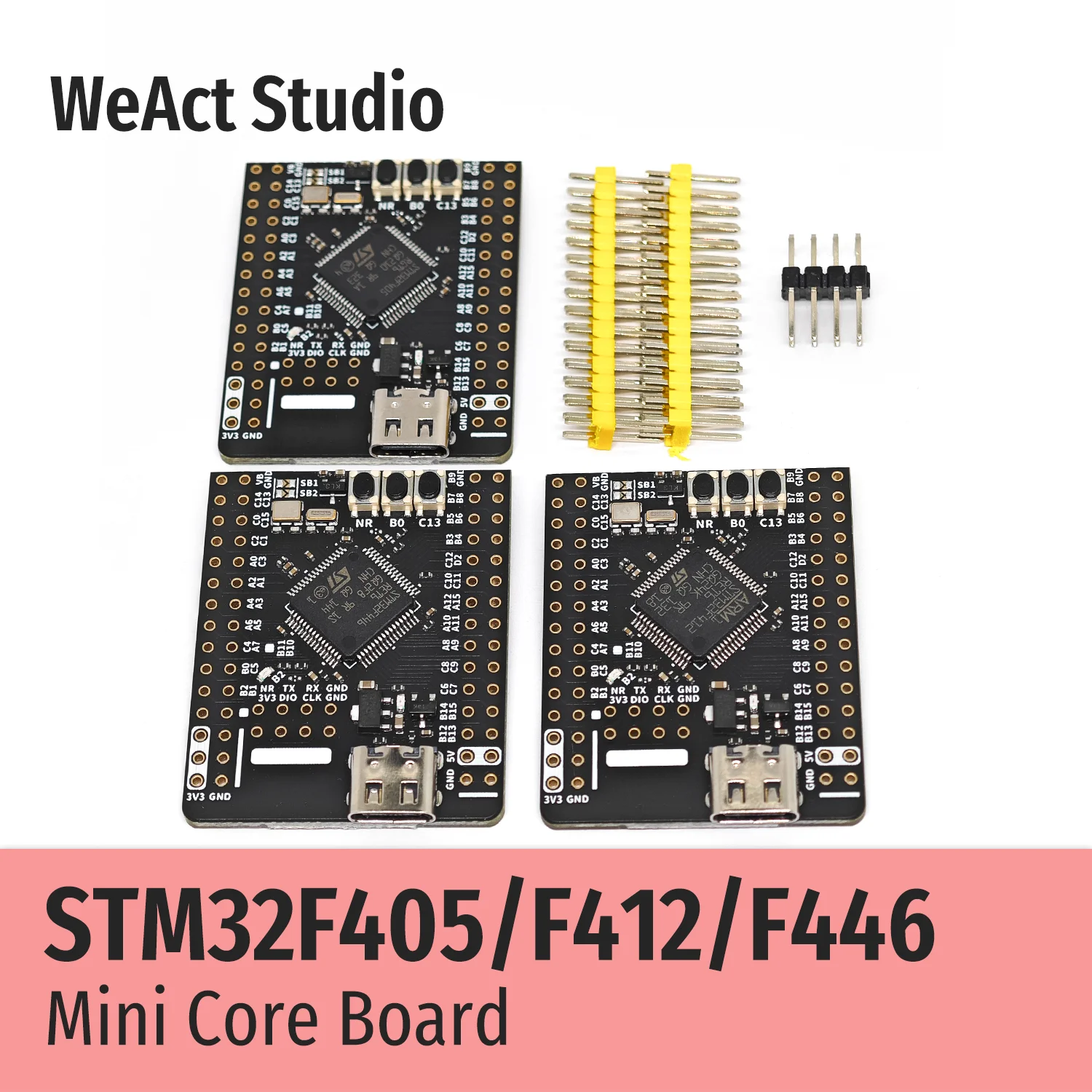
The WeAct Studio STM32F4 Mini Core Board is a robust and versatile microcontroller development platform tailored for embedded systems engineers and hobbyists seeking high-performance ARM Cortex-M4 processing in a compact footprint. This series of boards, encompassing the STM32F405RGT6, STM32F412RET6, and STM32F446RET6 variants, offers a compelling blend of computational power and peripheral integration, making it a formidable choice for a wide array of projects from industrial control to advanced robotics. Its design prioritizes accessibility for developers, particularly those working with Micropython, while providing the raw hardware capabilities expected from the STM32 ecosystem. This board empowers innovation.
The core of these boards is the ARM Cortex-M4 microcontroller, a 32-bit processor known for its digital signal processing (DSP) capabilities and floating-point unit (FPU). This architecture allows for complex calculations and rapid data manipulation, crucial for real-time applications where precision and speed are paramount. Unlike simpler 8-bit or even some 16-bit microcontrollers that might struggle with complex arithmetic, the STM32F4 series handles intensive tasks with ease, offering a significant performance uplift. This processing muscle translates directly into the ability to run more sophisticated algorithms, manage multiple high-speed peripherals simultaneously, and execute code with greater efficiency. Imagine a scenario where a drone's flight controller needs to process sensor data, execute PID loops, and communicate wirelessly all at once; the Cortex-M4 is built for such demands, providing the computational headroom required for stable and responsive control. It handles complex data.
Each variant within the WeAct Studio STM32F4 lineup presents distinct performance profiles, allowing developers to choose the optimal balance of speed, RAM, and Flash memory for their specific project. The STM32F405RGT6, for instance, operates at 168MHz with 192KB of RAM and a generous 1024KB of Flash memory, making it suitable for applications requiring substantial program storage. The STM32F412RET6, while clocking in at 100MHz, offers an expanded 256KB of RAM and 512KB of Flash, ideal for data-intensive applications. For sheer speed, the STM32F446RET6 pushes the envelope to 180MHz, coupled with 128KB RAM and 512KB Flash, prioritizing raw execution speed. These specifications are not merely numbers; they dictate the complexity and scale of projects that can be undertaken. A higher clock speed means faster instruction execution for time-critical operations. More RAM allows for larger data buffers and more complex program states, preventing memory bottlenecks. Increased Flash memory accommodates larger firmware images, including operating systems, extensive application code, or even embedded web assets. Choosing the right chip matters.
Connectivity Canvas: Expanding Horizons
The physical design of the WeAct Studio STM32F4 Mini Core Board emphasizes connectivity and expandability, crucial for integrating it into diverse electronic systems. The board features extensive GPIO (General Purpose Input/Output) pin headers, typically unpopulated upon purchase but easily solderable by the user. These headers break out a significant number of the microcontroller's pins, providing direct access to various communication protocols such as SPI (Serial Peripheral Interface) for high-speed data transfer, I2C (Inter-Integrated Circuit) for sensor communication, UART (Universal Asynchronous Receiver/Transmitter) for serial data, and CAN (Controller Area Network) for automotive applications. This direct access is fundamental for interfacing with a diverse ecosystem of external components, from simple LEDs and buttons to advanced displays, motor drivers, and network modules. The flexibility offered by these breakouts is a significant advantage over boards with fixed, limited I/O, allowing for truly custom hardware designs.
A crucial integrated peripheral is the MicroSD card slot, prominently visible on the underside of the board. This inclusion is a substantial upgrade over development boards that require external SD card modules, simplifying hardware integration, reducing wiring complexity, and minimizing the overall project footprint. The MicroSD slot enables robust data logging capabilities, allowing the storage of sensor readings, configuration files, or even serving as a small file system for embedded web servers. For applications requiring persistent data storage or the ability to load large assets like images or audio files, this feature is indispensable. Consider a weather station logging data over months, or a portable audio player; the MicroSD slot makes this feasible and efficient. It offers ample storage.
Power and programming are handled efficiently via a standard mini USB interface. This port serves a dual purpose: supplying 5V power to the board and facilitating serial communication for firmware uploads and debugging. While some modern devices have transitioned to USB-C, the mini USB remains a widely available and reliable connector for development boards, ensuring broad compatibility with existing development setups and readily available cables. This choice ensures broad compatibility. The USB connection also allows for convenient power delivery from a computer or a standard USB wall adapter, making initial setup straightforward for both development and deployment. This simplifies power integration.
Architectural Foundations: Build Quality and Design
The construction of the WeAct Studio STM32F4 Mini Core Board reflects a focus on a compact and functional design, essential for embedded applications where space is at a premium. The black PCB (Printed Circuit Board) provides a professional aesthetic and indicates a multi-layer design, which is typical for complex microcontrollers to effectively manage signal integrity and power distribution, especially at high frequencies. The component placement is clean and organized, minimizing potential interference and maximizing the available space for breakout pins. This attention to layout is critical for stable operation, particularly when the chips are running at their maximum clock speeds, ensuring reliable performance even under demanding conditions.
The board's diminutive dimensions are a key selling point, making it an ideal candidate for projects with strict size constraints. Its small footprint allows for seamless integration into custom enclosures, tight spaces within larger systems, or wearable projects where every millimeter counts. Unlike bulkier development kits that might be too large for a finished product, this mini core board can be easily embedded into a final product design. The choice of through-hole pin headers, while requiring user soldering, offers a robust physical connection once installed. This ensures durability for projects that might experience vibration or frequent handling, providing a secure interface for external wiring. It is built for endurance.
The visible components, including the main STM32 chip, the precise crystal oscillator for accurate timing, voltage regulators for stable power, and various capacitors and resistors, are standard high-quality surface-mount devices. The soldering appears precise and uniform, indicating good manufacturing practices and contributing to the board's overall reliability. The inclusion of a reset button and boot mode selection jumpers (or buttons) provides essential control for development and debugging, allowing developers to easily restart the microcontroller or enter different programming modes. These small but critical features enhance the user experience, allowing for easy recovery from programming errors or switching between different boot modes without complex procedures.
Powering Innovation: Efficiency and Integration
Power management on the WeAct Studio STM32F4 Mini Core Board is designed for efficiency and stability, crucial aspects for any embedded system. The board typically incorporates onboard voltage regulation to convert the 5V input from the USB port down to the 3.3V required by the STM32 microcontroller and its peripherals. This ensures a stable and clean power supply, which is paramount for reliable operation, especially when the chip is running at its maximum clock speed and drawing peak current. An unstable power supply can lead to unpredictable behavior, data corruption, or even permanent damage to the microcontroller, making robust regulation a necessity.
The compact nature of these boards also implies a relatively low power draw when idle or performing light tasks, making them suitable for battery-powered applications, provided external power regulation and battery management are handled appropriately. For PC builders, understanding the power requirements is crucial for integrating these boards into larger systems without overloading existing power rails or introducing noise. The 5V USB input is standard and readily available. This simplifies integration into existing power ecosystems, whether from a PC's internal USB header or an external hub. The board's design minimizes quiescent current, extending battery life in portable applications.
Compatibility with various development environments is a significant advantage, broadening the appeal of these boards. Beyond traditional C/C++ programming with robust toolchains like GCC ARM Embedded and powerful IDEs such as STM32CubeIDE or Keil MDK, the explicit support for Micropython opens up a world of rapid prototyping. Micropython allows developers to write code in Python, a high-level language, directly on the microcontroller. This significantly reduces development time for many applications, especially those involving IoT, data processing, or user interfaces, by abstracting away much of the low-level hardware interaction. This makes complex tasks simpler and more accessible.
The Development Ecosystem: Software and Support
The STM32 ecosystem is vast and well-supported, providing a wealth of resources for developers at all skill levels. This includes extensive documentation, numerous example code repositories, and a large, active community forum where solutions and insights are readily shared. For users of the WeAct Studio STM32F4 Mini Core Board, this means access to a mature and continuously updated set of tools and libraries, ensuring long-term viability for projects. The availability of official STMicroelectronics resources, such as STM32CubeMX for graphical configuration and code generation, further streamlines the development process by automating the setup of peripherals and clock trees. These tools help manage the intricate details of microcontroller setup.
Micropython support, prominently highlighted in the product title, is a significant draw for many developers. It democratizes embedded programming, allowing individuals with Python experience to quickly get started with powerful ARM microcontrollers without the steep learning curve often associated with C/C++ and low-level hardware registers. The Micropython firmware for STM32 boards is robust, offering access to most of the microcontroller's peripherals through simple, intuitive Python commands. This significantly accelerates project iteration and allows for quick experimentation. Debugging is also often simplified with Micropython's interactive REPL (Read-Eval-Print Loop) over the serial port, providing immediate feedback on code execution.
For those integrating these boards into larger PC-based projects, understanding the communication protocols is key for seamless interaction. The USB port acts as a virtual serial port, allowing for easy data exchange with a host computer. This is invaluable for monitoring sensor data, sending commands to the board, or updating firmware without needing a dedicated programmer for every iteration. The board's small size ensures it can be tucked away inside a PC case or a custom peripheral without occupying significant space, making it an unobtrusive yet powerful addition. Its minimal footprint is a benefit.
Strategic Deployment: Real-World Applications
The capabilities of the WeAct Studio STM32F4 Mini Core Boards lend themselves to a broad spectrum of real-world applications, showcasing their versatility and power. In the realm of robotics, these boards can serve as the brain for complex motion control systems, managing multiple motor drivers, encoders, and navigation sensors with high precision. Their FPU capabilities are particularly beneficial for inverse kinematics calculations, advanced filtering algorithms for sensor fusion, or real-time path planning, where computational speed is critical. For drone enthusiasts, a compact yet powerful flight controller is essential for agile and stable flight.
For IoT (Internet of Things) projects, the STM32F4 series provides the necessary processing power to handle sophisticated network stacks, encryption protocols for secure communication, and local data processing at the edge, reducing reliance on cloud resources. Coupled with the MicroSD card slot for local data storage and various communication interfaces for wireless modules (Wi-Fi, Bluetooth, LoRa), these boards are ideal for smart home devices, environmental monitoring stations, or industrial sensor nodes requiring robust and intelligent control. The ability to run Micropython further simplifies the development of network-connected applications, accelerating proof-of-concept and deployment. This accelerates deployment.
In the context of PC peripherals or custom hardware, these boards can act as intelligent controllers, adding bespoke functionality to a desktop setup. Imagine a custom gaming macro pad with complex key sequences and dynamic RGB lighting, a specialized input device for CAD software with haptic feedback, or a data acquisition unit for scientific experiments requiring high-speed sampling. The high-speed GPIO and communication interfaces allow for rapid interaction with the host PC or other hardware. The compact size ensures it fits within a sleek, custom enclosure, maintaining a clean aesthetic.
The Value Proposition: Investing in Capability
At a price point of approximately 7.34 USD, the WeAct Studio STM32F4 Mini Core Board offers exceptional value, making high-performance embedded development accessible to a wider audience, from students to professional engineers. This cost-effectiveness democratizes access to powerful ARM Cortex-M4 technology. Compared to proprietary development kits that can cost significantly more and often include features not always needed, these boards provide the core functionality without the added expense of integrated debuggers or extensive pre-soldered peripherals that might not be needed for every project. This is a budget-friendly option for serious development.
The long-term value of investing in the STM32 ecosystem is also considerable. The skills gained from working with these powerful microcontrollers are highly transferable and sought after in the embedded systems industry, enhancing a developer's career prospects. The robust community support and extensive resources ensure that developers will not be left without assistance, fostering continuous learning and problem-solving. Furthermore, the ability to choose between different STM32F4 variants allows for precise cost optimization based on specific project requirements, avoiding overspending on unnecessary features or under-specifying for critical tasks. This scalability is a major benefit.
For PC builders looking to integrate custom hardware or create unique peripherals, the WeAct Studio STM32F4 Mini Core Board represents a powerful and flexible solution. Its compact size, robust processing power, and extensive I/O capabilities make it an ideal choice for adding intelligent functionality to any system, from custom fan controllers to advanced input devices. The ease of programming with Micropython further lowers the barrier to entry for complex projects, enabling rapid development of sophisticated features. This board empowers innovation. Imagine the possibilities of a custom dashboard displaying real-time system metrics, or a sophisticated control panel for home automation, all driven by this compact powerhouse. The potential for creative expansion within a PC build is immense, offering a level of customization and control that pre-built solutions simply cannot match. This board is an investment in future projects.