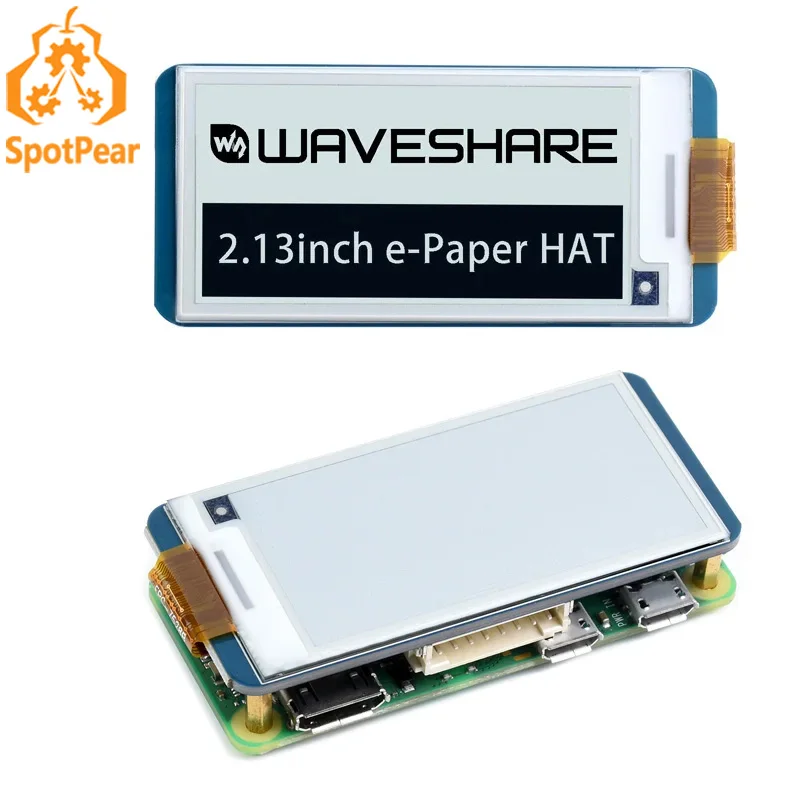
Waveshare 2.13-inch E-Paper HAT for Raspberry Pi
Official Store Deal
Expert Analysis Overview
The Waveshare 2.13-inch E-Paper HAT for Raspberry Pi is a specialized, ultra-efficient display solution engineered for embedded systems demanding persistent, low-power visual output. This is not a display for the faint of heart or those chasing high frame rates. It is for the meticulous designer, the data logger, the system monitor who understands the critical balance between information delivery and energy conservation.
The core of this unit is its 2.13-inch e-paper panel, delivering a crisp 250x122 pixel resolution. This isn't your typical LCD. It's bi-stable. Once an image is rendered, the electrophoretic particles lock into place, requiring zero power to maintain the visual state. This capability alone fundamentally alters project design, allowing for deployment in scenarios where continuous power draw is a non-starter. Imagine a remote weather station. Or a battery-powered sensor network. The display stays on. This is crucial for longevity.
The underlying technology, E-Ink (electrophoretic ink), relies on microcapsules containing positively charged white particles and negatively charged black particles suspended in a clear fluid. An electric field applied to the display surface causes these particles to move to the surface, making the pixel either black or white. This physical rearrangement of particles is why the image persists without power. It's a marvel of material science. The actual experience of interacting with e-paper is distinct. Text and simple graphics appear with exceptional clarity, mimicking the look and feel of ink on paper. Readability under direct sunlight is unparalleled, a stark contrast to emissive displays that wash out under such conditions. Viewing angles are virtually limitless, exceeding 170 degrees, ensuring information remains accessible from almost any perspective. This persistence is its superpower.
Compared to conventional TFT or OLED displays, which constantly consume power to illuminate pixels, this e-paper module is a power miser. Standard small OLEDs, even when showing static content, draw milliamps continuously, often in the range of 10-50mA depending on brightness and displayed content. This e-paper, however, draws power only during the refresh cycle, which typically lasts a few seconds and consumes approximately 26.4mW. For projects focused on extreme longevity from limited battery reserves, this distinction is not merely an advantage; it is a fundamental requirement. Consider an outdoor sensor array powered by a small solar panel and battery. Every milliwatt saved extends operational time significantly. Power efficiency is key.
The HAT (Hardware Attached on Top) form factor ensures a direct, robust connection to any Raspberry Pi model equipped with a standard 40-pin GPIO header. This eliminates the need for messy breadboards or unreliable jumper wires, critical for projects demanding long-term stability. The integration is seamless. A dedicated onboard voltage translator is a non-negotiable component, safeguarding the delicate e-paper panel and the Raspberry Pi from potential voltage mismatches. This translator ensures the 3.3V logic levels are correctly handled, preventing component degradation or outright failure, a common pitfall for less carefully designed peripherals. It protects your investment.
Operation is handled via the SPI (Serial Peripheral Interface) protocol. SPI is a synchronous serial communication interface, widely adopted in embedded systems for its efficiency and speed in short-distance data exchange. Unlike I2C, which uses two wires (SDA, SCL) and addresses, SPI employs four wires (MOSI, MISO, SCLK, CS) allowing for faster, full-duplex communication. The MOSI (Master Out Slave In) line sends data from the Raspberry Pi to the display, while MISO (Master In Slave Out) allows data to be read back (though less common for displays). SCLK (Serial Clock) synchronizes data transfer, and CS (Chip Select) activates the specific device. This direct, high-speed channel is crucial for pushing the pixel data efficiently to the display's internal controller, minimizing the refresh time as much as the e-paper technology allows. The protocol's simplicity is deceptive; its performance is raw.
When contrasted with displays utilizing slower interfaces like parallel data buses or even bit-banged GPIO, the SPI implementation here is a testament to focused engineering. The dedicated driver chip on the HAT manages the complex waveform generation required to manipulate the electrophoretic particles within the e-paper panel. This offloads significant processing overhead from the Raspberry Pi's CPU, allowing the main processor to focus on application logic rather than intricate display timing. Without this dedicated driver, the Raspberry Pi would be burdened with microsecond-level timing control for each pixel update, severely impacting its ability to perform other tasks. This is efficient design. It frees up resources.
While "overclocking" an e-paper display might sound counterintuitive, the principles of maximizing performance and stability still apply. The goal here shifts from raw clock speed to refresh cycle optimization and power efficiency at the edge. The Waveshare HAT, with its well-designed PCB (Rev2.1 visible in the images, indicating iterative refinement), suggests a stable foundation. The component layout is clean, with surface-mount technology (SMT) components tightly integrated. This compact design is vital for maintaining signal integrity, especially for the SPI lines, which can be susceptible to noise at higher frequencies or longer traces. Precision matters.
The power delivery aspect, though minimal for e-paper, is still critical during refreshes. The Raspberry Pi's 3.3V rail provides the necessary juice. Ensuring this rail remains stable under the transient load of a display refresh is paramount. High-quality capacitors are visible on the HAT, indicating an effort to smooth out any potential voltage dips during these operations. For the enthusiast aiming for the absolute fastest possible refresh, experimenting with custom SPI clock speeds beyond the default library settings could yield marginal gains, provided the Raspberry Pi's GPIO can sustain the higher frequencies without introducing data corruption. This requires careful testing. This is where the risk-taker thrives.
Compared to generic e-paper modules that might require external voltage regulators or complex wiring, this HAT simplifies the power path. The integrated driver and voltage translator mean less external circuitry, reducing potential points of failure and simplifying the power stability equation. This streamlined approach minimizes the risk of brownouts during refresh cycles, which could lead to incomplete or corrupted display updates. The less hardware, the fewer variables to manage. It's a cleaner setup. Furthermore, the ability to fine-tune the refresh parameters in the provided software libraries allows for an aggressive approach to update speed, balancing visual quality against the absolute minimum refresh time. This level of control is appreciated.
The physical construction of the Waveshare 2.13-inch E-Paper HAT is robust. The blue PCB exhibits a clean finish, with clearly labeled silkscreen printing for connections and component identification. The 40-pin header is securely soldered, providing a firm mechanical and electrical connection to the Raspberry Pi. The flexible flat cable (FFC) connecting the display panel to the HAT PCB appears well-seated and protected, a critical detail given the fragility of such connections. The matte finish of the e-paper panel itself resists glare and fingerprints, maintaining its pristine appearance even in challenging environments. It feels solid.
Durability for an e-paper display primarily revolves around the integrity of its flexible panel and the resilience of its driver electronics. The unit is designed for integration into projects where it might be exposed to ambient light and varying temperatures, but not necessarily harsh physical abuse. Its low power profile makes it an ideal candidate for long-term data logging displays, always-on status indicators, or electronic shelf labels. These are applications where an LCD would quickly drain power or fail under direct sunlight. Imagine a digital sign for a library book, updating only when the book is checked out, yet always visible. This display endures.
Unlike cheaper, generic e-paper modules that often come as bare panels requiring external breakout boards and complex wiring, the Waveshare HAT provides a fully integrated solution. This significantly reduces the time and effort required for prototyping and deployment. The consolidated design also means fewer exposed solder joints or fragile connections, contributing to its overall longevity in demanding, continuous operation scenarios. It's a complete package. The inclusion of clear interface markings on the PCB itself, such as "3-line SPI" and "4-line SPI" options, offers flexibility for developers to choose the most efficient communication mode for their specific needs, further highlighting the thoughtful design.
At its price point of approximately $8.85, this Waveshare e-paper HAT represents a compelling value proposition for specific use cases. While it may seem more expensive than a basic LCD character display, its zero static power consumption and sunlight readability fundamentally alter the operational cost over its lifespan. For battery-powered devices, the extended runtime translates directly into reduced maintenance cycles and fewer battery replacements, offering a significant return on investment. The initial outlay is offset by sustained efficiency. This is smart spending.
Consider a deployment of dozens or hundreds of sensor nodes across a large agricultural field. Each node equipped with a power-hungry LCD would necessitate larger batteries, more frequent charging, or more complex power management circuits, adding significant capital and operational expenses. This e-paper display drastically simplifies that equation, allowing for smaller, lighter, and more energy-independent designs. The cost-per-use, especially in remote or difficult-to-access installations, quickly makes this a more economical choice in the long run. It saves resources. The long-term savings often dwarf the initial component cost.
Compared to higher-resolution or color e-paper displays, which can easily cost five to ten times more, this 2.13-inch monochrome unit strikes an optimal balance between cost, performance, and power efficiency. It provides sufficient resolution (250x122) for clear text and simple graphical indicators without incurring the higher cost or more complex driving requirements of its advanced brethren. For projects where core information delivery is paramount, and aesthetic flourishes are secondary, this display offers an unparalleled blend of capability and affordability. It delivers essential data. It is the pragmatic choice.
The Waveshare 2.13-inch E-Paper HAT for Raspberry Pi stands as a potent tool for engineers and hobbyists pushing the boundaries of low-power embedded design. Its ability to maintain a display without drawing power is a paradigm shift for battery-operated projects, enabling unprecedented longevity and deployment flexibility. The robust HAT design, coupled with efficient SPI communication, ensures a stable and responsive platform for critical information display. This is a game-changer for specific applications.
Imagine your next IoT device, silently monitoring environmental conditions, its status clearly visible on a crisp, paper-like screen, powered by a tiny battery that lasts months, not hours. Picture a custom dashboard for your home automation system, displaying critical data points that update only when necessary, blending seamlessly into your environment without emitting harsh light or consuming precious energy. Envision a portable diagnostic tool, its essential metrics always visible, even when powered off. This display isn't just a component; it's an enabler for a new generation of truly energy-independent, always-on devices. It's the silent workhorse. The future is passive.
The Persistent Pixel Engine: A Deep Dive into E-Ink Technology
The core of this unit is its 2.13-inch e-paper panel, delivering a crisp 250x122 pixel resolution. This isn't your typical LCD. It's bi-stable. Once an image is rendered, the electrophoretic particles lock into place, requiring zero power to maintain the visual state. This capability alone fundamentally alters project design, allowing for deployment in scenarios where continuous power draw is a non-starter. Imagine a remote weather station. Or a battery-powered sensor network. The display stays on. This is crucial for longevity.
The underlying technology, E-Ink (electrophoretic ink), relies on microcapsules containing positively charged white particles and negatively charged black particles suspended in a clear fluid. An electric field applied to the display surface causes these particles to move to the surface, making the pixel either black or white. This physical rearrangement of particles is why the image persists without power. It's a marvel of material science. The actual experience of interacting with e-paper is distinct. Text and simple graphics appear with exceptional clarity, mimicking the look and feel of ink on paper. Readability under direct sunlight is unparalleled, a stark contrast to emissive displays that wash out under such conditions. Viewing angles are virtually limitless, exceeding 170 degrees, ensuring information remains accessible from almost any perspective. This persistence is its superpower.
Compared to conventional TFT or OLED displays, which constantly consume power to illuminate pixels, this e-paper module is a power miser. Standard small OLEDs, even when showing static content, draw milliamps continuously, often in the range of 10-50mA depending on brightness and displayed content. This e-paper, however, draws power only during the refresh cycle, which typically lasts a few seconds and consumes approximately 26.4mW. For projects focused on extreme longevity from limited battery reserves, this distinction is not merely an advantage; it is a fundamental requirement. Consider an outdoor sensor array powered by a small solar panel and battery. Every milliwatt saved extends operational time significantly. Power efficiency is key.
Precision Power Delivery and Interface Integrity: Engineering for Stability
The HAT (Hardware Attached on Top) form factor ensures a direct, robust connection to any Raspberry Pi model equipped with a standard 40-pin GPIO header. This eliminates the need for messy breadboards or unreliable jumper wires, critical for projects demanding long-term stability. The integration is seamless. A dedicated onboard voltage translator is a non-negotiable component, safeguarding the delicate e-paper panel and the Raspberry Pi from potential voltage mismatches. This translator ensures the 3.3V logic levels are correctly handled, preventing component degradation or outright failure, a common pitfall for less carefully designed peripherals. It protects your investment.
Operation is handled via the SPI (Serial Peripheral Interface) protocol. SPI is a synchronous serial communication interface, widely adopted in embedded systems for its efficiency and speed in short-distance data exchange. Unlike I2C, which uses two wires (SDA, SCL) and addresses, SPI employs four wires (MOSI, MISO, SCLK, CS) allowing for faster, full-duplex communication. The MOSI (Master Out Slave In) line sends data from the Raspberry Pi to the display, while MISO (Master In Slave Out) allows data to be read back (though less common for displays). SCLK (Serial Clock) synchronizes data transfer, and CS (Chip Select) activates the specific device. This direct, high-speed channel is crucial for pushing the pixel data efficiently to the display's internal controller, minimizing the refresh time as much as the e-paper technology allows. The protocol's simplicity is deceptive; its performance is raw.
When contrasted with displays utilizing slower interfaces like parallel data buses or even bit-banged GPIO, the SPI implementation here is a testament to focused engineering. The dedicated driver chip on the HAT manages the complex waveform generation required to manipulate the electrophoretic particles within the e-paper panel. This offloads significant processing overhead from the Raspberry Pi's CPU, allowing the main processor to focus on application logic rather than intricate display timing. Without this dedicated driver, the Raspberry Pi would be burdened with microsecond-level timing control for each pixel update, severely impacting its ability to perform other tasks. This is efficient design. It frees up resources.
The Overclocker's Perspective: Pushing the Limits of Display Refresh
While "overclocking" an e-paper display might sound counterintuitive, the principles of maximizing performance and stability still apply. The goal here shifts from raw clock speed to refresh cycle optimization and power efficiency at the edge. The Waveshare HAT, with its well-designed PCB (Rev2.1 visible in the images, indicating iterative refinement), suggests a stable foundation. The component layout is clean, with surface-mount technology (SMT) components tightly integrated. This compact design is vital for maintaining signal integrity, especially for the SPI lines, which can be susceptible to noise at higher frequencies or longer traces. Precision matters.
The power delivery aspect, though minimal for e-paper, is still critical during refreshes. The Raspberry Pi's 3.3V rail provides the necessary juice. Ensuring this rail remains stable under the transient load of a display refresh is paramount. High-quality capacitors are visible on the HAT, indicating an effort to smooth out any potential voltage dips during these operations. For the enthusiast aiming for the absolute fastest possible refresh, experimenting with custom SPI clock speeds beyond the default library settings could yield marginal gains, provided the Raspberry Pi's GPIO can sustain the higher frequencies without introducing data corruption. This requires careful testing. This is where the risk-taker thrives.
Compared to generic e-paper modules that might require external voltage regulators or complex wiring, this HAT simplifies the power path. The integrated driver and voltage translator mean less external circuitry, reducing potential points of failure and simplifying the power stability equation. This streamlined approach minimizes the risk of brownouts during refresh cycles, which could lead to incomplete or corrupted display updates. The less hardware, the fewer variables to manage. It's a cleaner setup. Furthermore, the ability to fine-tune the refresh parameters in the provided software libraries allows for an aggressive approach to update speed, balancing visual quality against the absolute minimum refresh time. This level of control is appreciated.
Build Quality and Enduring Applications: Designed for the Long Haul
The physical construction of the Waveshare 2.13-inch E-Paper HAT is robust. The blue PCB exhibits a clean finish, with clearly labeled silkscreen printing for connections and component identification. The 40-pin header is securely soldered, providing a firm mechanical and electrical connection to the Raspberry Pi. The flexible flat cable (FFC) connecting the display panel to the HAT PCB appears well-seated and protected, a critical detail given the fragility of such connections. The matte finish of the e-paper panel itself resists glare and fingerprints, maintaining its pristine appearance even in challenging environments. It feels solid.
Durability for an e-paper display primarily revolves around the integrity of its flexible panel and the resilience of its driver electronics. The unit is designed for integration into projects where it might be exposed to ambient light and varying temperatures, but not necessarily harsh physical abuse. Its low power profile makes it an ideal candidate for long-term data logging displays, always-on status indicators, or electronic shelf labels. These are applications where an LCD would quickly drain power or fail under direct sunlight. Imagine a digital sign for a library book, updating only when the book is checked out, yet always visible. This display endures.
Unlike cheaper, generic e-paper modules that often come as bare panels requiring external breakout boards and complex wiring, the Waveshare HAT provides a fully integrated solution. This significantly reduces the time and effort required for prototyping and deployment. The consolidated design also means fewer exposed solder joints or fragile connections, contributing to its overall longevity in demanding, continuous operation scenarios. It's a complete package. The inclusion of clear interface markings on the PCB itself, such as "3-line SPI" and "4-line SPI" options, offers flexibility for developers to choose the most efficient communication mode for their specific needs, further highlighting the thoughtful design.
The Cost-Benefit Equation for the Discerning Engineer: Value Beyond the Price Tag
At its price point of approximately $8.85, this Waveshare e-paper HAT represents a compelling value proposition for specific use cases. While it may seem more expensive than a basic LCD character display, its zero static power consumption and sunlight readability fundamentally alter the operational cost over its lifespan. For battery-powered devices, the extended runtime translates directly into reduced maintenance cycles and fewer battery replacements, offering a significant return on investment. The initial outlay is offset by sustained efficiency. This is smart spending.
Consider a deployment of dozens or hundreds of sensor nodes across a large agricultural field. Each node equipped with a power-hungry LCD would necessitate larger batteries, more frequent charging, or more complex power management circuits, adding significant capital and operational expenses. This e-paper display drastically simplifies that equation, allowing for smaller, lighter, and more energy-independent designs. The cost-per-use, especially in remote or difficult-to-access installations, quickly makes this a more economical choice in the long run. It saves resources. The long-term savings often dwarf the initial component cost.
Compared to higher-resolution or color e-paper displays, which can easily cost five to ten times more, this 2.13-inch monochrome unit strikes an optimal balance between cost, performance, and power efficiency. It provides sufficient resolution (250x122) for clear text and simple graphical indicators without incurring the higher cost or more complex driving requirements of its advanced brethren. For projects where core information delivery is paramount, and aesthetic flourishes are secondary, this display offers an unparalleled blend of capability and affordability. It delivers essential data. It is the pragmatic choice.
Final Assessment: Embracing the Future of Passive Display for Critical Information
The Waveshare 2.13-inch E-Paper HAT for Raspberry Pi stands as a potent tool for engineers and hobbyists pushing the boundaries of low-power embedded design. Its ability to maintain a display without drawing power is a paradigm shift for battery-operated projects, enabling unprecedented longevity and deployment flexibility. The robust HAT design, coupled with efficient SPI communication, ensures a stable and responsive platform for critical information display. This is a game-changer for specific applications.
Imagine your next IoT device, silently monitoring environmental conditions, its status clearly visible on a crisp, paper-like screen, powered by a tiny battery that lasts months, not hours. Picture a custom dashboard for your home automation system, displaying critical data points that update only when necessary, blending seamlessly into your environment without emitting harsh light or consuming precious energy. Envision a portable diagnostic tool, its essential metrics always visible, even when powered off. This display isn't just a component; it's an enabler for a new generation of truly energy-independent, always-on devices. It's the silent workhorse. The future is passive.