Waveshare 2.13-inch E-Ink Display HAT
Official Store Deal
Expert Analysis Overview
The Waveshare 2.13-inch E-Ink Display HAT is a specialized, low-power display solution engineered for embedded systems, targeting developers who prioritize resource efficiency and long-term display persistence over dynamic refresh rates. This HAT integrates directly onto various single-board computers and microcontrollers, including Raspberry Pi, STM32, Jetson Nano, and Arduino platforms, providing a static visual output without consuming continuous power once an image is rendered. Its design emphasizes minimal power draw, a critical factor for systems where every milliampere affects the overall performance envelope and potential for pushing clock speeds on the host.
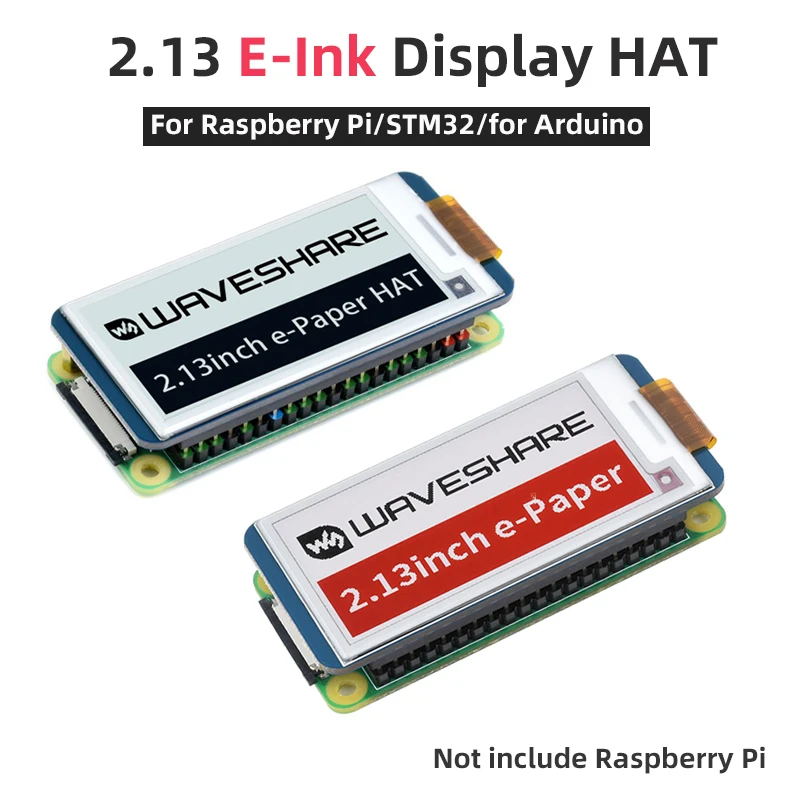
This E-Ink display features a 2.13-inch diagonal with a resolution of 250x122 pixels. The panel supports either black & white or black, white & red color schemes, as evidenced by the product imagery. This specific resolution and color depth are optimized for displaying static information such as sensor readings, status indicators, QR codes, or simple graphical elements.
Such a display excels in applications requiring information to be visible for extended periods without drawing power. Imagine a remote weather station. The display remains legible even if the host system enters a deep sleep state, preserving battery life for critical processing tasks or radio transmissions. This passive display characteristic is a significant advantage over power-hungry LCDs.
Compared to conventional TFT or OLED displays, the E-Ink panel sacrifices refresh speed for unparalleled power efficiency and readability under direct sunlight. Standard displays would drain a battery in hours; this E-Ink solution ensures days or weeks of persistent data visibility, allowing the host CPU to operate at higher frequencies or perform more complex computations for longer without power constraints from the display.
The 250x122 pixel array, while not high-definition, offers sufficient detail for character-based information and monochrome graphics. The option for black, white, and red adds a layer of visual hierarchy, enabling critical alerts or branding elements to stand out. The clarity of the e-ink pixels is exceptional.
For an overclocker, offloading display duties to an ultra-low-power peripheral like this frees up significant CPU cycles and memory bandwidth. The host system isn't constantly refreshing a framebuffer for a dynamic display. This allows for more aggressive core clock speeds or higher data throughput for other peripherals. It is a strategic choice for performance-critical embedded applications.
Traditional displays often require dedicated graphics memory or intensive CPU intervention for rendering, introducing latency and consuming precious computational resources. This E-Ink HAT operates with a 'set-and-forget' mentality, pushing pixels once and then allowing the host to focus on its primary, often more demanding, tasks.
The HAT (Hardware Attached on Top) form factor ensures seamless physical and electrical integration with Raspberry Pi boards. The connection relies on the SPI (Serial Peripheral Interface) bus, a robust and widely adopted communication protocol in embedded systems. This interface is known for its speed and efficiency, making it suitable for quickly transferring display data.
Utilizing SPI minimizes the GPIO pin count required, leaving more pins available for other sensors, actuators, or debugging interfaces. The direct HAT mounting also reduces cable clutter, which is crucial for compact, high-density projects where airflow and thermal management are paramount. A clean build helps prevent thermal hotspots.
Unlike generic display modules requiring external wiring and potentially custom mounting, the HAT design provides a standardized, secure connection. This reduces the risk of intermittent connections or signal integrity issues, which can be disastrous when pushing a system to its performance limits. Stability is key.
The HAT draws power directly from the host board's 3.3V or 5V rails, depending on the specific pinout and internal logic. The low power consumption of E-Ink means minimal current draw, which translates to negligible thermal impact on the host system. This is a critical consideration for overclocked Raspberry Pis, where every watt dissipated contributes to the overall heat load.
Stable power delivery is non-negotiable for overclocking. By not significantly taxing the host's power supply lines for display operation, the HAT helps maintain cleaner power to the CPU and other critical components. This reduces voltage ripple and noise, directly contributing to system stability at higher clock frequencies. Minimal power draw means maximum headroom.
Many external displays can introduce substantial power spikes or continuous current draw, destabilizing the host's power rail. This E-Ink HAT's design mitigates such risks, making it an ideal companion for systems tuned for peak performance. It doesn't fight for power. It sips it.
While the E-Ink display itself isn't overclockable, its inherent low-power, static nature directly benefits an overclocked host system. The less power diverted to peripherals, the more available for the CPU and GPU cores. This translates to higher stable clock speeds or lower operating temperatures at stock speeds, extending the lifespan of the silicon.
Consider a Raspberry Pi running a computationally intensive task, perhaps a real-time data analysis or a complex network application. By using an E-Ink display for status updates, the system avoids the overhead of a graphical desktop environment or constant display refreshes. This allows the CPU to dedicate its full attention and clock cycles to the primary workload. Every cycle counts.
Standard display solutions, especially those requiring HDMI or complex framebuffer management, can introduce significant latency and consume a non-trivial amount of system resources. The E-Ink HAT provides a 'fire-and-forget' display mechanism, freeing up those resources for the critical computations that overclocking aims to enhance. It's a performance multiplier.
The SPI interface, operating in a master-slave configuration, ensures efficient data transfer without significant CPU intervention once configured. Data is pushed to the display's internal controller, which then manages the pixel updates. This offloads the burden from the main processor, allowing it to focus on its primary tasks.
Reduced resource contention on the SPI bus means other high-speed peripherals can operate more reliably. If the host system is communicating with multiple sensors or high-speed storage devices via SPI, a low-demand display ensures the bus remains available for critical data transfers. This minimizes bottlenecks. It keeps the data flowing.
In scenarios where precise timing is essential, such as industrial control or robotics, minimizing display-related interruptions is paramount. The E-Ink display's ability to hold an image indefinitely without continuous CPU interaction makes it a superior choice for maintaining tight control loops and predictable system behavior even under heavy load. Predictable performance is paramount.
The visible construction of the Waveshare HAT suggests a robust PCB and well-soldered components. E-Ink panels themselves are generally durable, lacking the fragile glass substrates of many LCDs and being less susceptible to burn-in than OLEDs. The passive nature of the display contributes to its longevity, as there are no backlights to degrade or refresh cycles to wear out pixels.
The HAT's design, with its integrated display and minimal external wiring, inherently reduces points of failure. This is critical for deployments in environments where reliability is key, such as embedded systems in remote locations or industrial settings. Fewer moving parts means greater resilience. It’s built to last.
Compared to displays with active backlights or high refresh rates, the E-Ink panel generates virtually no heat, further contributing to the overall thermal stability of the system. This passive operation ensures that the display itself does not become a source of heat, preserving the thermal headroom for the host CPU, which is often running at elevated frequencies. Cool operation is always best.
Priced at approximately 9.26 USD, this E-Ink HAT offers exceptional value for its specialized capabilities. For the cost of a few cups of coffee, a developer gains a display solution that enhances the overall efficiency and stability of their embedded project, particularly those pushing the limits of their host hardware. The long-term value comes from enabling more complex or stable overclocked configurations.
The investment in this HAT quickly pays for itself through reduced power consumption in battery-powered applications and the ability to run host systems at higher, more stable clock speeds. It is a strategic component for optimizing the total system performance and longevity, not just a simple display. It's an enabler.
Generic, cheaper display options often come with hidden costs in terms of increased power draw, CPU overhead, and potential instability. This E-Ink HAT, while seemingly simple, provides a focused solution that directly addresses the challenges of resource-constrained, performance-oriented embedded development. It’s a smart investment for efficiency.
Imagine your Raspberry Pi project, running a custom kernel at optimized clock speeds, displaying critical telemetry on this E-Ink HAT. The display shows stable CPU temperature and frequency, a testament to the efficient resource allocation enabled by the E-Ink's passive nature. You can push the boundaries of your hardware, confident that the display isn't holding back your overclocking ambitions. This HAT ensures your system runs lean, cool, and powerful, providing essential visual feedback without compromising the very performance you've meticulously tuned. It allows the core processing unit to operate at its absolute peak, delivering consistent, high-speed results for your most demanding applications.
The Display Core: Persistent Visuals
This E-Ink display features a 2.13-inch diagonal with a resolution of 250x122 pixels. The panel supports either black & white or black, white & red color schemes, as evidenced by the product imagery. This specific resolution and color depth are optimized for displaying static information such as sensor readings, status indicators, QR codes, or simple graphical elements.
Such a display excels in applications requiring information to be visible for extended periods without drawing power. Imagine a remote weather station. The display remains legible even if the host system enters a deep sleep state, preserving battery life for critical processing tasks or radio transmissions. This passive display characteristic is a significant advantage over power-hungry LCDs.
Compared to conventional TFT or OLED displays, the E-Ink panel sacrifices refresh speed for unparalleled power efficiency and readability under direct sunlight. Standard displays would drain a battery in hours; this E-Ink solution ensures days or weeks of persistent data visibility, allowing the host CPU to operate at higher frequencies or perform more complex computations for longer without power constraints from the display.
Pixel Precision and Palette Choices
The 250x122 pixel array, while not high-definition, offers sufficient detail for character-based information and monochrome graphics. The option for black, white, and red adds a layer of visual hierarchy, enabling critical alerts or branding elements to stand out. The clarity of the e-ink pixels is exceptional.
For an overclocker, offloading display duties to an ultra-low-power peripheral like this frees up significant CPU cycles and memory bandwidth. The host system isn't constantly refreshing a framebuffer for a dynamic display. This allows for more aggressive core clock speeds or higher data throughput for other peripherals. It is a strategic choice for performance-critical embedded applications.
Traditional displays often require dedicated graphics memory or intensive CPU intervention for rendering, introducing latency and consuming precious computational resources. This E-Ink HAT operates with a 'set-and-forget' mentality, pushing pixels once and then allowing the host to focus on its primary, often more demanding, tasks.
Integration Dynamics: SPI Interface and HAT Form Factor
The HAT (Hardware Attached on Top) form factor ensures seamless physical and electrical integration with Raspberry Pi boards. The connection relies on the SPI (Serial Peripheral Interface) bus, a robust and widely adopted communication protocol in embedded systems. This interface is known for its speed and efficiency, making it suitable for quickly transferring display data.
Utilizing SPI minimizes the GPIO pin count required, leaving more pins available for other sensors, actuators, or debugging interfaces. The direct HAT mounting also reduces cable clutter, which is crucial for compact, high-density projects where airflow and thermal management are paramount. A clean build helps prevent thermal hotspots.
Unlike generic display modules requiring external wiring and potentially custom mounting, the HAT design provides a standardized, secure connection. This reduces the risk of intermittent connections or signal integrity issues, which can be disastrous when pushing a system to its performance limits. Stability is key.
Power Delivery and Thermal Footprint
The HAT draws power directly from the host board's 3.3V or 5V rails, depending on the specific pinout and internal logic. The low power consumption of E-Ink means minimal current draw, which translates to negligible thermal impact on the host system. This is a critical consideration for overclocked Raspberry Pis, where every watt dissipated contributes to the overall heat load.
Stable power delivery is non-negotiable for overclocking. By not significantly taxing the host's power supply lines for display operation, the HAT helps maintain cleaner power to the CPU and other critical components. This reduces voltage ripple and noise, directly contributing to system stability at higher clock frequencies. Minimal power draw means maximum headroom.
Many external displays can introduce substantial power spikes or continuous current draw, destabilizing the host's power rail. This E-Ink HAT's design mitigates such risks, making it an ideal companion for systems tuned for peak performance. It doesn't fight for power. It sips it.
Overclocking Synergy: Maximizing Host Performance
While the E-Ink display itself isn't overclockable, its inherent low-power, static nature directly benefits an overclocked host system. The less power diverted to peripherals, the more available for the CPU and GPU cores. This translates to higher stable clock speeds or lower operating temperatures at stock speeds, extending the lifespan of the silicon.
Consider a Raspberry Pi running a computationally intensive task, perhaps a real-time data analysis or a complex network application. By using an E-Ink display for status updates, the system avoids the overhead of a graphical desktop environment or constant display refreshes. This allows the CPU to dedicate its full attention and clock cycles to the primary workload. Every cycle counts.
Standard display solutions, especially those requiring HDMI or complex framebuffer management, can introduce significant latency and consume a non-trivial amount of system resources. The E-Ink HAT provides a 'fire-and-forget' display mechanism, freeing up those resources for the critical computations that overclocking aims to enhance. It's a performance multiplier.
Resource Allocation and Latency Reduction
The SPI interface, operating in a master-slave configuration, ensures efficient data transfer without significant CPU intervention once configured. Data is pushed to the display's internal controller, which then manages the pixel updates. This offloads the burden from the main processor, allowing it to focus on its primary tasks.
Reduced resource contention on the SPI bus means other high-speed peripherals can operate more reliably. If the host system is communicating with multiple sensors or high-speed storage devices via SPI, a low-demand display ensures the bus remains available for critical data transfers. This minimizes bottlenecks. It keeps the data flowing.
In scenarios where precise timing is essential, such as industrial control or robotics, minimizing display-related interruptions is paramount. The E-Ink display's ability to hold an image indefinitely without continuous CPU interaction makes it a superior choice for maintaining tight control loops and predictable system behavior even under heavy load. Predictable performance is paramount.
Durability and Longevity
The visible construction of the Waveshare HAT suggests a robust PCB and well-soldered components. E-Ink panels themselves are generally durable, lacking the fragile glass substrates of many LCDs and being less susceptible to burn-in than OLEDs. The passive nature of the display contributes to its longevity, as there are no backlights to degrade or refresh cycles to wear out pixels.
The HAT's design, with its integrated display and minimal external wiring, inherently reduces points of failure. This is critical for deployments in environments where reliability is key, such as embedded systems in remote locations or industrial settings. Fewer moving parts means greater resilience. It’s built to last.
Compared to displays with active backlights or high refresh rates, the E-Ink panel generates virtually no heat, further contributing to the overall thermal stability of the system. This passive operation ensures that the display itself does not become a source of heat, preserving the thermal headroom for the host CPU, which is often running at elevated frequencies. Cool operation is always best.
Value Proposition for the Performance Enthusiast
Priced at approximately 9.26 USD, this E-Ink HAT offers exceptional value for its specialized capabilities. For the cost of a few cups of coffee, a developer gains a display solution that enhances the overall efficiency and stability of their embedded project, particularly those pushing the limits of their host hardware. The long-term value comes from enabling more complex or stable overclocked configurations.
The investment in this HAT quickly pays for itself through reduced power consumption in battery-powered applications and the ability to run host systems at higher, more stable clock speeds. It is a strategic component for optimizing the total system performance and longevity, not just a simple display. It's an enabler.
Generic, cheaper display options often come with hidden costs in terms of increased power draw, CPU overhead, and potential instability. This E-Ink HAT, while seemingly simple, provides a focused solution that directly addresses the challenges of resource-constrained, performance-oriented embedded development. It’s a smart investment for efficiency.
Imagine your Raspberry Pi project, running a custom kernel at optimized clock speeds, displaying critical telemetry on this E-Ink HAT. The display shows stable CPU temperature and frequency, a testament to the efficient resource allocation enabled by the E-Ink's passive nature. You can push the boundaries of your hardware, confident that the display isn't holding back your overclocking ambitions. This HAT ensures your system runs lean, cool, and powerful, providing essential visual feedback without compromising the very performance you've meticulously tuned. It allows the core processing unit to operate at its absolute peak, delivering consistent, high-speed results for your most demanding applications.