Universal DDR3/DDR4/DDR5 SO-DIMM to DIMM Memory Adapter
Official Store Deal
Expert Analysis Overview
The Universal DDR3/DDR4/DDR5 SO-DIMM to DIMM Memory Adapter is a practical utility component designed for PC builders and enthusiasts seeking to repurpose laptop memory for desktop systems. This adapter bridges the physical and electrical gap between the smaller SO-DIMM (Small Outline Dual In-line Memory Module) found in laptops and the larger DIMM (Dual In-line Memory Module) slots prevalent in desktop motherboards. It is a critical tool for maximizing component value, transforming otherwise idle laptop RAM into a usable asset for new or upgraded desktop builds.
Modern computing environments often leave users with a surplus of perfectly functional laptop memory modules. Whether from a system upgrade, a retired notebook, or simply an accumulation of spare parts, these SO-DIMM modules frequently sit unused. The inherent frustration of having valuable components go to waste is a common pain point for budget-conscious builders. This adapter directly addresses that, offering a straightforward solution.
The core functionality of these adapters is to provide a physical and electrical interface. They do not actively convert voltage or alter memory timings; rather, they act as a pass-through, ensuring the correct pin alignment and contact for the SO-DIMM module to function within a desktop DIMM slot. This passive design is key to their reliability and simplicity.
Compared to purchasing new desktop DIMM modules, especially for older DDR3 or even DDR4 systems, repurposing existing SO-DIMMs via these adapters can represent a substantial cost saving. It's an economic advantage. For system integrators or hobbyists who frequently acquire used laptop components, these adapters become an indispensable part of their toolkit, enabling a more sustainable and less wasteful approach to PC building.
This range of adapters caters to three distinct generations of DDR memory: DDR3, DDR4, and DDR5. Each generation utilizes a specific pin configuration and notch placement, making cross-generational compatibility impossible without a dedicated adapter.
DDR3 SO-DIMM modules feature 204 pins, which are adapted to fit into a 240-pin DDR3 DIMM slot. The physical notch on a DDR3 module is positioned differently from its successors, preventing incorrect insertion. This precise engineering ensures proper electrical contact and data transfer, maintaining the integrity of the memory subsystem.
DDR4 and DDR5 SO-DIMM modules, in contrast, utilize 260 pins. These are designed to interface with 288-pin DDR4 or DDR5 DIMM slots respectively. While DDR4 and DDR5 SO-DIMMs share the same pin count, their notch positions are different, and their electrical signaling is fundamentally incompatible. Therefore, a DDR4 adapter cannot be used with a DDR5 module, and vice versa. Each adapter is meticulously designed for its specific generation.
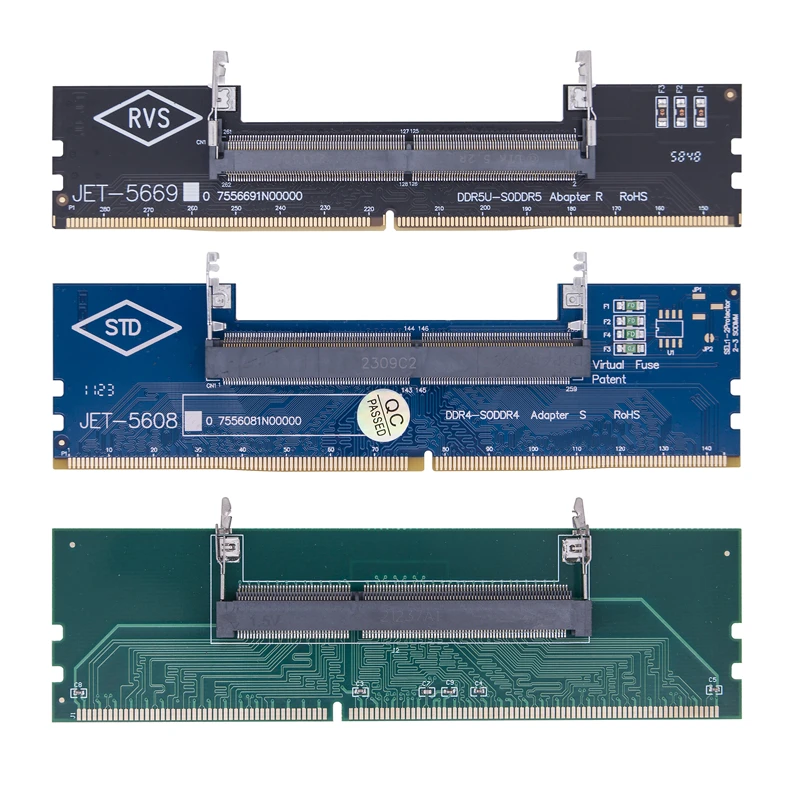
Observing the images, distinct adapters are visible for different generations, identifiable by their PCB markings (e.g., JET-5669 for a black board, JET-5608 for a blue board). The presence of multiple designs suggests a commitment to covering the various standards, ensuring that users can find the correct adapter for their specific SO-DIMM and motherboard combination. This broad support is a significant benefit.
The adapters themselves are constructed from standard fiberglass PCB material, similar to what is used for memory modules and motherboards. The visible components include the SO-DIMM slot with its retention clips, the gold-plated edge connector that interfaces with the desktop DIMM slot, and the necessary signal traces routed across the board.
Build quality appears consistent with other passive adapter components. The retention clips on the SO-DIMM slot are crucial for securely holding the laptop memory in place, preventing accidental dislodgement during installation or system operation. A firm, positive click should be felt when inserting the SO-DIMM, indicating proper seating.
A key physical consideration is the added height. Inserting an SO-DIMM into an adapter, and then the adapter into a DIMM slot, effectively doubles the vertical profile of the memory module. This increased height can become a critical factor in compact desktop builds or systems utilizing large, tower-style CPU air coolers. Users planning such configurations must verify clearance to avoid interference.
From a performance standpoint, these adapters are essentially transparent. They are passive devices, meaning they do not contain active components that could introduce processing delays or significant signal latency. The electrical signals from the SO-DIMM pass directly through the adapter's traces to the DIMM slot. The adapter's role is purely mechanical and electrical interfacing.
Theoretical concerns about signal degradation over the slightly longer trace paths are often raised but are generally negligible in practical use. Modern memory controllers and module designs are robust enough to handle the minimal additional distance. A well-designed adapter with high-quality PCB materials and gold-plated contacts ensures optimal signal integrity.
System stability is paramount. The adapter must provide a solid, unwavering electrical connection. Any looseness or intermittent contact can lead to memory errors, system crashes, or failure to boot. The quality of the SO-DIMM slot and the DIMM edge connector are critical here. Users should always ensure both the SO-DIMM and the adapter are fully seated and locked into place.
In a scenario where a user is building a home server or a secondary workstation where absolute bleeding-edge performance is not the primary concern, these adapters offer a perfectly viable solution. They allow for the creation of functional systems using components that might otherwise be discarded, extending the lifecycle of valuable hardware assets. This contributes to both economic savings and environmental sustainability.
The primary appeal of these SO-DIMM to DIMM adapters lies in their economic advantage. Laptop memory, particularly older DDR3 or DDR4 modules, can often be acquired for significantly less than their desktop counterparts, especially when purchased second-hand or salvaged from decommissioned machines. The adapter's low cost makes this conversion economically sensible.
Consider a user building a budget-friendly PC for office tasks, web browsing, or light gaming. If they have 8GB or 16GB of DDR4 SO-DIMM RAM lying around, purchasing one of these adapters for a few dollars allows them to avoid spending potentially much more on a new DDR4 DIMM kit. This direct cost saving can be redirected to other components, such as a faster SSD or a better CPU cooler.
For educational institutions or small businesses that frequently upgrade laptop fleets, these adapters provide a means to reuse the extracted RAM in desktop training labs or entry-level workstations. This maximizes the return on investment for hardware assets and minimizes waste. The ability to standardize on certain memory modules, even across different form factors, streamlines inventory management.
Imagine completing a desktop build knowing that you have maximized the utility of every component, saving money without compromising on essential functionality. The system boots flawlessly, applications launch smoothly, and the memory operates as intended, all thanks to a small, clever adapter. This practical flexibility translates into tangible savings and a sense of resourcefulness for the builder. Your repurposed laptop memory now powers your new desktop, running efficiently and reliably, a smart solution for optimizing your hardware investment.
The Ingenuity of Repurposing
Modern computing environments often leave users with a surplus of perfectly functional laptop memory modules. Whether from a system upgrade, a retired notebook, or simply an accumulation of spare parts, these SO-DIMM modules frequently sit unused. The inherent frustration of having valuable components go to waste is a common pain point for budget-conscious builders. This adapter directly addresses that, offering a straightforward solution.
The core functionality of these adapters is to provide a physical and electrical interface. They do not actively convert voltage or alter memory timings; rather, they act as a pass-through, ensuring the correct pin alignment and contact for the SO-DIMM module to function within a desktop DIMM slot. This passive design is key to their reliability and simplicity.
Compared to purchasing new desktop DIMM modules, especially for older DDR3 or even DDR4 systems, repurposing existing SO-DIMMs via these adapters can represent a substantial cost saving. It's an economic advantage. For system integrators or hobbyists who frequently acquire used laptop components, these adapters become an indispensable part of their toolkit, enabling a more sustainable and less wasteful approach to PC building.
Generational Compatibility and Pin Layouts
This range of adapters caters to three distinct generations of DDR memory: DDR3, DDR4, and DDR5. Each generation utilizes a specific pin configuration and notch placement, making cross-generational compatibility impossible without a dedicated adapter.
DDR3 SO-DIMM modules feature 204 pins, which are adapted to fit into a 240-pin DDR3 DIMM slot. The physical notch on a DDR3 module is positioned differently from its successors, preventing incorrect insertion. This precise engineering ensures proper electrical contact and data transfer, maintaining the integrity of the memory subsystem.
DDR4 and DDR5 SO-DIMM modules, in contrast, utilize 260 pins. These are designed to interface with 288-pin DDR4 or DDR5 DIMM slots respectively. While DDR4 and DDR5 SO-DIMMs share the same pin count, their notch positions are different, and their electrical signaling is fundamentally incompatible. Therefore, a DDR4 adapter cannot be used with a DDR5 module, and vice versa. Each adapter is meticulously designed for its specific generation.
Observing the images, distinct adapters are visible for different generations, identifiable by their PCB markings (e.g., JET-5669 for a black board, JET-5608 for a blue board). The presence of multiple designs suggests a commitment to covering the various standards, ensuring that users can find the correct adapter for their specific SO-DIMM and motherboard combination. This broad support is a significant benefit.
Construction and Physical Considerations
The adapters themselves are constructed from standard fiberglass PCB material, similar to what is used for memory modules and motherboards. The visible components include the SO-DIMM slot with its retention clips, the gold-plated edge connector that interfaces with the desktop DIMM slot, and the necessary signal traces routed across the board.
Build quality appears consistent with other passive adapter components. The retention clips on the SO-DIMM slot are crucial for securely holding the laptop memory in place, preventing accidental dislodgement during installation or system operation. A firm, positive click should be felt when inserting the SO-DIMM, indicating proper seating.
A key physical consideration is the added height. Inserting an SO-DIMM into an adapter, and then the adapter into a DIMM slot, effectively doubles the vertical profile of the memory module. This increased height can become a critical factor in compact desktop builds or systems utilizing large, tower-style CPU air coolers. Users planning such configurations must verify clearance to avoid interference.
Performance Integrity and System Stability
From a performance standpoint, these adapters are essentially transparent. They are passive devices, meaning they do not contain active components that could introduce processing delays or significant signal latency. The electrical signals from the SO-DIMM pass directly through the adapter's traces to the DIMM slot. The adapter's role is purely mechanical and electrical interfacing.
Theoretical concerns about signal degradation over the slightly longer trace paths are often raised but are generally negligible in practical use. Modern memory controllers and module designs are robust enough to handle the minimal additional distance. A well-designed adapter with high-quality PCB materials and gold-plated contacts ensures optimal signal integrity.
System stability is paramount. The adapter must provide a solid, unwavering electrical connection. Any looseness or intermittent contact can lead to memory errors, system crashes, or failure to boot. The quality of the SO-DIMM slot and the DIMM edge connector are critical here. Users should always ensure both the SO-DIMM and the adapter are fully seated and locked into place.
In a scenario where a user is building a home server or a secondary workstation where absolute bleeding-edge performance is not the primary concern, these adapters offer a perfectly viable solution. They allow for the creation of functional systems using components that might otherwise be discarded, extending the lifecycle of valuable hardware assets. This contributes to both economic savings and environmental sustainability.
The Economic Advantage and Practical Applications
The primary appeal of these SO-DIMM to DIMM adapters lies in their economic advantage. Laptop memory, particularly older DDR3 or DDR4 modules, can often be acquired for significantly less than their desktop counterparts, especially when purchased second-hand or salvaged from decommissioned machines. The adapter's low cost makes this conversion economically sensible.
Consider a user building a budget-friendly PC for office tasks, web browsing, or light gaming. If they have 8GB or 16GB of DDR4 SO-DIMM RAM lying around, purchasing one of these adapters for a few dollars allows them to avoid spending potentially much more on a new DDR4 DIMM kit. This direct cost saving can be redirected to other components, such as a faster SSD or a better CPU cooler.
For educational institutions or small businesses that frequently upgrade laptop fleets, these adapters provide a means to reuse the extracted RAM in desktop training labs or entry-level workstations. This maximizes the return on investment for hardware assets and minimizes waste. The ability to standardize on certain memory modules, even across different form factors, streamlines inventory management.
Imagine completing a desktop build knowing that you have maximized the utility of every component, saving money without compromising on essential functionality. The system boots flawlessly, applications launch smoothly, and the memory operates as intended, all thanks to a small, clever adapter. This practical flexibility translates into tangible savings and a sense of resourcefulness for the builder. Your repurposed laptop memory now powers your new desktop, running efficiently and reliably, a smart solution for optimizing your hardware investment.