TZ 3.0 All-Metal Hotend for Bambu Lab X1/P1 Series
Official Store Deal
Expert Analysis Overview
The TZ 3.0 All-Metal Hotend is a precision-engineered extrusion system designed for Bambu Lab X1, X1C, P1P, P1S, and X1E 3D printers, specifically targeting users who demand superior thermal performance and material versatility for advanced additive manufacturing.
This hotend represents a significant upgrade over standard components, focusing on critical areas such as thermal management, material compatibility, and extrusion consistency. Its design integrates advanced materials and construction techniques to address common limitations encountered during high-temperature and high-speed 3D printing.
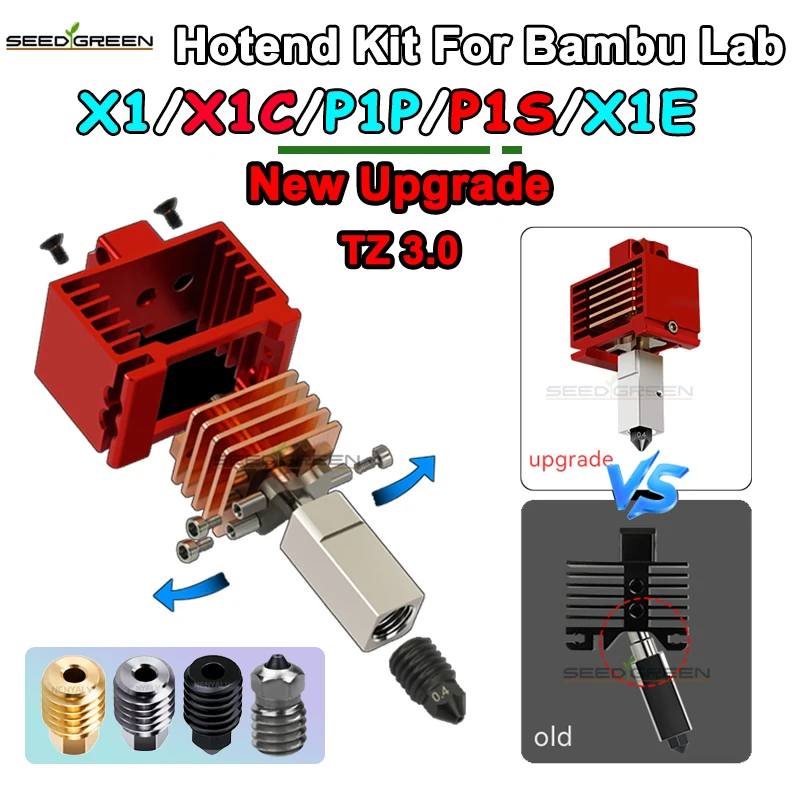
The TZ 3.0 hotend features an all-metal construction, a fundamental design choice that enables its high-temperature capabilities. The visible components include a red aluminum radiator, a titanium alloy heat break, and a chrome-zirconium copper heating block. This combination of materials is not arbitrary; each serves a specific function in the thermal and mechanical performance of the extrusion system.
An all-metal hotend, by definition, lacks a PTFE liner extending into the melt zone. This absence is crucial for printing filaments that require higher temperatures, such as ABS, Nylon, Polycarbonate (PC), and various fiber-filled composites. PTFE, or Teflon, degrades at temperatures above approximately 250°C, releasing toxic fumes and causing blockages. The all-metal design bypasses this limitation entirely.
Compared to hotends that utilize a PTFE liner, this all-metal configuration ensures that the filament path remains stable and free from degradation, even when operating at its maximum rated temperature of 350°C. This distinction is paramount for professional users and enthusiasts pushing the boundaries of material science in 3D printing.
The hotend's thermal performance is anchored by its chrome-zirconium copper heating block and titanium alloy heat break. Chrome-zirconium copper is selected for its exceptional thermal conductivity, ensuring rapid and uniform heating of the filament. This material efficiently transfers heat from the heater cartridge to the filament, minimizing temperature fluctuations within the melt zone. Uniform heating is critical.
Efficient heat transfer directly translates to consistent filament melting, which is a prerequisite for achieving precise layer adhesion and dimensional accuracy in printed parts. If the heating is uneven, the filament's viscosity changes erratically, leading to inconsistent extrusion and potential print defects like stringing, blobbing, or under-extrusion. This material choice mitigates such issues effectively.
Standard heating blocks often use brass or aluminum, which, while adequate for lower temperatures, do not offer the same thermal efficiency as chrome-zirconium copper. The superior thermal properties of the TZ 3.0's heating block allow for quicker heat-up times and more stable temperature control, particularly beneficial during rapid printing cycles or when switching between different filament types that require distinct temperature profiles.
Central to the hotend's design is the titanium alloy heat break. The heat break's primary function is to create a sharp thermal transition between the hot heating block and the cooler heatsink. Titanium alloy is chosen for this component due to its low thermal conductivity and high strength-to-weight ratio. Its low thermal conductivity prevents heat from creeping upwards from the melt zone into the cold end of the hotend.
Heat creep is a common issue where heat migrates too far up the filament path, causing the filament to soften prematurely before it reaches the melt zone. This premature softening can lead to clogs, especially with materials like PLA, which become sticky when warm. The titanium alloy effectively isolates the heat, maintaining a distinct cold zone where the filament remains solid until it enters the heating block.
Many entry-level hotends use stainless steel heat breaks, which offer decent thermal isolation but are not as effective as titanium alloy. The use of titanium in the TZ 3.0 hotend provides superior heat isolation, significantly reducing the likelihood of heat creep-related clogs and ensuring smoother, more reliable filament feeding, even during extended print jobs.
With a stated maximum flow rate of 35mm³/s, this hotend is engineered for speed without compromising print quality. The flow rate indicates the volume of molten plastic that can be extruded per second, a critical metric for determining how fast a printer can operate while maintaining optimal extrusion.
Achieving a high flow rate requires a combination of efficient heating and a well-designed melt zone. The chrome-zirconium copper heating block ensures that the filament melts quickly enough to keep up with rapid extrusion demands. The internal geometry of the hotend, while not explicitly detailed, must be optimized to minimize back pressure and allow for smooth, unimpeded flow of molten plastic.
Compared to hotends with lower flow rate capabilities, which might struggle to maintain consistent extrusion at higher print speeds, the TZ 3.0 allows users to push their Bambu Lab printers to their full potential. This is particularly advantageous for large prints where overall print time is a significant factor, or for production environments where throughput is paramount. Faster printing reduces overall project durations.
The design incorporates a replaceable threaded nozzle and titanium alloy screw fixation for the main components. This modularity simplifies maintenance and extends the lifespan of the hotend assembly. The ability to easily replace the nozzle means users can swap between different nozzle sizes or materials (e.g., hardened steel for abrasive filaments) without replacing the entire hotend.
Threaded nozzles provide a secure and leak-free connection to the heating block when properly installed. This design choice is standard in high-performance hotends, offering reliability and ease of use. The titanium alloy screw fixation for the radiator, heat break, and heating block ensures a stable and rigid assembly, crucial for maintaining precise alignment during printing.
Many integrated hotend designs, while convenient, can be more costly to repair if a single component fails or wears out. The TZ 3.0's modular approach allows for targeted replacement of individual parts, reducing long-term operational costs and minimizing downtime. This is a practical consideration for any active 3D printing setup.
This hotend is specifically designed for integration with Bambu Lab X1, X1C, P1P, P1S, and X1E 3D printers. This targeted compatibility ensures a direct fit and seamless operation with the existing printer ecosystem. Users can expect a straightforward upgrade path, leveraging the advanced features of their Bambu Lab machines.
Direct compatibility eliminates the need for complex adapters or modifications, which can introduce points of failure or compromise print quality. The hotend is engineered to work within the thermal and mechanical tolerances of these specific printer models, ensuring that the upgrade enhances performance without creating new integration challenges.
Unlike generic hotends that might require extensive calibration or custom firmware, this purpose-built upgrade is intended to integrate smoothly, allowing users to quickly benefit from its enhanced capabilities. This focus on specific printer models streamlines the upgrade process for the target audience.
The TZ 3.0 hotend is not merely a replacement part; it is an investment in expanded printing capabilities. For users who find their current hotend limiting when attempting to print with advanced engineering materials or when striving for faster print speeds, this upgrade provides the necessary performance headroom. It addresses the pain points of thermal limitations and flow restrictions.
By enabling reliable high-temperature printing, the hotend opens up a wider array of functional materials, allowing for the creation of stronger, more durable, and heat-resistant parts. This expands the utility of the 3D printer beyond prototyping into functional component manufacturing. The ability to print with materials like carbon fiber-filled Nylon or PC-ABS blends significantly broadens application possibilities.
Consider the long-term value: a single print failure due to an inadequate hotend can waste significant time and expensive filament. This upgrade minimizes such risks, leading to a higher success rate and more efficient use of resources. The initial cost is offset by increased reliability, material versatility, and improved print speeds, ultimately enhancing the return on investment for the 3D printer itself.
Imagine confidently loading a spool of high-performance carbon fiber filament, knowing your printer can handle the abrasive nature and high-temperature requirements without issue. Visualize completing large, complex prints in significantly less time, with consistent layer quality and robust mechanical properties. This hotend empowers users to transform their Bambu Lab printer into a more capable and versatile manufacturing tool, pushing the boundaries of what is achievable in desktop additive manufacturing.
Engineering for Elevated Performance
This hotend represents a significant upgrade over standard components, focusing on critical areas such as thermal management, material compatibility, and extrusion consistency. Its design integrates advanced materials and construction techniques to address common limitations encountered during high-temperature and high-speed 3D printing.
Material Science and Construction
The TZ 3.0 hotend features an all-metal construction, a fundamental design choice that enables its high-temperature capabilities. The visible components include a red aluminum radiator, a titanium alloy heat break, and a chrome-zirconium copper heating block. This combination of materials is not arbitrary; each serves a specific function in the thermal and mechanical performance of the extrusion system.
An all-metal hotend, by definition, lacks a PTFE liner extending into the melt zone. This absence is crucial for printing filaments that require higher temperatures, such as ABS, Nylon, Polycarbonate (PC), and various fiber-filled composites. PTFE, or Teflon, degrades at temperatures above approximately 250°C, releasing toxic fumes and causing blockages. The all-metal design bypasses this limitation entirely.
Compared to hotends that utilize a PTFE liner, this all-metal configuration ensures that the filament path remains stable and free from degradation, even when operating at its maximum rated temperature of 350°C. This distinction is paramount for professional users and enthusiasts pushing the boundaries of material science in 3D printing.
Optimized Thermal Management
The hotend's thermal performance is anchored by its chrome-zirconium copper heating block and titanium alloy heat break. Chrome-zirconium copper is selected for its exceptional thermal conductivity, ensuring rapid and uniform heating of the filament. This material efficiently transfers heat from the heater cartridge to the filament, minimizing temperature fluctuations within the melt zone. Uniform heating is critical.
Efficient heat transfer directly translates to consistent filament melting, which is a prerequisite for achieving precise layer adhesion and dimensional accuracy in printed parts. If the heating is uneven, the filament's viscosity changes erratically, leading to inconsistent extrusion and potential print defects like stringing, blobbing, or under-extrusion. This material choice mitigates such issues effectively.
Standard heating blocks often use brass or aluminum, which, while adequate for lower temperatures, do not offer the same thermal efficiency as chrome-zirconium copper. The superior thermal properties of the TZ 3.0's heating block allow for quicker heat-up times and more stable temperature control, particularly beneficial during rapid printing cycles or when switching between different filament types that require distinct temperature profiles.
The Role of the Heat Break
Central to the hotend's design is the titanium alloy heat break. The heat break's primary function is to create a sharp thermal transition between the hot heating block and the cooler heatsink. Titanium alloy is chosen for this component due to its low thermal conductivity and high strength-to-weight ratio. Its low thermal conductivity prevents heat from creeping upwards from the melt zone into the cold end of the hotend.
Heat creep is a common issue where heat migrates too far up the filament path, causing the filament to soften prematurely before it reaches the melt zone. This premature softening can lead to clogs, especially with materials like PLA, which become sticky when warm. The titanium alloy effectively isolates the heat, maintaining a distinct cold zone where the filament remains solid until it enters the heating block.
Many entry-level hotends use stainless steel heat breaks, which offer decent thermal isolation but are not as effective as titanium alloy. The use of titanium in the TZ 3.0 hotend provides superior heat isolation, significantly reducing the likelihood of heat creep-related clogs and ensuring smoother, more reliable filament feeding, even during extended print jobs.
Extrusion Dynamics and Flow Rate
With a stated maximum flow rate of 35mm³/s, this hotend is engineered for speed without compromising print quality. The flow rate indicates the volume of molten plastic that can be extruded per second, a critical metric for determining how fast a printer can operate while maintaining optimal extrusion.
Achieving a high flow rate requires a combination of efficient heating and a well-designed melt zone. The chrome-zirconium copper heating block ensures that the filament melts quickly enough to keep up with rapid extrusion demands. The internal geometry of the hotend, while not explicitly detailed, must be optimized to minimize back pressure and allow for smooth, unimpeded flow of molten plastic.
Compared to hotends with lower flow rate capabilities, which might struggle to maintain consistent extrusion at higher print speeds, the TZ 3.0 allows users to push their Bambu Lab printers to their full potential. This is particularly advantageous for large prints where overall print time is a significant factor, or for production environments where throughput is paramount. Faster printing reduces overall project durations.
Modularity and Maintenance
The design incorporates a replaceable threaded nozzle and titanium alloy screw fixation for the main components. This modularity simplifies maintenance and extends the lifespan of the hotend assembly. The ability to easily replace the nozzle means users can swap between different nozzle sizes or materials (e.g., hardened steel for abrasive filaments) without replacing the entire hotend.
Threaded nozzles provide a secure and leak-free connection to the heating block when properly installed. This design choice is standard in high-performance hotends, offering reliability and ease of use. The titanium alloy screw fixation for the radiator, heat break, and heating block ensures a stable and rigid assembly, crucial for maintaining precise alignment during printing.
Many integrated hotend designs, while convenient, can be more costly to repair if a single component fails or wears out. The TZ 3.0's modular approach allows for targeted replacement of individual parts, reducing long-term operational costs and minimizing downtime. This is a practical consideration for any active 3D printing setup.
Compatibility and Integration
This hotend is specifically designed for integration with Bambu Lab X1, X1C, P1P, P1S, and X1E 3D printers. This targeted compatibility ensures a direct fit and seamless operation with the existing printer ecosystem. Users can expect a straightforward upgrade path, leveraging the advanced features of their Bambu Lab machines.
Direct compatibility eliminates the need for complex adapters or modifications, which can introduce points of failure or compromise print quality. The hotend is engineered to work within the thermal and mechanical tolerances of these specific printer models, ensuring that the upgrade enhances performance without creating new integration challenges.
Unlike generic hotends that might require extensive calibration or custom firmware, this purpose-built upgrade is intended to integrate smoothly, allowing users to quickly benefit from its enhanced capabilities. This focus on specific printer models streamlines the upgrade process for the target audience.
The Upgrade Justification
The TZ 3.0 hotend is not merely a replacement part; it is an investment in expanded printing capabilities. For users who find their current hotend limiting when attempting to print with advanced engineering materials or when striving for faster print speeds, this upgrade provides the necessary performance headroom. It addresses the pain points of thermal limitations and flow restrictions.
By enabling reliable high-temperature printing, the hotend opens up a wider array of functional materials, allowing for the creation of stronger, more durable, and heat-resistant parts. This expands the utility of the 3D printer beyond prototyping into functional component manufacturing. The ability to print with materials like carbon fiber-filled Nylon or PC-ABS blends significantly broadens application possibilities.
Consider the long-term value: a single print failure due to an inadequate hotend can waste significant time and expensive filament. This upgrade minimizes such risks, leading to a higher success rate and more efficient use of resources. The initial cost is offset by increased reliability, material versatility, and improved print speeds, ultimately enhancing the return on investment for the 3D printer itself.
Imagine confidently loading a spool of high-performance carbon fiber filament, knowing your printer can handle the abrasive nature and high-temperature requirements without issue. Visualize completing large, complex prints in significantly less time, with consistent layer quality and robust mechanical properties. This hotend empowers users to transform their Bambu Lab printer into a more capable and versatile manufacturing tool, pushing the boundaries of what is achievable in desktop additive manufacturing.