Triangle-Lab HULA Anti-Vibration Feet for 3D Printers
Official Store Deal
Expert Analysis Overview
Precision in Motion: The HULA Anti-Vibration System
The Triangle-Lab HULA Anti-Vibration Feet are a precision-engineered isolation system designed for 3D printer enthusiasts seeking to mitigate print artifacts and reduce operational noise. This specialized solution targets the inherent vibrations produced by high-speed 3D printing, which often manifest as visible imperfections in printed parts. The system provides a critical upgrade for maintaining dimensional accuracy and achieving superior surface finishes, particularly on machines known for their rapid movements.Engineering for Stability: The HULA System Architecture
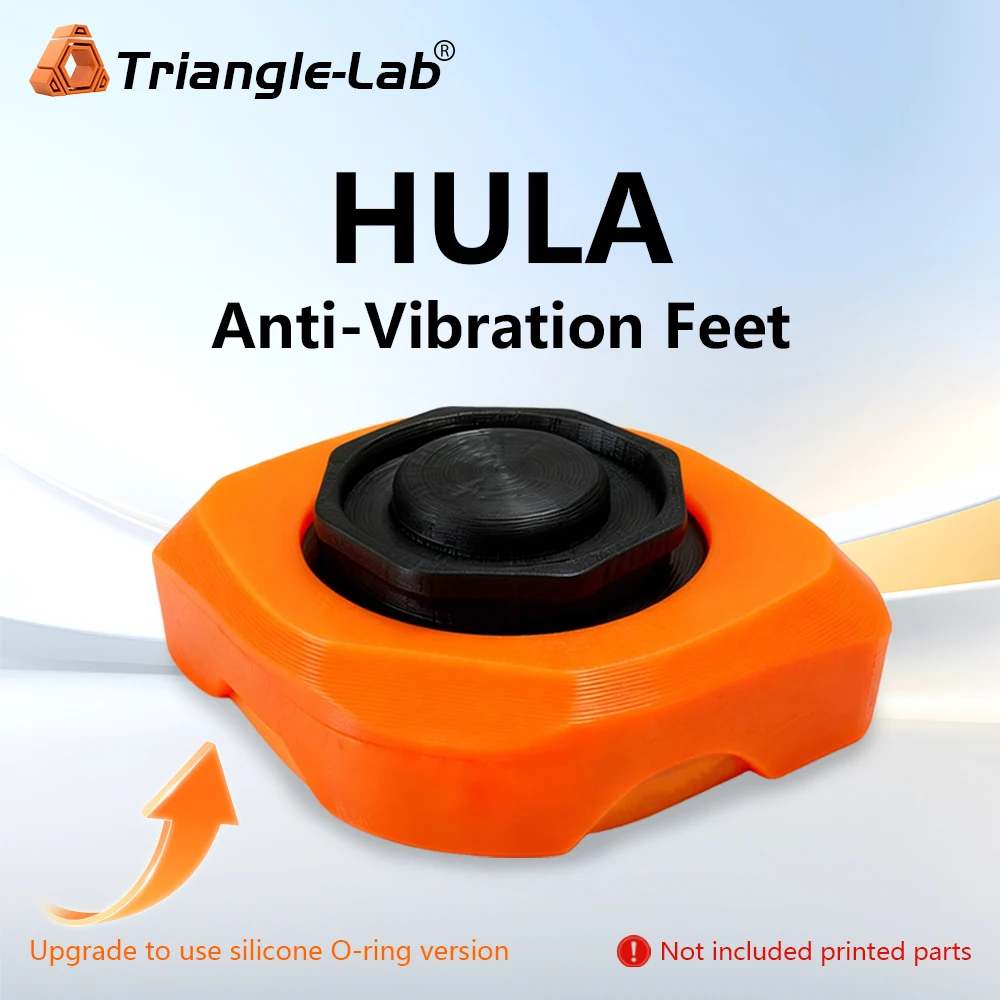
The HULA system's core functionality relies on a multi-component design. Visible elements include a top case, a bottom case, a center core, and shims, which are intended to be 3D printed by the user. These printed parts house the crucial mechanical components: F8-22M thrust bearings, a rubber band, and silicone O-rings. Each element plays a distinct role in the overall vibration dampening strategy. The design is modular.These components work in concert to decouple the printer's frame from its resting surface. Thrust bearings manage axial loads and facilitate smooth, low-friction movement, preventing direct transmission of vertical vibrations. The rubber band and silicone O-rings act as primary dampeners, absorbing kinetic energy and converting it into heat, thereby reducing resonant frequencies. This layered approach ensures comprehensive isolation.
Compared to standard rigid printer feet, which often transmit vibrations directly into the workbench or desk, the HULA system introduces a compliant interface. Generic rubber pads offer some dampening, but lack the multi-axis isolation provided by bearings and strategically placed elastomers. This engineered solution offers a significant performance advantage over simple, passive dampeners.
Material Science: Silicone's Superiority in Dampening
The kit prominently features silicone O-rings, a deliberate material choice. These O-rings are positioned to increase friction on the desktop surface and within the assembly, simultaneously reducing slippage and enhancing vibration absorption. Silicone exhibits excellent elasticity and a high coefficient of friction, making it ideal for this application. It grips surfaces well.By utilizing silicone O-rings instead of user-printed TPU alternatives, the kit achieves a significantly higher friction coefficient. This translates directly into superior anti-slip security for the printer, preventing unwanted movement during intense printing operations. The material choice directly impacts stability.
Standard TPU prints, while flexible, often have a lower inherent friction coefficient and can degrade faster under constant compression and shear forces. The pre-supplied silicone O-rings ensure consistent performance and durability, eliminating variables associated with user-printed flexible components. This guarantees optimal dampening from the outset.
Impact on Print Quality: Eliminating Artifacts
Vibrations are a primary culprit behind common 3D print defects such as ghosting, ringing, and inconsistent layer lines. These artifacts arise when the printer's frame or components oscillate during rapid movements, causing the nozzle to deviate from its intended path. The HULA feet directly address this root cause.The HULA system's ability to isolate these vibrations ensures that the print head maintains a more stable trajectory. This leads to a noticeable improvement in layer consistency and surface finish, particularly on prints with fine details or smooth, flat surfaces. Precision is paramount.
Printers equipped with standard feet often struggle to produce artifact-free prints at higher speeds, forcing users to reduce print velocity. The HULA feet allow printers to operate closer to their maximum mechanical capabilities without compromising output quality, effectively expanding the usable performance envelope. This means faster, better prints.
Acoustic Management: Quieter Operations
Beyond print quality, printer vibrations are a significant source of operational noise. The rapid movements of stepper motors, print heads, and cooling fans generate mechanical energy that propagates through the printer's frame and into the surrounding environment. This can be disruptive.The dampening properties of the rubber tubing and silicone O-rings within the HULA system absorb much of this mechanical energy before it can radiate as audible sound. By isolating the printer from its resting surface, the system prevents the desk or workbench from acting as a large soundboard, amplifying noise. The environment becomes quieter.
For users operating 3D printers in home offices, shared living spaces, or even dedicated workshops, reducing acoustic output is a substantial benefit. A quieter printer improves the working environment and minimizes disturbance to others, making long print jobs more tolerable. This enhances user comfort.
Installation and Customization: A DIY Approach
The HULA system is designed with a DIY ethos, requiring users to 3D print the main housing components. This approach offers significant customization potential, allowing individuals to choose their preferred filament material and color for the top case, bottom case, center core, and shims. Personalization is simple.Users can select materials like PETG or ABS for increased rigidity and durability, or even experiment with different infill patterns to fine-tune the structural properties of the feet. This flexibility empowers users to tailor the aesthetic and mechanical characteristics of their anti-vibration solution. The choice is yours.
While requiring an active role from the user, this DIY aspect also ensures that the solution remains cost-effective. The kit focuses on providing the specialized mechanical components, leveraging the user's existing 3D printing capabilities for the structural elements. This collaborative design reduces overall cost.
Compatibility Across Platforms: A Universal Solution
The Triangle-Lab HULA Anti-Vibration Feet are engineered for broad compatibility with several popular 3D printer models. The product explicitly lists support for Bambu Lab A1, A1 Mini, P1P, P1S, P2S, Creality K1, K1C, K1 Max, and QIDI Q2 printers. This wide range covers many popular machines.This extensive compatibility is achieved through a standardized mounting interface or adaptable design of the 3D printable components. The core dampening mechanism remains consistent, while the outer housing can be designed to fit various printer footprints and mounting points. Adaptability is key.
For users owning multiple printers or considering future upgrades, a universally compatible anti-vibration solution offers significant value. It ensures that the investment in dampening technology can be carried forward or applied across different machines, maximizing utility. This future-proofs the investment.
Long-Term Value: Protecting Your Investment
Investing in an anti-vibration system like the HULA feet extends beyond immediate print quality improvements. Reduced vibrations also contribute to the longevity and reliability of the 3D printer itself. Less vibration means less wear.Constant micro-vibrations can accelerate wear on critical printer components such as linear rails, bearings, lead screws, and even the printer's frame. By mitigating these forces, the HULA system helps to reduce mechanical stress, potentially extending the lifespan of these expensive parts. This protects the printer.
The consistent production of high-quality prints also reduces material waste from failed or suboptimal prints, offering a tangible return on investment over time. This system ensures that every print has the best chance of success, saving both time and filament. It's an economical choice.
Imagine your 3D printer operating with a newfound quietness, its movements precise and unburdened by resonant frequencies. Picture flawlessly smooth prints emerging from the build plate, free from ghosting or layer inconsistencies, even at your machine's highest speeds. Envision a workspace where the hum of creation is no longer a distracting rumble, allowing for focused work or peaceful enjoyment. This anti-vibration upgrade transforms the printing experience, delivering consistent, high-fidelity results and a more serene environment for every project.