Thermalright USB 2.0 9-Pin X5 Internal Hub
Official Store Deal
Expert Analysis Overview
Expanding Internal Connectivity: The Thermalright USB 2.0 9-Pin Hub
The Thermalright USB 2.0 9-Pin X5 Internal Hub is a critical internal expansion solution for system builders facing a deficit of motherboard USB 2.0 headers. This device addresses a common bottleneck in modern PC construction, where an increasing number of peripherals demand internal USB connectivity. It is a simple, yet highly effective, utility.Many contemporary motherboards, even high-end models, often provide only one or two internal USB 2.0 headers. This limitation becomes pronounced when integrating multiple RGB lighting controllers, AIO liquid coolers with integrated pumps and lighting, fan controllers, or even internal card readers. Each of these components typically requires its own dedicated 9-pin USB 2.0 connection. Without a hub like this, builders are often forced to choose which devices to connect, or resort to less elegant external solutions.
Unlike generic, unpowered internal hubs, this Thermalright unit features a dedicated SATA power input. This is a crucial distinction. Drawing power directly from the SATA connector ensures stable and sufficient power delivery to all connected devices, preventing potential issues like device dropouts or instability that can plague unpowered or inadequately powered hubs. Stable power is paramount for reliable operation.
Architectural Design and Installation Dynamics
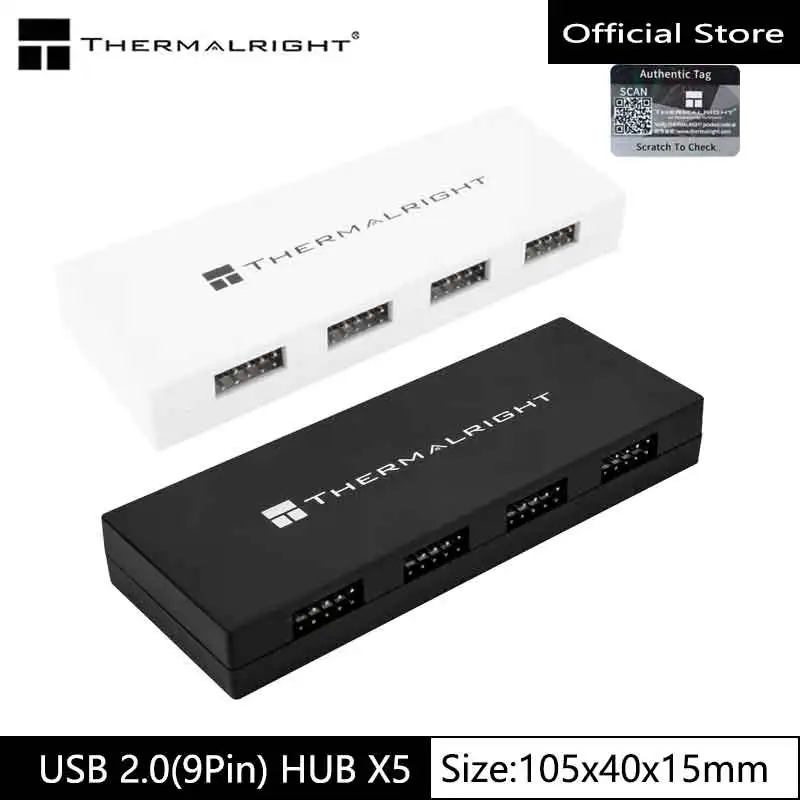
The physical design of the Thermalright hub emphasizes both functionality and ease of integration. Its compact form factor, measuring 105x40x15mm, allows for flexible placement within a PC chassis. This small footprint is a significant advantage, particularly in smaller cases or builds with intricate cable management.The hub's magnetic adsorption feature simplifies installation considerably. Builders can affix the unit to any ferrous surface inside the case, such as the motherboard tray, PSU shroud, or drive cages, without the need for screws or adhesive. This tool-less approach not only speeds up the build process but also allows for easy repositioning if needed. It offers quick mounting.
Compared to traditional screw-mounted or adhesive-backed hubs, the magnetic solution provides superior flexibility. Screw-mounted hubs require pre-drilled holes, which are rarely available in ideal locations, while adhesive solutions can leave residue or lose their grip over time, especially in warmer operating environments. The magnetic attachment is secure and reusable.
Power Delivery and Device Integration
The inclusion of a SATA power input is a defining characteristic of this hub. A single SATA power cable from the power supply provides ample current to power up to five connected USB 2.0 devices. This centralized power delivery eliminates the risk of overloading a single motherboard header, which is not designed to supply significant power to multiple high-draw peripherals.For instance, an AIO liquid cooler's pump and RGB lighting, combined with several RGB fan controllers, can collectively draw more power than a standard motherboard USB 2.0 header can reliably provide. The SATA power connection isolates these power demands from the motherboard, ensuring optimal performance for both the connected devices and the motherboard itself. Power stability is guaranteed.
This robust power solution makes the Thermalright hub suitable for even the most complex RGB setups or systems with numerous internal USB-dependent components. It provides a dedicated power pathway. The hub effectively acts as a power distribution block for internal USB 2.0, a feature often overlooked but vital for system stability.
Connectivity and Compatibility
The hub features one input 9-pin USB 2.0 header and five output 9-pin USB 2.0 headers. This configuration allows a single motherboard header to be expanded into five usable connections. The 9-pin USB 2.0 standard is widely used for internal PC peripherals, making this hub broadly compatible with a vast array of devices.It is important to understand that this hub is specifically for USB 2.0. It does not convert or upgrade USB 2.0 signals to USB 3.0 or higher speeds. Devices requiring USB 3.0 or faster connectivity, such as front panel USB 3.0 ports, will need to connect to dedicated USB 3.0 headers on the motherboard. This is a USB 2.0 solution.
In a scenario where a builder has a motherboard with only one USB 2.0 header but needs to connect an AIO pump, an RGB controller, and a front panel USB 2.0 port, this hub becomes indispensable. It allows all these devices to function simultaneously without conflict or the need for compromises. The expansion capability is significant.
Real-World Application and Builder Benefits
Consider a high-performance gaming rig with multiple RGB fans, an RGB AIO cooler, and perhaps an internal capture card or a specialized fan controller. Each of these components often requires a 9-pin USB 2.0 connection. Without the Thermalright hub, a builder might find themselves with insufficient headers, leading to difficult choices or an untidy external hub solution.This internal hub cleans up cable management by centralizing internal USB connections. Instead of running multiple cables directly to the motherboard, which can look cluttered, a single cable runs from the motherboard to the hub, and then shorter cables branch out to the peripherals. This simplifies the build process.
For PC enthusiasts and professional system integrators, the Thermalright USB 2.0 9-Pin X5 Internal Hub offers a streamlined, reliable, and aesthetically pleasing solution to a common internal connectivity challenge. It ensures all internal USB 2.0 devices receive stable power and data connections, contributing to a clean and functional build. Imagine a system where every internal peripheral connects seamlessly, powered reliably, and tucked away neatly inside the chassis, contributing to both optimal performance and a visually appealing build. This hub makes that vision a reality, providing the essential backbone for complex internal device ecosystems, ensuring stability and expanding the possibilities of your PC build without compromise.