SUNLU High Speed Matte PETG Filament
Official Store Deal
Expert Analysis Overview
The SUNLU High Speed Matte PETG Filament is a performance-oriented material engineered for rapid prototyping and functional part production, targeting users who demand both speed and mechanical robustness from their 3D prints. This filament represents a significant advancement in PETG technology, specifically formulated to overcome the traditional speed limitations associated with the material while retaining its inherent strength and ease of use.
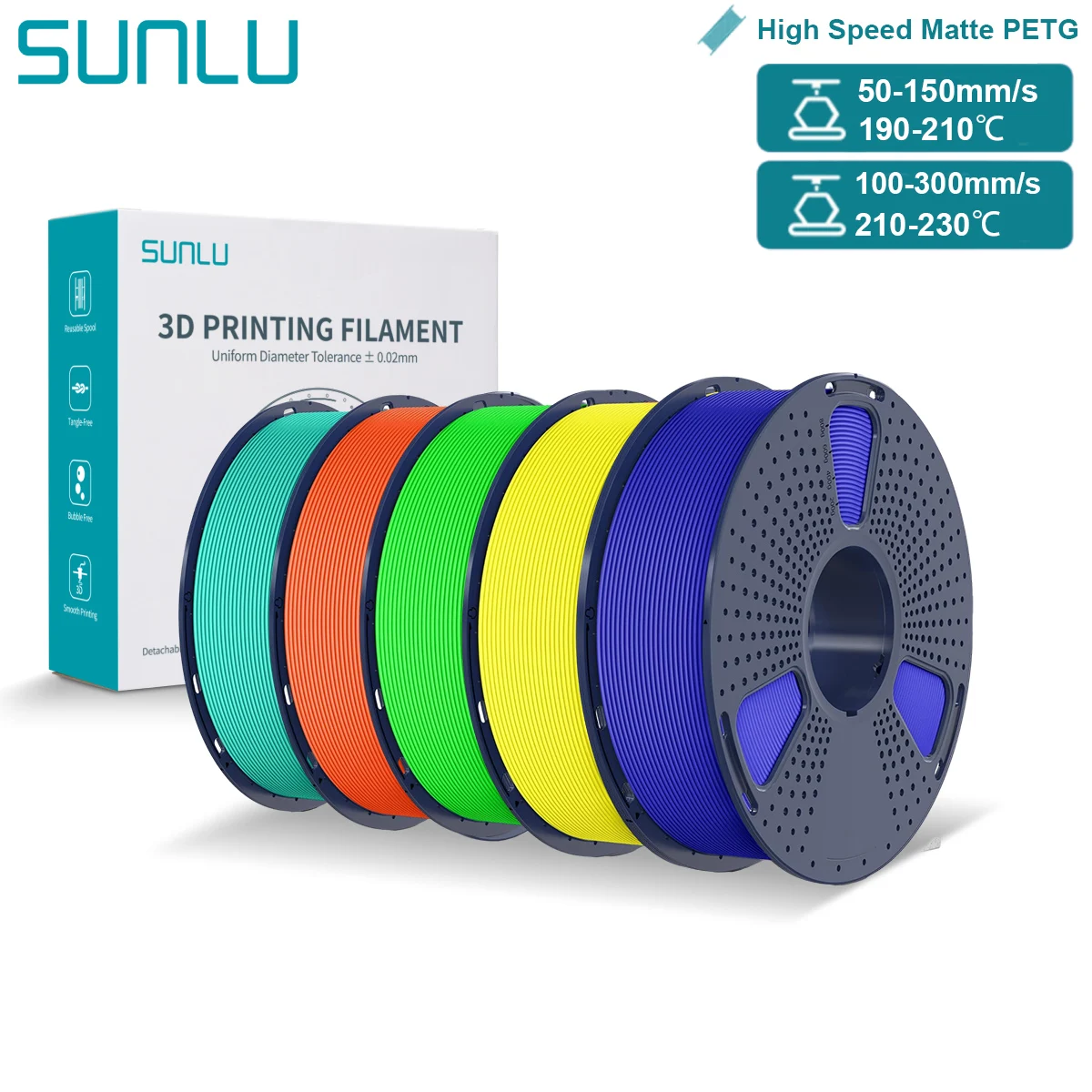
The filament is explicitly rated for print speeds ranging from 50-600mm/s, depending on the specific temperature profile. For optimal results, a print temperature of 190-210°C is recommended for speeds between 50-150mm/s. For faster operations, 210-230°C supports 100-300mm/s, and an even higher range of 230-270°C enables speeds from 300-600mm/s. These are impressive figures.
This broad speed compatibility allows for significant reduction in print times, making it suitable for batch production or iterative design cycles where rapid turnaround is critical. Complex geometries print faster. This directly impacts project timelines. The ability to print at such high velocities without compromising structural integrity is a key differentiator, addressing a common bottleneck in additive manufacturing workflows.
Unlike standard PETG formulations that often struggle with consistent extrusion at higher velocities, this high-speed variant is formulated to maintain material flow and layer adhesion, mitigating common issues like stringing or under-extrusion that plague faster prints with conventional filaments. It provides a smoother experience. This formulation ensures that even at peak speeds, the material behaves predictably, reducing print failures and material waste.
SUNLU High Speed Matte PETG is marketed with toughness comparable to ABS. This implies a material that is durable, flexible, and highly impact-resistant. The matte finish also contributes to a professional appearance, often desired for end-use parts or prototypes where visual quality is paramount. It resists scratches well.
This material characteristic makes it ideal for printing daily necessities and functional components that require resilience against physical stress. The enhanced toughness means printed parts are less prone to breaking under impact or bending, extending the lifespan of the printed objects. This is crucial for tools or enclosures. The material's inherent flexibility also helps absorb shocks, preventing brittle fractures common with some other filament types.
Compared to standard PLA, which is known for its ease of printing but can be brittle, this PETG offers a substantial upgrade in mechanical properties. It bridges the gap between the printability of PLA and the strength of ABS, providing a material that is both user-friendly and robust. This makes it a versatile choice. The odorless nature during printing is an added benefit, improving the working environment compared to ABS.
The filament is designed to print as effortlessly as PLA. This claim suggests a material that is less prone to warping, stringing, or bed adhesion issues often associated with more advanced engineering filaments. Easy printing saves time. The resilience delivered ensures that while the printing process is simplified, the final product retains the desired strength and durability.
This ease of use is particularly beneficial for users transitioning from PLA to more robust materials, as it lowers the barrier to entry for producing functional parts. The reduced likelihood of print failures translates directly into less wasted material and time, improving overall efficiency. It is a reliable choice. The consistent diameter and winding on the spool further contribute to a smooth printing experience, preventing tangles and jams.
Many high-strength filaments require specific enclosure conditions or heated print beds to prevent warping, but this High Speed PETG aims to minimize such requirements, making it compatible with a wider range of 3D printers. This broadens its accessibility. Its formulation for excellent layer adhesion ensures that printed objects have strong bonds between layers, contributing to the overall strength and integrity of the part, even under stress.
The recommended hot bed temperature range is 70-80°C. This temperature range is standard for PETG and helps ensure proper bed adhesion without excessive warping. Maintaining a stable bed temperature is critical for successful prints, especially for larger objects. A consistent temperature prevents lifting.
Optimizing these settings is crucial for achieving the advertised high speeds and quality. Users should calibrate their printers to find the sweet spot within the recommended ranges for their specific machine and project. Experimentation is key. The provided settings serve as an excellent starting point, guiding users towards successful prints with minimal trial and error.
Unlike some exotic filaments that demand highly specialized thermal management, this PETG operates within accessible temperature ranges for most modern 3D printers. This reduces the need for expensive upgrades. The material's thermal stability at higher extrusion temperatures is a testament to its advanced formulation, allowing for rapid melting and deposition without degradation.
This filament offers a compelling value proposition for both hobbyists and professionals. The combination of high-speed printing, ABS-like toughness, and PLA-like ease of use positions it as a versatile material for a wide array of applications. It saves time and money. The ability to produce strong, functional parts quickly means faster iteration cycles for designers and quicker fulfillment for small-batch manufacturers.
By enabling faster print times, the filament effectively reduces the 'cost per part' by increasing throughput, making it a more economical choice in the long run compared to slower, less efficient materials. This is a significant ROI. The reduced likelihood of print failures also minimizes material waste, further contributing to cost savings and environmental sustainability.
For those currently using standard PETG or even ABS, this high-speed matte variant offers a direct upgrade, providing superior performance characteristics without a steep learning curve. It streamlines workflows. The consistent quality and reliable performance ensure that users can depend on this filament for critical projects, delivering predictable and excellent results every time.
Imagine completing complex functional prototypes in a fraction of the time, moving from concept to tangible object with unprecedented speed. Visualize producing durable, impact-resistant parts that withstand real-world use, all while enjoying a printing process as straightforward as with common materials. Envision a workshop where material limitations no longer dictate project timelines, allowing for boundless creativity and efficient production. This filament empowers rapid innovation.
Accelerated Layer Deposition
The filament is explicitly rated for print speeds ranging from 50-600mm/s, depending on the specific temperature profile. For optimal results, a print temperature of 190-210°C is recommended for speeds between 50-150mm/s. For faster operations, 210-230°C supports 100-300mm/s, and an even higher range of 230-270°C enables speeds from 300-600mm/s. These are impressive figures.
This broad speed compatibility allows for significant reduction in print times, making it suitable for batch production or iterative design cycles where rapid turnaround is critical. Complex geometries print faster. This directly impacts project timelines. The ability to print at such high velocities without compromising structural integrity is a key differentiator, addressing a common bottleneck in additive manufacturing workflows.
Unlike standard PETG formulations that often struggle with consistent extrusion at higher velocities, this high-speed variant is formulated to maintain material flow and layer adhesion, mitigating common issues like stringing or under-extrusion that plague faster prints with conventional filaments. It provides a smoother experience. This formulation ensures that even at peak speeds, the material behaves predictably, reducing print failures and material waste.
Structural Integrity and Material Properties
SUNLU High Speed Matte PETG is marketed with toughness comparable to ABS. This implies a material that is durable, flexible, and highly impact-resistant. The matte finish also contributes to a professional appearance, often desired for end-use parts or prototypes where visual quality is paramount. It resists scratches well.
This material characteristic makes it ideal for printing daily necessities and functional components that require resilience against physical stress. The enhanced toughness means printed parts are less prone to breaking under impact or bending, extending the lifespan of the printed objects. This is crucial for tools or enclosures. The material's inherent flexibility also helps absorb shocks, preventing brittle fractures common with some other filament types.
Compared to standard PLA, which is known for its ease of printing but can be brittle, this PETG offers a substantial upgrade in mechanical properties. It bridges the gap between the printability of PLA and the strength of ABS, providing a material that is both user-friendly and robust. This makes it a versatile choice. The odorless nature during printing is an added benefit, improving the working environment compared to ABS.
Printability and User Experience
The filament is designed to print as effortlessly as PLA. This claim suggests a material that is less prone to warping, stringing, or bed adhesion issues often associated with more advanced engineering filaments. Easy printing saves time. The resilience delivered ensures that while the printing process is simplified, the final product retains the desired strength and durability.
This ease of use is particularly beneficial for users transitioning from PLA to more robust materials, as it lowers the barrier to entry for producing functional parts. The reduced likelihood of print failures translates directly into less wasted material and time, improving overall efficiency. It is a reliable choice. The consistent diameter and winding on the spool further contribute to a smooth printing experience, preventing tangles and jams.
Many high-strength filaments require specific enclosure conditions or heated print beds to prevent warping, but this High Speed PETG aims to minimize such requirements, making it compatible with a wider range of 3D printers. This broadens its accessibility. Its formulation for excellent layer adhesion ensures that printed objects have strong bonds between layers, contributing to the overall strength and integrity of the part, even under stress.
Thermal Performance and Settings
The recommended hot bed temperature range is 70-80°C. This temperature range is standard for PETG and helps ensure proper bed adhesion without excessive warping. Maintaining a stable bed temperature is critical for successful prints, especially for larger objects. A consistent temperature prevents lifting.
Optimizing these settings is crucial for achieving the advertised high speeds and quality. Users should calibrate their printers to find the sweet spot within the recommended ranges for their specific machine and project. Experimentation is key. The provided settings serve as an excellent starting point, guiding users towards successful prints with minimal trial and error.
Unlike some exotic filaments that demand highly specialized thermal management, this PETG operates within accessible temperature ranges for most modern 3D printers. This reduces the need for expensive upgrades. The material's thermal stability at higher extrusion temperatures is a testament to its advanced formulation, allowing for rapid melting and deposition without degradation.
Value Proposition for Prototyping and Production
This filament offers a compelling value proposition for both hobbyists and professionals. The combination of high-speed printing, ABS-like toughness, and PLA-like ease of use positions it as a versatile material for a wide array of applications. It saves time and money. The ability to produce strong, functional parts quickly means faster iteration cycles for designers and quicker fulfillment for small-batch manufacturers.
By enabling faster print times, the filament effectively reduces the 'cost per part' by increasing throughput, making it a more economical choice in the long run compared to slower, less efficient materials. This is a significant ROI. The reduced likelihood of print failures also minimizes material waste, further contributing to cost savings and environmental sustainability.
For those currently using standard PETG or even ABS, this high-speed matte variant offers a direct upgrade, providing superior performance characteristics without a steep learning curve. It streamlines workflows. The consistent quality and reliable performance ensure that users can depend on this filament for critical projects, delivering predictable and excellent results every time.
Imagine completing complex functional prototypes in a fraction of the time, moving from concept to tangible object with unprecedented speed. Visualize producing durable, impact-resistant parts that withstand real-world use, all while enjoying a printing process as straightforward as with common materials. Envision a workshop where material limitations no longer dictate project timelines, allowing for boundless creativity and efficient production. This filament empowers rapid innovation.