SpotPear ESP32-S3 AI Ball Smart Display
Official Store Deal
Expert Analysis Overview
The SpotPear ESP32-S3 AI Ball Smart Display is a compact, highly customizable IoT development platform aimed at enthusiasts and developers seeking a versatile smart home interface. Its integrated ESP32-S3 microcontroller provides robust processing power for AI and connectivity tasks. This device offers a compelling blend of hardware features for creating interactive and intelligent desktop companions.
The core of this device is the ESP32-S3 processor. This microcontroller is known for its dual-core Xtensa LX7 CPU, operating at up to 240 MHz. It integrates Wi-Fi and Bluetooth 5 (LE) capabilities directly onto the chip. The N16R8 designation implies 16MB of Flash memory and 8MB of PSRAM, providing ample space for complex firmware and data buffering.
This processing capability allows the AI Ball to handle demanding tasks such as local AI inference, complex sensor data processing, and rapid UI updates. Users can expect smooth operation for applications like voice command recognition and real-time data display. The integrated wireless protocols simplify communication with other smart devices and network services.
Unlike basic microcontrollers that often require external modules for Wi-Fi and Bluetooth, the ESP32-S3 consolidates these functions. This integration reduces component count and simplifies board design, offering a more streamlined development experience compared to piecing together separate modules. It's a powerful chip.
A 1.28-inch LCD display with a resolution of 240x240 pixels serves as the primary visual interface. This display supports 262K colors and utilizes an IPS panel, offering a 170-degree visible angle. The display driver is specified as GC9A01, and it communicates via SPI. For input, a touch interface is present, driven by an I2C-based CST816S touch driver.
The IPS panel ensures vibrant colors and excellent viewing angles, making the display readable from various positions on a desk. The touch interface provides intuitive interaction, allowing users to navigate menus or trigger actions directly on the screen. This combination facilitates a rich user experience for applications like weather clocks or interactive AI dialogues.
Many entry-level smart displays use TN panels with limited viewing angles, which can distort colors when viewed off-center. The IPS technology here provides a superior visual experience. The inclusion of a dedicated touch driver, rather than relying on basic button inputs, significantly enhances user interaction beyond what typical development boards offer.
The device features 2.4 GHz Wi-Fi and Bluetooth 5 (BLE), both managed by the integrated ESP32-S3 chip. An onboard antenna is visible, suggesting a compact and self-contained wireless solution. This ensures robust signal reception.
Robust Wi-Fi connectivity enables the device to fetch real-time data for weather updates, connect to cloud-based AI services, or integrate with smart home platforms like Home Assistant. Bluetooth 5 (BLE) allows for low-power communication with peripherals or local control from a smartphone. This dual connectivity ensures broad compatibility.
Unlike older IoT devices that might only offer Wi-Fi or require external Bluetooth dongles, the integrated Wi-Fi and BLE on the ESP32-S3 provide a comprehensive wireless communication suite. This simplifies network setup and expands the range of possible applications, from simple data logging to complex smart home automation. It's highly efficient.
Power is supplied via a Type-C port, a modern and reversible connector. The device also includes battery management capabilities, suggesting it can operate untethered. The images show a compact form factor, implying potential for portable use. Power delivery is simple.
The Type-C port offers convenient and fast charging, compatible with widely available cables and power adapters. Integrated battery management is crucial for applications requiring intermittent power or portability, such as a desk clock that needs to retain time during power outages. This allows for flexible deployment.
Many DIY projects rely on older micro-USB ports or require external battery management circuits, adding complexity. The inclusion of Type-C and built-in battery management simplifies the power solution significantly. This design choice enhances user convenience and reduces the need for additional external components. It's a modern standard.
The device incorporates a loudspeaker and a microphone. These components are essential for its advertised "AI Voice Chat Robot" functionality. The product description also mentions "AI Dialogue" and "SD Playback". Audio is key.
The microphone allows for voice input, enabling interaction with AI assistants or recording audio. The loudspeaker provides audible feedback, whether it's responding to queries, playing music from an SD card, or delivering notifications. This creates a truly interactive experience.
Basic smart displays often omit either a microphone or a loudspeaker, limiting their interactive capabilities. The inclusion of both, along with the processing power for AI dialogue, positions this device as a more complete communication hub. This makes it suitable for voice-controlled applications. It hears and speaks.
A card slot is visible, indicating support for external storage, likely a microSD card. The product explicitly mentions "SD Playback" as a feature. Storage is expandable.
The SD card slot provides expandable storage for media files, custom sound effects, or logging extensive data. This is particularly useful for offline music playback or storing large datasets for local AI models. Users gain significant flexibility.
Many small IoT devices rely solely on internal flash memory, which can be restrictive for media-rich applications. The SD card slot offers a cost-effective way to expand storage significantly, surpassing the limitations of typical onboard memory. This allows for greater functionality. It's a smart addition.
The product title explicitly mentions "espHome Assistant For XiaoZhi," indicating compatibility with the espHome ecosystem and potential integration with Home Assistant. The "Customizable" label is also prominent. Openness is a strength.
Compatibility with espHome means users can easily flash custom firmware using YAML configurations, integrating the device seamlessly into their smart home setup. This allows for deep customization of its functions, from displaying sensor data to acting as a control interface. The open-source nature of these platforms fosters a vibrant community.
Unlike proprietary smart devices with locked-down firmware, the espHome and Home Assistant compatibility provides an open and flexible platform. This empowers users to tailor the device's behavior precisely to their needs, avoiding vendor lock-in and maximizing its long-term utility. It's a significant advantage for hobbyists.
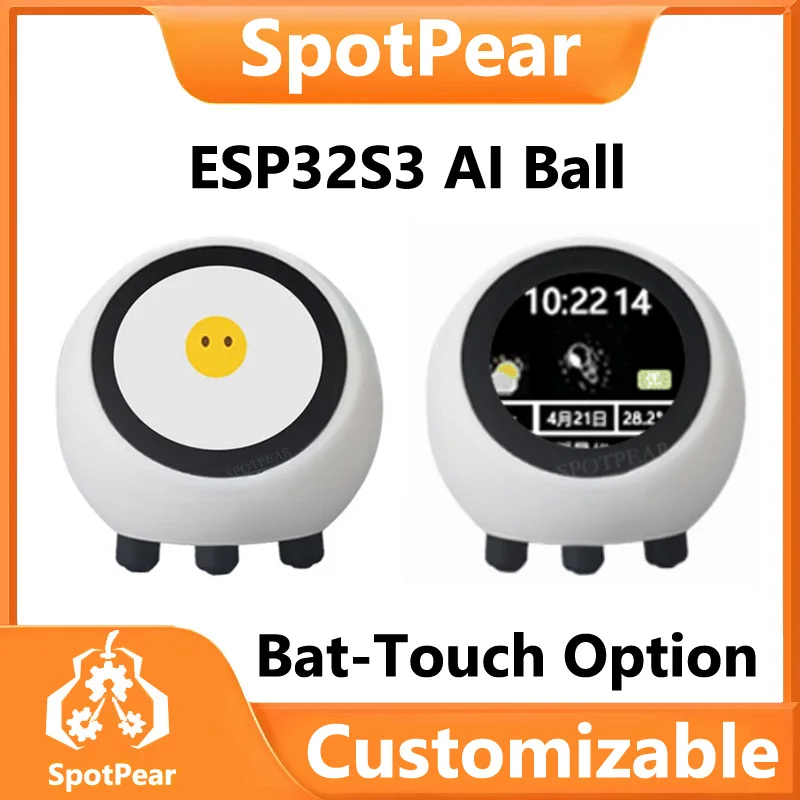
The device features a spherical, white enclosure with a black display bezel and three small black feet. The overall aesthetic is minimalist and modern, resembling a stylized "eye" or a compact desktop gadget. The images show various display contents, including a clock, a "galaxy" animation, and an "eye" graphic. Its form is unique.
This compact, unobtrusive design allows the AI Ball to blend into various desktop or shelf environments without drawing excessive attention. Its small footprint makes it suitable for crowded workspaces or minimalist setups. The visual versatility of the display allows for dynamic personalization.
Many development boards are bare PCBs or housed in utilitarian enclosures, which are not aesthetically pleasing for desktop use. The SpotPear AI Ball offers a finished product aesthetic, making it suitable for direct placement in a living space. It looks good.
As a standalone IoT device, the AI Ball does not directly integrate into a PC case like a traditional component. However, its compatibility with espHome and Home Assistant means it can act as a peripheral or a smart display for a PC-centric smart home setup. Power is via Type-C, and data transfer for programming is also via this port. It extends PC functionality.
For a PC builder, this device offers an extension of their digital environment. It can display system stats from a PC via Home Assistant integrations, act as a custom notification hub, or provide voice control for PC-related tasks. Its small size ensures it won't clutter a desk.
Unlike adding an internal component, integrating this AI Ball is about network and software compatibility. It offers a more dynamic and interactive external display option compared to a static secondary monitor. The Type-C power ensures easy integration with modern power bricks. It's a versatile addition.
Imagine your desk transformed, a sleek, intelligent orb providing instant weather updates, managing your smart home devices with a simple voice command, or playing your favorite ambient tracks from its SD card. Envision a personalized digital companion that adapts to your routine, offering a seamless blend of utility and aesthetic appeal. This device isn't just a gadget; it's a gateway to a more connected and responsive personal environment, simplifying your digital life one interaction at a time.
Core Processing and Architectural Foundation
The core of this device is the ESP32-S3 processor. This microcontroller is known for its dual-core Xtensa LX7 CPU, operating at up to 240 MHz. It integrates Wi-Fi and Bluetooth 5 (LE) capabilities directly onto the chip. The N16R8 designation implies 16MB of Flash memory and 8MB of PSRAM, providing ample space for complex firmware and data buffering.
This processing capability allows the AI Ball to handle demanding tasks such as local AI inference, complex sensor data processing, and rapid UI updates. Users can expect smooth operation for applications like voice command recognition and real-time data display. The integrated wireless protocols simplify communication with other smart devices and network services.
Unlike basic microcontrollers that often require external modules for Wi-Fi and Bluetooth, the ESP32-S3 consolidates these functions. This integration reduces component count and simplifies board design, offering a more streamlined development experience compared to piecing together separate modules. It's a powerful chip.
Dynamic Visual Interface and Interaction
A 1.28-inch LCD display with a resolution of 240x240 pixels serves as the primary visual interface. This display supports 262K colors and utilizes an IPS panel, offering a 170-degree visible angle. The display driver is specified as GC9A01, and it communicates via SPI. For input, a touch interface is present, driven by an I2C-based CST816S touch driver.
The IPS panel ensures vibrant colors and excellent viewing angles, making the display readable from various positions on a desk. The touch interface provides intuitive interaction, allowing users to navigate menus or trigger actions directly on the screen. This combination facilitates a rich user experience for applications like weather clocks or interactive AI dialogues.
Many entry-level smart displays use TN panels with limited viewing angles, which can distort colors when viewed off-center. The IPS technology here provides a superior visual experience. The inclusion of a dedicated touch driver, rather than relying on basic button inputs, significantly enhances user interaction beyond what typical development boards offer.
Seamless Wireless Integration
The device features 2.4 GHz Wi-Fi and Bluetooth 5 (BLE), both managed by the integrated ESP32-S3 chip. An onboard antenna is visible, suggesting a compact and self-contained wireless solution. This ensures robust signal reception.
Robust Wi-Fi connectivity enables the device to fetch real-time data for weather updates, connect to cloud-based AI services, or integrate with smart home platforms like Home Assistant. Bluetooth 5 (BLE) allows for low-power communication with peripherals or local control from a smartphone. This dual connectivity ensures broad compatibility.
Unlike older IoT devices that might only offer Wi-Fi or require external Bluetooth dongles, the integrated Wi-Fi and BLE on the ESP32-S3 provide a comprehensive wireless communication suite. This simplifies network setup and expands the range of possible applications, from simple data logging to complex smart home automation. It's highly efficient.
Enduring Power and Portability
Power is supplied via a Type-C port, a modern and reversible connector. The device also includes battery management capabilities, suggesting it can operate untethered. The images show a compact form factor, implying potential for portable use. Power delivery is simple.
The Type-C port offers convenient and fast charging, compatible with widely available cables and power adapters. Integrated battery management is crucial for applications requiring intermittent power or portability, such as a desk clock that needs to retain time during power outages. This allows for flexible deployment.
Many DIY projects rely on older micro-USB ports or require external battery management circuits, adding complexity. The inclusion of Type-C and built-in battery management simplifies the power solution significantly. This design choice enhances user convenience and reduces the need for additional external components. It's a modern standard.
Voice Interaction and Audio Capabilities
The device incorporates a loudspeaker and a microphone. These components are essential for its advertised "AI Voice Chat Robot" functionality. The product description also mentions "AI Dialogue" and "SD Playback". Audio is key.
The microphone allows for voice input, enabling interaction with AI assistants or recording audio. The loudspeaker provides audible feedback, whether it's responding to queries, playing music from an SD card, or delivering notifications. This creates a truly interactive experience.
Basic smart displays often omit either a microphone or a loudspeaker, limiting their interactive capabilities. The inclusion of both, along with the processing power for AI dialogue, positions this device as a more complete communication hub. This makes it suitable for voice-controlled applications. It hears and speaks.
Expandable Storage Solutions
A card slot is visible, indicating support for external storage, likely a microSD card. The product explicitly mentions "SD Playback" as a feature. Storage is expandable.
The SD card slot provides expandable storage for media files, custom sound effects, or logging extensive data. This is particularly useful for offline music playback or storing large datasets for local AI models. Users gain significant flexibility.
Many small IoT devices rely solely on internal flash memory, which can be restrictive for media-rich applications. The SD card slot offers a cost-effective way to expand storage significantly, surpassing the limitations of typical onboard memory. This allows for greater functionality. It's a smart addition.
Open Software Ecosystem and Personalization
The product title explicitly mentions "espHome Assistant For XiaoZhi," indicating compatibility with the espHome ecosystem and potential integration with Home Assistant. The "Customizable" label is also prominent. Openness is a strength.
Compatibility with espHome means users can easily flash custom firmware using YAML configurations, integrating the device seamlessly into their smart home setup. This allows for deep customization of its functions, from displaying sensor data to acting as a control interface. The open-source nature of these platforms fosters a vibrant community.
Unlike proprietary smart devices with locked-down firmware, the espHome and Home Assistant compatibility provides an open and flexible platform. This empowers users to tailor the device's behavior precisely to their needs, avoiding vendor lock-in and maximizing its long-term utility. It's a significant advantage for hobbyists.
Aesthetic Design and Form Factor
The device features a spherical, white enclosure with a black display bezel and three small black feet. The overall aesthetic is minimalist and modern, resembling a stylized "eye" or a compact desktop gadget. The images show various display contents, including a clock, a "galaxy" animation, and an "eye" graphic. Its form is unique.
This compact, unobtrusive design allows the AI Ball to blend into various desktop or shelf environments without drawing excessive attention. Its small footprint makes it suitable for crowded workspaces or minimalist setups. The visual versatility of the display allows for dynamic personalization.
Many development boards are bare PCBs or housed in utilitarian enclosures, which are not aesthetically pleasing for desktop use. The SpotPear AI Ball offers a finished product aesthetic, making it suitable for direct placement in a living space. It looks good.
Integration for the Modern PC Builder
As a standalone IoT device, the AI Ball does not directly integrate into a PC case like a traditional component. However, its compatibility with espHome and Home Assistant means it can act as a peripheral or a smart display for a PC-centric smart home setup. Power is via Type-C, and data transfer for programming is also via this port. It extends PC functionality.
For a PC builder, this device offers an extension of their digital environment. It can display system stats from a PC via Home Assistant integrations, act as a custom notification hub, or provide voice control for PC-related tasks. Its small size ensures it won't clutter a desk.
Unlike adding an internal component, integrating this AI Ball is about network and software compatibility. It offers a more dynamic and interactive external display option compared to a static secondary monitor. The Type-C power ensures easy integration with modern power bricks. It's a versatile addition.
Imagine your desk transformed, a sleek, intelligent orb providing instant weather updates, managing your smart home devices with a simple voice command, or playing your favorite ambient tracks from its SD card. Envision a personalized digital companion that adapts to your routine, offering a seamless blend of utility and aesthetic appeal. This device isn't just a gadget; it's a gateway to a more connected and responsive personal environment, simplifying your digital life one interaction at a time.