SOYO X99 Motherboard & Xeon E5-2680 V4 CPU Kit
Official Store Deal
Expert Analysis Overview
The Foundation of a Budget Workstation
The SOYO X99 Motherboard & Xeon E5-2680 V4 CPU Kit is a compelling, budget-friendly platform aimed at users seeking high core and thread counts for demanding multi-tasking, server applications, or entry-level workstation builds. This combination leverages the robust, albeit aging, LGA 2011-3 socket and Intel C612 chipset to deliver substantial processing power at an accessible price point. It is a formidable option for those prioritizing raw computational throughput over single-core gaming prowess.
Core Processing Power: The Xeon E5-2680 V4
The included Intel Xeon E5-2680 V4 processor is the heart of this kit. This CPU features 14 physical cores and 28 threads, a specification typically found in high-end server or workstation environments. Its base clock speed operates at 2.4GHz, with a maximum turbo frequency reaching 3.3GHz. This is a lot of cores. The processor is built on a 14nm production process, offering a balance of performance and efficiency for its generation. The TDP (Thermal Design Power) is rated at 120W, indicating a need for a capable CPU cooler to manage heat effectively. For context, TDP represents the maximum amount of heat generated by the CPU that the cooling system is required to dissipate under typical workloads. A 120W TDP is moderate for a chip of this core count.
In a real-world usage scenario, these specifications translate into exceptional multi-threaded performance. Tasks such as video rendering, 3D modeling, virtual machine hosting, or compiling large codebases will benefit significantly from the sheer number of available threads. Unlike mainstream consumer CPUs that often prioritize higher single-core speeds for gaming, the Xeon E5-2680 V4 excels where parallel processing is paramount. This chip is a workhorse.
Compared to standard consumer desktop CPUs like an Intel Core i5 or i7 from a similar era, the Xeon offers a distinct advantage in applications that can fully utilize its numerous cores. However, for applications that are primarily single-threaded, such as many older games or specific productivity software, its lower per-core clock speed might result in comparatively slower performance. The trade-off is clear: many cores for many tasks.
The SOYO X99 C612 Motherboard: A Solid Foundation
The SOYO X99 motherboard, utilizing the Intel C612 chipset, provides the necessary infrastructure for the Xeon E5-2680 V4. The C612 chipset is designed for server and workstation platforms, offering stability and support for features like ECC (Error-Correcting Code) memory, though the included RAM is non-ECC. The board adheres to the ATX form factor, ensuring compatibility with a wide range of PC cases. This is a standard size.
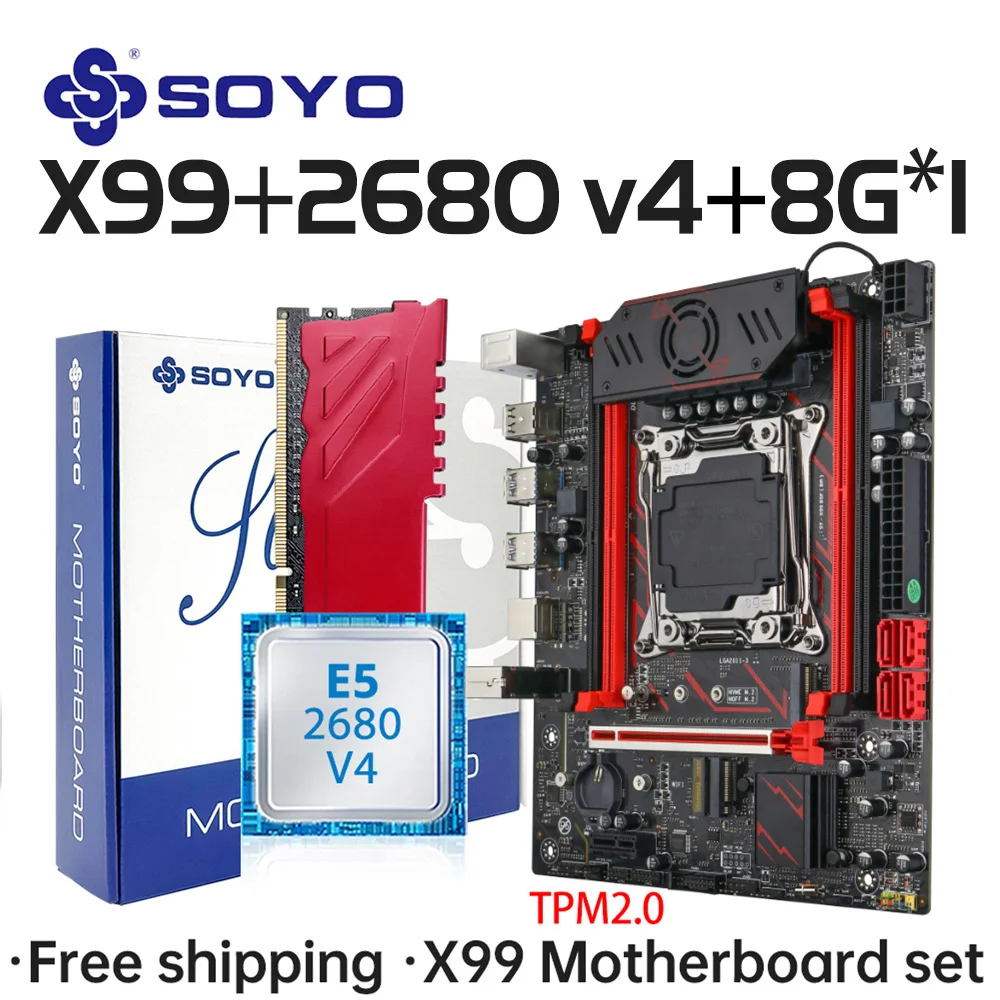
The board features an LGA 2011-3 socket, which is crucial for compatibility with the included Xeon CPU. It supports DDR4 memory, with four DIMM slots visible, allowing for quad-channel memory configurations. Quad-channel memory significantly boosts memory bandwidth, which is particularly beneficial for data-intensive applications and workstations. The image shows two M.2 slots, one for NVMe/NGFF storage and another potentially for M.2 WiFi, offering modern storage and connectivity options. NVMe drives are incredibly fast.
For connectivity, the motherboard includes a PCIe 3.0 x16 slot for a dedicated graphics card, along with additional PCIe x1 slots for expansion cards. Storage options comprise multiple SATA 3.0 ports. Rear I/O includes a mix of USB 2.0 and USB 3.0 ports, along with Gigabit LAN and audio jacks. The power delivery system appears to be a 6-phase VRM (Voltage Regulator Module) design, which is adequate for the E5-2680 V4 at stock speeds, providing stable power to the CPU. A stable VRM is important.
When considering the implications of this motherboard, its C612 chipset and LGA 2011-3 socket position it as a robust choice for a dedicated workstation or a server. The inclusion of M.2 NVMe slots is a significant advantage, allowing for lightning-fast boot times and application loading. Unlike older X79 or even some entry-level X99 boards, the C612 chipset offers a more refined and stable platform for Xeon processors, often with better I/O capabilities. It is a capable board.
Memory Configuration: Room for Growth
The kit includes a single 8GB DDR4 RAM stick running at 2133MHz. While 8GB is the minimum for a functional system, it is often insufficient for modern gaming or workstation tasks, especially those that benefit from the high core count of the Xeon CPU. The motherboard supports quad-channel memory, meaning optimal performance is achieved with four matching RAM sticks. This is a critical detail.
For a user building a system with this kit, the immediate implication is that an additional 8GB, or preferably three more 8GB sticks to enable quad-channel, will be a necessary upgrade for any serious workload. Running in single-channel mode severely bottlenecks the CPU's potential, particularly in memory-intensive applications. The 2133MHz speed is standard for early DDR4, but the X99 platform can often support higher speeds, depending on the CPU and motherboard combination. More RAM is always better.
Compared to systems that bundle 16GB or 32GB of RAM, this kit's single 8GB stick represents a starting point rather than a complete memory solution. It offers flexibility for users to choose their preferred RAM capacity and speed, but also adds to the immediate upgrade cost. For example, a user planning to run multiple virtual machines would find 8GB quickly exhausted. Investing in a full quad-channel setup will unlock the platform's true potential.
Connectivity and Expansion: Modern Essentials
The SOYO X99 motherboard provides a decent array of connectivity options. On the rear I/O, there are multiple USB 2.0 and USB 3.0 ports, ensuring compatibility with both older and newer peripherals. The presence of USB 3.0 is essential for fast data transfer with external drives. Gigabit Ethernet provides reliable wired network access. Audio jacks are standard. These are basic necessities.
Internally, the board features multiple SATA 3.0 ports for traditional hard drives and SSDs. The dual M.2 slots are a standout feature. One M.2 slot supports NVMe (Non-Volatile Memory Express) SSDs, which offer significantly faster read/write speeds than SATA SSDs, leveraging the PCIe bus. The other M.2 slot appears to be for NGFF (Next Generation Form Factor) or potentially a Wi-Fi module, adding versatility. Fast storage is a must.
The PCIe 3.0 x16 slot is ready for a modern graphics card, allowing users to build a capable gaming or rendering rig. The X99 platform, while older, still offers sufficient PCIe bandwidth for most current-generation GPUs, especially when paired with a powerful CPU like the E5-2680 V4. Additional PCIe x1 slots provide room for sound cards, network cards, or other expansion. Expansion is possible.
For someone assembling a new system, these connectivity options mean a relatively future-proof setup for storage and graphics. Unlike older platforms that might lack M.2 NVMe or sufficient USB 3.0 ports, this SOYO X99 board covers the essentials for a modern PC. It allows for a balance of legacy and contemporary components, making it a versatile choice for various build types. The board handles current demands.
Assembly and Compatibility Considerations
Building with this kit requires attention to standard PC assembly practices. The ATX form factor ensures it fits most mid-tower and full-tower cases. The LGA 2011-3 socket requires careful CPU installation, aligning the triangular markers on the CPU and socket. The CPU cooler mounting bracket shown in one image is for LGA 2011 sockets, which is compatible. Proper cooler installation is vital.
Power supply compatibility is another key factor. The motherboard requires a standard 24-pin ATX power connector and an 8-pin EPS 12V CPU power connector. Given the 120W TDP of the Xeon E5-2680 V4 and the power draw of a typical graphics card, a power supply of at least 550W-650W is recommended, depending on the chosen GPU. A good PSU is non-negotiable.
For those considering this kit, understanding the power requirements and physical dimensions is crucial. Unlike compact ITX boards, this ATX board offers more expansion but demands a larger case. The included CPU cooler bracket simplifies cooler selection, but users should verify their chosen cooler is indeed LGA 2011-3 compatible and has sufficient cooling capacity for a 120W TDP chip. Careful planning prevents headaches.
This kit offers a pathway to a powerful multi-core system without the premium price tag of newer platforms. Imagine rendering complex 3D scenes with ease, running multiple virtual machines simultaneously for development, or managing a home server with ample processing power. The SOYO X99 and Xeon E5-2680 V4 combination provides the raw horsepower to tackle these demanding tasks efficiently, allowing for a smooth and productive computing experience that belies its affordable entry cost. It's a smart choice for the performance-conscious builder on a budget.