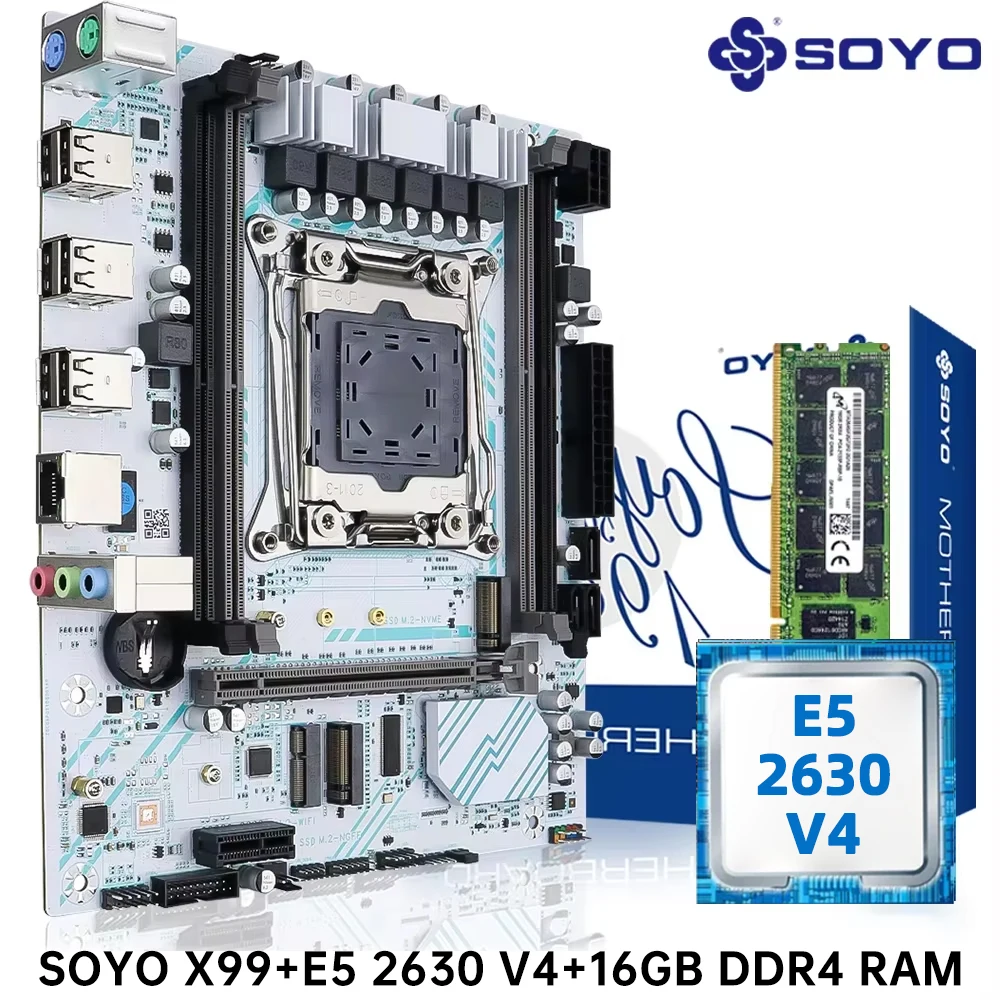
SOYO X99 Motherboard Kit with Xeon E5 2630 V4 CPU and 16GB DDR4 ECC RAM
Official Store Deal
Expert Analysis Overview
The SOYO X99 Platform: A Budget Workstation Foundation
The SOYO X99 Motherboard Kit is a highly cost-effective platform designed for users seeking robust multi-core performance without the premium price tag. It targets professionals and enthusiasts who prioritize raw thread count for demanding tasks like virtualization, video rendering, or hosting entry-level servers. This kit provides a complete foundation: a SOYO X99 motherboard, an Intel Xeon E5-2630 v4 CPU, and 16GB of DDR4 REG ECC RAM. It's a solid start.
The Core Processing Powerhouse
At the heart of this kit lies the Intel Xeon E5-2630 v4 processor. This CPU is a multi-threaded workhorse, engineered for parallel processing. It features 10 physical cores and 20 threads, operating at a base frequency of 2.2GHz, boosting up to 3.1GHz under load. This core count is significant. Its substantial 25MB L3 cache further aids in handling large datasets efficiently, reducing latency for frequently accessed data. The 14nm production process, while not the absolute latest, provides a respectable balance of performance and power consumption, evidenced by its 85W Thermal Design Power (TDP). This means less heat.
For users engaged in CPU-intensive applications such as 3D rendering, complex scientific simulations, or running multiple virtual machines, this processor offers substantial capability. Imagine compiling large codebases or encoding high-resolution video files; the numerous threads can significantly reduce processing times, accelerating project completion. This allows for greater productivity. The 85W TDP also implies that a moderately sized CPU cooler, rather than an expensive high-end solution, will be sufficient for effective thermal management, keeping overall build costs down.
Compared to standard consumer CPUs found in pre-built systems at a similar price point, the Xeon's multi-core prowess is a distinct advantage. Unlike typical desktop processors that often prioritize higher single-core speeds for gaming or general desktop responsiveness, the Xeon E5-2630 v4 is an upgrade for specific needs, excelling in environments where raw thread count for parallel execution is paramount. It's a different class of performance.
Motherboard Architecture and Connectivity
The SOYO X99 motherboard forms the backbone of this system. It features the LGA 2011-3 socket, providing broad compatibility with a wide range of Intel Xeon E5 V3 and V4 processors. The board's design, clearly visible in the images, includes a 7-phase power delivery system. This robust VRM (Voltage Regulator Module) ensures stable and consistent power to the CPU, which is crucial for maintaining performance during sustained heavy loads and preventing thermal throttling. A stable power delivery system prevents instability.
Connectivity options are functional, though they lean towards an older generation. The board includes two DDR4 RAM slots, supporting the included 16GB REG ECC memory. While two slots limit total memory capacity compared to high-end quad-channel X99 boards, it's sufficient for many workstation tasks and allows for future upgrades to higher capacity modules. The inclusion of an M.2 NVMe slot (PCIe 3.0 X16) is a welcome modern touch, allowing for ultra-fast storage solutions that dramatically improve boot times and application loading. This slot dramatically improves boot times. There is also an M.2 NGFF/WiFi slot, offering flexibility for wireless connectivity. For traditional storage, five SATA 2.0 ports are available. These are slower than SATA 3.0, meaning traditional SSDs will not reach their full potential, but they are adequate for hard drives.
Compared to contemporary motherboards, the prevalence of USB 2.0 ports and SATA 2.0 ports represents a trade-off. Modern systems typically offer USB 3.0/3.1/3.2 and SATA 3.0 for faster peripheral and storage connectivity. However, for a system primarily focused on internal processing and server-like functions, these older standards are often acceptable. The X99 platform's strength lies in its CPU support, not cutting-edge I/O. This is a practical compromise.
Memory Configuration and Stability
The kit includes 16GB of DDR4 REG ECC RAM. This type of memory is a key differentiator for this platform. ECC (Error-Correcting Code) RAM actively detects and corrects single-bit data corruption, providing a higher level of system stability and data integrity. This is paramount. It significantly reduces the risk of crashes or data errors, which is critical in professional environments where data accuracy cannot be compromised.
For applications where data accuracy is critical, such as scientific computing, financial modeling, or server operations, ECC memory is indispensable. Standard consumer RAM lacks this crucial error-correction feature, making it less suitable for mission-critical tasks. The single 16GB stick allows for future expansion, though the two-slot limitation means a maximum of two sticks. Users can upgrade to higher capacity modules if needed, but should ensure they are also REG ECC type for compatibility and continued data integrity. The memory operates at DDR4 2133MHz, matching the CPU's supported memory frequency. While not the fastest DDR4, it provides ample bandwidth for the target applications of this platform. This memory setup is robust.
Building Considerations and Compatibility
When integrating this kit into a new build, several factors require attention to ensure a smooth assembly. First, case compatibility is essential. The motherboard appears to be a standard ATX or Micro-ATX form factor, which should fit most mid-tower cases. Users must verify the specific dimensions against their chosen case to ensure proper fitment and adequate space for components and cable management. Proper airflow is always important.
Second, power supply sufficiency is critical. The 8-pin ATX CPU power connector, alongside the standard 24-pin ATX connector, indicates the need for a PSU capable of delivering stable power to the Xeon processor. An 85W TDP is manageable, but a quality power supply with sufficient wattage (e.g., 500W-600W for a system with a dedicated GPU) is recommended to ensure system stability and longevity. Overlooking PSU quality can lead to instability and unexpected shutdowns.
Third, CPU cooler compatibility for the LGA 2011-3 socket is paramount. The kit includes a cooler bracket, but the actual cooler must be purchased separately. Given the 85W TDP of the Xeon E5-2630 v4, a decent tower air cooler or a compact AIO liquid cooler will suffice to keep temperatures in check. Ensuring proper thermal management prevents performance degradation and extends the lifespan of the CPU. This prevents throttling.
Performance Profile and Practical Applications
The performance profile of this SOYO X99 kit is distinctly geared towards multi-threaded workloads. The 10 cores and 20 threads of the Xeon E5-2630 v4 CPU provide substantial parallel processing power. This translates directly into efficiency for tasks that can leverage multiple threads simultaneously. For instance, in virtualization, users can run several virtual machines concurrently without significant performance bottlenecks, making it ideal for home labs or small server deployments. It handles many tasks at once.
For content creators, especially those involved in video editing, 3D rendering, or audio production, the high core count accelerates rendering times and allows for smoother multitasking between demanding applications. Encoding large video files becomes a much faster process. Scientific computing and data analysis applications also benefit immensely from the ability to process large datasets across many threads. This enables faster insights. While the base clock speed of 2.2GHz might seem modest compared to modern consumer CPUs, its strength lies in its ability to sustain high loads across all cores for extended periods, a characteristic of server-grade hardware.
This kit is a specialized tool, not a general-purpose solution. It is not designed to compete with high-refresh-rate gaming rigs, which typically demand higher single-core performance. Instead, it offers a powerful and stable foundation for professional and semi-professional applications where the sheer number of processing threads dictates overall performance. It's a workstation, not a gaming rig.
Long-Term Viability and Upgrade Path
While the LGA 2011-3 platform is not current-generation, it remains a viable and cost-effective option for specific workloads. The ability to upgrade the CPU to more powerful Xeon E5 V3/V4 processors (e.g., 12-core, 14-core, or even 18-core models) offers a clear upgrade path for increased processing power should future needs dictate. Memory upgrades are limited by the two slots, but higher capacity DDR4 REG ECC modules are available, allowing for up to 32GB or 64GB depending on module availability. The M.2 NVMe slot ensures modern storage speeds, which is crucial for system responsiveness.
The primary limitation for longevity lies in the older I/O standards, particularly the prevalence of USB 2.0 and SATA 2.0. For users who rely heavily on high-speed external storage or numerous modern peripherals, this might necessitate the addition of PCIe expansion cards to gain USB 3.0/3.1 or SATA 3.0 connectivity. However, for a dedicated server or a workstation focused on internal processing and network connectivity, these limitations are often minor trade-offs. It's a cost-effective entry point.
This SOYO X99 kit with the Xeon E5-2630 v4 CPU and ECC RAM is a testament to the enduring value of previous-generation server hardware. It provides a pathway to high-thread count computing that is otherwise inaccessible at this price point. The inclusion of ECC memory is a significant benefit for data integrity, making it a reliable choice for professional use. The M.2 NVMe support ensures that storage performance doesn't become a bottleneck. Imagine a scenario where you are running multiple virtual machines for software development, or rendering complex scenes in Blender, or even setting up a home lab server. This kit provides the raw processing power and stability to handle these tasks efficiently. It empowers users to achieve professional-grade results without the typical investment. This is a smart investment. The system will handle demanding applications with confidence, allowing for smoother workflows and faster project completion. It's built for productivity.