SOYO X99 LGA 2011-3 Motherboard Kit with Xeon E5-2680 V4 CPU and DDR4 ECC RAM
Official Store Deal
Expert Analysis Overview
The X99 Platform: A Workstation Powerhouse on a Budget
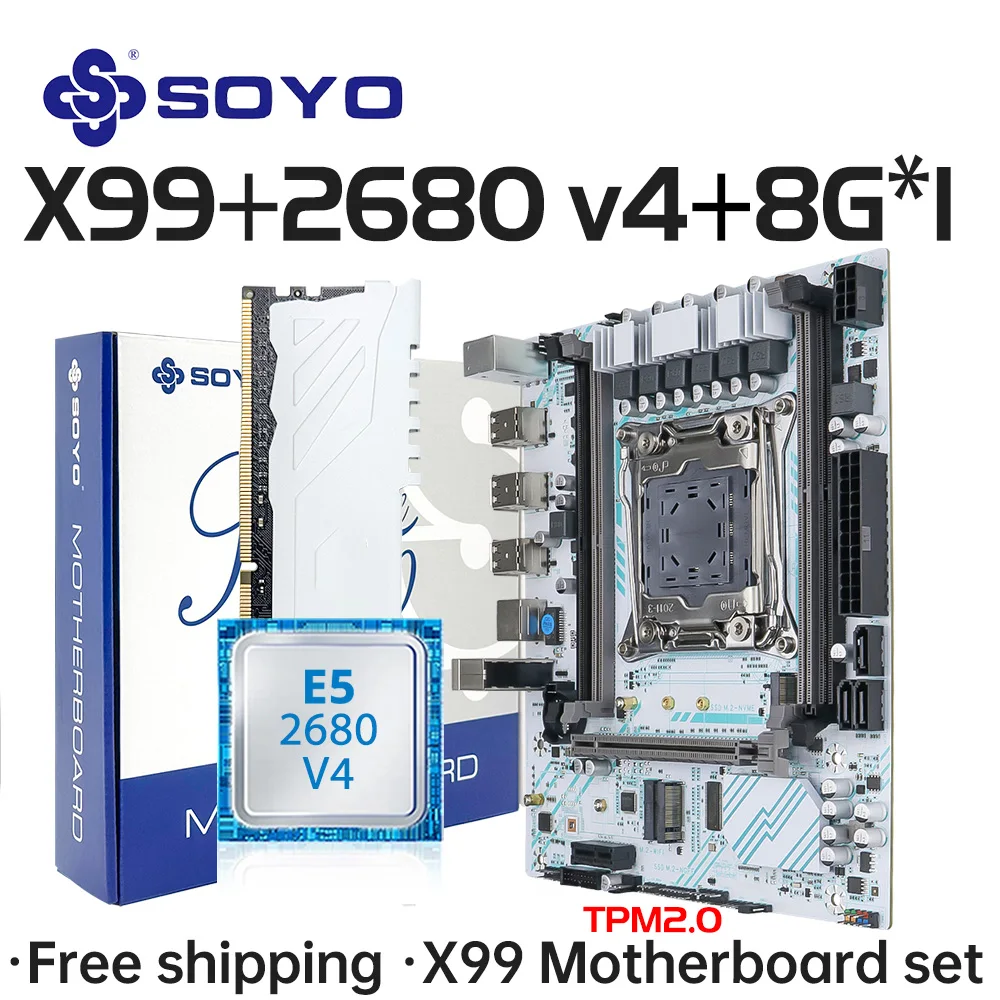
The SOYO X99 LGA 2011-3 Motherboard Kit, bundled with a Xeon E5-2680 V4 CPU and 8GB of DDR4 REG ECC RAM, is a cost-effective server-grade foundation designed for enthusiasts seeking high core counts and memory capacity without the premium price tag of contemporary platforms. This package delivers substantial processing capability. It offers a compelling alternative to expensive new hardware.
Unlike typical consumer-grade motherboards that often prioritize gaming aesthetics or feature sets for a single GPU, this X99 platform leans into its workstation heritage. The visible layout emphasizes stability and multi-core performance, crucial for tasks beyond pure gaming. Users gain access to a robust ecosystem.
Core Processing Prowess: The Xeon E5-2680 V4
At the heart of this kit lies the Intel Xeon E5-2680 V4 processor. This CPU is a formidable piece of silicon. Image 5 clearly outlines its specifications: 14 cores and 28 threads, operating at a base frequency of 2.4GHz with a turbo boost up to 3.3GHz. Manufactured on a 14nm process, this processor fits the LGA 2011-3 socket and boasts a 120W TDP. These are serious numbers.
For those accustomed to mainstream consumer CPUs, the core and thread count of the E5-2680 V4 represents a significant leap. Modern applications, especially professional software for video editing, 3D rendering, or virtual machine hosting, thrive on parallel processing. This chip excels in such environments, handling demanding workloads with relative ease. It is a genuine multitasker.
Compared to standard consumer CPUs of its era, or even many modern mid-range options, the E5-2680 V4's multi-threaded performance remains highly competitive for specific tasks. While its single-core performance won't match the latest gaming chips, its ability to chew through complex computational tasks makes it an exceptional value proposition. This is a true workhorse.
Power Delivery and Thermal Considerations
The motherboard's power delivery system is a critical aspect for stability, particularly under sustained high loads. Image 4 explicitly labels a 6-phase VRM (Voltage Regulator Module). This configuration is standard for many budget-oriented X99 boards. It provides adequate power.
For the E5-2680 V4 with its 120W TDP, a 6-phase VRM is generally sufficient for stock operation. However, for users pushing the CPU to its maximum turbo frequency across all cores for extended periods, or considering base clock (BCLK) adjustments—the closest an overclocker can get to 'overclocking' a locked Xeon—the thermal performance of the VRM becomes paramount. The visible heatsinks appear functional but modest. Aggressive cooling might be needed.
Unlike high-end enthusiast boards with elaborate VRM designs and massive heatsinks, this SOYO X99 board's simpler VRM suggests a focus on reliable operation rather than extreme, sustained overcurrent capabilities. Users aiming for maximum stability in compute-intensive tasks should consider supplemental VRM cooling, such as a direct fan airflow, to prevent thermal throttling. This ensures consistent performance.
Memory Subsystem: Stability with ECC DDR4
The kit includes 8GB of DDR4 REG ECC RAM. Image 5 confirms the E5-2680 V4 supports DDR4 memory at speeds of 1600/1866/2133/2400MHz. ECC (Error-Correcting Code) memory is a hallmark of server and workstation platforms. It provides enhanced data integrity.
ECC memory detects and corrects common types of internal data corruption. For critical applications where data accuracy is non-negotiable, such as scientific simulations, financial modeling, or database servers, ECC RAM offers a significant advantage in reliability. This is a key differentiator. While not strictly necessary for gaming, its inclusion underscores the platform's workstation pedigree. It ensures system stability.
It is important to note a potential discrepancy: Image 4's diagram labels "2*DDR3" slots, which contradicts the product title and CPU specifications for DDR4. Based on the CPU's native support for DDR4 and the explicit mention in the title, the board is presumed to support DDR4. Users should verify this detail if ordering, but the E5-2680 V4 *only* uses DDR4. The diagram is likely generic.
Storage and Expansion Capabilities
The motherboard provides essential modern storage and expansion options. An M.2 NVMe slot is clearly visible in Image 4, supporting high-speed solid-state drives. This is a crucial feature. Additionally, the diagram indicates an M.2 WIFI slot and an M.2 NGFF slot, suggesting flexibility for wireless connectivity and other M.2 form factor devices. Three SATA2.0 ports are also listed, though given the platform's capabilities, these are more likely SATA 3.0 or a mix, which should be verified. SATA 3.0 is standard.
High-speed NVMe storage dramatically improves system responsiveness, reducing boot times and application loading speeds. For a workstation, this translates directly into productivity gains. The inclusion of multiple M.2 slots broadens connectivity and storage possibilities, offering more than just the basics. This enhances system versatility.
Compared to older X79 platforms, the integration of native M.2 NVMe support is a significant upgrade. It bypasses the need for PCIe adapter cards, streamlining the build process and ensuring optimal performance from modern storage solutions. This is a welcome addition. The board also features a PCIe 3.0 x16 slot, essential for dedicated graphics cards or other high-bandwidth expansion cards.
Connectivity and I/O
Peripheral connectivity is comprehensive for a board in this segment. Image 4 and 3 display a range of ports including USB 2.0 and USB 3.0 ports, RJ45 LAN, and standard audio jacks. PS/2 ports are present for legacy keyboard and mouse support, a common feature on workstation-oriented boards ensuring broad peripheral compatibility. Debug headers and front panel connectors are also visible.
The mix of USB 2.0 and USB 3.0 ports provides flexibility for various peripherals, from high-speed external drives to simpler input devices. The presence of a Gigabit Ethernet port is standard for reliable network access. For users with older but reliable peripherals, the PS/2 ports are a practical inclusion, preventing the need for adapters. This board covers the essentials.
While not offering the bleeding-edge connectivity of Thunderbolt or USB 3.2 Gen 2x2, the provided I/O is more than adequate for the target audience. It delivers solid, dependable connectivity for everyday tasks and workstation loads. This is a practical setup. It focuses on core functionality rather than premium, niche features.
Building for Performance and Value
This SOYO X99 kit presents a unique opportunity for users to assemble a potent workstation or a high-core-count gaming rig without the prohibitive cost of new components. The combination of a powerful Xeon CPU, ECC memory, and modern storage options like NVMe M.2 makes it a compelling package. It addresses the need for raw processing power.
Imagine compiling complex code, rendering intricate 3D models, or managing multiple virtual machines simultaneously, all powered by this robust platform. The stability of ECC memory ensures your critical data remains uncorrupted, providing peace of mind during intensive operations. This system delivers consistent results. The substantial core count of the E5-2680 V4 means less waiting and more doing, allowing creative professionals and power users to accelerate their workflows significantly. This is efficiency personified.