Sovol SH02 Filament Dryer
Official Store Deal
Expert Analysis Overview
The Sovol SH02 Filament Dryer is an essential environmental control unit designed for 3D printing enthusiasts and educational institutions grappling with moisture-compromised filaments. This device directly addresses the pervasive issue of filament degradation, which often leads to print failures, stringing, and weakened parts, ensuring optimal material conditions for superior print quality and a smoother learning curve for students.
Filament drying is not merely an accessory function; it is a fundamental aspect of successful 3D printing, especially when working with hygroscopic materials like PLA, PETG, ABS, Nylon, and PVA. These materials readily absorb moisture from the ambient air, even in seemingly dry environments. When wet filament is extruded, the absorbed water rapidly turns to steam, creating bubbles within the molten plastic. This leads to a host of print quality issues, including noticeable stringing, poor layer adhesion, inconsistent extrusion, and a generally brittle final product. For educators introducing students to 3D printing, managing these variables is paramount. A dry filament ensures that students experience the true capabilities of their printers and materials, fostering a sense of accomplishment rather than frustration.
Consider the common scenario in a classroom or workshop where filament spools are left exposed. Over time, even a few hours can be enough for certain materials to absorb significant moisture. This absorption is often invisible until printing begins. The resulting prints exhibit a rough surface finish, a clear indicator of moisture contamination. This unit offers a proactive solution. It prevents these issues before they start.
Compared to simply storing filament in airtight bags with desiccant, which only maintains the current moisture level, the SH02 actively removes absorbed moisture. This distinction is critical for materials that have already been exposed to humidity, effectively rehabilitating them for optimal performance. It's a significant upgrade from passive storage methods.
At the core of the SH02's effectiveness is its fast heating system, capable of reaching temperatures up to 70°C. This is achieved through a 150W PTC ceramic heating element. Unlike traditional resistive heaters, PTC (Positive Temperature Coefficient) elements offer self-regulating temperature control, enhancing safety and efficiency. This means the heater won't overheat, even if left unattended.
Achieving a target temperature of 70°C takes approximately 25 minutes, while 50°C is reached in just 7 minutes. This rapid heating capability is vital for educational settings where time is often limited. Students can quickly prepare their materials. Imagine a scenario where a student needs to print a critical component for a project, and their filament has been exposed. The quick heating allows for minimal downtime, keeping projects on schedule.
Many entry-level filament dryers struggle to reach and maintain consistent higher temperatures, often maxing out around 50°C. The SH02's ability to hit 70°C is particularly beneficial for more demanding materials like Nylon or PC, which require higher drying temperatures to effectively release absorbed moisture. This expanded temperature range broadens the scope of materials that can be successfully processed.
The unit features great seal performance, crucial for both drying and long-term storage. An increasing sealing strip around the lid ensures a tight closure, minimizing air exchange. Furthermore, the filament outlet utilizes a PTFE seal, preventing moisture re-entry during printing. This thoughtful design minimizes the risk of re-humidification.
When a filament spool is placed inside, the robust sealing mechanism creates a controlled micro-environment. This is a significant improvement over open-air spool holders or even basic dry boxes that lack active heating and proper seals. The tactile feedback of the lid closing indicates a secure seal, a small but important detail for ensuring consistent results.
Compared to simply placing a spool on a printer's external holder, which offers no protection, the SH02 provides a sealed, heated chamber. This integrated approach means the filament remains dry not just before printing, but *during* the entire print job, which can often span many hours. This continuous protection is invaluable for preventing mid-print quality degradation.
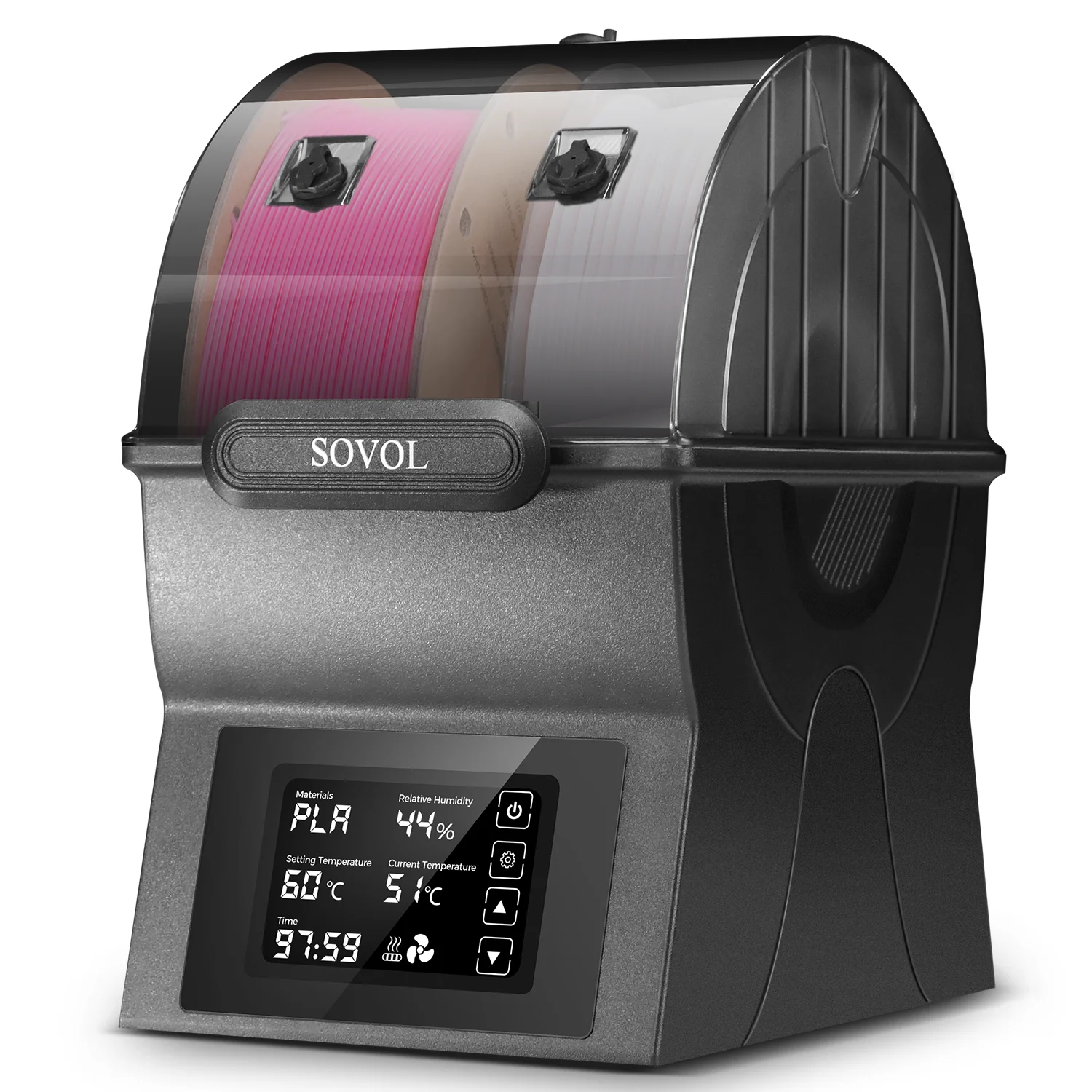
The Sovol SH02 is designed for easy use, featuring a one-key switch for filament materials. This functionality automatically adjusts drying time and temperature to optimal settings based on the selected filament type. The interface displays critical information such as current humidity, temperature, and remaining drying time.
The pre-programmed settings cover a wide range of common 3D printing filaments, including PLA, PETG, ABS, TPU, PVA, ASA, PA, PP, and PC. Each material has a recommended drying temperature (ranging from 50°C to 70°C) and drying time (4-8 hours for most, up to 8-12 hours for some). This simplifies the preparation process. Students can easily select their material.
Imagine a classroom setting where multiple students are using different filament types. Instead of manually looking up and setting parameters, they can simply choose their material from a list, reducing errors and saving valuable class time. This automated approach lowers the barrier to entry for complex materials, making them more accessible for educational exploration.
Many basic filament dryers require manual setting of temperature and time, which can be confusing or lead to suboptimal results if not done correctly. The SH02's intelligent presets remove this guesswork, offering a more consistent and reliable drying experience. This level of automation is a clear advantage for both novice users and busy educators.
The unit is compatible with two rolls of 200x70mm filament or one roll of 200x150mm filament. This dual-spool capacity is a practical feature for multi-color prints or for drying two different materials simultaneously. The internal spool holder design ensures smooth rotation during printing.
Visually, the clear top cover allows for easy monitoring of the filament spools. The internal rollers provide a low-friction path for the filament as it's pulled by the printer, preventing tangles or snags. The overall form factor is compact, fitting comfortably on a workbench or next to a 3D printer without occupying excessive space.
Compared to single-spool dryers, the dual-spool capacity offers greater flexibility and efficiency. For projects requiring different colors or support materials, having both spools pre-dried and ready within the same unit streamlines the workflow. This is particularly beneficial in an educational environment where multiple projects might be running concurrently.
Safety is a primary concern in any educational or workshop environment. The SH02's use of a PTC ceramic heating element is a significant safety feature. These elements inherently limit their maximum temperature, reducing the risk of overheating or fire hazards. The sturdy construction, with a dense, matte finish on the lower housing, suggests a durable build capable of withstanding regular use.
The overall feel of the unit is solid. The buttons on the front panel have a distinct, satisfying click, indicating well-engineered tactile feedback rather than a mushy response. The clear top cover, while allowing visibility, appears to be made from a robust plastic, resistant to minor impacts. This attention to build quality contributes to the device's longevity.
Unlike cheaper alternatives that might use less reliable heating methods or flimsy plastic construction, the Sovol SH02 prioritizes both safety and durability. This makes it a suitable investment for institutions where equipment sees frequent use and needs to withstand the rigors of a learning environment. The design choices reflect a commitment to a reliable user experience.
For STEM educators, the Sovol SH02 is more than just a filament dryer; it is a tool that enhances the learning experience. By eliminating common print failures caused by wet filament, students can focus on design principles, slicing parameters, and problem-solving related to mechanical issues, rather than struggling with material inconsistencies. This simplifies the slicing workflow by removing a critical variable.
Imagine a lesson where students are experimenting with advanced materials like Nylon. Without proper drying, these prints would almost certainly fail, leading to frustration and wasted material. With the SH02, students can confidently explore these materials, understanding their properties and applications without the added hurdle of moisture management. This encourages deeper engagement with the science of materials.
Compared to teaching 3D printing with undried filament, which often requires extensive troubleshooting of seemingly random print defects, the SH02 provides a stable foundation. It allows educators to demonstrate reliable printing processes, building student confidence and competence. This device ensures safe operation in classrooms by minimizing fire risks associated with poorly regulated heating elements.
Picture your 3D printing projects consistently succeeding, free from the common pitfalls of stringing, bubbling, and weak layer adhesion. Envision students in your classroom confidently experimenting with a diverse range of filaments, their designs coming to life with pristine quality. This filament dryer integrates seamlessly into any 3D printing workflow, becoming an indispensable part of achieving professional-grade results and fostering a truly effective learning environment. It’s an investment that pays dividends in print quality, material longevity, and educational success.
The Crucial Role of Filament Drying in 3D Printing
Filament drying is not merely an accessory function; it is a fundamental aspect of successful 3D printing, especially when working with hygroscopic materials like PLA, PETG, ABS, Nylon, and PVA. These materials readily absorb moisture from the ambient air, even in seemingly dry environments. When wet filament is extruded, the absorbed water rapidly turns to steam, creating bubbles within the molten plastic. This leads to a host of print quality issues, including noticeable stringing, poor layer adhesion, inconsistent extrusion, and a generally brittle final product. For educators introducing students to 3D printing, managing these variables is paramount. A dry filament ensures that students experience the true capabilities of their printers and materials, fostering a sense of accomplishment rather than frustration.
Understanding the Moisture Menace
Consider the common scenario in a classroom or workshop where filament spools are left exposed. Over time, even a few hours can be enough for certain materials to absorb significant moisture. This absorption is often invisible until printing begins. The resulting prints exhibit a rough surface finish, a clear indicator of moisture contamination. This unit offers a proactive solution. It prevents these issues before they start.
Compared to simply storing filament in airtight bags with desiccant, which only maintains the current moisture level, the SH02 actively removes absorbed moisture. This distinction is critical for materials that have already been exposed to humidity, effectively rehabilitating them for optimal performance. It's a significant upgrade from passive storage methods.
Engineered for Optimal Performance: Heating and Sealing
At the core of the SH02's effectiveness is its fast heating system, capable of reaching temperatures up to 70°C. This is achieved through a 150W PTC ceramic heating element. Unlike traditional resistive heaters, PTC (Positive Temperature Coefficient) elements offer self-regulating temperature control, enhancing safety and efficiency. This means the heater won't overheat, even if left unattended.
Rapid Thermal Conditioning
Achieving a target temperature of 70°C takes approximately 25 minutes, while 50°C is reached in just 7 minutes. This rapid heating capability is vital for educational settings where time is often limited. Students can quickly prepare their materials. Imagine a scenario where a student needs to print a critical component for a project, and their filament has been exposed. The quick heating allows for minimal downtime, keeping projects on schedule.
Many entry-level filament dryers struggle to reach and maintain consistent higher temperatures, often maxing out around 50°C. The SH02's ability to hit 70°C is particularly beneficial for more demanding materials like Nylon or PC, which require higher drying temperatures to effectively release absorbed moisture. This expanded temperature range broadens the scope of materials that can be successfully processed.
Superior Moisture Retention and Sealing
The unit features great seal performance, crucial for both drying and long-term storage. An increasing sealing strip around the lid ensures a tight closure, minimizing air exchange. Furthermore, the filament outlet utilizes a PTFE seal, preventing moisture re-entry during printing. This thoughtful design minimizes the risk of re-humidification.
When a filament spool is placed inside, the robust sealing mechanism creates a controlled micro-environment. This is a significant improvement over open-air spool holders or even basic dry boxes that lack active heating and proper seals. The tactile feedback of the lid closing indicates a secure seal, a small but important detail for ensuring consistent results.
Compared to simply placing a spool on a printer's external holder, which offers no protection, the SH02 provides a sealed, heated chamber. This integrated approach means the filament remains dry not just before printing, but *during* the entire print job, which can often span many hours. This continuous protection is invaluable for preventing mid-print quality degradation.
Intuitive Operation and Material Compatibility
The Sovol SH02 is designed for easy use, featuring a one-key switch for filament materials. This functionality automatically adjusts drying time and temperature to optimal settings based on the selected filament type. The interface displays critical information such as current humidity, temperature, and remaining drying time.
Streamlined Material Management
The pre-programmed settings cover a wide range of common 3D printing filaments, including PLA, PETG, ABS, TPU, PVA, ASA, PA, PP, and PC. Each material has a recommended drying temperature (ranging from 50°C to 70°C) and drying time (4-8 hours for most, up to 8-12 hours for some). This simplifies the preparation process. Students can easily select their material.
Imagine a classroom setting where multiple students are using different filament types. Instead of manually looking up and setting parameters, they can simply choose their material from a list, reducing errors and saving valuable class time. This automated approach lowers the barrier to entry for complex materials, making them more accessible for educational exploration.
Many basic filament dryers require manual setting of temperature and time, which can be confusing or lead to suboptimal results if not done correctly. The SH02's intelligent presets remove this guesswork, offering a more consistent and reliable drying experience. This level of automation is a clear advantage for both novice users and busy educators.
Capacity and Adaptability
The unit is compatible with two rolls of 200x70mm filament or one roll of 200x150mm filament. This dual-spool capacity is a practical feature for multi-color prints or for drying two different materials simultaneously. The internal spool holder design ensures smooth rotation during printing.
Visually, the clear top cover allows for easy monitoring of the filament spools. The internal rollers provide a low-friction path for the filament as it's pulled by the printer, preventing tangles or snags. The overall form factor is compact, fitting comfortably on a workbench or next to a 3D printer without occupying excessive space.
Compared to single-spool dryers, the dual-spool capacity offers greater flexibility and efficiency. For projects requiring different colors or support materials, having both spools pre-dried and ready within the same unit streamlines the workflow. This is particularly beneficial in an educational environment where multiple projects might be running concurrently.
Safety and Durability in the Classroom
Safety is a primary concern in any educational or workshop environment. The SH02's use of a PTC ceramic heating element is a significant safety feature. These elements inherently limit their maximum temperature, reducing the risk of overheating or fire hazards. The sturdy construction, with a dense, matte finish on the lower housing, suggests a durable build capable of withstanding regular use.
Robust Construction for Longevity
The overall feel of the unit is solid. The buttons on the front panel have a distinct, satisfying click, indicating well-engineered tactile feedback rather than a mushy response. The clear top cover, while allowing visibility, appears to be made from a robust plastic, resistant to minor impacts. This attention to build quality contributes to the device's longevity.
Unlike cheaper alternatives that might use less reliable heating methods or flimsy plastic construction, the Sovol SH02 prioritizes both safety and durability. This makes it a suitable investment for institutions where equipment sees frequent use and needs to withstand the rigors of a learning environment. The design choices reflect a commitment to a reliable user experience.
The Educational Advantage
For STEM educators, the Sovol SH02 is more than just a filament dryer; it is a tool that enhances the learning experience. By eliminating common print failures caused by wet filament, students can focus on design principles, slicing parameters, and problem-solving related to mechanical issues, rather than struggling with material inconsistencies. This simplifies the slicing workflow by removing a critical variable.
Imagine a lesson where students are experimenting with advanced materials like Nylon. Without proper drying, these prints would almost certainly fail, leading to frustration and wasted material. With the SH02, students can confidently explore these materials, understanding their properties and applications without the added hurdle of moisture management. This encourages deeper engagement with the science of materials.
Compared to teaching 3D printing with undried filament, which often requires extensive troubleshooting of seemingly random print defects, the SH02 provides a stable foundation. It allows educators to demonstrate reliable printing processes, building student confidence and competence. This device ensures safe operation in classrooms by minimizing fire risks associated with poorly regulated heating elements.
Final Thoughts on Ownership
Picture your 3D printing projects consistently succeeding, free from the common pitfalls of stringing, bubbling, and weak layer adhesion. Envision students in your classroom confidently experimenting with a diverse range of filaments, their designs coming to life with pristine quality. This filament dryer integrates seamlessly into any 3D printing workflow, becoming an indispensable part of achieving professional-grade results and fostering a truly effective learning environment. It’s an investment that pays dividends in print quality, material longevity, and educational success.