Sovol SH02 Filament Dryer
Official Store Deal
Expert Analysis Overview
The Imperative of Dry Filament
The Sovol SH02 Filament Dryer is an essential moisture management solution designed for 3D printing enthusiasts and professionals who understand the critical impact of dry filament on print quality. It stands as a proactive defense against common printing failures, ensuring material integrity from spool to nozzle. This device addresses the fundamental challenge of hygroscopic filaments, offering a controlled environment for drying and storage.
Moisture absorption significantly degrades filament properties. When filament absorbs water, it can lead to issues like stringing, bubbling, weakened layer adhesion, and even nozzle clogging during printing. Such problems are frustrating. The SH02 aims to eliminate these common hurdles, allowing for smoother prints and more reliable outcomes. For many makers, a filament dryer moves beyond a luxury to become a necessity, particularly when working with advanced engineering materials.
Unlike passive desiccant boxes that merely slow moisture absorption, the SH02 actively heats and dries the filament. This active drying capability distinguishes it from simpler storage solutions. It provides a consistent, elevated temperature environment, promoting the release of trapped moisture from the filament's core. This is a significant upgrade for serious printing operations.
Unveiling the Heating Prowess
At the core of the SH02's functionality is its fast heating system, capable of reaching a maximum temperature of 70°C. This rapid heating is driven by a 150W PTC ceramic heating element, ensuring efficient and uniform temperature distribution within the drying chamber. Consistent heat is vital.
The PTC (Positive Temperature Coefficient) ceramic heating element is a crucial component. These heaters are known for their self-regulating properties, meaning they heat up quickly to a set temperature and then maintain it efficiently without external controls constantly cycling power. This inherent safety feature prevents overheating and provides stable drying conditions. It protects your valuable filament.
Compared to resistive wire heaters, PTC elements often offer better thermal stability and longevity. This design choice implies a focus on both performance and safety for continuous operation. The system can reach 70°C in approximately 25 minutes, or 50°C in just 7 minutes, which is remarkably swift for preparing filament. Such speed means less waiting and more printing.
Precision Control and User Experience
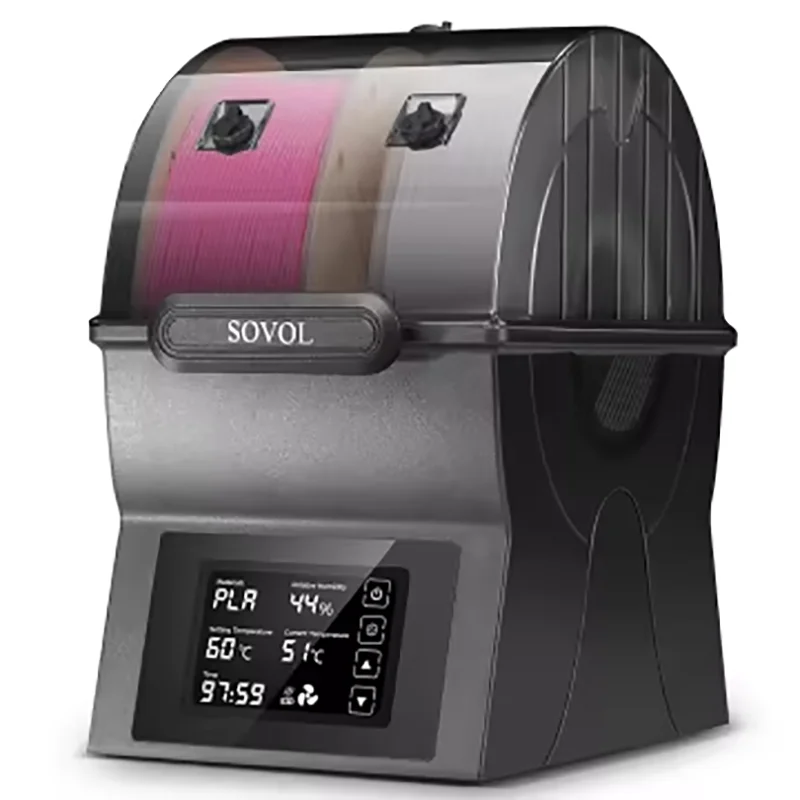
Operation of the SH02 is streamlined through its intuitive digital display and control panel. Users can easily monitor and adjust key parameters, including filament type, current humidity, target temperature, and remaining drying time. The clear interface shows everything at a glance.
The device comes pre-programmed with optimal drying temperatures and times for a wide array of common 3D printing filaments, including PLA, PETG, ABS, TPU, PVA, ASA, PA, PP, and PC. This one-key switching functionality simplifies the process considerably for new users. Setting specific parameters is straightforward. It automatically jumps to the recommended settings, reducing guesswork and potential errors. This feature is a time-saver.
Beyond the presets, the SH02 offers a customizable temperature range of 40-70°C and a drying time up to 98 hours. This level of granular control caters to specific filament brands or unique drying requirements, offering flexibility for advanced users. Experimentation is encouraged. This adaptability ensures that even exotic or highly hygroscopic materials can be effectively conditioned. It supports diverse printing projects.
Engineered for Long-Term Storage and Modularity
The Sovol SH02 prioritizes great seal performance to maintain the integrity of dried filament, even during extended storage. A robust sealing strip around the lid and PTFE seals on the filament outlets work in tandem to create a dry, isolated environment. A tight seal is paramount.
The filament outlets are thoughtfully designed to accept PTFE tubing, allowing for a direct, sealed path from the dryer to the 3D printer's extruder. This continuous sealed environment minimizes re-exposure to ambient moisture during the printing process itself. It prevents re-absorption. This is particularly beneficial for materials like nylon or PVA that are highly susceptible to moisture, ensuring print quality is maintained from start to finish. This feature extends the benefits beyond just drying.
For tinkerers and those who enjoy modifying their setups, the inclusion of dedicated filament outlets and a moisture outlet provides opportunities for customization. Makers can integrate the SH02 seamlessly into existing dry boxes or enclosed printer setups. The transparent lid also offers a visual check on filament levels and drying progress without needing to open the unit. This visual feedback is helpful.
Capacity and Compatibility for Diverse Projects
The SH02 is designed to accommodate various spool sizes, offering versatility for different printing needs. It can hold two standard 200x70mm filament rolls simultaneously, or a single larger 200x150mm roll. This capacity is practical.
This dual-spool capability is a significant advantage for multi-material printing or for keeping common filaments readily available and dry. Imagine running a dual-extruder print with perfectly conditioned materials. The larger single spool capacity supports bulk filament purchases or specialized engineering filaments that often come in wider formats. Flexibility in spool size is crucial for many users.
Compared to single-spool dryers, the SH02 provides enhanced efficiency for workshops or users with multiple printers. It reduces the need for multiple drying units. This design choice optimizes space and workflow, making it a valuable addition to any 3D printing station, from hobbyist setups to small production environments. It handles your filament needs.
Community and Customization Potential
The open-source nature of the 3D printing community often leads to shared knowledge and modifications for popular accessories. The Sovol SH02, with its clear display and accessible controls, lends itself well to community-driven troubleshooting and optimization. Users often share settings. Online forums provide a wealth of information regarding specific filament types and their ideal drying parameters, allowing users to fine-tune their experience beyond the factory presets. This collective knowledge is invaluable.
For those who enjoy experimenting, the physical design of the SH02 offers avenues for minor upgrades or custom parts. The filament path, for instance, could inspire custom PTFE tube holders or even integration with humidity sensors for data logging. The visible components suggest a straightforward internal layout. Such modifications could further enhance the unit's sealing performance or its interaction with automated printing setups. This invites personal touches.
Community support is a powerful asset in the 3D printing world. Sharing experiences with the SH02, discussing optimal drying strategies for obscure filaments, or even proposing firmware enhancements could extend the lifespan and utility of the device. This collaborative spirit drives innovation. The transparent lid and visible filament paths make it easy to diagnose issues or share setup configurations with others. It fosters a sense of shared learning.
Maintaining Filament Health for Peak Performance
Owning the Sovol SH02 Filament Dryer means entering a new era of printing reliability. Imagine starting every print with filament at its absolute best, free from the inconsistencies caused by moisture. Your prints will improve. The days of struggling with brittle filament or prints riddled with bubbles will become a distant memory, replaced by smooth, strong, and visually impeccable creations. This dryer will redefine your workflow. It allows for unwavering confidence in material quality, leading to fewer failed prints and more successful projects. This translates directly to saved time and material. Your projects will consistently achieve the desired finish and mechanical properties, making every print a testament to precision and care. It’s an investment in quality outcomes.