Sipeed LicheeRV Nano SG2002 RISC-V Development Board
Official Store Deal
Expert Analysis Overview
The Sipeed LicheeRV Nano: A Compact RISC-V Powerhouse
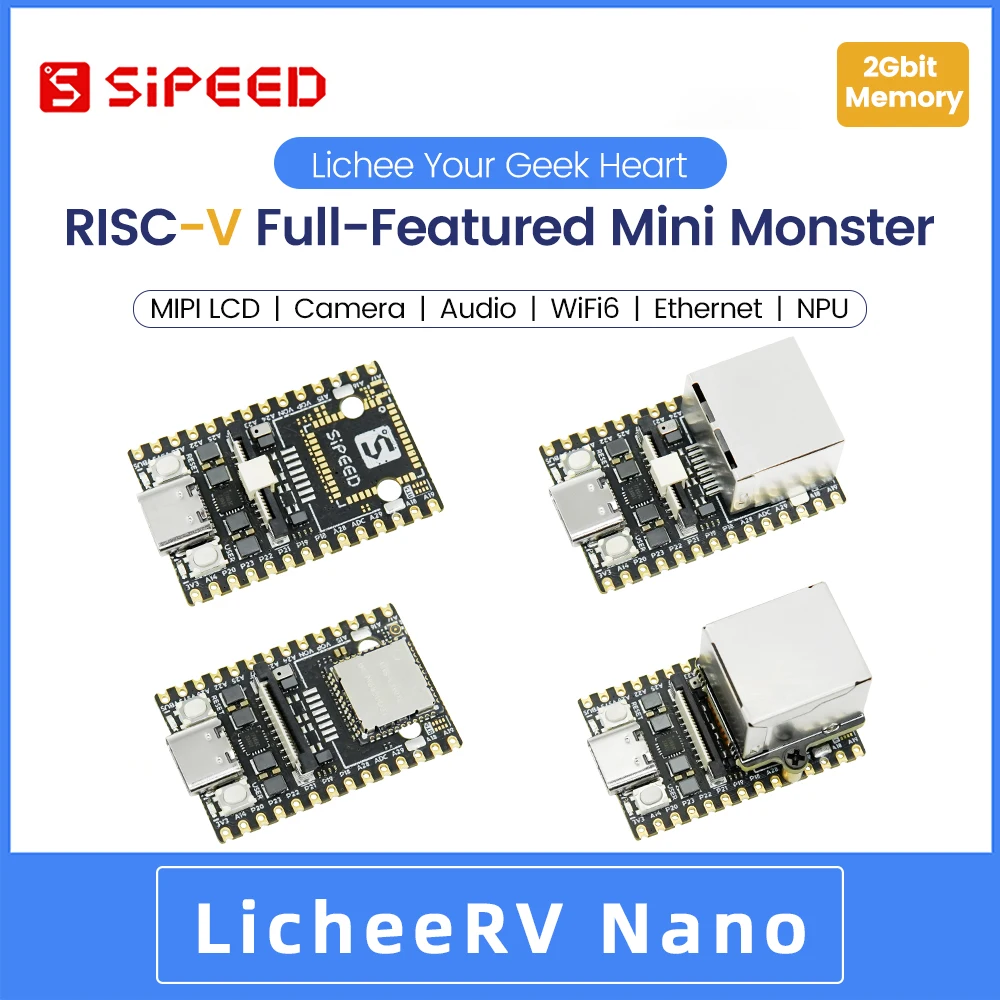
The Sipeed LicheeRV Nano SG2002 is a compact, feature-rich RISC-V development board engineered for embedded AI, IoT, and vision-based projects. This board targets developers, hobbyists, and researchers seeking an efficient, open-source platform with integrated connectivity and AI acceleration capabilities.
Architectural Foundation: The RISC-V Core
At its core, the LicheeRV Nano utilizes the SG2002 RISC-V processor, complemented by a dedicated Neural Processing Unit (NPU) and 2Gbit (256MB) of onboard memory. This configuration provides a solid foundation for edge computing tasks.
This hardware setup is specifically designed for efficient execution of machine learning inference at the edge. Small, yet mighty. Developers can deploy lightweight AI models directly on the device, reducing latency and reliance on cloud processing. This makes it ideal for real-time applications where immediate decision-making is crucial.
Unlike many entry-level microcontrollers, the inclusion of a dedicated NPU significantly offloads AI workloads from the main CPU. This specialized hardware accelerates tasks like object detection or image classification, offering a substantial performance boost over purely software-based solutions on general-purpose processors. The RISC-V architecture itself offers inherent flexibility and a growing open-source community, providing a future-proof foundation for innovative projects.
Connectivity Command Center: WiFi6 and Ethernet
Connectivity options on the LicheeRV Nano are robust, featuring integrated WiFi6 and an Ethernet port on specific variants. These options ensure versatile networking capabilities for diverse deployment scenarios.
High-speed WiFi6 enables rapid data transfer and seamless integration into modern wireless networks, crucial for IoT devices that require constant communication. The presence of a physical Ethernet port provides a stable, high-bandwidth wired connection, essential for industrial applications or situations demanding maximum reliability. Network stability is paramount.
Many basic development boards often omit advanced wireless standards or wired networking entirely, forcing developers to rely on external modules. The LicheeRV Nano's integrated approach streamlines development and reduces the overall bill of materials, offering a more complete solution out of the box. This integrated design simplifies system integration and reduces potential points of failure, a significant advantage for production-ready designs.
Visual Intelligence: MIPI Interfaces
The board incorporates MIPI LCD and Camera interfaces, enabling direct connection to displays and camera modules. This facilitates the development of sophisticated vision systems and human-machine interfaces.
These dedicated interfaces allow for high-bandwidth, low-latency data transfer from cameras and to displays, critical for applications like facial recognition, environmental monitoring, or smart appliance interfaces. Visual processing becomes highly responsive. The direct connection minimizes the need for complex external circuitry, simplifying hardware design.
Compared to general-purpose GPIO-based camera or display connections, MIPI interfaces are purpose-built for high-performance visual data streams. This specialized support ensures better image quality, faster frame rates, and reduced processing overhead for the main CPU. It is a significant upgrade for any vision-centric project, ensuring that the visual data pipeline is as efficient as possible from sensor to screen.
The Compact Footprint: Design and Integration
The Sipeed LicheeRV Nano boasts a highly compact form factor and utilizes USB-C for power and data. Its small size is a key differentiator.
This miniature design makes the board exceptionally suitable for space-constrained applications, such as wearables, drones, or embedded modules within larger systems. The USB-C port offers modern, reversible connectivity, simplifying power delivery and data communication during development and deployment. It is easy to power.
Many older development boards rely on bulkier form factors or outdated micro-USB connectors, which can complicate integration into sleek product designs. The LicheeRV Nano's compact dimensions and contemporary USB-C interface provide a significant advantage for developers aiming for a professional, integrated final product. Its small size also implies easier fitment into custom enclosures, a common consideration for embedded projects.
Power Management and System Stability
Ensuring adequate power delivery is critical for the stable operation of any embedded system, especially one with integrated AI and networking. The LicheeRV Nano, with its various integrated components, requires a stable 5V power source.
An insufficient or fluctuating power supply can lead to unpredictable behavior, system crashes, or data corruption, particularly during intensive processing tasks or high-bandwidth network activity. Reliable power is non-negotiable. Developers must verify that their chosen power adapter or host USB port can provide sufficient current to the board and any connected peripherals.
Unlike simple microcontrollers that draw minimal current, a board featuring a RISC-V processor, NPU, WiFi6, and Ethernet has higher peak power demands. Overlooking power supply sufficiency is a common pitfall in embedded development. Investing in a quality power source prevents countless hours of troubleshooting later, ensuring consistent performance. This attention to power ensures the board operates within its specified parameters, safeguarding project integrity.
Software Ecosystem and Development Experience
Developing on the LicheeRV Nano leverages the evolving RISC-V software ecosystem. This open instruction set architecture offers significant advantages for long-term project viability.
Developers can typically utilize open-source toolchains and Linux distributions tailored for RISC-V, such as Buildroot or Yocto, to build custom firmware and applications. The learning curve exists. This approach provides granular control over the software stack, allowing for highly optimized and secure embedded solutions. The open nature of RISC-V also encourages community contributions and innovation.
While the ARM ecosystem boasts greater maturity and a wider array of pre-built libraries, RISC-V offers unparalleled transparency and freedom from licensing restrictions. For projects where customizability, security, and long-term independence are paramount, the RISC-V platform, despite its relative youth, presents a compelling alternative. The ability to inspect and modify the entire instruction set is a powerful asset for advanced users.
Value Proposition: Cost-Effectiveness and ROI
Positioned at an accessible price point, the Sipeed LicheeRV Nano offers significant value for its feature set. This makes it an attractive option for budget-conscious projects.
For approximately 15 USD, developers gain access to a modern RISC-V processor with AI acceleration, WiFi6, and Ethernet connectivity. This is a formidable package. The cost-effectiveness lowers the barrier to entry for experimenting with advanced embedded technologies, allowing more individuals and small teams to innovate without substantial initial investment.
Compared to higher-priced proprietary development boards that may offer similar features, the LicheeRV Nano provides a compelling return on investment, especially for prototyping and educational purposes. The long-term value comes from its open-source nature, reducing ongoing licensing costs and fostering a collaborative development environment. This board delivers capability without breaking the bank, enabling more projects to move from concept to reality efficiently.
Imagine bringing your next innovative IoT device or AI vision system to life with a board that fits almost anywhere. Picture seamless data streaming over WiFi6, precise object recognition powered by an NPU, and robust network access through Ethernet, all within a tiny footprint. This board empowers creators to push the boundaries of embedded intelligence, turning complex ideas into tangible, functional solutions with efficiency and reliability.