SenseCAP Card Tracker T1000-E: LoRa Meshtastic Outdoor Tracker
Official Store Deal
Expert Analysis Overview
The SenseCAP Card Tracker T1000-E is a purpose-built, rugged LoRaWAN tracker engineered for reliable long-range asset monitoring in demanding outdoor environments. This device is not merely a gadget; it represents a calculated assembly of components designed for pushing the boundaries of off-grid communication.
At its foundation, the T1000-E integrates the Nordic nRF52840 microcontroller and the Semtech LR1110 LoRa transceiver. These are not arbitrary selections; the nRF52840 is a powerful, low-power system-on-chip known for its robust ARM Cortex-M4 processor and extensive connectivity options, including Bluetooth 5.0, which is critical for local device interaction. The LR1110, on the other hand, is a dedicated LoRa device, optimized for long-range, low-power communication across sub-GHz bands. It handles the complex radio frequency modulation and demodulation with exceptional efficiency.
This pairing implies a deliberate focus on signal integrity and power efficiency. The nRF52840 manages the Meshtastic protocol stack, orchestrating data packets and device states with minimal overhead. The LR1110 then executes the physical layer transmissions, maximizing the effective range and penetration through obstacles. This separation of duties ensures each component operates within its optimal performance envelope, preventing bottlenecks and maintaining consistent communication. Performance is paramount.
Unlike generic Bluetooth trackers, which are inherently limited to short-range line-of-sight communication, this architecture facilitates communication over several kilometers. This extended reach is indispensable for tracking assets in vast, unpopulated areas where cellular infrastructure simply does not exist. It's a fundamental shift in tracking capability.
The T1000-E boasts an IP65 dust and water resistance rating. This signifies substantial protection against ingress from dust and low-pressure water jets from any direction. The visible casing appears to be a durable, sealed plastic composite, designed to withstand the rigors of outdoor exposure. This level of protection is crucial for devices deployed in environments prone to rain, dust storms, or accidental splashes.
Such a sealed design directly impacts the internal thermal management of the components. While the nRF52840 and LR1110 are inherently low-power, continuous operation in direct sunlight or enclosed spaces can still generate heat. The IP65 enclosure, by its nature, limits direct airflow for cooling. Therefore, the selection of low-power components with efficient thermal profiles is not merely a feature, but a necessity to ensure long-term operational stability without thermal throttling or premature component degradation. Reliability is key.
Contrast this with many consumer-grade electronics that offer minimal or no environmental protection. Those devices are prone to failure from moisture, dirt, or even humidity, rendering them useless in the very conditions where a tracker like the T1000-E excels. This tracker is built for the elements, not just the desktop.
Powering this long-range capability is an integrated rechargeable battery, with charging facilitated via a USB Type-C port. The choice of USB-C is a modern standard, ensuring widespread compatibility with existing chargers and cables, simplifying field replenishment. An integrated battery suggests a design optimized for a specific energy density and discharge curve, tailored for the low-power consumption profile of LoRa and nRF52840.
The operational endurance of the tracker directly correlates with its transmission frequency and power settings. In scenarios requiring infrequent updates, the device can achieve extended periods of operation, potentially weeks or even months. Conversely, more frequent transmissions will naturally shorten the battery cycle. Users must calibrate their tracking needs against desired battery longevity, a common trade-off in remote sensing devices. Every milliampere counts.
This approach contrasts sharply with devices reliant on disposable batteries, which introduce ongoing operational costs and environmental waste. The rechargeable nature of the T1000-E positions it as a more sustainable and cost-effective solution over its operational lifespan, especially for repeated deployments. It's an investment in continuous utility.
The T1000-E supports a broad frequency range of 863-928 MHz, explicitly mentioning 868MHz and 915MHz. This multi-band capability is a critical design choice, acknowledging the diverse regulatory landscape for unlicensed LoRa operation across different global regions. The 868MHz band is common in Europe, while 915MHz is prevalent in North America and Australia.
This wide frequency support provides significant operational advantages for users deploying the tracker internationally or across different regions within a large country. It allows for compliance with local radio regulations without requiring different hardware variants. The LR1110 transceiver is inherently capable of this frequency agility, ensuring the device can adapt its radio parameters to optimize performance within the permitted spectrum. Adaptability is crucial for global reach.
Single-band LoRa devices, while simpler, restrict deployment to specific geographical zones. The T1000-E's flexibility eliminates this limitation, offering a truly global solution for Meshtastic networks. This broad spectrum capability ensures the device remains a viable tool regardless of the operational theater. It's engineered for worldwide deployment.
The device's integration with Meshtastic is its defining feature. Meshtastic is an open-source, peer-to-peer mesh network protocol built on LoRa technology. It allows devices to communicate directly with each other, forming a resilient network without reliance on centralized servers, cellular towers, or internet connectivity. This decentralization is a powerful paradigm shift for remote communication.
For outdoor tracking, Meshtastic offers unparalleled resilience. In environments where cellular service is non-existent—think deep wilderness, remote construction sites, or maritime operations—a Meshtastic network can still provide communication and location data. Each tracker can act as a repeater, extending the network's reach and improving redundancy. Data packets can hop between nodes until they reach a gateway connected to the internet, or simply communicate locally. This creates a highly robust and self-healing communication fabric. Off-grid is its strength.
This contrasts sharply with traditional cellular-based trackers, which become useless outside of network coverage. Meshtastic liberates tracking from infrastructure dependency, offering a truly independent communication solution. It's a network that builds itself, node by node, wherever the mission takes it.
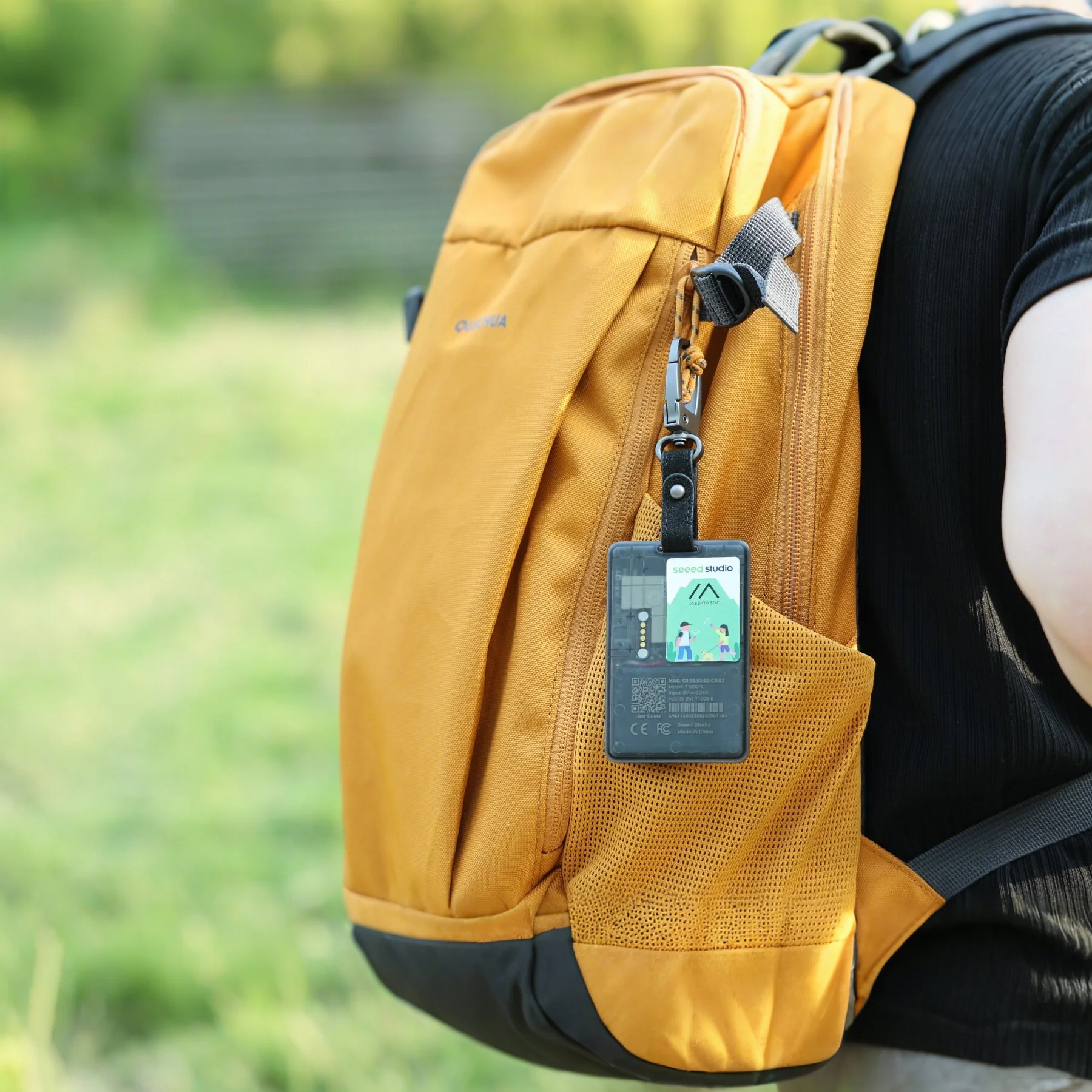
The card-sized form factor of the T1000-E is a significant practical advantage. Its compact dimensions make it highly portable and discreet, allowing it to be easily attached to backpacks, keychains, tools, or other valuable assets without adding significant bulk or drawing undue attention. The images clearly show its integration with everyday gear, highlighting its unobtrusive design.
This compact size facilitates versatile deployment scenarios. It can slip into a wallet, be clipped to a harness, or even be concealed within equipment. The minimal footprint ensures it doesn't interfere with the primary function of the item it's tracking. Its lightweight nature also means it adds negligible burden to the user or the tracked asset. Small footprint, big impact.
Larger, more cumbersome tracking units can be impractical for personal gear or discreet asset monitoring. The T1000-E's design emphasizes ease of integration, making it a natural extension of existing equipment rather than an additional burden. It's designed to disappear until it's needed.
Interaction with the T1000-E is primarily managed through a smartphone application. This app provides the interface for initial setup, configuration of network parameters, monitoring of device status, and visualization of tracking data. The images show a clean, intuitive app interface, suggesting a user-friendly experience despite the advanced underlying technology.
A well-designed software layer is crucial for maximizing the utility of such specialized hardware. It allows users to adjust transmission intervals, view network topology, and interpret location data without needing deep technical knowledge of the LoRa protocol itself. The app bridges the complexity of the hardware with the practical needs of the user, making advanced features accessible. User control is essential.
Without a stable and intuitive software interface, even the most capable hardware can be frustrating to use. The app's role is to unlock the full potential of the nRF52840 and LR1110, translating raw radio signals into actionable intelligence. It's the command center for your tracking operations.
From an overclocker's perspective, the SenseCAP Card Tracker T1000-E represents an optimized platform. The selection of the nRF52840 alongside the LR1110 is a power-efficient combination, ensuring stable operation even when pushing the boundaries of range. The IP65 rating, while protective, necessitates a low thermal design point, a challenge met by the inherent efficiency of these components. This isn't about raw clock speed; it's about sustained, reliable performance under duress. Every component choice is deliberate.
For advanced users, the open-source Meshtastic platform offers significant potential for firmware customization and network optimization. One could envision tweaking transmission power, packet sizes, or sleep cycles to extract every last drop of range or battery life, pushing the hardware beyond its default stock limits. This is where true performance enthusiasts will find their stride, tailoring the device to specific, extreme use cases. Customization unlocks potential.
Ultimately, this tracker is a formidable tool for those who demand uncompromising connectivity in environments where standard solutions falter. Its robust hardware, coupled with the flexibility of Meshtastic, makes it an essential piece of kit for anyone serious about off-grid asset tracking. It's built to perform, built to last, and ready for whatever you throw at it.
Imagine the peace of mind knowing your critical gear, or even your fellow adventurers, remain trackable deep in the backcountry, far beyond the reach of conventional networks. Picture the confidence of deploying a device that shrugs off rain and dust, consistently delivering vital location updates. Envision the expanded possibilities for remote monitoring and communication, liberated from monthly subscriptions and fragile cellular signals. This tracker empowers exploration, securing your assets and enhancing safety across the most challenging terrains, ensuring your focus remains on the adventure, not on lost connections.
The Core Architecture: Engineering for Endurance
At its foundation, the T1000-E integrates the Nordic nRF52840 microcontroller and the Semtech LR1110 LoRa transceiver. These are not arbitrary selections; the nRF52840 is a powerful, low-power system-on-chip known for its robust ARM Cortex-M4 processor and extensive connectivity options, including Bluetooth 5.0, which is critical for local device interaction. The LR1110, on the other hand, is a dedicated LoRa device, optimized for long-range, low-power communication across sub-GHz bands. It handles the complex radio frequency modulation and demodulation with exceptional efficiency.
This pairing implies a deliberate focus on signal integrity and power efficiency. The nRF52840 manages the Meshtastic protocol stack, orchestrating data packets and device states with minimal overhead. The LR1110 then executes the physical layer transmissions, maximizing the effective range and penetration through obstacles. This separation of duties ensures each component operates within its optimal performance envelope, preventing bottlenecks and maintaining consistent communication. Performance is paramount.
Unlike generic Bluetooth trackers, which are inherently limited to short-range line-of-sight communication, this architecture facilitates communication over several kilometers. This extended reach is indispensable for tracking assets in vast, unpopulated areas where cellular infrastructure simply does not exist. It's a fundamental shift in tracking capability.
Encapsulation for Extremes: IP65 and Thermal Considerations
The T1000-E boasts an IP65 dust and water resistance rating. This signifies substantial protection against ingress from dust and low-pressure water jets from any direction. The visible casing appears to be a durable, sealed plastic composite, designed to withstand the rigors of outdoor exposure. This level of protection is crucial for devices deployed in environments prone to rain, dust storms, or accidental splashes.
Such a sealed design directly impacts the internal thermal management of the components. While the nRF52840 and LR1110 are inherently low-power, continuous operation in direct sunlight or enclosed spaces can still generate heat. The IP65 enclosure, by its nature, limits direct airflow for cooling. Therefore, the selection of low-power components with efficient thermal profiles is not merely a feature, but a necessity to ensure long-term operational stability without thermal throttling or premature component degradation. Reliability is key.
Contrast this with many consumer-grade electronics that offer minimal or no environmental protection. Those devices are prone to failure from moisture, dirt, or even humidity, rendering them useless in the very conditions where a tracker like the T1000-E excels. This tracker is built for the elements, not just the desktop.
Powering the Long Haul: Battery Dynamics
Powering this long-range capability is an integrated rechargeable battery, with charging facilitated via a USB Type-C port. The choice of USB-C is a modern standard, ensuring widespread compatibility with existing chargers and cables, simplifying field replenishment. An integrated battery suggests a design optimized for a specific energy density and discharge curve, tailored for the low-power consumption profile of LoRa and nRF52840.
The operational endurance of the tracker directly correlates with its transmission frequency and power settings. In scenarios requiring infrequent updates, the device can achieve extended periods of operation, potentially weeks or even months. Conversely, more frequent transmissions will naturally shorten the battery cycle. Users must calibrate their tracking needs against desired battery longevity, a common trade-off in remote sensing devices. Every milliampere counts.
This approach contrasts sharply with devices reliant on disposable batteries, which introduce ongoing operational costs and environmental waste. The rechargeable nature of the T1000-E positions it as a more sustainable and cost-effective solution over its operational lifespan, especially for repeated deployments. It's an investment in continuous utility.
Frequency Agility: Global Connectivity Architecture
The T1000-E supports a broad frequency range of 863-928 MHz, explicitly mentioning 868MHz and 915MHz. This multi-band capability is a critical design choice, acknowledging the diverse regulatory landscape for unlicensed LoRa operation across different global regions. The 868MHz band is common in Europe, while 915MHz is prevalent in North America and Australia.
This wide frequency support provides significant operational advantages for users deploying the tracker internationally or across different regions within a large country. It allows for compliance with local radio regulations without requiring different hardware variants. The LR1110 transceiver is inherently capable of this frequency agility, ensuring the device can adapt its radio parameters to optimize performance within the permitted spectrum. Adaptability is crucial for global reach.
Single-band LoRa devices, while simpler, restrict deployment to specific geographical zones. The T1000-E's flexibility eliminates this limitation, offering a truly global solution for Meshtastic networks. This broad spectrum capability ensures the device remains a viable tool regardless of the operational theater. It's engineered for worldwide deployment.
The Meshtastic Advantage: Decentralized Communication Protocol
The device's integration with Meshtastic is its defining feature. Meshtastic is an open-source, peer-to-peer mesh network protocol built on LoRa technology. It allows devices to communicate directly with each other, forming a resilient network without reliance on centralized servers, cellular towers, or internet connectivity. This decentralization is a powerful paradigm shift for remote communication.
For outdoor tracking, Meshtastic offers unparalleled resilience. In environments where cellular service is non-existent—think deep wilderness, remote construction sites, or maritime operations—a Meshtastic network can still provide communication and location data. Each tracker can act as a repeater, extending the network's reach and improving redundancy. Data packets can hop between nodes until they reach a gateway connected to the internet, or simply communicate locally. This creates a highly robust and self-healing communication fabric. Off-grid is its strength.
This contrasts sharply with traditional cellular-based trackers, which become useless outside of network coverage. Meshtastic liberates tracking from infrastructure dependency, offering a truly independent communication solution. It's a network that builds itself, node by node, wherever the mission takes it.
Form Factor and Deployment Versatility
The card-sized form factor of the T1000-E is a significant practical advantage. Its compact dimensions make it highly portable and discreet, allowing it to be easily attached to backpacks, keychains, tools, or other valuable assets without adding significant bulk or drawing undue attention. The images clearly show its integration with everyday gear, highlighting its unobtrusive design.
This compact size facilitates versatile deployment scenarios. It can slip into a wallet, be clipped to a harness, or even be concealed within equipment. The minimal footprint ensures it doesn't interfere with the primary function of the item it's tracking. Its lightweight nature also means it adds negligible burden to the user or the tracked asset. Small footprint, big impact.
Larger, more cumbersome tracking units can be impractical for personal gear or discreet asset monitoring. The T1000-E's design emphasizes ease of integration, making it a natural extension of existing equipment rather than an additional burden. It's designed to disappear until it's needed.
Software Interface: Bridging Hardware and User
Interaction with the T1000-E is primarily managed through a smartphone application. This app provides the interface for initial setup, configuration of network parameters, monitoring of device status, and visualization of tracking data. The images show a clean, intuitive app interface, suggesting a user-friendly experience despite the advanced underlying technology.
A well-designed software layer is crucial for maximizing the utility of such specialized hardware. It allows users to adjust transmission intervals, view network topology, and interpret location data without needing deep technical knowledge of the LoRa protocol itself. The app bridges the complexity of the hardware with the practical needs of the user, making advanced features accessible. User control is essential.
Without a stable and intuitive software interface, even the most capable hardware can be frustrating to use. The app's role is to unlock the full potential of the nRF52840 and LR1110, translating raw radio signals into actionable intelligence. It's the command center for your tracking operations.
The Overclocker's Final Assessment: Pushing the Limits
From an overclocker's perspective, the SenseCAP Card Tracker T1000-E represents an optimized platform. The selection of the nRF52840 alongside the LR1110 is a power-efficient combination, ensuring stable operation even when pushing the boundaries of range. The IP65 rating, while protective, necessitates a low thermal design point, a challenge met by the inherent efficiency of these components. This isn't about raw clock speed; it's about sustained, reliable performance under duress. Every component choice is deliberate.
For advanced users, the open-source Meshtastic platform offers significant potential for firmware customization and network optimization. One could envision tweaking transmission power, packet sizes, or sleep cycles to extract every last drop of range or battery life, pushing the hardware beyond its default stock limits. This is where true performance enthusiasts will find their stride, tailoring the device to specific, extreme use cases. Customization unlocks potential.
Ultimately, this tracker is a formidable tool for those who demand uncompromising connectivity in environments where standard solutions falter. Its robust hardware, coupled with the flexibility of Meshtastic, makes it an essential piece of kit for anyone serious about off-grid asset tracking. It's built to perform, built to last, and ready for whatever you throw at it.
Imagine the peace of mind knowing your critical gear, or even your fellow adventurers, remain trackable deep in the backcountry, far beyond the reach of conventional networks. Picture the confidence of deploying a device that shrugs off rain and dust, consistently delivering vital location updates. Envision the expanded possibilities for remote monitoring and communication, liberated from monthly subscriptions and fragile cellular signals. This tracker empowers exploration, securing your assets and enhancing safety across the most challenging terrains, ensuring your focus remains on the adventure, not on lost connections.