RJ45 Ethernet Splitter Y-Cable for Single-Cable Dual Device Connectivity
Official Store Deal
Expert Analysis Overview
The RJ45 Ethernet Splitter Y-Cable is a specialized networking adapter designed for precise, sequential management of wired connections, targeting users who need to optimize existing cable infrastructure without installing new runs. This passive device offers a strategic solution for specific wired networking challenges, particularly in environments where running additional Ethernet cables is impractical or costly. It is not a network switch; its function is distinct and often misunderstood.
A common misunderstanding surrounds the functionality of a single RJ45 splitter. Many users mistakenly believe one adapter can magically transform a single Ethernet port into two active, simultaneous Gigabit connections, much like an active network switch. This is incorrect. A single splitter, as depicted with its male RJ45 plug and two female sockets, does not act as a network hub or switch. It cannot provide two independent, simultaneous network connections from a single source port on its own. The device's primary warning, visible in product imagery, explicitly states that its two RJ45 ports cannot be used at the same time when referring to a single unit's direct connection to a router.
The true utility of this splitter emerges when it is deployed in a pair. When two identical RJ45 splitters are used—one at the network source (e.g., a router or switch) and another at the device end (e.g., connecting two computers)—they enable the transmission of two separate Fast Ethernet (10/100Mbps) connections over a single existing Cat5, Cat5e, or Cat6 cable run. This clever engineering leverages the fact that 10/100Mbps Ethernet only uses four of the eight wires within a standard Ethernet cable. By splitting these wires, each splitter effectively creates two distinct 4-wire pathways, allowing two devices to share the physical cable infrastructure. This is a crucial distinction. It saves considerable effort.
Unlike active network switches that require power and manage data traffic, these passive splitters simply re-route the internal wiring. This means they do not regenerate signals or provide intelligent packet switching. Their simplicity is their strength, but also their limitation. Understanding this fundamental principle is key to successful deployment.
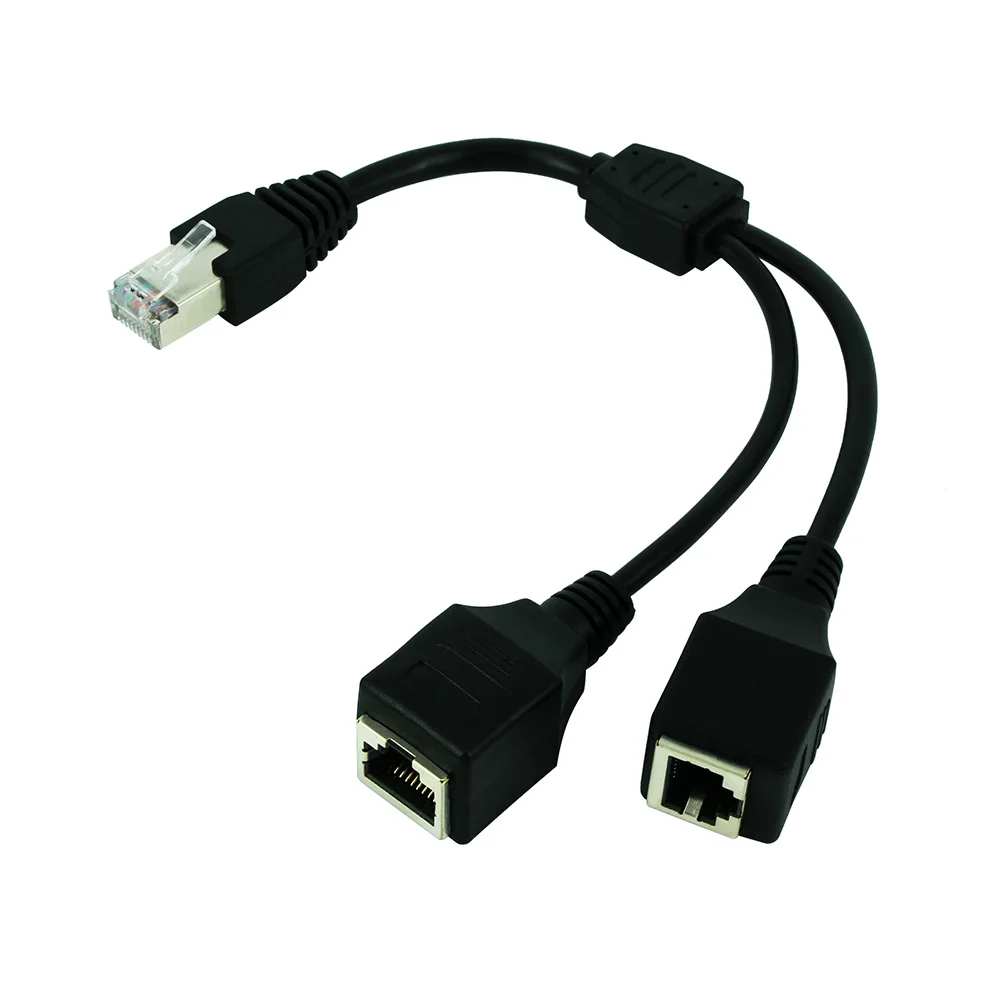
Visually, the RJ45 Ethernet Splitter Y-Cable presents a straightforward, robust design. The cable features a durable black PVC (Polyvinyl Chloride) jacket, which offers essential protection for the internal wiring. This material choice implies good resistance to minor abrasions and environmental factors commonly found in home or office settings. The flexibility of the cable is apparent, allowing for easier routing around furniture or through cable management channels without excessive strain. A flexible cable is always better.
The connectors themselves are molded directly onto the cable, a manufacturing technique that enhances durability and reduces the likelihood of internal wire breaks at stress points. The male RJ45 connector, with its clear plastic locking tab, ensures a secure fit into network ports, preventing accidental disconnections. The two female RJ45 sockets are equally well-integrated, providing stable receptacles for connecting client devices or additional patch cables. The metallic contacts within the female ports appear standard, facilitating reliable electrical connections. Such construction implies a longer operational lifespan compared to poorly assembled alternatives.
This build quality positions the splitter as a dependable component within a wired network setup. It avoids the common pitfalls of flimsy adapters that can quickly degrade or fail under normal use. The compact Y-split design also minimizes bulk, making it easier to conceal or manage alongside other network cables. This is a practical consideration.
The primary benefit of the RJ45 Ethernet Splitter Y-Cable lies in its ability to optimize existing wired infrastructure. Imagine a scenario where a single Ethernet cable runs from your router to a room with two devices that require a wired connection—perhaps a desktop computer and a gaming console, or two smart home hubs. Instead of undertaking the disruptive and often costly task of running a second Ethernet cable through walls or ceilings, a pair of these splitters offers a streamlined alternative. This avoids significant disruption.
As illustrated in the connection diagram, one splitter is connected to two ports on your network switch or router. Its male end then plugs into the existing wall socket or the long Ethernet cable run. At the other end of that same cable run, a second splitter is connected, with its two female ports then connecting to the two client devices. This setup effectively doubles the usable wired connections at the remote end, all while utilizing a single physical cable pathway. This is efficient cable management.
This solution is particularly valuable for renters or in older buildings where modifying existing wiring is not feasible. It also reduces cable clutter by consolidating two logical connections into one physical cable. For home Wi-Fi fixers, this means extending wired reach without complex installations. It simplifies connectivity challenges. The ability to leverage existing cabling infrastructure represents a significant cost and time saving, making it an attractive option for specific networking needs. It's an intelligent workaround.
While highly practical for specific scenarios, it is crucial to understand the performance implications of using an RJ45 splitter. This device is designed for Fast Ethernet (10/100Mbps) applications. When used in a pair to split a single Cat5/5e/6 cable, each of the two resulting connections will operate at a maximum speed of 100Mbps. This limitation stems from the fact that 10/100Mbps Ethernet only requires four wires (two pairs) for data transmission, allowing the splitter to separate the eight wires of a standard cable into two distinct four-wire pathways. Gigabit Ethernet, by contrast, requires all eight wires for its higher data rates. This is a hard limit.
Therefore, if your network infrastructure (router, switch, and devices) supports Gigabit Ethernet (1000Mbps), and you utilize this splitter, the connections routed through it will automatically negotiate down to 100Mbps. This speed is perfectly adequate for many common tasks, including general internet browsing, email, standard definition video streaming, and non-competitive online gaming. However, for bandwidth-intensive applications such as transferring large files over a local network, high-definition 4K streaming, or competitive online gaming where every millisecond counts, the 100Mbps limitation might be noticeable. Users should assess their needs. It is important to manage expectations.
The splitter is compatible with Cat5, Cat5e, and Cat6 cables, ensuring broad usability with most existing Ethernet setups. Signal integrity is generally maintained over standard cable lengths, but as with any passive component, excessively long or poorly shielded cables, combined with splitters, could theoretically introduce minor signal degradation. For typical home or small office environments, this is rarely a concern. The splitter performs its function reliably within its design parameters. It's built for purpose.
From a value perspective, the RJ45 Ethernet Splitter Y-Cable offers a compelling proposition for its specific use case. The cost of running new Ethernet cabling, especially in finished homes or offices, can quickly escalate due to labor, materials, and potential wall repairs. This passive splitter provides a significantly more affordable alternative. Its low purchase price, combined with the ability to leverage existing infrastructure, makes it a highly cost-effective solution for expanding wired connectivity. It saves real money.
The simplicity of installation is another major advantage. There is no software to configure, no drivers to install, and no power supply required. It is a true plug-and-play device. For non-experts or those intimidated by complex networking setups, this ease of use is invaluable. This device simplifies network management. It transforms a potentially daunting wiring project into a matter of simply plugging in a few cables. This accessibility empowers users to manage their network needs independently.
This splitter is an upgrade for anyone grappling with a shortage of wired network ports in a specific location. Unlike simply tolerating slow Wi-Fi or resorting to inconvenient powerline adapters, this solution provides a stable, dedicated Fast Ethernet connection. It extends the capability of your existing wired network without the expense or complexity of active switches or new cable installations. For those seeking to eliminate dead zones in wired access or simplify setup for multiple devices in a single area, this splitter, used in pairs, is a smart, practical choice. It offers a clear, tangible benefit.
Imagine a home office where both a desktop PC and a network printer need a stable wired connection, but only one wall port exists. With a pair of these splitters, both devices can reliably connect, ensuring consistent performance for critical tasks. Picture a living room where a smart TV and a gaming console share a single Ethernet drop, effortlessly switching between each device's wired needs. This simple adapter empowers users to extend their wired network's reach and functionality, ensuring stable, dedicated connections where they are needed most, without the headache of extensive rewiring. It provides peace of mind.
The Misconception vs. Reality: Understanding Network Splitting
A common misunderstanding surrounds the functionality of a single RJ45 splitter. Many users mistakenly believe one adapter can magically transform a single Ethernet port into two active, simultaneous Gigabit connections, much like an active network switch. This is incorrect. A single splitter, as depicted with its male RJ45 plug and two female sockets, does not act as a network hub or switch. It cannot provide two independent, simultaneous network connections from a single source port on its own. The device's primary warning, visible in product imagery, explicitly states that its two RJ45 ports cannot be used at the same time when referring to a single unit's direct connection to a router.
The true utility of this splitter emerges when it is deployed in a pair. When two identical RJ45 splitters are used—one at the network source (e.g., a router or switch) and another at the device end (e.g., connecting two computers)—they enable the transmission of two separate Fast Ethernet (10/100Mbps) connections over a single existing Cat5, Cat5e, or Cat6 cable run. This clever engineering leverages the fact that 10/100Mbps Ethernet only uses four of the eight wires within a standard Ethernet cable. By splitting these wires, each splitter effectively creates two distinct 4-wire pathways, allowing two devices to share the physical cable infrastructure. This is a crucial distinction. It saves considerable effort.
Unlike active network switches that require power and manage data traffic, these passive splitters simply re-route the internal wiring. This means they do not regenerate signals or provide intelligent packet switching. Their simplicity is their strength, but also their limitation. Understanding this fundamental principle is key to successful deployment.
Engineering for Connectivity: Design and Construction
Visually, the RJ45 Ethernet Splitter Y-Cable presents a straightforward, robust design. The cable features a durable black PVC (Polyvinyl Chloride) jacket, which offers essential protection for the internal wiring. This material choice implies good resistance to minor abrasions and environmental factors commonly found in home or office settings. The flexibility of the cable is apparent, allowing for easier routing around furniture or through cable management channels without excessive strain. A flexible cable is always better.
The connectors themselves are molded directly onto the cable, a manufacturing technique that enhances durability and reduces the likelihood of internal wire breaks at stress points. The male RJ45 connector, with its clear plastic locking tab, ensures a secure fit into network ports, preventing accidental disconnections. The two female RJ45 sockets are equally well-integrated, providing stable receptacles for connecting client devices or additional patch cables. The metallic contacts within the female ports appear standard, facilitating reliable electrical connections. Such construction implies a longer operational lifespan compared to poorly assembled alternatives.
This build quality positions the splitter as a dependable component within a wired network setup. It avoids the common pitfalls of flimsy adapters that can quickly degrade or fail under normal use. The compact Y-split design also minimizes bulk, making it easier to conceal or manage alongside other network cables. This is a practical consideration.
Strategic Deployment: Optimizing Existing Cable Runs
The primary benefit of the RJ45 Ethernet Splitter Y-Cable lies in its ability to optimize existing wired infrastructure. Imagine a scenario where a single Ethernet cable runs from your router to a room with two devices that require a wired connection—perhaps a desktop computer and a gaming console, or two smart home hubs. Instead of undertaking the disruptive and often costly task of running a second Ethernet cable through walls or ceilings, a pair of these splitters offers a streamlined alternative. This avoids significant disruption.
As illustrated in the connection diagram, one splitter is connected to two ports on your network switch or router. Its male end then plugs into the existing wall socket or the long Ethernet cable run. At the other end of that same cable run, a second splitter is connected, with its two female ports then connecting to the two client devices. This setup effectively doubles the usable wired connections at the remote end, all while utilizing a single physical cable pathway. This is efficient cable management.
This solution is particularly valuable for renters or in older buildings where modifying existing wiring is not feasible. It also reduces cable clutter by consolidating two logical connections into one physical cable. For home Wi-Fi fixers, this means extending wired reach without complex installations. It simplifies connectivity challenges. The ability to leverage existing cabling infrastructure represents a significant cost and time saving, making it an attractive option for specific networking needs. It's an intelligent workaround.
Performance Parameters: Speed and Signal Integrity
While highly practical for specific scenarios, it is crucial to understand the performance implications of using an RJ45 splitter. This device is designed for Fast Ethernet (10/100Mbps) applications. When used in a pair to split a single Cat5/5e/6 cable, each of the two resulting connections will operate at a maximum speed of 100Mbps. This limitation stems from the fact that 10/100Mbps Ethernet only requires four wires (two pairs) for data transmission, allowing the splitter to separate the eight wires of a standard cable into two distinct four-wire pathways. Gigabit Ethernet, by contrast, requires all eight wires for its higher data rates. This is a hard limit.
Therefore, if your network infrastructure (router, switch, and devices) supports Gigabit Ethernet (1000Mbps), and you utilize this splitter, the connections routed through it will automatically negotiate down to 100Mbps. This speed is perfectly adequate for many common tasks, including general internet browsing, email, standard definition video streaming, and non-competitive online gaming. However, for bandwidth-intensive applications such as transferring large files over a local network, high-definition 4K streaming, or competitive online gaming where every millisecond counts, the 100Mbps limitation might be noticeable. Users should assess their needs. It is important to manage expectations.
The splitter is compatible with Cat5, Cat5e, and Cat6 cables, ensuring broad usability with most existing Ethernet setups. Signal integrity is generally maintained over standard cable lengths, but as with any passive component, excessively long or poorly shielded cables, combined with splitters, could theoretically introduce minor signal degradation. For typical home or small office environments, this is rarely a concern. The splitter performs its function reliably within its design parameters. It's built for purpose.
The Smart Investment: Value and Practicality
From a value perspective, the RJ45 Ethernet Splitter Y-Cable offers a compelling proposition for its specific use case. The cost of running new Ethernet cabling, especially in finished homes or offices, can quickly escalate due to labor, materials, and potential wall repairs. This passive splitter provides a significantly more affordable alternative. Its low purchase price, combined with the ability to leverage existing infrastructure, makes it a highly cost-effective solution for expanding wired connectivity. It saves real money.
The simplicity of installation is another major advantage. There is no software to configure, no drivers to install, and no power supply required. It is a true plug-and-play device. For non-experts or those intimidated by complex networking setups, this ease of use is invaluable. This device simplifies network management. It transforms a potentially daunting wiring project into a matter of simply plugging in a few cables. This accessibility empowers users to manage their network needs independently.
This splitter is an upgrade for anyone grappling with a shortage of wired network ports in a specific location. Unlike simply tolerating slow Wi-Fi or resorting to inconvenient powerline adapters, this solution provides a stable, dedicated Fast Ethernet connection. It extends the capability of your existing wired network without the expense or complexity of active switches or new cable installations. For those seeking to eliminate dead zones in wired access or simplify setup for multiple devices in a single area, this splitter, used in pairs, is a smart, practical choice. It offers a clear, tangible benefit.
Imagine a home office where both a desktop PC and a network printer need a stable wired connection, but only one wall port exists. With a pair of these splitters, both devices can reliably connect, ensuring consistent performance for critical tasks. Picture a living room where a smart TV and a gaming console share a single Ethernet drop, effortlessly switching between each device's wired needs. This simple adapter empowers users to extend their wired network's reach and functionality, ensuring stable, dedicated connections where they are needed most, without the headache of extensive rewiring. It provides peace of mind.