Raspberry Pi Zero 2 W
Official Store Deal
Expert Analysis Overview
The Raspberry Pi Zero 2 W is a remarkably compact, high-performance single-board computer engineered for embedded systems and IoT projects requiring significant processing power in a minimal footprint. This iteration builds upon the original Zero's legacy, delivering a substantial upgrade in computational capability while retaining its signature miniature size. For PC builders and embedded developers, understanding its core specifications and real-world implications is paramount for successful project integration.
At the heart of the Raspberry Pi Zero 2 W lies the Broadcom BCM2710A1 SoC, featuring a quad-core 64-bit Arm Cortex-A53 processor clocked at 1GHz. This is a significant upgrade from the single-core processor found in the original Raspberry Pi Zero. The architecture provides a substantial boost in multi-threaded performance. This means more complex computations are possible.
This enhanced processing power translates directly into expanded project capabilities. Developers can now run more demanding applications, such as lightweight web servers, basic machine learning inference models, or more sophisticated sensor data processing, directly on the device. Imagine a smart home hub that responds faster. The board handles concurrent tasks with greater efficiency, reducing lag in responsive applications.
Compared to its predecessor, the Zero 2 W offers up to five times the performance in multi-threaded workloads. This positions it closer to the original Raspberry Pi 3 B+ in terms of raw CPU power, but within the tiny Zero form factor. Unlike older single-core embedded solutions that often bottlenecked at basic OS operations, this quad-core unit ensures a smoother, more responsive user experience for headless or light GUI applications.
Integrated 2.4GHz 802.11 b/g/n Wi-Fi and Bluetooth 4.2/BLE are standard features on the Zero 2 W, complete with an onboard antenna. This eliminates the need for external USB dongles for wireless communication. The convenience is undeniable.
These wireless capabilities are crucial for modern IoT and embedded projects. They enable seamless communication with other devices, cloud services, and local networks without additional hardware. Consider a battery-powered sensor node transmitting data wirelessly. Bluetooth Low Energy (BLE) is particularly valuable for low-power applications, extending battery life in remote deployments or wearable tech. This simplifies bill of materials.
Unlike many entry-level microcontrollers that require separate modules for Wi-Fi or Bluetooth, the Zero 2 W integrates these essential features directly onto the board. This not only saves space but also reduces complexity in wiring and software configuration. It provides a robust foundation for projects requiring reliable wireless data exchange, making it a superior choice over boards that necessitate external adapters.
The Raspberry Pi Zero 2 W retains the incredibly small dimensions of its predecessors, measuring just 65mm x 30mm. This credit-card-sized footprint is a defining characteristic. It fits almost anywhere.
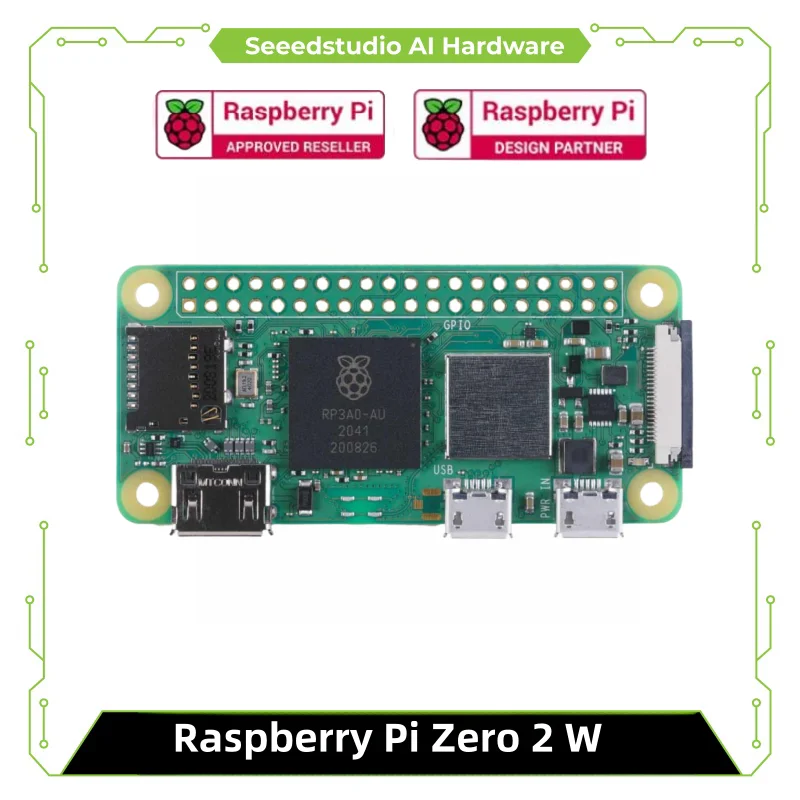
This miniature size makes the Zero 2 W ideal for projects where space is at a premium, such as wearable devices, drones, or custom enclosures. Its compact nature allows for discreet integration into existing systems or the creation of highly portable solutions. The 40-pin HAT-compatible GPIO header ensures compatibility with a vast ecosystem of add-on boards, despite the small size. A mini-HDMI port provides video output, while two micro-USB ports handle power and data (one OTG capable).
However, this compact design necessitates the use of adapters for standard USB-A peripherals and full-size HDMI cables, which can add to the overall project cost and physical footprint. Unlike larger Raspberry Pi models with full-size ports, users must plan for these adapter requirements. This is a common trade-off for extreme miniaturization. Careful cable management becomes important.
Powering the Raspberry Pi Zero 2 W is typically done via its micro-USB power port, requiring a 5V DC input. While specific power consumption figures vary with workload, the Zero line is known for its efficiency. It sips power.
Its relatively low power draw makes it suitable for battery-powered applications, remote monitoring stations, or devices where power consumption is a critical factor. For instance, a solar-powered weather station could leverage the Zero 2 W's efficiency to operate for extended periods. A stable power supply is non-negotiable. A minimum of 2.5A is recommended, especially when connecting multiple peripherals or running CPU-intensive tasks, to prevent brownouts or system instability.
Compared to more power-hungry single-board computers, the Zero 2 W offers a compelling balance of performance and efficiency. This makes it a more viable option for embedded systems that cannot afford the power budget of a full-sized Raspberry Pi. While some industrial embedded solutions might offer even lower power profiles, they often come at a significantly higher cost and lack the Zero 2 W's versatile software ecosystem.
The Raspberry Pi Zero 2 W benefits from the extensive and mature Raspberry Pi OS (formerly Raspbian) ecosystem, a Debian-based Linux distribution. This provides a familiar and powerful environment. It is easy to get started.
This robust software foundation allows developers to leverage a vast array of open-source tools, libraries, and programming languages (Python, C++, Node.js, etc.) for their projects. The active and supportive global community provides abundant tutorials, forums, and project examples, significantly lowering the barrier to entry for new users and offering solutions for complex challenges. Imagine troubleshooting a sensor issue with community help.
Unlike proprietary microcontroller platforms that often rely on vendor-specific IDEs and limited libraries, the Zero 2 W's Linux environment offers unparalleled flexibility and extensibility. This open-source approach fosters innovation and provides long-term support, ensuring that projects remain viable and adaptable over time. It is a powerful learning tool.
With a price point around $25.34 USD, the Raspberry Pi Zero 2 W presents an exceptional value proposition. It offers significant computational power for its cost. This is a budget-friendly option.
This affordability makes advanced embedded computing accessible to hobbyists, students, and professional developers on a tight budget. The cost-effectiveness allows for scaling projects, deploying multiple units without prohibitive expenses, or simply experimenting with complex ideas without a large initial investment. Consider building a cluster of these for distributed computing. The return on investment is high.
When compared to industrial embedded systems or even other single-board computers with similar specifications, the Zero 2 W stands out for its price-to-performance ratio. While some alternatives might offer specialized features, they often come with a premium price tag. The Zero 2 W democratizes access to quad-core processing in a tiny, affordable package, making it a compelling choice for a wide range of applications where budget is a consideration.
While the Raspberry Pi Zero 2 W offers impressive capabilities for its size and price, it does come with certain trade-offs. The 512MB of LPDDR2 SDRAM can be a limiting factor. Memory is finite.
This limited RAM means that while it can run a full Linux OS, heavy multitasking or memory-intensive applications will quickly exhaust available resources. Users might experience slowdowns or crashes if attempting to run a full desktop environment with multiple browser tabs open. Projects should be optimized for memory efficiency. The reliance on micro-USB for peripherals and mini-HDMI for display also means users must factor in the cost and bulk of adapters.
Unlike the larger Raspberry Pi 4 models which offer up to 8GB of RAM and full-size ports, the Zero 2 W prioritizes compactness and cost over expansive I/O and memory. This is a deliberate design choice. For projects where every millimeter and every dollar counts, these trade-offs are often acceptable. However, for applications demanding extensive I/O or significant memory, a larger Raspberry Pi might be a more suitable, albeit more expensive, alternative.
Imagine bringing your most ambitious IoT concepts to life, from smart environmental sensors to compact robotics, all powered by a board that fits almost anywhere. The Raspberry Pi Zero 2 W empowers creators to innovate without being constrained by size or budget, offering a robust platform for countless embedded applications. Its blend of power, connectivity, and minuscule footprint makes it an indispensable tool for the modern maker and developer.
Processing Prowess: A Leap in Performance
At the heart of the Raspberry Pi Zero 2 W lies the Broadcom BCM2710A1 SoC, featuring a quad-core 64-bit Arm Cortex-A53 processor clocked at 1GHz. This is a significant upgrade from the single-core processor found in the original Raspberry Pi Zero. The architecture provides a substantial boost in multi-threaded performance. This means more complex computations are possible.
This enhanced processing power translates directly into expanded project capabilities. Developers can now run more demanding applications, such as lightweight web servers, basic machine learning inference models, or more sophisticated sensor data processing, directly on the device. Imagine a smart home hub that responds faster. The board handles concurrent tasks with greater efficiency, reducing lag in responsive applications.
Compared to its predecessor, the Zero 2 W offers up to five times the performance in multi-threaded workloads. This positions it closer to the original Raspberry Pi 3 B+ in terms of raw CPU power, but within the tiny Zero form factor. Unlike older single-core embedded solutions that often bottlenecked at basic OS operations, this quad-core unit ensures a smoother, more responsive user experience for headless or light GUI applications.
Connectivity Solutions: Wireless Integration
Integrated 2.4GHz 802.11 b/g/n Wi-Fi and Bluetooth 4.2/BLE are standard features on the Zero 2 W, complete with an onboard antenna. This eliminates the need for external USB dongles for wireless communication. The convenience is undeniable.
These wireless capabilities are crucial for modern IoT and embedded projects. They enable seamless communication with other devices, cloud services, and local networks without additional hardware. Consider a battery-powered sensor node transmitting data wirelessly. Bluetooth Low Energy (BLE) is particularly valuable for low-power applications, extending battery life in remote deployments or wearable tech. This simplifies bill of materials.
Unlike many entry-level microcontrollers that require separate modules for Wi-Fi or Bluetooth, the Zero 2 W integrates these essential features directly onto the board. This not only saves space but also reduces complexity in wiring and software configuration. It provides a robust foundation for projects requiring reliable wireless data exchange, making it a superior choice over boards that necessitate external adapters.
Compact Form Factor and Integration Challenges
The Raspberry Pi Zero 2 W retains the incredibly small dimensions of its predecessors, measuring just 65mm x 30mm. This credit-card-sized footprint is a defining characteristic. It fits almost anywhere.
This miniature size makes the Zero 2 W ideal for projects where space is at a premium, such as wearable devices, drones, or custom enclosures. Its compact nature allows for discreet integration into existing systems or the creation of highly portable solutions. The 40-pin HAT-compatible GPIO header ensures compatibility with a vast ecosystem of add-on boards, despite the small size. A mini-HDMI port provides video output, while two micro-USB ports handle power and data (one OTG capable).
However, this compact design necessitates the use of adapters for standard USB-A peripherals and full-size HDMI cables, which can add to the overall project cost and physical footprint. Unlike larger Raspberry Pi models with full-size ports, users must plan for these adapter requirements. This is a common trade-off for extreme miniaturization. Careful cable management becomes important.
Power Efficiency and Supply Considerations
Powering the Raspberry Pi Zero 2 W is typically done via its micro-USB power port, requiring a 5V DC input. While specific power consumption figures vary with workload, the Zero line is known for its efficiency. It sips power.
Its relatively low power draw makes it suitable for battery-powered applications, remote monitoring stations, or devices where power consumption is a critical factor. For instance, a solar-powered weather station could leverage the Zero 2 W's efficiency to operate for extended periods. A stable power supply is non-negotiable. A minimum of 2.5A is recommended, especially when connecting multiple peripherals or running CPU-intensive tasks, to prevent brownouts or system instability.
Compared to more power-hungry single-board computers, the Zero 2 W offers a compelling balance of performance and efficiency. This makes it a more viable option for embedded systems that cannot afford the power budget of a full-sized Raspberry Pi. While some industrial embedded solutions might offer even lower power profiles, they often come at a significantly higher cost and lack the Zero 2 W's versatile software ecosystem.
Software Ecosystem and Community Support
The Raspberry Pi Zero 2 W benefits from the extensive and mature Raspberry Pi OS (formerly Raspbian) ecosystem, a Debian-based Linux distribution. This provides a familiar and powerful environment. It is easy to get started.
This robust software foundation allows developers to leverage a vast array of open-source tools, libraries, and programming languages (Python, C++, Node.js, etc.) for their projects. The active and supportive global community provides abundant tutorials, forums, and project examples, significantly lowering the barrier to entry for new users and offering solutions for complex challenges. Imagine troubleshooting a sensor issue with community help.
Unlike proprietary microcontroller platforms that often rely on vendor-specific IDEs and limited libraries, the Zero 2 W's Linux environment offers unparalleled flexibility and extensibility. This open-source approach fosters innovation and provides long-term support, ensuring that projects remain viable and adaptable over time. It is a powerful learning tool.
Value Proposition: Performance per Dollar
With a price point around $25.34 USD, the Raspberry Pi Zero 2 W presents an exceptional value proposition. It offers significant computational power for its cost. This is a budget-friendly option.
This affordability makes advanced embedded computing accessible to hobbyists, students, and professional developers on a tight budget. The cost-effectiveness allows for scaling projects, deploying multiple units without prohibitive expenses, or simply experimenting with complex ideas without a large initial investment. Consider building a cluster of these for distributed computing. The return on investment is high.
When compared to industrial embedded systems or even other single-board computers with similar specifications, the Zero 2 W stands out for its price-to-performance ratio. While some alternatives might offer specialized features, they often come with a premium price tag. The Zero 2 W democratizes access to quad-core processing in a tiny, affordable package, making it a compelling choice for a wide range of applications where budget is a consideration.
Strategic Trade-offs: Navigating Limitations
While the Raspberry Pi Zero 2 W offers impressive capabilities for its size and price, it does come with certain trade-offs. The 512MB of LPDDR2 SDRAM can be a limiting factor. Memory is finite.
This limited RAM means that while it can run a full Linux OS, heavy multitasking or memory-intensive applications will quickly exhaust available resources. Users might experience slowdowns or crashes if attempting to run a full desktop environment with multiple browser tabs open. Projects should be optimized for memory efficiency. The reliance on micro-USB for peripherals and mini-HDMI for display also means users must factor in the cost and bulk of adapters.
Unlike the larger Raspberry Pi 4 models which offer up to 8GB of RAM and full-size ports, the Zero 2 W prioritizes compactness and cost over expansive I/O and memory. This is a deliberate design choice. For projects where every millimeter and every dollar counts, these trade-offs are often acceptable. However, for applications demanding extensive I/O or significant memory, a larger Raspberry Pi might be a more suitable, albeit more expensive, alternative.
Imagine bringing your most ambitious IoT concepts to life, from smart environmental sensors to compact robotics, all powered by a board that fits almost anywhere. The Raspberry Pi Zero 2 W empowers creators to innovate without being constrained by size or budget, offering a robust platform for countless embedded applications. Its blend of power, connectivity, and minuscule footprint makes it an indispensable tool for the modern maker and developer.