Portable 4G LTE Mobile Hotspot with SIM Slot
Official Store Deal
Expert Analysis Overview
Cellular Connectivity Architecture
The Portable 4G LTE Mobile Hotspot with SIM Slot is a compact wireless access point engineered for mobile internet deployment. This device targets users requiring on-the-go network access, leveraging cellular infrastructure to provide Wi-Fi connectivity. Its design prioritizes portability and ease of use, making it a viable solution for temporary or remote networking requirements. The unit integrates a cellular modem, a Wi-Fi access point, and a power source within a single enclosure.
Initial assessment of the product title, which references "4G 5G WiFi 6," necessitates immediate clarification. The device's visual interface explicitly displays "LTE," and the advertised maximum throughput is 150 Mbps. This data strongly indicates a primary operational capability within the 4G LTE (Long-Term Evolution) Cat 4 specification. True 5G New Radio (NR) performance or Wi-Fi 6 (802.11ax) local area network capabilities are not demonstrably supported by the presented specifications or visual cues. This distinction is critical for network architects and end-users alike.
Such a discrepancy in marketing nomenclature versus actual technical specifications is not uncommon in the consumer electronics sector. Users must prioritize verified technical data over broad marketing claims. The device functions as a dedicated 4G LTE hotspot. It provides a reliable connection. This is a fundamental aspect of its utility.
Throughput Dynamics and Performance Metrics
The device specifies a maximum downlink throughput of 150 Mbps. This speed is characteristic of a Category 4 LTE modem. For a single user performing standard web browsing, email, or even streaming high-definition video, this bandwidth is generally adequate. However, when multiple clients simultaneously access the network, the available bandwidth per user diminishes proportionally.
Consider a scenario where 10 devices are connected, as the product claims to support. If each device attempts to stream video or engage in data-intensive tasks, the effective bandwidth per device could drop to 15 Mbps or less. This level of performance might introduce latency and buffering, particularly for applications sensitive to network delays, such as online gaming or video conferencing. The 150 Mbps ceiling is a shared resource.
Compared to modern 5G NR deployments offering multi-gigabit speeds or even advanced 4G LTE-A (LTE Advanced) networks capable of 300 Mbps or higher through carrier aggregation, this hotspot operates at a more foundational level. It is not designed for high-demand, low-latency enterprise applications. Its utility lies in providing consistent, albeit moderate, bandwidth. This is a key differentiator.
Power Management and Operational Autonomy
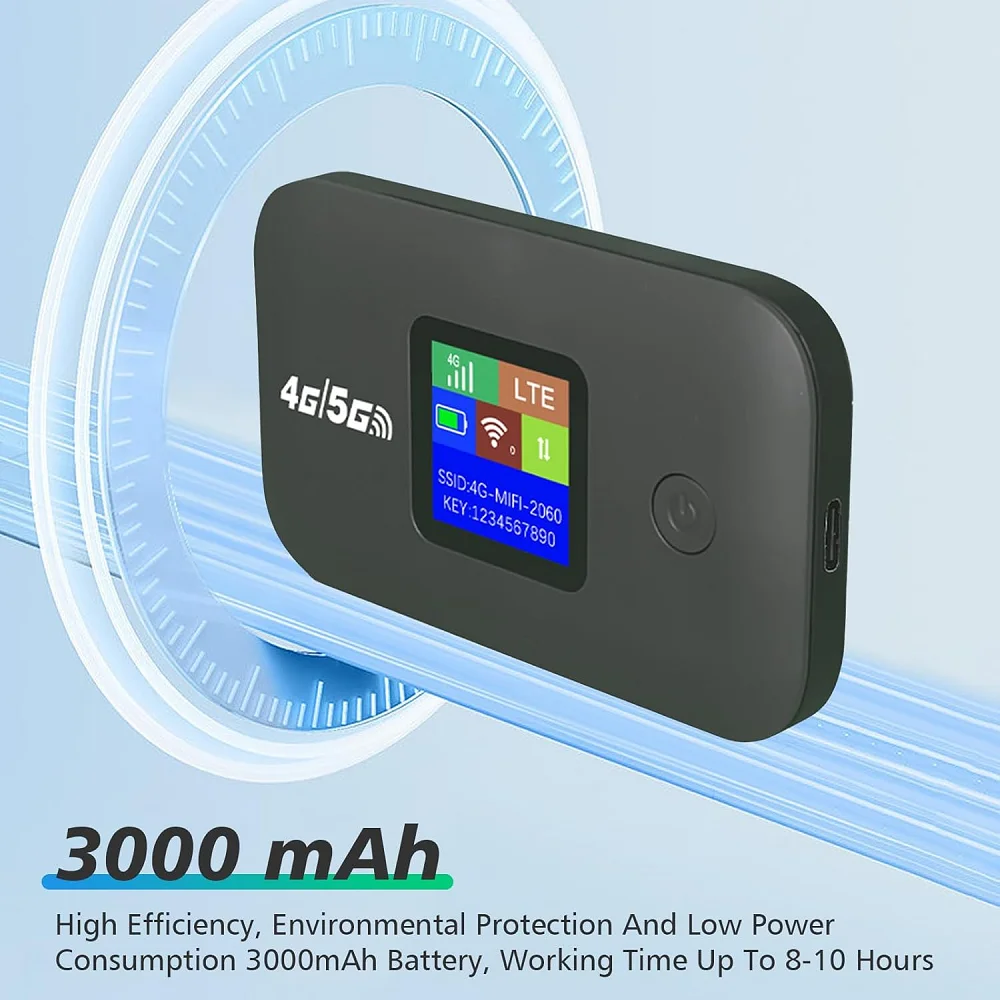
An integrated 3000 mAh battery powers the mobile hotspot, providing an estimated operational duration of 8 to 10 hours. This capacity is substantial for a device of its form factor, enabling extended use during travel, outdoor activities, or power outages. The battery life is a significant advantage.
The inclusion of a Type-C charging interface is a modern and practical design choice. USB Type-C facilitates faster charging rates compared to older micro-USB standards and offers reversible plug orientation, enhancing user convenience. The device also incorporates an "intelligent chipset" designed for low power consumption, which contributes directly to its extended battery life. This optimization is crucial.
In contrast to tethering a smartphone, which can rapidly deplete the phone's battery and potentially impact its primary communication functions, a dedicated mobile hotspot offloads this power burden. This separation of concerns ensures the smartphone remains available for calls and other essential tasks. The hotspot manages its own power. This is a distinct benefit for users who rely heavily on their mobile devices throughout the day.
Interoperability and Client Device Support
This mobile hotspot is engineered to support simultaneous connections for up to 10 client devices. This capability positions it as a versatile networking solution for small groups, families, or individuals managing multiple personal electronics. The device creates a local Wi-Fi network.
The visual documentation illustrates a broad spectrum of compatible devices, including laptops, desktop computers, tablets, mobile phones, smart robots, sweeping robots, monitors, and even TV/audio systems. This extensive interoperability highlights the device's utility in diverse environments, from a home office to an RV or a temporary workspace. Any Wi-Fi enabled device can connect.
Unlike public Wi-Fi networks, which often suffer from congestion, security vulnerabilities, and inconsistent performance, a personal mobile hotspot provides a dedicated and more secure connection. It offers a private network. This control over the local network environment is a significant advantage for users concerned about data privacy and consistent access. The device acts as a personal gateway.
Regional Spectrum Adherence
The product explicitly details its support for various 4G LTE frequency bands, categorized into European and Asian versions. The European version supports B1/B3/B5/B7/B8/B20/B40/B41, while the Asian version supports B1/B3/B5/B8/B38/B39/B40/B41. This information is critical for international travelers or users residing in regions with specific spectrum allocations. Band compatibility is paramount.
Before purchasing, users are advised to verify the frequency bands utilized by their local cellular carriers. This proactive step prevents connectivity issues and ensures the device will function optimally in the intended operational area. The provided links to frequency checking resources underscore the importance of this due diligence. Network engineers understand this necessity.
Many generic mobile hotspots offer limited band support, restricting their utility across different geographical regions. This device's explicit listing of multiple bands, while not exhaustive, indicates a more considered approach to global compatibility. It offers broader coverage. This is an upgrade from single-band or highly localized devices, providing greater flexibility for users with international mobility.
Security Protocols and System Integrity
The device incorporates an "intelligent chipset" that includes features like "anti-theft network with multiple pre-lock protection." While the specifics of these security protocols are not detailed, this typically implies standard Wi-Fi Protected Access (WPA2/WPA3) encryption for the local Wi-Fi network and potentially basic firewall functionalities to prevent unauthorized access to the hotspot's management interface. Network security is fundamental.
For a consumer-grade mobile hotspot, these features provide a baseline level of security, protecting the local Wi-Fi network from casual intrusion. However, advanced network security features such as Virtual Local Area Network (VLAN) support, MAC address filtering, or granular access control lists (ACLs) are not indicated. These are typically found in more sophisticated enterprise-grade routers. The device focuses on simplicity.
Compared to relying on unsecured public Wi-Fi networks, which are notorious for data interception risks, this mobile hotspot offers a significantly more secure connection. It creates a private tunnel. While not offering the robust security suite of a corporate VPN or a managed firewall, it provides a much safer alternative for personal data transmission in public spaces. This is a clear advantage for privacy-conscious users.
User Interface and Ergonomics
The mobile hotspot features a small color LCD screen that displays essential operational information. This includes network signal strength, battery level, current cellular technology (LTE), and potentially connected client count. An intuitive display is crucial.
This visual feedback allows users to quickly ascertain the device's status without needing to access a web-based management interface via a connected client. The presence of a physical power button and a compact, matte black form factor further enhances its user-friendliness and portability. It fits easily in a pocket.
Many entry-level hotspots omit a dedicated display, forcing users to rely on LED indicators or a companion app for status updates. The integrated LCD screen on this device provides immediate, at-a-glance information, streamlining the user experience. This is a practical design choice. It simplifies monitoring.
Concluding Network Assessment
This portable 4G LTE mobile hotspot presents itself as a practical solution for individuals and small groups requiring reliable internet access in mobile or temporary settings. Its 3000 mAh battery, 8-10 hour operational window, and support for up to 10 client devices underscore its utility for extended deployments. The Type-C charging interface and broad regional LTE band support further enhance its appeal for a diverse user base. While the marketing may suggest 5G and Wi-Fi 6 capabilities, the technical specifications firmly place it within the 4G LTE Cat 4 domain, offering a consistent 150 Mbps throughput. This is a functional device.
For those who frequently travel, work remotely from various locations, or simply need a dependable backup internet connection, this hotspot provides a compelling value proposition. It offers a significant upgrade over the inherent limitations and security risks of public Wi-Fi, delivering a private, managed network experience. Imagine seamless video calls from a remote cabin, uninterrupted streaming during a long road trip, or efficient data synchronization for a mobile workstation, all powered by a dedicated, long-lasting internet source. This device enables consistent connectivity. It empowers mobile productivity and entertainment, ensuring you remain connected wherever your journey takes you, free from the constraints of fixed infrastructure. The freedom of connectivity is yours.