PCIe X16 Quad M.2 NVMe SSD Adapter Card
Official Store Deal
Expert Analysis Overview
Unlocking Peak Storage Performance
The PCIe X16 Quad M.2 NVMe SSD Adapter Card is a critical expansion solution designed for enthusiasts and power users demanding extreme storage bandwidth. This adapter converts a single PCIe x16 slot into four independent M.2 NVMe interfaces, directly addressing the bottleneck of limited M.2 slots on many motherboards. It is a direct route to unparalleled data throughput.
The Bandwidth Imperative
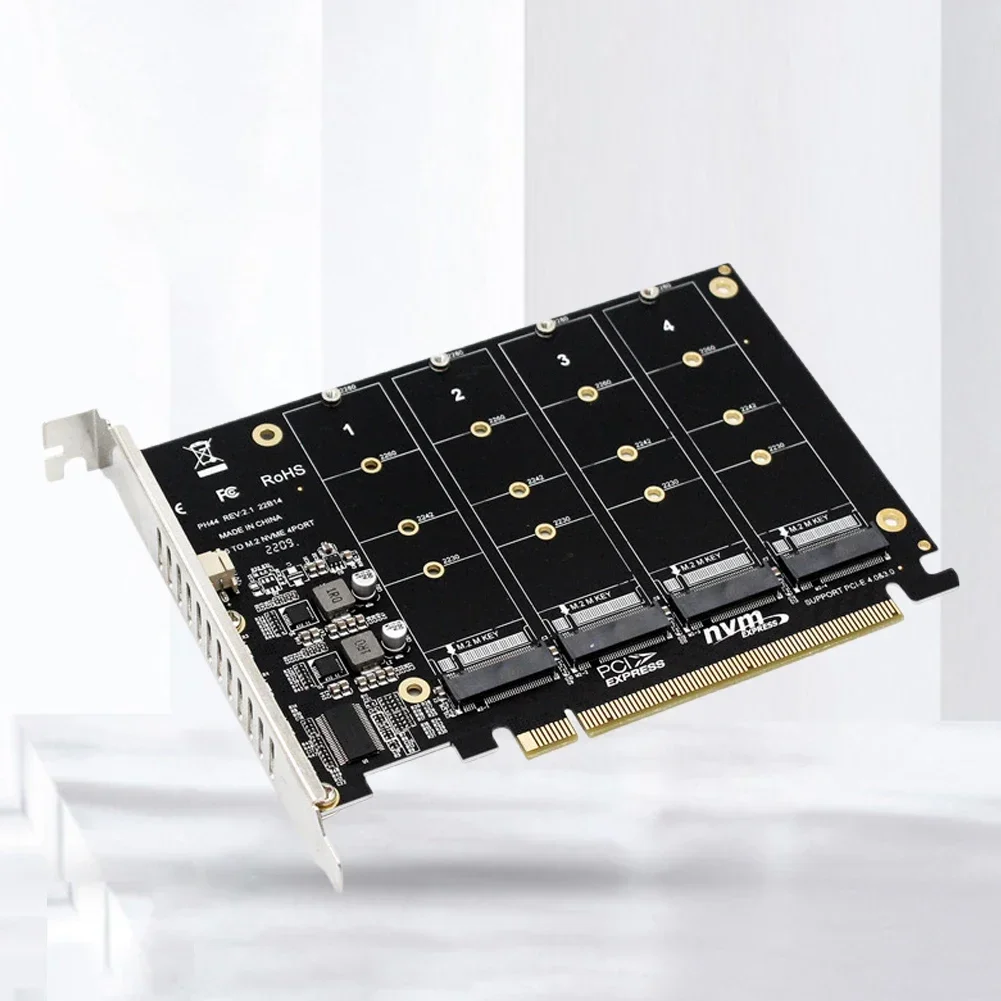
This adapter card leverages a PCIe X16 interface, crucial for its claimed performance. The visual evidence strongly suggests a passive design, relying on the motherboard's PCIe lanes. Each of the four M.2 slots is advertised to support a 32Gbps full-speed signal, which corresponds to a PCIe 3.0 x4 connection. For systems with PCIe 4.0 capabilities, this implies potential for even greater aggregate bandwidth, provided the motherboard bifurcation and CPU support it.
Modern high-performance NVMe drives demand dedicated lanes. Without proper lane allocation, performance suffers. This card offers a direct pathway. The architecture allows for simultaneous access to multiple drives.
Compared to using a single M.2 slot or slower SATA SSDs, this configuration multiplies the available bandwidth. This setup is ideal for data-intensive workloads.
Thermal Dynamics and Sustained Throughput
The card features a passive cooling design, evident from the lack of active fans or substantial heatsinks. While this simplifies installation and reduces noise, it places the onus of thermal management squarely on the system's internal airflow. High-speed NVMe SSDs, especially under sustained heavy loads, generate significant heat. Overheating leads to thermal throttling, which can severely degrade performance.
Overclockers understand that thermal stability is paramount. A hot storage array can impact surrounding components. Adequate case ventilation becomes non-negotiable.
Unlike NVMe drives directly mounted on a motherboard with dedicated heatsinks, this adapter relies on open-air cooling. Users must ensure robust case fans direct airflow over the card and its installed SSDs. Consider adding individual M.2 heatsinks to each drive for optimal thermal headroom. This is a simple, effective upgrade.
Software RAID Integration
The product explicitly mentions "Support disk 4 soft RAID" capability, specifically under Windows 10. This indicates that the card itself does not incorporate a dedicated hardware RAID controller. Instead, it relies on the operating system's built-in software RAID functionalities (like Storage Spaces in Windows or mdadm in Linux) to combine the four NVMe drives into a single logical volume. This approach offers flexibility and cost-effectiveness but typically comes with a slight performance overhead and CPU utilization compared to dedicated hardware RAID.
Software RAID requires careful configuration. System resources are utilized for parity calculations. This can impact CPU-intensive tasks.
Hardware RAID controllers, while more expensive, offload processing from the CPU and often provide more advanced features and better performance consistency. For the budget-conscious builder, software RAID is a viable option. It allows for large, fast storage arrays.
Robust Construction and Compatibility
The card's construction appears rugged, with a thickened PCB and a solid PCIe X16 interface connector. This physical resilience is vital for stability, especially when housing multiple sensitive NVMe drives within a system that might experience vibrations or frequent component changes. The LED indicators for each M.2 slot are a practical addition, offering quick visual confirmation of drive activity and status.
Thickened PCBs resist warping. This ensures consistent electrical connections. Durability matters.
Many generic adapter cards feature thinner PCBs prone to flexing, which can lead to intermittent connectivity issues, especially under load or during installation. The robust design here minimizes such risks. This protects your investment in high-speed storage.
Crucially, the card's functionality hinges on motherboard support for PCIe bifurcation (PCIe Split). This BIOS setting allows a single PCIe x16 slot to be divided into multiple smaller slots (e.g., x4/x4/x4/x4), enabling the operating system to recognize each NVMe drive independently. Without this feature, the motherboard may only detect one or none of the installed drives. Users must verify their motherboard's compatibility before purchase. This is a non-negotiable requirement for full functionality.
The Overclocker's Edge
For an overclocker, stable and fast storage is not merely a convenience; it is a foundation for pushing system limits. When the CPU and GPU are operating at their extreme, any I/O bottleneck can introduce instability or limit benchmark scores. This adapter card provides the storage headroom necessary to complement an aggressively tuned system. Rapid load times for large game files, quick compilation of complex code, or lightning-fast access to scratch disks for video editing all contribute to a smoother, more responsive overclocking experience. The ability to run multiple NVMe drives in a RAID 0 configuration via software RAID can yield sequential read/write speeds that saturate even the fastest consumer-grade PCIe 3.0 interfaces, pushing the boundaries of what a storage subsystem can achieve. This raw speed minimizes waiting.
Imagine a system where storage is never the bottleneck. This card facilitates that vision, allowing your CPU and GPU to truly stretch their legs without waiting for data. This is about maximizing every component's potential. It's about eliminating compromise.
Future-Proofing Your Storage Infrastructure
This PCIe X16 Quad M.2 NVMe SSD Adapter Card is more than just a component; it's an investment in your system's future capabilities. By providing ample high-speed storage expansion, it ensures that as your data demands grow, your system can keep pace. It offers the foundation for a truly high-performance workstation or gaming rig, where load times are virtually eliminated, and data transfers occur at the speed of thought. The flexibility to configure drives in RAID arrays further enhances its utility, allowing users to prioritize either raw speed or data redundancy based on their specific needs. This is the path to unconstrained performance.