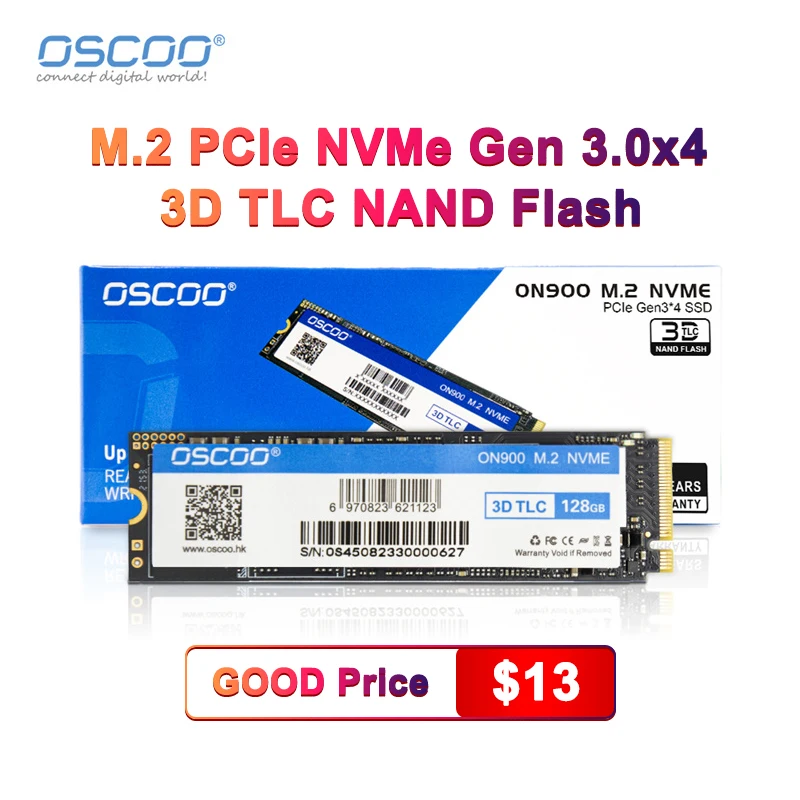
OSCOO ON900 M.2 NVMe PCIe Gen 3.0x4 SSD
Official Store Deal
Expert Analysis Overview
The OSCOO ON900 NVMe SSD is a budget-focused PCIe Gen 3.0x4 storage solution for users demanding a significant speed upgrade over traditional SATA drives without breaking the bank. This M.2 2280 form factor drive targets mainstream users and gamers who prioritize faster boot times, quicker application loading, and improved overall system responsiveness. It's a direct answer to the sluggish performance inherent in older storage technologies.
Traditional hard drives crawl. They are mechanical and slow. SATA SSDs offer a noticeable improvement, but their interface, limited to around 600 MB/s, bottlenecks throughput. The ON900, with its PCIe Gen 3.0x4 interface, bypasses these older limitations, providing a direct, high-bandwidth connection to the CPU. This connection provides four dedicated lanes. Each lane is capable of high-speed data transfer.
Unlike older SATA SSDs, which are capped around 550 MB/s in real-world scenarios, this NVMe drive leverages the PCIe bus for dramatically reduced latency and increased throughput. The NVMe protocol itself is engineered specifically for flash memory, optimizing command queues and reducing overhead. This means your system can access data far more efficiently. It truly speeds things up.
Consider a scenario involving massive video files or large game installations. Moving hundreds of gigabytes of footage or game assets on a SATA drive is a test of patience, often taking many minutes. With the ON900's advertised sequential read speeds up to 2150 MB/s and write speeds up to 1600 MB/s, those transfer times shrink considerably, often to just a few minutes. This capability is crucial for content creators, game developers, or anyone frequently handling substantial datasets where time is money.
The ON900 utilizes 3D TLC NAND Flash. This technology involves stacking memory cells vertically in multiple layers. Vertical stacking allows for significantly higher storage densities within the compact M.2 form factor. It also improves endurance characteristics compared to planar NAND. This design is efficient.
This architectural choice provides a good balance between cost, performance, and longevity, making it suitable for a wide range of applications. TLC (Triple-Level Cell) stores three bits of data per cell, which is more economical to produce than MLC (Multi-Level Cell) or SLC (Single-Level Cell) NAND, making NVMe technology more accessible. The 3D aspect helps mitigate some of the endurance and performance concerns traditionally associated with planar TLC, offering a more robust solution. The drive aims for sustained operation.
Compared to basic QLC (Quad-Level Cell) NAND found in some ultra-budget drives, 3D TLC generally offers better write endurance and more consistent performance, especially under heavier workloads. While not top-tier in terms of raw endurance like enterprise-grade MLC, it is a reliable choice for most daily computing tasks and even moderately intensive workloads. This ensures a decent lifespan.
The provided speed test data offers a clear picture of the ON900's capabilities across different capacities, highlighting the performance scaling. For instance, the 1TB model shows sequential reads around 2103 MB/s and writes around 1638 MB/s. These are solid numbers for a Gen 3.0 drive, approaching the practical limits of the interface. Smaller capacities, like the 128GB version, exhibit lower performance, with reads at 1795 MB/s and writes at 648.2 MB/s. This performance scaling is typical for SSDs. It is expected.
These figures translate directly to tangible real-world gains that impact daily productivity and user experience. System boot times shorten dramatically, often reducing from minutes to mere seconds. Applications launch almost instantly, eliminating frustrating delays. Large game worlds load much faster, minimizing wait times between levels or during fast travel. The drive provides a snappy user experience.
When stacked against a traditional 7200 RPM hard drive, the performance gap is colossal, making it an essential upgrade. Even against a mainstream SATA SSD, the NVMe advantage is clear, especially in scenarios involving multiple small file operations or demanding application launches. The difference in responsiveness is palpable, making computing feel far more fluid and immediate. It's a significant leap.
For gamers, waiting for levels to load, assets to stream, or textures to pop in is a constant source of frustration. The ON900 directly addresses this pain point by drastically reducing the time spent staring at loading screens. Its high-speed read capabilities ensure that game data is pulled from storage quickly and efficiently. This reduces loading screens.
Imagine launching your favorite open-world title and experiencing initial load times cut by half or more compared to a SATA SSD. In-game asset streaming also benefits significantly, minimizing stuttering or texture pop-in that can occur with slower storage, particularly in graphically intensive titles. This creates a smoother, more immersive gaming session, keeping players engaged. You stay in the game.
Many modern games are increasingly optimized for fast storage, with some next-gen titles even requiring NVMe SSDs for optimal performance. Using an NVMe drive like the ON900 ensures the system isn't bottlenecked by disk I/O, allowing the CPU and GPU to process data without unnecessary delays. It keeps you in the action.
The M.2 2280 form factor makes the ON900 highly versatile and easy to integrate into most modern computing platforms. This compact stick, measuring 22mm wide and 80mm long, plugs directly into compatible motherboard slots, eliminating the need for bulky cables. It fits most modern laptops.
Its wide compatibility extends to desktop computers and even external M.2 enclosures, provided they support NVMe PCIe drives. Installation is straightforward for anyone familiar with basic PC hardware, typically involving just inserting the drive and securing it with a single screw. The drive is plug-and-play.
Unlike older M.2 SATA drives that share the same physical connector but use a different underlying protocol, the ON900 is explicitly NVMe. Users must confirm their motherboard's M.2 slot supports NVMe PCIe to ensure proper function and avoid compatibility headaches. This prevents installation frustration.
While peak sequential speeds are impressive, sustained performance matters, especially for large, continuous file transfers that push the drive for extended periods. Many budget NVMe drives, particularly Gen 3.0 models, often employ a DRAM-less design, relying instead on Host Memory Buffer (HMB) technology. This utilizes a small portion of the system's main RAM as a cache. It works effectively for most tasks.
However, for transferring massive video files, compiling large codebases, or performing prolonged write operations that exceed the drive's SLC cache buffer, performance can degrade significantly after the cache is filled. The drive might slow down. This is a common and acceptable trade-off for achieving a lower price point.
Users frequently moving hundreds of gigabytes at once, such as professional video editors or data analysts, might notice this temporary performance dip. For typical daily use, including gaming, application launches, and general file management, this performance degradation is rarely an issue, as workloads are usually bursty. The drive remains quick.
The ON900 includes crucial features for maintaining drive health, optimizing performance, and ensuring data integrity over its lifespan. S.M.A.R.T. (Self-Monitoring, Analysis, and Reporting Technology) actively monitors various internal drive parameters. It provides early warnings of potential issues.
TRIM command support ensures that deleted data blocks are properly managed and reclaimed by the SSD's controller. This prevents performance degradation over time by allowing the SSD to efficiently prepare space for new data, maintaining optimal write speeds. It helps prolong drive life.
NCQ (Native Command Queuing) optimizes the order of read/write commands, allowing the drive to execute multiple commands simultaneously and more efficiently. This enhances multitasking efficiency, particularly beneficial in scenarios where multiple applications are accessing the drive concurrently. It boosts overall responsiveness. These features are standard expectations for modern SSDs.
Upgrading to an NVMe SSD like the OSCOO ON900 is one of the most impactful hardware changes for dramatically improving overall system speed and responsiveness. It breathes new life into an aging laptop. It makes a new PC feel even faster. The performance gains are immediate and noticeable, transforming the user experience.
The current price point for PCIe Gen 3.0 NVMe technology makes it more accessible than ever, offering incredible value for the performance delivered. Users no longer need to settle for the limitations of slower SATA speeds or the mechanical delays of traditional hard drives. This drive offers a tangible performance boost.
Imagine a workflow where large files transfer in a fraction of the time, applications snap open without hesitation, and your entire system responds with an immediacy you've only dreamed of. This drive delivers that experience, making daily computing tasks less frustrating and significantly more efficient. It's time for an upgrade. Don't wait.
Accelerating Data Throughput: The PCIe Advantage
Traditional hard drives crawl. They are mechanical and slow. SATA SSDs offer a noticeable improvement, but their interface, limited to around 600 MB/s, bottlenecks throughput. The ON900, with its PCIe Gen 3.0x4 interface, bypasses these older limitations, providing a direct, high-bandwidth connection to the CPU. This connection provides four dedicated lanes. Each lane is capable of high-speed data transfer.
Unlike older SATA SSDs, which are capped around 550 MB/s in real-world scenarios, this NVMe drive leverages the PCIe bus for dramatically reduced latency and increased throughput. The NVMe protocol itself is engineered specifically for flash memory, optimizing command queues and reducing overhead. This means your system can access data far more efficiently. It truly speeds things up.
Consider a scenario involving massive video files or large game installations. Moving hundreds of gigabytes of footage or game assets on a SATA drive is a test of patience, often taking many minutes. With the ON900's advertised sequential read speeds up to 2150 MB/s and write speeds up to 1600 MB/s, those transfer times shrink considerably, often to just a few minutes. This capability is crucial for content creators, game developers, or anyone frequently handling substantial datasets where time is money.
Memory Architecture: 3D TLC NAND Under Scrutiny
The ON900 utilizes 3D TLC NAND Flash. This technology involves stacking memory cells vertically in multiple layers. Vertical stacking allows for significantly higher storage densities within the compact M.2 form factor. It also improves endurance characteristics compared to planar NAND. This design is efficient.
This architectural choice provides a good balance between cost, performance, and longevity, making it suitable for a wide range of applications. TLC (Triple-Level Cell) stores three bits of data per cell, which is more economical to produce than MLC (Multi-Level Cell) or SLC (Single-Level Cell) NAND, making NVMe technology more accessible. The 3D aspect helps mitigate some of the endurance and performance concerns traditionally associated with planar TLC, offering a more robust solution. The drive aims for sustained operation.
Compared to basic QLC (Quad-Level Cell) NAND found in some ultra-budget drives, 3D TLC generally offers better write endurance and more consistent performance, especially under heavier workloads. While not top-tier in terms of raw endurance like enterprise-grade MLC, it is a reliable choice for most daily computing tasks and even moderately intensive workloads. This ensures a decent lifespan.
Performance Benchmarks: Raw Numbers and Real-World Impact
The provided speed test data offers a clear picture of the ON900's capabilities across different capacities, highlighting the performance scaling. For instance, the 1TB model shows sequential reads around 2103 MB/s and writes around 1638 MB/s. These are solid numbers for a Gen 3.0 drive, approaching the practical limits of the interface. Smaller capacities, like the 128GB version, exhibit lower performance, with reads at 1795 MB/s and writes at 648.2 MB/s. This performance scaling is typical for SSDs. It is expected.
These figures translate directly to tangible real-world gains that impact daily productivity and user experience. System boot times shorten dramatically, often reducing from minutes to mere seconds. Applications launch almost instantly, eliminating frustrating delays. Large game worlds load much faster, minimizing wait times between levels or during fast travel. The drive provides a snappy user experience.
When stacked against a traditional 7200 RPM hard drive, the performance gap is colossal, making it an essential upgrade. Even against a mainstream SATA SSD, the NVMe advantage is clear, especially in scenarios involving multiple small file operations or demanding application launches. The difference in responsiveness is palpable, making computing feel far more fluid and immediate. It's a significant leap.
Gaming Acceleration: Eliminating Load Screen Bottlenecks
For gamers, waiting for levels to load, assets to stream, or textures to pop in is a constant source of frustration. The ON900 directly addresses this pain point by drastically reducing the time spent staring at loading screens. Its high-speed read capabilities ensure that game data is pulled from storage quickly and efficiently. This reduces loading screens.
Imagine launching your favorite open-world title and experiencing initial load times cut by half or more compared to a SATA SSD. In-game asset streaming also benefits significantly, minimizing stuttering or texture pop-in that can occur with slower storage, particularly in graphically intensive titles. This creates a smoother, more immersive gaming session, keeping players engaged. You stay in the game.
Many modern games are increasingly optimized for fast storage, with some next-gen titles even requiring NVMe SSDs for optimal performance. Using an NVMe drive like the ON900 ensures the system isn't bottlenecked by disk I/O, allowing the CPU and GPU to process data without unnecessary delays. It keeps you in the action.
Seamless Integration: Form Factor and Compatibility
The M.2 2280 form factor makes the ON900 highly versatile and easy to integrate into most modern computing platforms. This compact stick, measuring 22mm wide and 80mm long, plugs directly into compatible motherboard slots, eliminating the need for bulky cables. It fits most modern laptops.
Its wide compatibility extends to desktop computers and even external M.2 enclosures, provided they support NVMe PCIe drives. Installation is straightforward for anyone familiar with basic PC hardware, typically involving just inserting the drive and securing it with a single screw. The drive is plug-and-play.
Unlike older M.2 SATA drives that share the same physical connector but use a different underlying protocol, the ON900 is explicitly NVMe. Users must confirm their motherboard's M.2 slot supports NVMe PCIe to ensure proper function and avoid compatibility headaches. This prevents installation frustration.
Sustained Performance: The DRAM-less Design Consideration
While peak sequential speeds are impressive, sustained performance matters, especially for large, continuous file transfers that push the drive for extended periods. Many budget NVMe drives, particularly Gen 3.0 models, often employ a DRAM-less design, relying instead on Host Memory Buffer (HMB) technology. This utilizes a small portion of the system's main RAM as a cache. It works effectively for most tasks.
However, for transferring massive video files, compiling large codebases, or performing prolonged write operations that exceed the drive's SLC cache buffer, performance can degrade significantly after the cache is filled. The drive might slow down. This is a common and acceptable trade-off for achieving a lower price point.
Users frequently moving hundreds of gigabytes at once, such as professional video editors or data analysts, might notice this temporary performance dip. For typical daily use, including gaming, application launches, and general file management, this performance degradation is rarely an issue, as workloads are usually bursty. The drive remains quick.
Essential Features: Maintaining Health and Efficiency
The ON900 includes crucial features for maintaining drive health, optimizing performance, and ensuring data integrity over its lifespan. S.M.A.R.T. (Self-Monitoring, Analysis, and Reporting Technology) actively monitors various internal drive parameters. It provides early warnings of potential issues.
TRIM command support ensures that deleted data blocks are properly managed and reclaimed by the SSD's controller. This prevents performance degradation over time by allowing the SSD to efficiently prepare space for new data, maintaining optimal write speeds. It helps prolong drive life.
NCQ (Native Command Queuing) optimizes the order of read/write commands, allowing the drive to execute multiple commands simultaneously and more efficiently. This enhances multitasking efficiency, particularly beneficial in scenarios where multiple applications are accessing the drive concurrently. It boosts overall responsiveness. These features are standard expectations for modern SSDs.
The Upgrade Imperative: Why Now is the Time
Upgrading to an NVMe SSD like the OSCOO ON900 is one of the most impactful hardware changes for dramatically improving overall system speed and responsiveness. It breathes new life into an aging laptop. It makes a new PC feel even faster. The performance gains are immediate and noticeable, transforming the user experience.
The current price point for PCIe Gen 3.0 NVMe technology makes it more accessible than ever, offering incredible value for the performance delivered. Users no longer need to settle for the limitations of slower SATA speeds or the mechanical delays of traditional hard drives. This drive offers a tangible performance boost.
Imagine a workflow where large files transfer in a fraction of the time, applications snap open without hesitation, and your entire system responds with an immediacy you've only dreamed of. This drive delivers that experience, making daily computing tasks less frustrating and significantly more efficient. It's time for an upgrade. Don't wait.