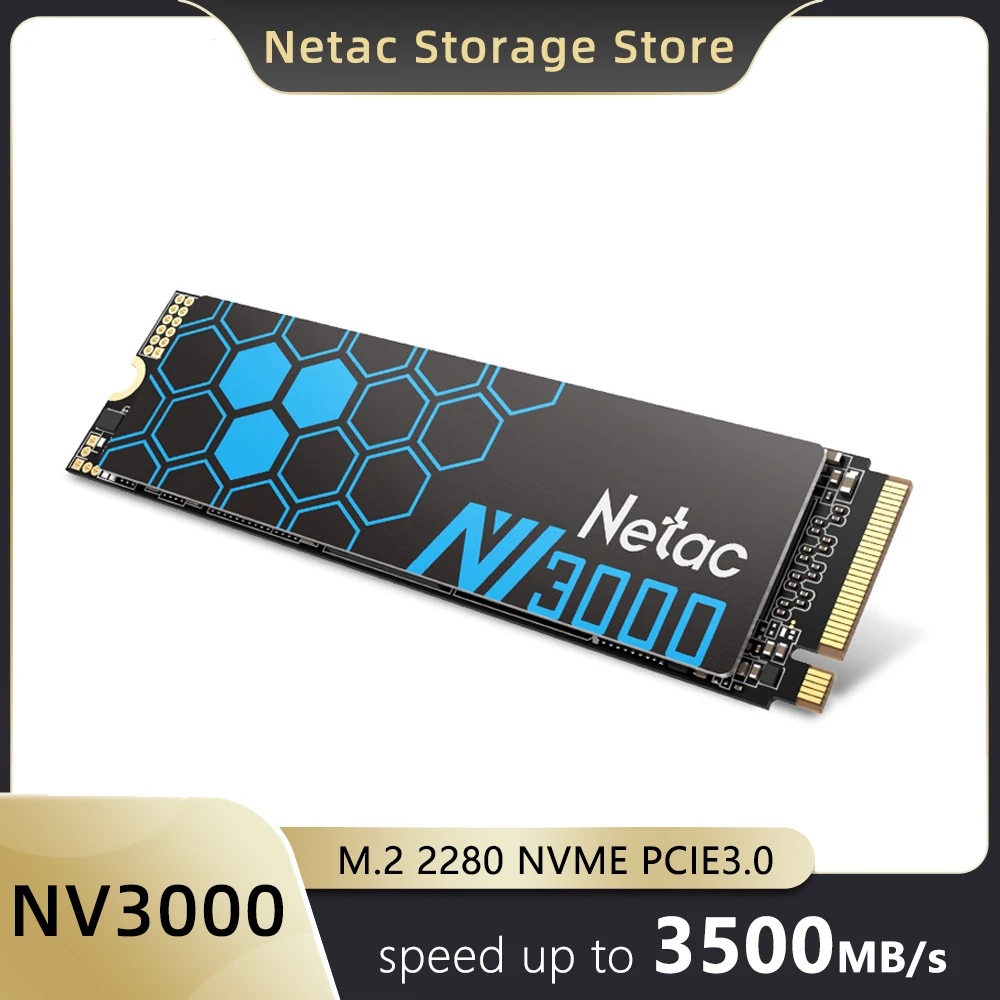
Netac NV3000 M.2 NVMe PCIe 3.0 SSD
Official Store Deal
Expert Analysis Overview
The Imperative of Speed: Netac NV3000 Performance Analysis
The Netac NV3000 is a high-performance M.2 NVMe PCIe 3.0 solid-state drive engineered for users who demand rapid data access and efficient system responsiveness. This drive targets content creators, gamers, and professionals regularly handling large datasets, where every second saved in file transfers directly translates to increased productivity. It's a clear upgrade path for systems still relying on slower SATA-based storage.
The Core of Rapid Transfers: Interface and Protocol
The NV3000 leverages the PCIe Gen3*4 interface. This means it connects directly to the motherboard's Peripheral Component Interconnect Express (PCIe) bus, utilizing four data lanes (x4) of the third generation standard. This direct connection bypasses the bottlenecks inherent in older SATA interfaces.
For context, a SATA III SSD typically maxes out at around 550 MB/s. The NVMe (Non-Volatile Memory Express) protocol, which the NV3000 employs, is specifically designed for flash-based storage. It allows for significantly higher throughput and lower latency compared to the legacy AHCI (Advanced Host Controller Interface) protocol, which was originally developed for hard disk drives. This drive is designed for speed.
Unlike traditional SATA SSDs, which are limited by a single command queue and higher latency, NVMe drives like the NV3000 can handle thousands of command queues simultaneously. This architectural advantage drastically reduces the time it takes for the CPU to communicate with the storage device, making operations feel instantaneous. For users moving massive video files or loading complex game environments, this translates into dramatically reduced wait times.
Unpacking the Performance Metrics
Performance figures are critical. The Netac NV3000 boasts sequential read speeds up to 3500 MB/s and sequential write speeds up to 3200 MB/s for its 1TB variant, according to internal testing. These numbers are not merely theoretical peaks.
The provided speed test results illustrate real-world performance across different capacities. For instance, the 2TB model shows a sequential read of approximately 3559 MB/s and a sequential write of 3107 MB/s. The 1TB model performs similarly, with 3567 MB/s read and 3202 MB/s write. Even the 250GB entry-level option delivers a respectable 3055 MB/s read, though its write speed drops to 1442 MB/s. This variation is common in SSDs, where smaller capacities often have fewer NAND dies, impacting parallel write operations.
These speeds are crucial for tasks such as loading large applications, booting the operating system, or transferring multi-gigabyte files. A system equipped with the NV3000 will feel significantly more responsive than one with a SATA SSD, especially when dealing with data-intensive workloads. The difference is palpable.
Sustained Speed and Thermal Management
High-performance SSDs generate heat. Sustained high-speed transfers can lead to thermal throttling, where the drive reduces its performance to prevent overheating. The Netac NV3000 addresses this with superior heat dissipation performance.
It integrates a combination of graphene and aluminum heat dissipation material. This innovative approach ensures uniform and real-time heat dissipation across the drive's components. The visible hexagonal pattern on the drive's label is not just aesthetic; it hints at the underlying thermal design.
Measured cooling of 10°C indicates a significant reduction in operating temperature compared to a drive without such thermal management. This is a critical feature for maintaining peak performance during extended file transfers or intense gaming sessions. Without effective cooling, even the fastest SSDs can slow to a crawl, negating their inherent speed advantage. This prevents frustrating slowdowns.
Unlike many bare M.2 SSDs that rely solely on motherboard-provided heatsinks or passive airflow, the NV3000's integrated solution provides a baseline of thermal stability. This means users in systems with less-than-optimal airflow or without dedicated M.2 heatsinks can still expect more consistent performance. It's a thoughtful inclusion that directly impacts user experience.
Durability and Longevity: The TBW Metric
An SSD's lifespan is often measured by its Terabytes Written (TBW) rating. This metric indicates the total amount of data that can be written to the drive over its lifetime before its reliability may begin to degrade. The NV3000 utilizes 3D NAND flash technology, which stacks memory cells vertically to achieve higher densities and improved endurance.
The TBW ratings vary by capacity: 150 TBW for 250GB, 300 TBW for 500GB, 600 TBW for 1TB, and an impressive 1200 TBW for the 2TB model. These figures represent significant longevity for most users. For example, a 1TB drive with 600 TBW could have 600 terabytes written to it over its 5-year warranty period, which translates to writing 328 GB per day, every day, for five years. Few users approach such daily write volumes.
This robust endurance rating, combined with a 5-year warranty, provides substantial peace of mind. It assures users that the drive is built to last and can withstand the rigors of heavy daily use. This is a considerable advantage over drives with shorter warranty periods or lower TBW ratings, offering long-term value.
Form Factor and Compatibility
The Netac NV3000 adheres to the standard M.2 2280 form factor. This means it is 22mm wide and 80mm long, making it compatible with the vast majority of modern laptops and desktop motherboards that feature an M.2 slot. Its slim profile, at just 2.9mm thick, ensures it fits comfortably into tight spaces.
Installation is straightforward for anyone familiar with PC hardware. It simply slots into an available M.2 port and is secured with a single screw. This compact design is a significant advantage over bulkier 2.5-inch SATA SSDs or traditional 3.5-inch hard drives, freeing up valuable space within a system. It's a clean, efficient upgrade.
Users should verify their motherboard or laptop supports NVMe PCIe 3.0 drives, as some older systems might only have SATA M.2 slots or lack M.2 slots entirely. Most modern systems, however, will offer at least one compatible slot, ready to accept this performance upgrade. This ensures broad applicability for current-generation machines.
The Upgrade Imperative: Beyond AHCI
One of the most compelling reasons to choose an NVMe drive like the Netac NV3000 is its performance leap over older AHCI-based storage. The product imagery highlights this, claiming it's "6 times faster than AHCI". This isn't just marketing; it's a fundamental architectural difference.
AHCI, as mentioned, was designed for mechanical hard drives. It handles commands sequentially and introduces significant overhead when communicating with fast flash memory. NVMe, conversely, was built from the ground up for SSDs. It optimizes the command queue and data transfer paths, leading to vastly superior input/output operations per second (IOPS) and lower latency.
For practical use, this means applications launch quicker, games load in a fraction of the time, and the entire operating system feels snappier. Imagine the frustration of waiting for large project files to open or for game levels to load; the NV3000 dramatically reduces these bottlenecks. It's an essential component for any system aiming for peak responsiveness.
This upgrade isn't just about raw speed numbers; it's about transforming the user experience. The constant delays associated with slower storage can severely impact workflow and enjoyment. By eliminating these friction points, the NV3000 allows users to focus on their tasks rather than waiting for their hardware. It's an investment in efficiency.
Final Thoughts on Value and Experience
The Netac NV3000 positions itself as a strong contender in the PCIe 3.0 NVMe market. It offers competitive speeds, robust thermal management, and solid endurance ratings, all backed by a 5-year warranty. The performance gains over SATA SSDs are substantial, making it an excellent choice for anyone looking to significantly improve their system's storage performance without moving to the more expensive PCIe 4.0 or 5.0 platforms.
Consider the scenarios where time is money: video rendering, large database queries, or compiling extensive codebases. This drive cuts down those agonizing waits. For gamers, it means getting into the action faster, reducing load screens from minutes to seconds. The integrated cooling ensures these speeds are maintained, even under pressure. This drive represents a pragmatic investment for tangible performance gains. Imagine your workflow unburdened by storage bottlenecks, applications snapping open instantly, and massive files transferring with unprecedented speed, allowing you to focus purely on creation and productivity. This is the operational reality the NV3000 delivers.