MLLSE RX 580 8GB 2048SP Gaming Graphics Card
Official Store Deal
Expert Analysis Overview
The MLLSE RX 580 8GB 2048SP is a budget-focused graphics accelerator engineered for users seeking a cost-effective entry into 1080p gaming with a willingness to push hardware limits. This specific variant, featuring 2048 shader processors, positions it closer to an RX 570 in raw silicon, yet retains the RX 580 branding and 8GB VRAM. It demands a meticulous approach from any serious overclocker.
The GPU-Z readout confirms the Ellesmere die, fabricated on a 14nm process, with 2048 Unified Shaders. This is the defining characteristic of the 2048SP designation, differentiating it from the full 2304SP RX 580. The die measures 232mm², integrating 5700 million transistors. This architecture, while mature, still offers a solid foundation for clock manipulation.
When loading into demanding titles, the 2048SP configuration translates to a slight reduction in peak frame rates compared to its full-fat counterpart. However, for 1080p gaming, particularly in esports titles or slightly older AAA releases, the performance remains highly competitive. The 8GB of GDDR5 memory is a significant asset here.
Compared to the original RX 570, this MLLSE offering often comes with higher factory clocks, attempting to bridge the performance gap. Overclocking potential on these 2048SP chips can sometimes surprise, as they are essentially binned RX 580 dies with a few disabled shader units. The right voltage and clock curve can yield impressive gains.
The card draws power through a single 8-pin PCIe power connector. This is standard for the RX 580 series, providing up to 150W supplementary power in addition to the 75W from the PCIe slot. Stable power delivery is paramount for sustained high clocks.
Under heavy load, especially during aggressive overclocking, the VRM (Voltage Regulator Module) quality becomes critical. While specifics on the phase design are not visually discernible from the images, budget cards often opt for simpler VRM configurations. Monitoring VRM temperatures is non-negotiable.
Unlike premium cards with over-engineered power stages, this MLLSE unit likely employs a more utilitarian setup. This necessitates careful voltage adjustments. Pushing too much voltage without adequate VRM cooling can lead to instability or premature component degradation.
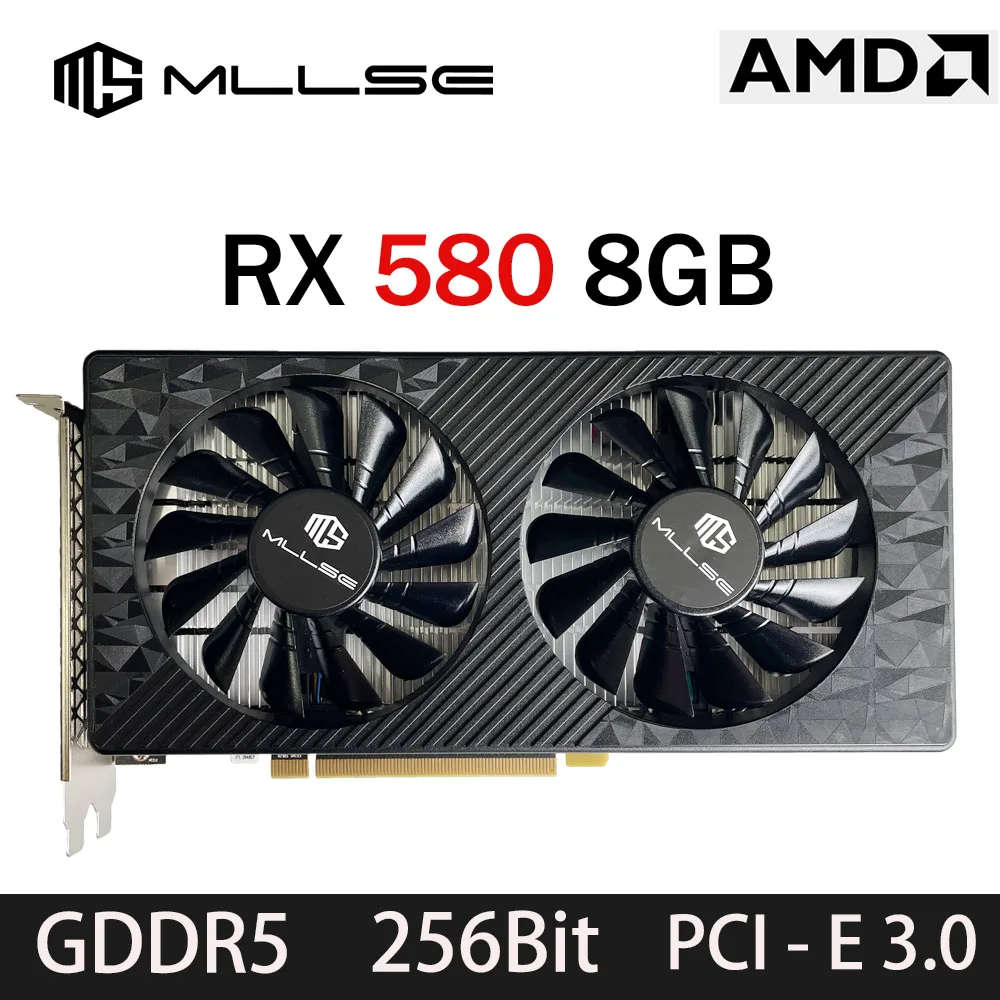
The MLLSE RX 580 2048SP utilizes a dual-fan cooling solution, housed within a plastic shroud. Two large axial fans are visible, designed to push air directly onto the heatsink fins. The side profile reveals heat pipes, suggesting direct contact with the GPU die.
During extended gaming sessions, the dual-fan setup aims to keep the Ellesmere GPU within acceptable thermal limits. The visible heatsink array appears to provide sufficient surface area for heat dissipation at stock clocks. Effective heat transfer is crucial for maintaining boost clocks.
Compared to single-fan or blower-style coolers found on some reference designs, a dual-fan open-air cooler typically offers superior thermal performance and lower noise levels. For overclockers, this translates to more thermal headroom before throttling becomes an issue. However, the exact fin density and heat pipe configuration determine the true cooling capacity.
The card presents a utilitarian, no-frills design. The black plastic shroud with red accents gives it a gamer aesthetic without being overly ostentatious. The PCB itself appears to be a custom design, rather than a direct reference board.
When held, the plastic shroud feels sturdy enough for its purpose, though it lacks the premium feel of metal backplates or more rigid constructions. The fans spin freely, exhibiting minimal wobble. Connector plating appears standard.
This build quality is a clear trade-off for the aggressive price point. While it won't win awards for industrial design, it is functionally sound. The compact dimensions (one variant at 215mm) make it suitable for smaller cases, a definite advantage for ITX builds.
Out of the box, the MLLSE RX 580 2048SP delivers respectable 1080p performance. Its 1284 MHz GPU clock and 1750 MHz memory clock (7000 MHz effective) are solid. The 8GB GDDR5 on a 256-bit bus provides ample bandwidth at 224 GB/s. This is a strong foundation.
For the overclocker, the real game begins with pushing the core clock beyond 1300 MHz and the memory past 2000 MHz (8000 MHz effective). The Samsung GDDR5 memory chips are often quite receptive to higher frequencies. Careful voltage adjustments are key.
Unlike a factory-overclocked premium card, this unit offers a blank slate for manual tuning. The silicon lottery plays a significant role here; some units will scale better than others. Expect to spend time fine-tuning voltage, clock speeds, and fan curves to find the optimal stable point. The PCI-E 3.0 x16 interface provides sufficient bandwidth for the card's capabilities.
The AMD Adrenalin software suite provides a comprehensive platform for managing and monitoring the RX 580. It offers robust controls for fan curves, core clocks, memory clocks, and voltage. The driver support is mature and well-optimized for a wide range of games.
Utilizing Adrenalin's performance tuning features allows for precise control over the card's operating parameters. Undervolting, for instance, can significantly improve efficiency and reduce heat output, even if raw clocks are not pushed. This is a powerful tool for balancing performance and thermals.
Compared to the early days of AMD's driver ecosystem, Adrenalin is a polished and reliable package. Regular updates ensure compatibility with new game releases and often bring performance improvements. This active support extends the lifespan and usability of the card.
Imagine firing up your favorite competitive shooter, knowing that every frame is meticulously extracted from this hardware. The smooth, responsive gameplay at 1080p, achieved through careful tuning, provides a deeply satisfying experience. This card, when properly configured, delivers performance that belies its modest price, allowing for immersive gaming without compromise.
Core Silicon and Architectural Nuances
The GPU-Z readout confirms the Ellesmere die, fabricated on a 14nm process, with 2048 Unified Shaders. This is the defining characteristic of the 2048SP designation, differentiating it from the full 2304SP RX 580. The die measures 232mm², integrating 5700 million transistors. This architecture, while mature, still offers a solid foundation for clock manipulation.
When loading into demanding titles, the 2048SP configuration translates to a slight reduction in peak frame rates compared to its full-fat counterpart. However, for 1080p gaming, particularly in esports titles or slightly older AAA releases, the performance remains highly competitive. The 8GB of GDDR5 memory is a significant asset here.
Compared to the original RX 570, this MLLSE offering often comes with higher factory clocks, attempting to bridge the performance gap. Overclocking potential on these 2048SP chips can sometimes surprise, as they are essentially binned RX 580 dies with a few disabled shader units. The right voltage and clock curve can yield impressive gains.
Power Delivery Architecture
The card draws power through a single 8-pin PCIe power connector. This is standard for the RX 580 series, providing up to 150W supplementary power in addition to the 75W from the PCIe slot. Stable power delivery is paramount for sustained high clocks.
Under heavy load, especially during aggressive overclocking, the VRM (Voltage Regulator Module) quality becomes critical. While specifics on the phase design are not visually discernible from the images, budget cards often opt for simpler VRM configurations. Monitoring VRM temperatures is non-negotiable.
Unlike premium cards with over-engineered power stages, this MLLSE unit likely employs a more utilitarian setup. This necessitates careful voltage adjustments. Pushing too much voltage without adequate VRM cooling can lead to instability or premature component degradation.
Thermal Management and Cooling Apparatus
The MLLSE RX 580 2048SP utilizes a dual-fan cooling solution, housed within a plastic shroud. Two large axial fans are visible, designed to push air directly onto the heatsink fins. The side profile reveals heat pipes, suggesting direct contact with the GPU die.
During extended gaming sessions, the dual-fan setup aims to keep the Ellesmere GPU within acceptable thermal limits. The visible heatsink array appears to provide sufficient surface area for heat dissipation at stock clocks. Effective heat transfer is crucial for maintaining boost clocks.
Compared to single-fan or blower-style coolers found on some reference designs, a dual-fan open-air cooler typically offers superior thermal performance and lower noise levels. For overclockers, this translates to more thermal headroom before throttling becomes an issue. However, the exact fin density and heat pipe configuration determine the true cooling capacity.
Physical Construction and Aesthetics
The card presents a utilitarian, no-frills design. The black plastic shroud with red accents gives it a gamer aesthetic without being overly ostentatious. The PCB itself appears to be a custom design, rather than a direct reference board.
When held, the plastic shroud feels sturdy enough for its purpose, though it lacks the premium feel of metal backplates or more rigid constructions. The fans spin freely, exhibiting minimal wobble. Connector plating appears standard.
This build quality is a clear trade-off for the aggressive price point. While it won't win awards for industrial design, it is functionally sound. The compact dimensions (one variant at 215mm) make it suitable for smaller cases, a definite advantage for ITX builds.
Performance Ceiling and Overclocking Potential
Out of the box, the MLLSE RX 580 2048SP delivers respectable 1080p performance. Its 1284 MHz GPU clock and 1750 MHz memory clock (7000 MHz effective) are solid. The 8GB GDDR5 on a 256-bit bus provides ample bandwidth at 224 GB/s. This is a strong foundation.
For the overclocker, the real game begins with pushing the core clock beyond 1300 MHz and the memory past 2000 MHz (8000 MHz effective). The Samsung GDDR5 memory chips are often quite receptive to higher frequencies. Careful voltage adjustments are key.
Unlike a factory-overclocked premium card, this unit offers a blank slate for manual tuning. The silicon lottery plays a significant role here; some units will scale better than others. Expect to spend time fine-tuning voltage, clock speeds, and fan curves to find the optimal stable point. The PCI-E 3.0 x16 interface provides sufficient bandwidth for the card's capabilities.
Driver Ecosystem and Software Suite
The AMD Adrenalin software suite provides a comprehensive platform for managing and monitoring the RX 580. It offers robust controls for fan curves, core clocks, memory clocks, and voltage. The driver support is mature and well-optimized for a wide range of games.
Utilizing Adrenalin's performance tuning features allows for precise control over the card's operating parameters. Undervolting, for instance, can significantly improve efficiency and reduce heat output, even if raw clocks are not pushed. This is a powerful tool for balancing performance and thermals.
Compared to the early days of AMD's driver ecosystem, Adrenalin is a polished and reliable package. Regular updates ensure compatibility with new game releases and often bring performance improvements. This active support extends the lifespan and usability of the card.
Imagine firing up your favorite competitive shooter, knowing that every frame is meticulously extracted from this hardware. The smooth, responsive gameplay at 1080p, achieved through careful tuning, provides a deeply satisfying experience. This card, when properly configured, delivers performance that belies its modest price, allowing for immersive gaming without compromise.