Mellow FLY D5 5-Axis Klipper/Marlin 3D Printer Mainboard
Official Store Deal
Expert Analysis Overview
The Mellow FLY D5 is a high-performance 3D printer mainboard engineered for enthusiasts and professionals seeking enhanced control and reliability in their additive manufacturing projects. This board targets users demanding superior layer consistency, precise axis stability, and broad material compatibility, particularly with challenging filaments like ABS and Nylon.
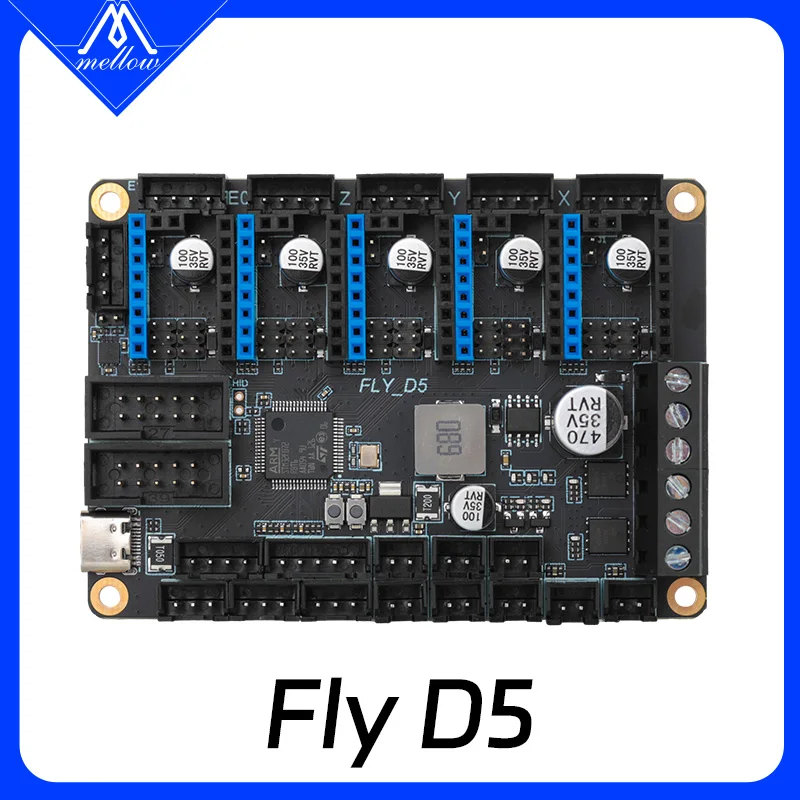
At its heart, the FLY D5 board integrates an ARM Cortex-M0+ 32-bit STM32F072RBT6 microcontroller, operating at a brisk 48MHz. This specific MCU is a significant upgrade from older 8-bit or less powerful 32-bit processors commonly found in entry-level 3D printer mainboards. Its architecture provides the computational bandwidth necessary for complex motion planning and real-time sensor data processing.
This processing capability directly translates into smoother, more accurate print movements. The board handles intricate G-code commands with minimal latency, crucial for achieving fine detail and reducing artifacts like ringing or ghosting. Users will experience improved responsiveness from their printer, especially during high-speed operations or when managing multiple complex tasks simultaneously.
Compared to the often-limited processing power of generic 8-bit boards, the STM32F072RBT6 offers a substantial leap. It enables advanced features like input shaping and pressure advance, which are fundamental to Klipper firmware's performance benefits. This is a powerful chip.
A standout feature of the FLY D5 is its direct CAN bus connectivity. The board provides dedicated CAN_L and CAN_H pins, alongside 5V, 12/24V, and GND, for a robust communication link. This eliminates the need for an external UTOC board, simplifying wiring and reducing potential points of failure.
CAN bus technology offers inherently more stable data transmission over longer distances and with greater noise immunity compared to traditional UART or SPI connections. This lower latency and enhanced reliability are critical for toolhead communication, where precise, real-time data exchange prevents print errors. Data integrity is paramount.
Standard 3D printer setups often rely on long ribbon cables or multiple individual wires, which are susceptible to electromagnetic interference and signal degradation. The integrated CAN bus on the FLY D5 provides a cleaner, more robust alternative, ensuring consistent performance even in electrically noisy environments. This is a significant upgrade.
The FLY D5 board is designed to drive five independent stepper motors, accommodating a wide range of 3D printer configurations. Each motor driver slot is compatible with UART-enabled drivers, specifically mentioning TMC2209 in the product title, which are renowned for their silent operation and advanced features like sensorless homing.
This 5-axis capability allows for versatile printer designs, including coreXY, delta, or even multi-extruder setups that require additional motor control. The ability to individually control five motors provides the flexibility needed for custom builds and advanced kinematics. Precise control is achievable.
Many entry-level boards are limited to four axes, restricting printer design possibilities. The FLY D5's five dedicated slots offer a clear advantage for those looking to build or upgrade a more complex or specialized machine, ensuring all necessary movements are precisely managed. The board supports diverse configurations.
Despite its advanced capabilities, the FLY D5 board maintains a smaller, compact size. This optimized form factor is crucial for integration into modern 3D printers, where space is often at a premium. The board fits into tight enclosures.
A smaller footprint simplifies mounting and cable management within the printer's frame. This design consideration is particularly beneficial for compact printers like the Voron 0.1/0.2, where every millimeter counts. Installation becomes less cumbersome.
Larger, more cumbersome mainboards can complicate printer assembly and limit placement options. The FLY D5's compact design offers greater flexibility, allowing for cleaner builds and potentially better airflow around components. This is a practical advantage.
The FLY D5 board offers broad firmware compatibility with both Klipper and Marlin. This dual-firmware support provides users with significant flexibility to choose the operating system that best suits their workflow and performance requirements. Klipper is often preferred for its advanced features and computational offloading.
Klipper firmware, when paired with a powerful MCU like the STM32F072RBT6, unlocks features such as input shaping, which actively compensates for printer resonances, leading to higher print speeds without sacrificing quality. Marlin, on the other hand, offers a more traditional, self-contained firmware experience. Users can select their preferred environment.
Unlike boards locked into a single firmware ecosystem, the FLY D5's versatility ensures it remains relevant as firmware technologies evolve. This adaptability protects the user's investment and allows for experimentation with different printer control philosophies. This is a smart design choice.
The board is explicitly designed for integration into popular 3D printer platforms such as the Ender 3/5 and Voron 0.1/0.2. This targeted compatibility suggests a thoughtful design process, ensuring the board's physical dimensions and electrical interfaces align with these widely used machines. Direct fitment simplifies upgrades.
This focus on specific printer models reduces the guesswork and modification often required when installing aftermarket mainboards. Users of these printers can expect a more straightforward installation process, minimizing downtime and maximizing the benefits of the upgrade. Compatibility is a key factor.
Generic mainboards often require extensive adapter boards, custom mounts, or wiring harnesses to fit into specific printer models. The FLY D5's tailored compatibility streamlines the upgrade path, making advanced control accessible to a broader user base. This saves time and effort.
The FLY D5 provides essential power delivery and peripheral connections, including 12V/24V power input, multiple fan headers, and heater outputs. These connections are standard for 3D printer operation, ensuring compatibility with existing components like hotends, heated beds, and cooling fans. All necessary ports are present.
Proper power management and peripheral control are fundamental to reliable 3D printing. The board's design supports the power requirements of typical printer components, allowing for stable operation of heaters and fans, which are critical for temperature control and part cooling. Stable power is crucial.
Some budget boards may skimp on dedicated fan headers or robust power circuits, leading to limitations in cooling or potential reliability issues. The FLY D5 appears to offer a comprehensive set of connections, supporting a full range of printer functions without compromise. This ensures operational stability.
Imagine your 3D printer operating with unprecedented precision, producing parts with flawless surface finishes and dimensional accuracy previously unattainable. Picture the quiet hum of motors, the seamless communication between components, and the confidence that comes from a stable, high-performance control system. This board enables faster print speeds without sacrificing quality, allowing for rapid prototyping and efficient production of complex geometries. Envision your most ambitious projects brought to life with consistent, professional-grade results, transforming your creative ideas into tangible realities with ease and reliability.
The Processing Core: Unlocking Advanced Control
At its heart, the FLY D5 board integrates an ARM Cortex-M0+ 32-bit STM32F072RBT6 microcontroller, operating at a brisk 48MHz. This specific MCU is a significant upgrade from older 8-bit or less powerful 32-bit processors commonly found in entry-level 3D printer mainboards. Its architecture provides the computational bandwidth necessary for complex motion planning and real-time sensor data processing.
This processing capability directly translates into smoother, more accurate print movements. The board handles intricate G-code commands with minimal latency, crucial for achieving fine detail and reducing artifacts like ringing or ghosting. Users will experience improved responsiveness from their printer, especially during high-speed operations or when managing multiple complex tasks simultaneously.
Compared to the often-limited processing power of generic 8-bit boards, the STM32F072RBT6 offers a substantial leap. It enables advanced features like input shaping and pressure advance, which are fundamental to Klipper firmware's performance benefits. This is a powerful chip.
Seamless Data Pathways: The CAN Bus Advantage
A standout feature of the FLY D5 is its direct CAN bus connectivity. The board provides dedicated CAN_L and CAN_H pins, alongside 5V, 12/24V, and GND, for a robust communication link. This eliminates the need for an external UTOC board, simplifying wiring and reducing potential points of failure.
CAN bus technology offers inherently more stable data transmission over longer distances and with greater noise immunity compared to traditional UART or SPI connections. This lower latency and enhanced reliability are critical for toolhead communication, where precise, real-time data exchange prevents print errors. Data integrity is paramount.
Standard 3D printer setups often rely on long ribbon cables or multiple individual wires, which are susceptible to electromagnetic interference and signal degradation. The integrated CAN bus on the FLY D5 provides a cleaner, more robust alternative, ensuring consistent performance even in electrically noisy environments. This is a significant upgrade.
Motion Control Precision: Driving Five Axes
The FLY D5 board is designed to drive five independent stepper motors, accommodating a wide range of 3D printer configurations. Each motor driver slot is compatible with UART-enabled drivers, specifically mentioning TMC2209 in the product title, which are renowned for their silent operation and advanced features like sensorless homing.
This 5-axis capability allows for versatile printer designs, including coreXY, delta, or even multi-extruder setups that require additional motor control. The ability to individually control five motors provides the flexibility needed for custom builds and advanced kinematics. Precise control is achievable.
Many entry-level boards are limited to four axes, restricting printer design possibilities. The FLY D5's five dedicated slots offer a clear advantage for those looking to build or upgrade a more complex or specialized machine, ensuring all necessary movements are precisely managed. The board supports diverse configurations.
Compact Engineering: Optimized Form Factor
Despite its advanced capabilities, the FLY D5 board maintains a smaller, compact size. This optimized form factor is crucial for integration into modern 3D printers, where space is often at a premium. The board fits into tight enclosures.
A smaller footprint simplifies mounting and cable management within the printer's frame. This design consideration is particularly beneficial for compact printers like the Voron 0.1/0.2, where every millimeter counts. Installation becomes less cumbersome.
Larger, more cumbersome mainboards can complicate printer assembly and limit placement options. The FLY D5's compact design offers greater flexibility, allowing for cleaner builds and potentially better airflow around components. This is a practical advantage.
Firmware Flexibility: Klipper and Marlin Ready
The FLY D5 board offers broad firmware compatibility with both Klipper and Marlin. This dual-firmware support provides users with significant flexibility to choose the operating system that best suits their workflow and performance requirements. Klipper is often preferred for its advanced features and computational offloading.
Klipper firmware, when paired with a powerful MCU like the STM32F072RBT6, unlocks features such as input shaping, which actively compensates for printer resonances, leading to higher print speeds without sacrificing quality. Marlin, on the other hand, offers a more traditional, self-contained firmware experience. Users can select their preferred environment.
Unlike boards locked into a single firmware ecosystem, the FLY D5's versatility ensures it remains relevant as firmware technologies evolve. This adaptability protects the user's investment and allows for experimentation with different printer control philosophies. This is a smart design choice.
Integration and Compatibility: Designed for Popular Platforms
The board is explicitly designed for integration into popular 3D printer platforms such as the Ender 3/5 and Voron 0.1/0.2. This targeted compatibility suggests a thoughtful design process, ensuring the board's physical dimensions and electrical interfaces align with these widely used machines. Direct fitment simplifies upgrades.
This focus on specific printer models reduces the guesswork and modification often required when installing aftermarket mainboards. Users of these printers can expect a more straightforward installation process, minimizing downtime and maximizing the benefits of the upgrade. Compatibility is a key factor.
Generic mainboards often require extensive adapter boards, custom mounts, or wiring harnesses to fit into specific printer models. The FLY D5's tailored compatibility streamlines the upgrade path, making advanced control accessible to a broader user base. This saves time and effort.
Power Delivery and Peripherals: Essential Connections
The FLY D5 provides essential power delivery and peripheral connections, including 12V/24V power input, multiple fan headers, and heater outputs. These connections are standard for 3D printer operation, ensuring compatibility with existing components like hotends, heated beds, and cooling fans. All necessary ports are present.
Proper power management and peripheral control are fundamental to reliable 3D printing. The board's design supports the power requirements of typical printer components, allowing for stable operation of heaters and fans, which are critical for temperature control and part cooling. Stable power is crucial.
Some budget boards may skimp on dedicated fan headers or robust power circuits, leading to limitations in cooling or potential reliability issues. The FLY D5 appears to offer a comprehensive set of connections, supporting a full range of printer functions without compromise. This ensures operational stability.
Imagine your 3D printer operating with unprecedented precision, producing parts with flawless surface finishes and dimensional accuracy previously unattainable. Picture the quiet hum of motors, the seamless communication between components, and the confidence that comes from a stable, high-performance control system. This board enables faster print speeds without sacrificing quality, allowing for rapid prototyping and efficient production of complex geometries. Envision your most ambitious projects brought to life with consistent, professional-grade results, transforming your creative ideas into tangible realities with ease and reliability.