Makerbase MKS DLC32 MAX CNC Router Board
Official Store Deal
Expert Analysis Overview
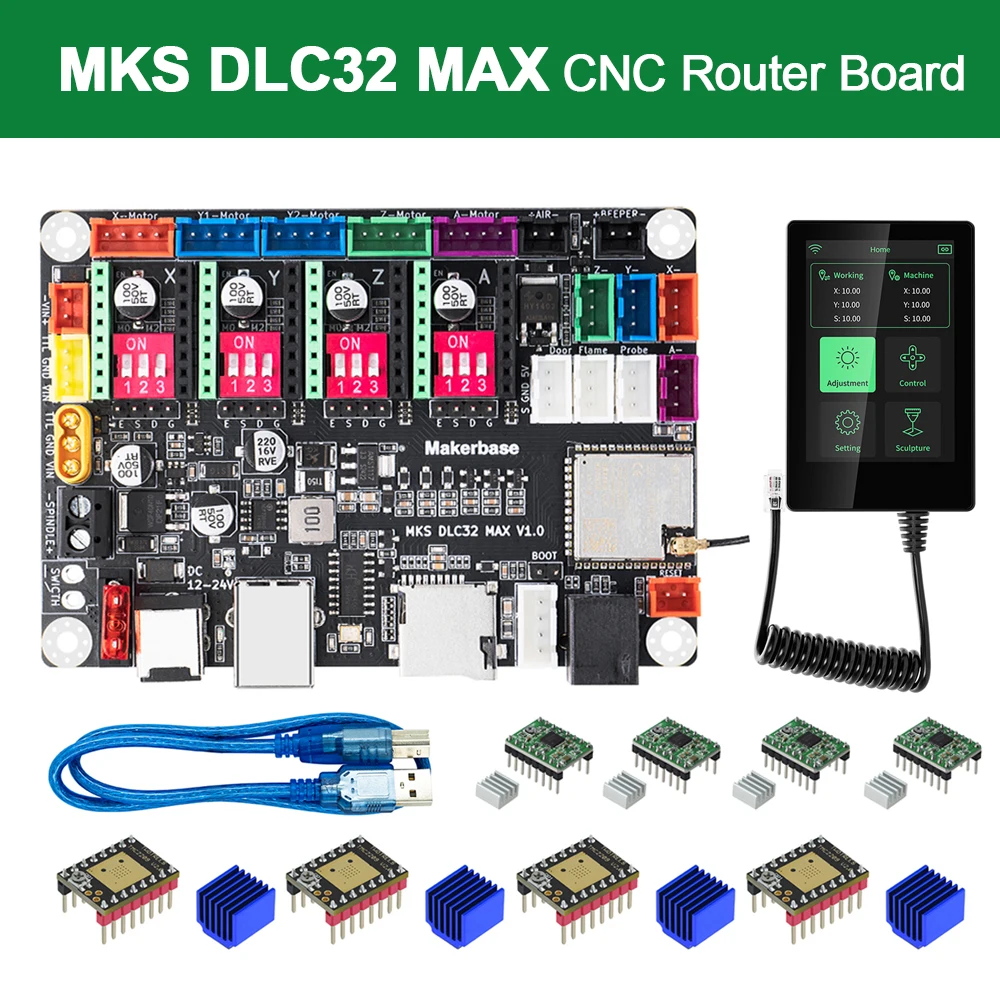
The Makerbase MKS DLC32 MAX is a highly capable and integrated CNC router board engineered for advanced laser engraving and 4-axis control, targeting hobbyists and small-scale manufacturers seeking enhanced precision and operational flexibility. This controller board significantly upgrades typical entry-level systems by consolidating multiple functionalities into a single, robust unit, streamlining complex setups. It offers a compelling solution for users aiming to achieve dimensionally accurate engineering parts and reliably process difficult materials.
The MKS DLC32 MAX board integrates an ESP32 S3 processor, operating at a main frequency of 240MHz. This processing capability is a substantial upgrade over the ESP32 S1 found in standard DLC32 models. The faster processor ensures smoother execution of complex G-code, reducing potential stuttering or lag during intricate engraving or milling operations. This is a powerful chip.
This enhanced processing power directly translates into superior command interpretation and motor control. Users will experience more responsive machine movements and a reduced likelihood of processing errors, particularly when dealing with high-resolution designs or rapid tool path changes. The system handles data efficiently.
Compared to older, less integrated control boards that often rely on external microcontrollers with lower clock speeds, the ESP32 S3 provides a unified and more powerful platform. This integration minimizes communication bottlenecks and simplifies the overall system architecture, offering a more stable and efficient control environment for demanding applications.
Connectivity options are comprehensive, including WiFi PC Interface and WiFi APP Interface. These features enable remote control and monitoring of engraving tasks. The board supports both web-based control and mobile remote control.
Remote operation allows for greater workflow flexibility. Operators can initiate, pause, or monitor jobs from a computer or smartphone, freeing them from constant physical proximity to the machine. This is particularly useful in workshop environments where multiple machines might be running simultaneously or when monitoring long engraving processes.
Many basic CNC controllers require a direct USB connection or an SD card for file transfer, limiting operational freedom. The integrated WiFi capabilities of the MKS DLC32 MAX eliminate these constraints, providing a modern and convenient method for project management and machine interaction. It is a modern solution.
The board supports a plug-in type/external driver type, offering significant flexibility in motor driver selection. This allows users to choose drivers best suited for their specific stepper motors and application requirements, from high-torque industrial motors to quieter, more precise options.
This modularity ensures that the MKS DLC32 MAX can be adapted to a wide range of CNC and laser engraving machines. Users are not locked into proprietary driver solutions, which can be a common limitation with all-in-one boards. Driver current and microstep settings are clearly detailed, supporting A4988, MKS TMC2209, and MKS TB67S109 drivers.
Unlike boards with fixed, integrated drivers, the ability to swap out drivers means easier upgrades and maintenance. If a driver fails or a user wishes to implement quieter operation with TMC2209 drivers, the process is straightforward. This extends the board's lifespan and adaptability.
Crucially, the MKS DLC32 MAX supports an A-axis, enabling 4-axis control. This capability is essential for complex rotary engraving or milling tasks, expanding the types of projects that can be undertaken. Many standard boards only offer 3-axis control.
Four-axis control opens up possibilities for intricate 3D carving and cylindrical object engraving, which are impossible with simpler 3-axis systems. This feature is a significant differentiator for users looking to push the boundaries of their fabrication capabilities. Complex geometries are now possible.
For precision prototyping, the A-axis support allows for the creation of dimensionally accurate parts with complex rotational features. This minimizes the need for manual repositioning and potential errors, leading to higher quality finished products and reduced print failures.
The inclusion of a 3.5-inch capacitive touchscreen for laser engraver control provides an intuitive and responsive offline operation experience. This eliminates the need for a constant PC connection for basic tasks.
This dedicated touchscreen simplifies machine setup, file selection, and job initiation directly at the machine. The capacitive nature ensures smooth touch response, similar to a modern smartphone, enhancing the user experience. It is very responsive.
Many entry-level boards rely on small, non-touch LCDs or require a connected computer for all operations, which can be cumbersome. The integrated capacitive touchscreen offers a self-contained and user-friendly interface, making the machine more accessible and efficient for quick jobs.
One-button switching between CNC and Laser Mode is a key feature for operational efficiency. This simplifies the transition between different machine functionalities, saving time and reducing potential configuration errors.
This streamlined mode switching is invaluable for workshops that utilize their machine for both milling and laser engraving. The ability to quickly change modes without complex software adjustments improves workflow and productivity. Switching is fast.
Traditional systems often require manual firmware changes or intricate software settings to switch between CNC and laser modes, which can be time-consuming and prone to user error. The MKS DLC32 MAX's dedicated button simplifies this process, making multi-functional use practical.
An Emergency Stop function is supported, providing a critical safety feature for immediate machine shutdown in case of unexpected events or malfunctions. This is a non-negotiable safety requirement for any power tool.
The presence of an emergency stop button enhances operator safety and protects the workpiece and machine from damage during unforeseen circumstances. Rapid shutdown minimizes risks. Safety is paramount.
Unlike some minimalist control boards that omit dedicated safety features, the MKS DLC32 MAX prioritizes user protection by integrating an emergency stop. This reflects a commitment to a safer operating environment, aligning with professional workshop standards.
Air Assist support is also included, which is beneficial for laser engraving applications. Air assist helps to clear smoke and debris from the cutting area, improving cutting performance and reducing charring.
By providing a clear line of sight for the laser and preventing material combustion, air assist significantly enhances the quality of laser cuts and engravings. It also extends the life of the laser lens by keeping it cleaner. Cleaner cuts result.
Many basic laser setups lack integrated air assist control, requiring external, often manual, solutions. The MKS DLC32 MAX's support for air assist streamlines this functionality, offering a more professional and effective laser engraving experience.
The board boasts a Maximum Engraving Speed of 30000mm/min. This high speed allows for rapid project completion, especially for large-area engravings or production runs. Speed is a major advantage.
Such high engraving speeds are crucial for maximizing throughput in a production environment or for quickly iterating on design prototypes. The ESP32 S3 processor's capabilities are fully utilized to maintain precision even at these elevated speeds. This minimizes print failures due to speed-related inaccuracies.
Compared to the 6000mm/min maximum speed of the standard DLC32, the DLC32 MAX offers a five-fold increase in potential engraving speed. This substantial performance gain directly impacts productivity and project turnaround times, delivering significant value over the long term.
The optional dual-fan enclosure design (as depicted) is a critical feature for maintaining optimal operating temperatures. Efficient heat dissipation is essential for the longevity and stable performance of electronic components.
Effective cooling prevents thermal throttling of the processor and stepper drivers, ensuring consistent performance even during prolonged, intensive operations. This directly contributes to the reliability and accuracy of the CNC machine. Stable operation is key.
Without adequate cooling, electronic boards can suffer from reduced performance, intermittent errors, and premature component failure. The dual-fan system proactively addresses these issues, offering a more dependable and durable control solution than passively cooled alternatives.
The motherboard dimensions are precisely detailed, with a length of 100.00mm and a width of 70.00mm. These dimensions are crucial for integration into custom enclosures or existing machine frames.
Accurate dimensional data allows for precise planning and fabrication of mounting solutions, ensuring a secure and stable installation. This prevents fitment issues and simplifies the mechanical integration process. Fitment is exact.
Unlike generic boards where dimensions might be approximate or require guesswork, the provided engineering drawing ensures that users can confidently design their machine's housing or mounting points, minimizing rework and assembly time. This attention to detail supports precision prototyping.
The Makerbase MKS DLC32 MAX is a robust control solution for those requiring high precision and versatility in their CNC and laser engraving projects. Its advanced processor, 4-axis support, and comprehensive connectivity options position it as a superior choice for demanding applications. The board's ability to handle high engraving speeds and support various driver types ensures that it can adapt to evolving project requirements, making it a cost-effective investment in the long run. Imagine the intricate designs and rapid prototyping capabilities this board unlocks, transforming complex ideas into tangible, high-quality products with unprecedented efficiency and control.
Core Processing Power and Connectivity
The MKS DLC32 MAX board integrates an ESP32 S3 processor, operating at a main frequency of 240MHz. This processing capability is a substantial upgrade over the ESP32 S1 found in standard DLC32 models. The faster processor ensures smoother execution of complex G-code, reducing potential stuttering or lag during intricate engraving or milling operations. This is a powerful chip.
This enhanced processing power directly translates into superior command interpretation and motor control. Users will experience more responsive machine movements and a reduced likelihood of processing errors, particularly when dealing with high-resolution designs or rapid tool path changes. The system handles data efficiently.
Compared to older, less integrated control boards that often rely on external microcontrollers with lower clock speeds, the ESP32 S3 provides a unified and more powerful platform. This integration minimizes communication bottlenecks and simplifies the overall system architecture, offering a more stable and efficient control environment for demanding applications.
Connectivity options are comprehensive, including WiFi PC Interface and WiFi APP Interface. These features enable remote control and monitoring of engraving tasks. The board supports both web-based control and mobile remote control.
Remote operation allows for greater workflow flexibility. Operators can initiate, pause, or monitor jobs from a computer or smartphone, freeing them from constant physical proximity to the machine. This is particularly useful in workshop environments where multiple machines might be running simultaneously or when monitoring long engraving processes.
Many basic CNC controllers require a direct USB connection or an SD card for file transfer, limiting operational freedom. The integrated WiFi capabilities of the MKS DLC32 MAX eliminate these constraints, providing a modern and convenient method for project management and machine interaction. It is a modern solution.
Advanced Motion Control and Driver Compatibility
The board supports a plug-in type/external driver type, offering significant flexibility in motor driver selection. This allows users to choose drivers best suited for their specific stepper motors and application requirements, from high-torque industrial motors to quieter, more precise options.
This modularity ensures that the MKS DLC32 MAX can be adapted to a wide range of CNC and laser engraving machines. Users are not locked into proprietary driver solutions, which can be a common limitation with all-in-one boards. Driver current and microstep settings are clearly detailed, supporting A4988, MKS TMC2209, and MKS TB67S109 drivers.
Unlike boards with fixed, integrated drivers, the ability to swap out drivers means easier upgrades and maintenance. If a driver fails or a user wishes to implement quieter operation with TMC2209 drivers, the process is straightforward. This extends the board's lifespan and adaptability.
Crucially, the MKS DLC32 MAX supports an A-axis, enabling 4-axis control. This capability is essential for complex rotary engraving or milling tasks, expanding the types of projects that can be undertaken. Many standard boards only offer 3-axis control.
Four-axis control opens up possibilities for intricate 3D carving and cylindrical object engraving, which are impossible with simpler 3-axis systems. This feature is a significant differentiator for users looking to push the boundaries of their fabrication capabilities. Complex geometries are now possible.
For precision prototyping, the A-axis support allows for the creation of dimensionally accurate parts with complex rotational features. This minimizes the need for manual repositioning and potential errors, leading to higher quality finished products and reduced print failures.
User Interface and Operational Efficiency
The inclusion of a 3.5-inch capacitive touchscreen for laser engraver control provides an intuitive and responsive offline operation experience. This eliminates the need for a constant PC connection for basic tasks.
This dedicated touchscreen simplifies machine setup, file selection, and job initiation directly at the machine. The capacitive nature ensures smooth touch response, similar to a modern smartphone, enhancing the user experience. It is very responsive.
Many entry-level boards rely on small, non-touch LCDs or require a connected computer for all operations, which can be cumbersome. The integrated capacitive touchscreen offers a self-contained and user-friendly interface, making the machine more accessible and efficient for quick jobs.
One-button switching between CNC and Laser Mode is a key feature for operational efficiency. This simplifies the transition between different machine functionalities, saving time and reducing potential configuration errors.
This streamlined mode switching is invaluable for workshops that utilize their machine for both milling and laser engraving. The ability to quickly change modes without complex software adjustments improves workflow and productivity. Switching is fast.
Traditional systems often require manual firmware changes or intricate software settings to switch between CNC and laser modes, which can be time-consuming and prone to user error. The MKS DLC32 MAX's dedicated button simplifies this process, making multi-functional use practical.
Safety and Performance Enhancements
An Emergency Stop function is supported, providing a critical safety feature for immediate machine shutdown in case of unexpected events or malfunctions. This is a non-negotiable safety requirement for any power tool.
The presence of an emergency stop button enhances operator safety and protects the workpiece and machine from damage during unforeseen circumstances. Rapid shutdown minimizes risks. Safety is paramount.
Unlike some minimalist control boards that omit dedicated safety features, the MKS DLC32 MAX prioritizes user protection by integrating an emergency stop. This reflects a commitment to a safer operating environment, aligning with professional workshop standards.
Air Assist support is also included, which is beneficial for laser engraving applications. Air assist helps to clear smoke and debris from the cutting area, improving cutting performance and reducing charring.
By providing a clear line of sight for the laser and preventing material combustion, air assist significantly enhances the quality of laser cuts and engravings. It also extends the life of the laser lens by keeping it cleaner. Cleaner cuts result.
Many basic laser setups lack integrated air assist control, requiring external, often manual, solutions. The MKS DLC32 MAX's support for air assist streamlines this functionality, offering a more professional and effective laser engraving experience.
The board boasts a Maximum Engraving Speed of 30000mm/min. This high speed allows for rapid project completion, especially for large-area engravings or production runs. Speed is a major advantage.
Such high engraving speeds are crucial for maximizing throughput in a production environment or for quickly iterating on design prototypes. The ESP32 S3 processor's capabilities are fully utilized to maintain precision even at these elevated speeds. This minimizes print failures due to speed-related inaccuracies.
Compared to the 6000mm/min maximum speed of the standard DLC32, the DLC32 MAX offers a five-fold increase in potential engraving speed. This substantial performance gain directly impacts productivity and project turnaround times, delivering significant value over the long term.
Thermal Management and Physical Design
The optional dual-fan enclosure design (as depicted) is a critical feature for maintaining optimal operating temperatures. Efficient heat dissipation is essential for the longevity and stable performance of electronic components.
Effective cooling prevents thermal throttling of the processor and stepper drivers, ensuring consistent performance even during prolonged, intensive operations. This directly contributes to the reliability and accuracy of the CNC machine. Stable operation is key.
Without adequate cooling, electronic boards can suffer from reduced performance, intermittent errors, and premature component failure. The dual-fan system proactively addresses these issues, offering a more dependable and durable control solution than passively cooled alternatives.
The motherboard dimensions are precisely detailed, with a length of 100.00mm and a width of 70.00mm. These dimensions are crucial for integration into custom enclosures or existing machine frames.
Accurate dimensional data allows for precise planning and fabrication of mounting solutions, ensuring a secure and stable installation. This prevents fitment issues and simplifies the mechanical integration process. Fitment is exact.
Unlike generic boards where dimensions might be approximate or require guesswork, the provided engineering drawing ensures that users can confidently design their machine's housing or mounting points, minimizing rework and assembly time. This attention to detail supports precision prototyping.
Value Proposition for Precision Prototyping
The Makerbase MKS DLC32 MAX is a robust control solution for those requiring high precision and versatility in their CNC and laser engraving projects. Its advanced processor, 4-axis support, and comprehensive connectivity options position it as a superior choice for demanding applications. The board's ability to handle high engraving speeds and support various driver types ensures that it can adapt to evolving project requirements, making it a cost-effective investment in the long run. Imagine the intricate designs and rapid prototyping capabilities this board unlocks, transforming complex ideas into tangible, high-quality products with unprecedented efficiency and control.