M5Stack M5StickC PLUS2 ESP32 Mini IoT Development Kit
Official Store Deal
Expert Analysis Overview
The M5StickC PLUS2 is a highly integrated, compact IoT development kit engineered for rapid prototyping and embedded system deployment in space-constrained applications. This device stands out in the crowded field of microcontrollers by offering a comprehensive suite of features within an exceptionally small form factor, making it an ideal choice for developers seeking efficiency and versatility. Its design philosophy prioritizes ease of use and rapid iteration, a critical advantage for modern IoT projects.
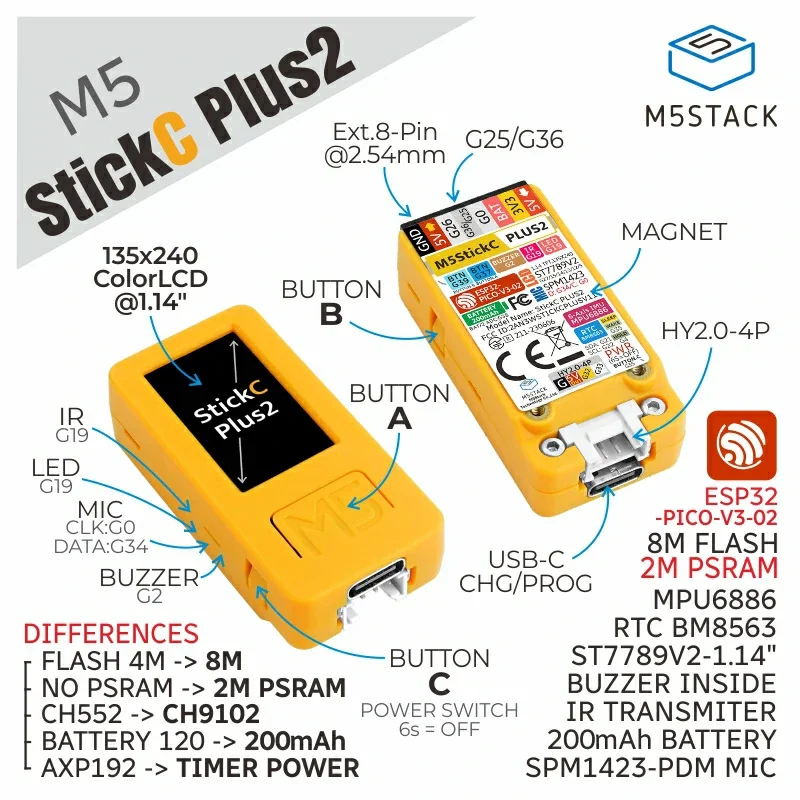
The physical dimensions of the M5StickC PLUS2 are notably miniature, measuring 48mm by 24mm by 13.5mm. This small footprint allows for integration into projects where space is at a premium. The device incorporates a 1.14-inch TFT color LCD with a resolution of 135x240 pixels. Visual feedback is immediate.
This compact size means the module can be discreetly embedded into various enclosures or worn as a wearable device. The small display, while not large, is perfectly adequate for displaying sensor readings, status updates, or simple user interfaces. It provides essential information at a glance.
Compared to larger development boards that often require external displays and bulky wiring, the M5StickC PLUS2 integrates the display directly. This reduces the overall bill of materials and simplifies assembly for many projects. It is a consolidated package.
At the heart of the M5StickC PLUS2 lies the ESP32-PICO-V3-02 microcontroller. This system-on-chip (SoC) is known for its dual-core processing capabilities and integrated Wi-Fi and Bluetooth connectivity. The device also features 8MB of Flash memory and 2MB of PSRAM.
This powerful ESP32 chip ensures that the M5StickC PLUS2 can handle complex tasks, concurrent operations, and network communications with relative ease. The ample Flash memory provides sufficient space for larger firmware and data storage. Program execution is swift.
Many entry-level IoT devices rely on less capable microcontrollers with limited memory, restricting project scope. The ESP32-PICO-V3-02, with its generous memory allocation, offers a significant upgrade in processing power and storage capacity. This allows for more sophisticated applications.
The 8MB Flash memory is a substantial upgrade from the 4MB found in previous StickC models. This increased capacity directly translates to the ability to host more complex applications, larger data logs, or even multiple firmware images for over-the-air (OTA) updates. More code fits.
For developers working with graphics, extensive libraries, or data-intensive tasks, the 2MB PSRAM is invaluable. It provides additional volatile memory beyond the ESP32's internal SRAM, preventing memory bottlenecks that can plague smaller embedded systems. Performance remains fluid.
Standard microcontrollers often force developers to meticulously optimize code and data structures due to severe memory constraints. The M5StickC PLUS2 mitigates this common pain point, offering a more forgiving development environment. It expands possibilities.
The M5StickC PLUS2 offers versatile connectivity options, including a USB-C port for power and programming, and a Grove-compatible port. An external 8-pin header provides access to additional GPIOs, including G25/G36. These interfaces are crucial.
The USB-C port ensures modern, reversible connectivity and fast data transfer, simplifying the flashing process and power delivery. The Grove port allows for quick integration with a vast ecosystem of sensors and actuators, minimizing wiring complexity. Expansion is straightforward.
Unlike many bare-bones development boards that require breadboards and intricate wiring for every peripheral, the integrated Grove port streamlines sensor integration. This significantly reduces setup time and potential wiring errors. It accelerates prototyping.
This development kit is packed with on-board peripherals, including an MPU6886 (6-axis IMU), a built-in buzzer, an IR transmitter, an RTC (BM8563), a microphone (SPM1423-PDM), and an LED. These components are factory-integrated.
The MPU6886 provides motion sensing capabilities, enabling applications like gesture control, orientation tracking, or vibration monitoring. The buzzer offers audible feedback, while the IR transmitter allows for control of infrared-enabled devices. Sensor data is rich.
Many competitor boards require users to purchase and wire these components separately, adding cost and complexity. The M5StickC PLUS2's integrated suite of sensors and actuators means developers can start building functional prototypes immediately. It saves time and effort.
Powering the M5StickC PLUS2 is a 200mAh lithium battery, managed by an AXP192 power management IC. This combination ensures efficient power delivery and respectable operational duration for a device of its size. Power is optimized.
The 200mAh battery, an upgrade from the previous 120mAh, provides extended runtime for portable applications. The AXP192 PMIC offers fine-grained control over power consumption, allowing developers to optimize battery life for specific use cases. Longer operation is possible.
Compared to boards that rely solely on external power or smaller batteries, the M5StickC PLUS2 offers greater independence and flexibility for mobile projects. This reduces the need for constant recharging. It enhances portability.
The M5StickC PLUS2 is designed to work seamlessly with UIFlow, M5Stack's block-based visual programming platform. It also supports Arduino IDE and MicroPython, offering flexibility for different developer preferences. Programming is accessible.
UIFlow simplifies the initial learning curve for beginners and speeds up development for experienced users by allowing drag-and-drop programming. For more complex or performance-critical applications, the Arduino IDE provides granular control. Rapid iteration is key.
While some development kits offer limited software support, the M5StickC PLUS2 benefits from a robust and well-documented ecosystem. This broad compatibility ensures that developers can choose the programming environment that best suits their skills and project requirements. It caters to diverse needs.
This mini IoT development kit is exceptionally well-suited for a wide array of applications, including smart home devices, DIY projects, STEM education, and wearable devices. Its compact size and integrated features make it highly adaptable. Versatility is a core strength.
For smart home integration, the Wi-Fi and IR capabilities allow it to act as a remote control or a sensor node for environmental monitoring. In STEM education, its ease of use with UIFlow makes it an excellent tool for teaching programming and electronics concepts. Learning is engaging.
Unlike generic microcontrollers that require extensive additional hardware to achieve similar functionality, the M5StickC PLUS2 provides a near-complete solution out of the box. This reduces the barrier to entry for many projects. It offers significant value.
Imagine developing a custom smart thermostat that fits unobtrusively on a wall, displaying temperature and humidity on its small screen. Consider building a wearable device for tracking activity without the bulk of larger electronics. Picture a classroom where students quickly prototype their ideas using a device that handles complex integrations effortlessly. This development kit empowers creators to bring their compact, connected visions to life with minimal friction and maximum capability, making advanced embedded projects more attainable than ever before.
The Compact Enclosure and Visual Interface
The physical dimensions of the M5StickC PLUS2 are notably miniature, measuring 48mm by 24mm by 13.5mm. This small footprint allows for integration into projects where space is at a premium. The device incorporates a 1.14-inch TFT color LCD with a resolution of 135x240 pixels. Visual feedback is immediate.
This compact size means the module can be discreetly embedded into various enclosures or worn as a wearable device. The small display, while not large, is perfectly adequate for displaying sensor readings, status updates, or simple user interfaces. It provides essential information at a glance.
Compared to larger development boards that often require external displays and bulky wiring, the M5StickC PLUS2 integrates the display directly. This reduces the overall bill of materials and simplifies assembly for many projects. It is a consolidated package.
Core Processing Prowess
At the heart of the M5StickC PLUS2 lies the ESP32-PICO-V3-02 microcontroller. This system-on-chip (SoC) is known for its dual-core processing capabilities and integrated Wi-Fi and Bluetooth connectivity. The device also features 8MB of Flash memory and 2MB of PSRAM.
This powerful ESP32 chip ensures that the M5StickC PLUS2 can handle complex tasks, concurrent operations, and network communications with relative ease. The ample Flash memory provides sufficient space for larger firmware and data storage. Program execution is swift.
Many entry-level IoT devices rely on less capable microcontrollers with limited memory, restricting project scope. The ESP32-PICO-V3-02, with its generous memory allocation, offers a significant upgrade in processing power and storage capacity. This allows for more sophisticated applications.
Memory and Storage Considerations
The 8MB Flash memory is a substantial upgrade from the 4MB found in previous StickC models. This increased capacity directly translates to the ability to host more complex applications, larger data logs, or even multiple firmware images for over-the-air (OTA) updates. More code fits.
For developers working with graphics, extensive libraries, or data-intensive tasks, the 2MB PSRAM is invaluable. It provides additional volatile memory beyond the ESP32's internal SRAM, preventing memory bottlenecks that can plague smaller embedded systems. Performance remains fluid.
Standard microcontrollers often force developers to meticulously optimize code and data structures due to severe memory constraints. The M5StickC PLUS2 mitigates this common pain point, offering a more forgiving development environment. It expands possibilities.
Connectivity and Expansion Capabilities
The M5StickC PLUS2 offers versatile connectivity options, including a USB-C port for power and programming, and a Grove-compatible port. An external 8-pin header provides access to additional GPIOs, including G25/G36. These interfaces are crucial.
The USB-C port ensures modern, reversible connectivity and fast data transfer, simplifying the flashing process and power delivery. The Grove port allows for quick integration with a vast ecosystem of sensors and actuators, minimizing wiring complexity. Expansion is straightforward.
Unlike many bare-bones development boards that require breadboards and intricate wiring for every peripheral, the integrated Grove port streamlines sensor integration. This significantly reduces setup time and potential wiring errors. It accelerates prototyping.
Integrated Peripherals and Sensors
This development kit is packed with on-board peripherals, including an MPU6886 (6-axis IMU), a built-in buzzer, an IR transmitter, an RTC (BM8563), a microphone (SPM1423-PDM), and an LED. These components are factory-integrated.
The MPU6886 provides motion sensing capabilities, enabling applications like gesture control, orientation tracking, or vibration monitoring. The buzzer offers audible feedback, while the IR transmitter allows for control of infrared-enabled devices. Sensor data is rich.
Many competitor boards require users to purchase and wire these components separately, adding cost and complexity. The M5StickC PLUS2's integrated suite of sensors and actuators means developers can start building functional prototypes immediately. It saves time and effort.
Power Management and Longevity
Powering the M5StickC PLUS2 is a 200mAh lithium battery, managed by an AXP192 power management IC. This combination ensures efficient power delivery and respectable operational duration for a device of its size. Power is optimized.
The 200mAh battery, an upgrade from the previous 120mAh, provides extended runtime for portable applications. The AXP192 PMIC offers fine-grained control over power consumption, allowing developers to optimize battery life for specific use cases. Longer operation is possible.
Compared to boards that rely solely on external power or smaller batteries, the M5StickC PLUS2 offers greater independence and flexibility for mobile projects. This reduces the need for constant recharging. It enhances portability.
Software Ecosystem and Development Workflow
The M5StickC PLUS2 is designed to work seamlessly with UIFlow, M5Stack's block-based visual programming platform. It also supports Arduino IDE and MicroPython, offering flexibility for different developer preferences. Programming is accessible.
UIFlow simplifies the initial learning curve for beginners and speeds up development for experienced users by allowing drag-and-drop programming. For more complex or performance-critical applications, the Arduino IDE provides granular control. Rapid iteration is key.
While some development kits offer limited software support, the M5StickC PLUS2 benefits from a robust and well-documented ecosystem. This broad compatibility ensures that developers can choose the programming environment that best suits their skills and project requirements. It caters to diverse needs.
Real-World Applications and Value Proposition
This mini IoT development kit is exceptionally well-suited for a wide array of applications, including smart home devices, DIY projects, STEM education, and wearable devices. Its compact size and integrated features make it highly adaptable. Versatility is a core strength.
For smart home integration, the Wi-Fi and IR capabilities allow it to act as a remote control or a sensor node for environmental monitoring. In STEM education, its ease of use with UIFlow makes it an excellent tool for teaching programming and electronics concepts. Learning is engaging.
Unlike generic microcontrollers that require extensive additional hardware to achieve similar functionality, the M5StickC PLUS2 provides a near-complete solution out of the box. This reduces the barrier to entry for many projects. It offers significant value.
Imagine developing a custom smart thermostat that fits unobtrusively on a wall, displaying temperature and humidity on its small screen. Consider building a wearable device for tracking activity without the bulk of larger electronics. Picture a classroom where students quickly prototype their ideas using a device that handles complex integrations effortlessly. This development kit empowers creators to bring their compact, connected visions to life with minimal friction and maximum capability, making advanced embedded projects more attainable than ever before.