M5Stack Atom Echo ESP32 Smart Speaker Dev Kit
Official Store Deal
Expert Analysis Overview
The Atom Echo: A Compact IoT Audio Powerhouse
The M5Stack Atom Echo is a highly integrated, compact ESP32-based development kit. It is a miniature smart speaker development platform aimed squarely at engineers and hobbyists building voice-controlled IoT devices or compact audio solutions. This device integrates an ESP32-PICO-D4 chip, a speaker, a microphone, and an RGB LED into an incredibly small form factor, making it an ideal choice for projects where space is at a premium and audio interaction is key. Its design prioritizes ease of integration into existing systems or standalone applications, offering a complete package for audio-centric embedded development.Miniature Footprint and Core Processing
The Atom Echo measures a mere 24x24x17mm. This diminutive size is a significant advantage. The device weighs only 5 grams, making it exceptionally light for portable applications. At its heart lies the ESP32-PICO-D4 microcontroller, a powerful chip known for its integrated Wi-Fi and Bluetooth capabilities. This provides robust wireless connectivity for any project.This compact form factor allows the Atom Echo to be seamlessly embedded into tight enclosures or discreet installations. Unlike bulkier development boards that demand considerable physical space, the Atom Echo minimizes the overall project footprint. This is crucial for wearables, smart home devices, or any application where aesthetics and size constraints are critical design considerations.
Compared to generic ESP32 modules which often require external breakout boards for basic functionality, the Atom Echo integrates essential components directly. This reduces the need for additional wiring and external modules, simplifying the bill of materials and assembly process. The integrated nature saves valuable development time.
Integrated Audio and Visual Feedback
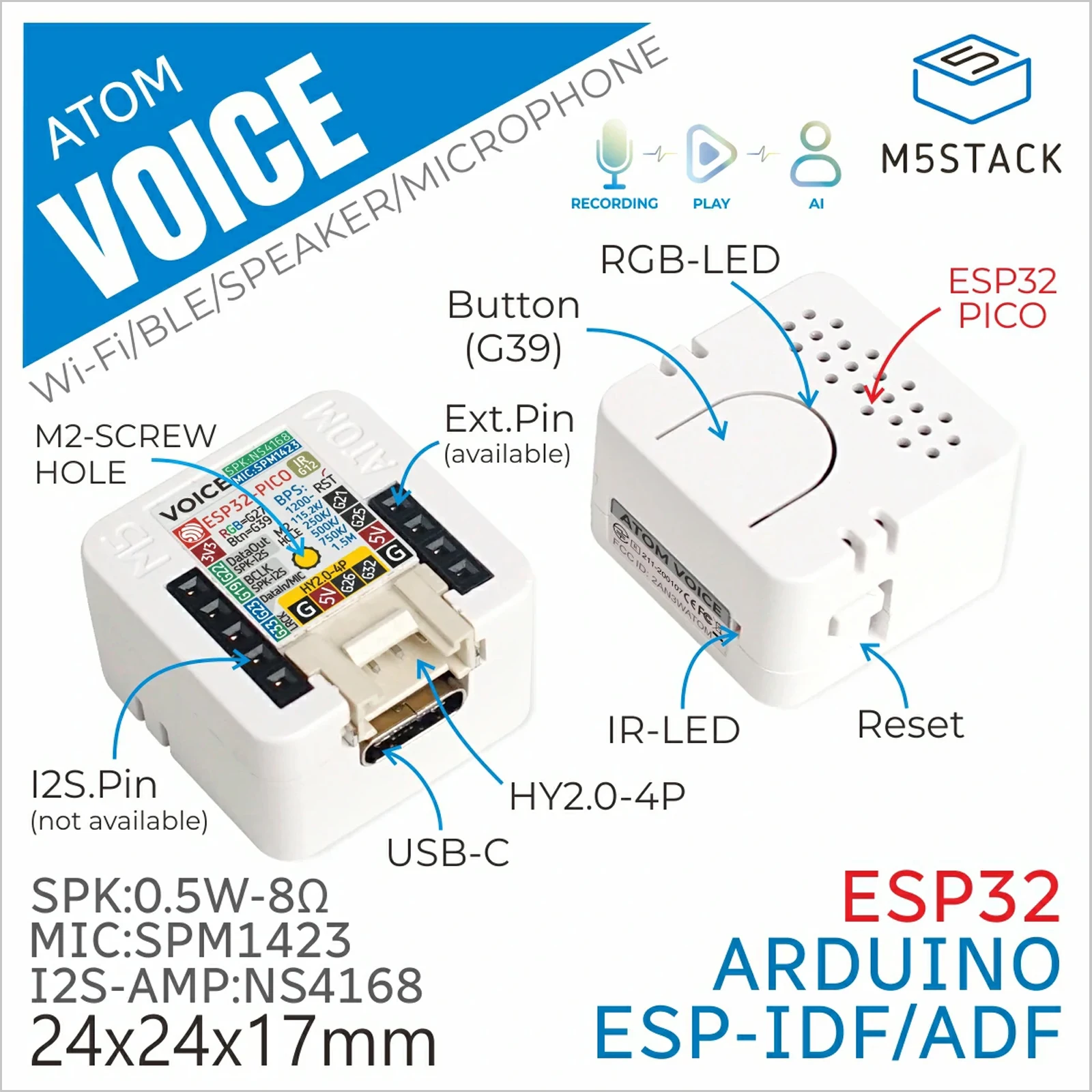
Audio capabilities are central to the Atom Echo's design. It features a 0.5W-8Ω speaker and an SPM1423 microphone. The microphone is a digital MEMS type, offering good sensitivity for voice input. An I2S-AMP NS4168 chip drives the speaker, ensuring clear audio output despite the small size. Visual feedback is provided by an integrated RGB LED, offering customizable status indicators. A physical button, mapped to GPIO39, allows for direct user input. An IR-LED is also present, enabling infrared control capabilities.These integrated components facilitate a wide range of interactive applications. Users can implement voice commands for smart home control, create audio prompts for interactive displays, or design custom sound effects for embedded systems. The RGB LED provides immediate visual cues, enhancing user experience by indicating status like Wi-Fi connection, command reception, or operational mode. The IR-LED expands its utility to control other devices.
Standard development kits often necessitate sourcing and integrating separate speaker, microphone, and LED modules. This adds complexity in terms of wiring, driver selection, and enclosure design. The Atom Echo's all-in-one approach streamlines this, allowing developers to focus on application logic rather than hardware integration challenges. It is a complete audio solution.
Connectivity and Expansion Options
Despite its small size, the Atom Echo offers practical connectivity. It utilizes a USB-C port for power and programming, a modern and convenient standard. An Ext. Pin is available for additional GPIO, though the image indicates I2S.Pin is not available for external use. A PH2.0-4P connector provides a robust interface for external peripherals, suggesting I2C or UART communication. For physical mounting, M2-screw holes are included, ensuring secure installation within a project enclosure.The USB-C port ensures broad compatibility with modern power adapters and development environments. The PH2.0-4P connector is particularly useful for adding sensors or actuators without requiring soldering, simplifying prototyping and deployment. The M2-screw holes are a practical addition, allowing for secure and permanent integration into custom enclosures, preventing accidental dislodgement during operation.
Many micro-development boards offer only exposed header pins, which can be prone to accidental disconnection or require custom PCB design for secure connections. The Atom Echo's inclusion of a PH2.0-4P connector and M2-screw holes provides a more robust and user-friendly approach to peripheral integration and mounting. This enhances the overall durability of the final product.
Development Ecosystem and Power Considerations
The Atom Echo supports a versatile development ecosystem, including ESP32, Arduino, ESP-IDF/ADF. This broad compatibility means developers can leverage familiar tools and extensive community resources. The ESP-IDF (Espressif IoT Development Framework) and ADF (Audio Development Framework) provide powerful, low-level control for optimized performance, while Arduino offers a more accessible entry point for rapid prototyping. Power is supplied via the USB-C port, typically 5V.This wide range of development environments caters to both beginners and experienced embedded engineers. Arduino's simplicity allows for quick iteration and concept validation, while ESP-IDF/ADF provides the necessary tools for complex, performance-critical applications like advanced audio processing or real-time voice recognition. The 5V USB-C power input is standard and easily sourced.
Unlike proprietary development platforms that lock users into specific software or toolchains, the Atom Echo's support for open-source frameworks fosters flexibility and long-term viability. This reduces vendor lock-in and allows projects to evolve with the broader ESP32 ecosystem. The standard 5V power input simplifies power supply integration, eliminating the need for specialized voltage regulators in most setups.