Luckfox PicoKVM IP Remote Management Module
Official Store Deal
Expert Analysis Overview
Remote System Oversight: The Luckfox PicoKVM Advantage
The Luckfox PicoKVM is a compact, network-enabled KVM solution designed for remote server and embedded system management. This device targets system administrators, IT professionals, and hobbyists requiring efficient, out-of-band access to headless or remote machines. Its small form factor and comprehensive connectivity options make it a compelling alternative to traditional, bulkier KVM setups. Remote management is crucial for modern infrastructure.Core Functionality: Uninterrupted Access
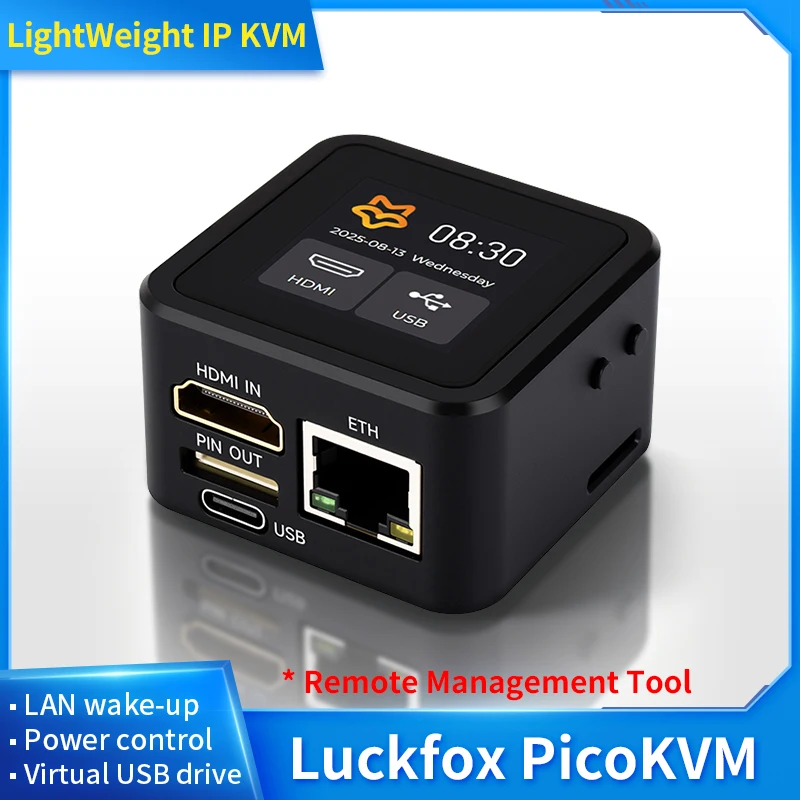
At its core, the Luckfox PicoKVM integrates HDMI-compatible video input, USB for keyboard/mouse emulation, and an Ethernet port for IP-based control. The full version includes a 1.54-inch touch display, providing immediate local status and basic interaction. This visual feedback is instant.This combination of inputs allows a user to connect directly to a target system's video output and USB input, effectively acting as a virtual keyboard, mouse, and monitor over a network connection. Such capability is invaluable for diagnosing boot issues, installing operating systems, or performing maintenance without physical presence. It saves significant time.
Unlike simple remote desktop protocols that require an active operating system, an IP KVM operates at the hardware level. This means full control from POST (Power-On Self-Test) through BIOS/UEFI settings and OS installation, a critical distinction for true server management. Standard remote access tools often fall short here.
Physical Footprint and Deployment Flexibility
The device comes in two primary configurations: a full version with a metal case and touch display, and a base version as a bare PCB. The full version measures approximately 48.50 x 48.50 x 29.00 mm. The base version is even more compact at 44.00 x 42.00 x 23.60 mm. These dimensions are remarkably small.Such miniature sizing allows the PicoKVM to be deployed in environments where space is at a premium, such as crowded server racks, custom enclosures, or embedded projects. Its discrete presence ensures it does not add significant bulk to existing hardware. Integration is straightforward.
Compared to traditional rack-mounted KVM switches, which can occupy significant rack units, the PicoKVM offers unparalleled flexibility. It can be tucked away behind a server or integrated directly into a custom system, reducing physical infrastructure demands. This minimizes clutter effectively.
Comprehensive Connectivity for Control
Connectivity is robust, featuring an HDMI IN interface for video capture, a USB port for target system control, and an ETH port for network access. There is also a USB Type-C port for power and programming, along with I/O expansion and a TF card slot. Multiple ports enhance utility.These ports collectively enable a comprehensive remote control experience. The HDMI input captures video from the target system, while the USB connection emulates a keyboard and mouse, allowing full interactive control. The Ethernet port provides the IP backbone for remote access, making the device accessible from anywhere with network connectivity. Data transfer is also possible.
This level of integrated connectivity surpasses many single-purpose remote access tools, which might only offer screen sharing or limited command-line access. The PicoKVM provides a complete virtual console, essential for deep system management. It offers full hardware interaction.
Intuitive Interface and Remote Access
The 1.54-inch touch display on the full version provides local status information, including time and input selection. For full functionality and advanced control, web access is provided, allowing management through a standard web browser. Local control is convenient.This dual control method offers flexibility. For quick checks or initial setup, the local touch display can be sufficient. For in-depth troubleshooting, OS installation, or ongoing management, the web interface provides a rich, graphical environment accessible from any networked device. It simplifies complex tasks.
Unlike purely headless solutions that offer no local feedback, or purely web-based interfaces that can be inaccessible during network issues, the PicoKVM's combination of local display and web access offers a resilient and user-friendly experience. This ensures continuous oversight.
Power Efficiency and System Integration
The device is powered via a USB Type-C port, indicating a low power draw suitable for various environments. This standard power input simplifies integration, as USB Type-C power sources are ubiquitous. Power delivery is efficient.This choice of power input means the PicoKVM can be powered by a standard USB charger, a computer's USB port, or even a power bank, enhancing its portability and deployment options. It avoids the need for proprietary power bricks, reducing complexity. Setup is quick and easy.
Utilizing a common power standard like USB Type-C is a significant advantage over devices requiring specific voltage adapters, which can complicate deployment and increase the bill of materials for system integrators. It streamlines power management.
Version Options: Tailored for Specific Needs
The Luckfox PicoKVM is available in a full version with a metal case and 1.54-inch touch display, and a base version as a bare circuit board. The full version offers a complete, ready-to-deploy solution. The base version is for custom projects. Both versions serve distinct purposes.The full version is ideal for users who need a standalone, durable remote management tool that can be quickly deployed in a server room or office. Its protective case and integrated display provide a robust user experience. It is ready out of the box.
Conversely, the base version caters to embedded system developers, custom PC builders, or those integrating the KVM functionality into a larger project. The bare PCB allows for greater customization and integration into bespoke enclosures or existing hardware. This flexibility is invaluable for specialized applications.
Cross-Domain Networking: Beyond the PC
The visual representation of "Cross-domain Networking" highlights the PicoKVM's potential for managing a diverse range of devices, not just traditional PCs. Icons suggest applications in drones, robotics, industrial control, and general IoT devices. Its reach is broad.This capability positions the PicoKVM as a versatile tool for managing complex, distributed systems where traditional KVMs might not apply. Its ability to provide remote console access to various embedded platforms opens up new possibilities for monitoring and control in industrial automation or specialized computing. It extends its utility significantly.
Unlike KVMs strictly designed for desktop or server environments, the PicoKVM's architecture and compact size make it suitable for integration into a broader ecosystem of intelligent devices. This expands its market appeal considerably. It is highly adaptable.
Imagine a scenario where a critical industrial control system experiences a software crash in a remote facility. With the Luckfox PicoKVM, an engineer can remotely access the system's BIOS, diagnose the issue, and even reinstall the operating system without traveling to the site. This capability drastically reduces downtime and operational costs, ensuring continuous productivity and minimizing logistical challenges. The ability to manage diverse systems from a central location streamlines operations, providing peace of mind and enhanced control over distributed assets. This is true remote power.