Luckfox Pico Pro Max Linux RV1106 AI Board
Official Store Deal
Expert Analysis Overview
The Next-Gen Edge AI Compute Module
The Luckfox Pico Pro Max Linux RV1106 AI Board is a compact, high-performance embedded Linux development board engineered for advanced AI acceleration and real-time processing tasks. This board targets developers and hobbyists seeking a powerful yet cost-effective solution for edge computing, particularly in applications requiring robust vision processing and machine learning capabilities. It represents a significant upgrade over previous generations, offering enhanced computational power and memory configurations within a familiar, small form factor.
Traditional microcontrollers often struggle with complex AI workloads. This board provides a dedicated NPU (Neural Processing Unit) to offload these demanding computations. This ensures smoother operation for vision-based AI. It's a powerful little device.
Core Processing Power
At its heart, the Luckfox Pico Pro Max leverages the Rockchip RV1106 processor, featuring a single-core ARM Cortex-A7 alongside a RISC-V core. This dual-core architecture allows for efficient task distribution, with the Cortex-A7 handling higher-level operating system functions and application logic, while the RISC-V core can manage real-time tasks or specific peripheral control. The RV1106 is a notable step up from the RV1103, offering improved performance and efficiency for embedded AI applications. This chip provides substantial processing grunt.
Many entry-level boards rely solely on a single ARM core, which can become a bottleneck when running Linux and simultaneously performing AI inference. The inclusion of a dedicated RISC-V core alleviates this pressure, enabling more responsive and stable operation. This dual-core approach is a smart design choice for balancing power and efficiency in a constrained environment.
AI Acceleration Capabilities
One of the standout features of this board is its integrated Neural Processing Unit (NPU), which delivers 0.5 TOPS (Tera Operations Per Second) of AI computing power. This NPU is specifically designed to accelerate machine learning inference, making the board highly suitable for applications such as facial recognition, object detection, and intelligent video analysis. The ability to perform AI tasks directly on the edge device reduces latency and bandwidth requirements, crucial for real-time systems.
Without a dedicated NPU, AI workloads would fall back to the CPU, severely impacting overall system performance and power consumption. The NPU offloads these intensive calculations, freeing up the main CPU for other tasks and allowing for more complex AI models to run efficiently. This is a game-changer for many projects.
Memory Configurations
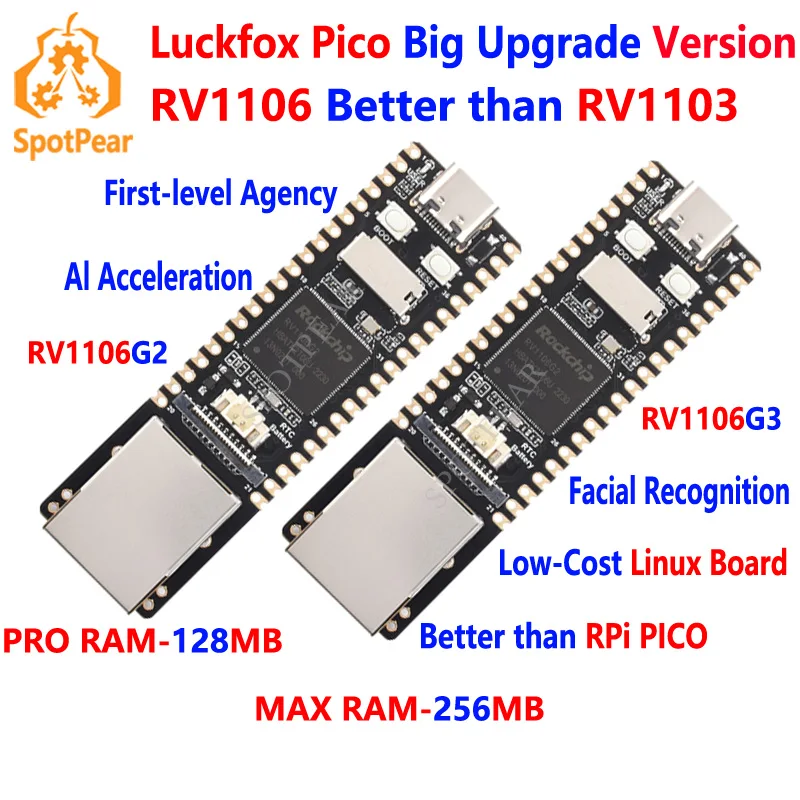
The Luckfox Pico Pro Max is available in two main memory configurations: 128MB RAM (RV1106G2) and 256MB RAM (RV1106G3). The 256MB option provides significantly more headroom for running larger Linux distributions, more complex applications, and bigger AI models. For demanding vision applications or scenarios requiring extensive data buffering, the 256MB variant is the preferred choice. More RAM means more possibilities.
Boards with limited RAM often force developers to use highly stripped-down Linux builds or resort to complex memory management techniques. The 256MB option minimizes these compromises, offering a more comfortable development experience and broader application scope. Consider the larger memory for serious projects.
Connectivity and Peripherals
Visual inspection reveals a USB Type-C port for power and data, along with a standard RJ45 Ethernet port for reliable wired network connectivity. The presence of an Ethernet port is a significant advantage for industrial applications, network-attached devices, or any project where stable, high-speed data transfer is critical. Wireless connectivity, while convenient, often introduces latency and reliability issues that wired connections avoid. It offers solid networking.
The board also features multiple GPIO pins exposed via standard headers, allowing for extensive interfacing with sensors, actuators, and other custom hardware. A CSI camera interface is clearly visible, indicating native support for camera modules, essential for its intended AI vision applications. This broad I/O capability makes the board highly adaptable to various embedded projects.
Form Factor and Compatibility
Designed with a compact footprint, the board's dimensions appear similar to a Raspberry Pi Pico, making it suitable for space-constrained projects. The pin headers are arranged to facilitate easy integration into breadboards or custom PCBs. Its small size belies its processing power. This form factor is highly versatile.
When integrating into a custom enclosure, the board's dimensions and the placement of the Ethernet port and USB-C connector are critical. Careful planning ensures all components fit without obstruction. Power supply considerations are also paramount; a stable 5V source via the USB-C port is expected for optimal performance. Ensure proper voltage delivery.
Operating System and Development Ecosystem
This board runs Linux, providing a familiar and powerful environment for software development. The Linux ecosystem offers a vast array of tools, libraries, and frameworks, including those for AI and machine learning. This open-source foundation simplifies development, allowing access to a rich community and extensive documentation. Linux provides flexibility.
Developing on a Linux board like this, especially with AI capabilities, opens doors to sophisticated applications that are simply not feasible on simpler microcontrollers. The ability to run Python, C++, and other high-level languages directly on the device streamlines the development workflow. This is a powerful platform for innovation.
Value Proposition and Market Positioning
The Luckfox Pico Pro Max positions itself as a low-cost Linux board that offers performance superior to a Raspberry Pi Pico, particularly in AI acceleration. While the Raspberry Pi Pico is an excellent microcontroller for basic embedded tasks, it lacks the processing power, RAM, and dedicated AI hardware to run a full Linux OS and perform complex AI inference. This board fills that gap, providing a more capable platform at a competitive price point. It offers more for less.
For projects that have outgrown the capabilities of a microcontroller but don't require the full power (or cost) of a larger single-board computer like a Raspberry Pi 4, the Luckfox Pico Pro Max presents an ideal middle ground. It balances performance, features, and cost effectively. This board targets a specific niche.
Real-World Application Scenarios
Imagine deploying a compact security camera system that performs facial recognition directly on the device, sending alerts only when specific individuals are detected, reducing false positives and bandwidth usage. Consider smart home devices that analyze environmental data and user behavior with on-device AI for personalized automation. Picture industrial sensors that perform real-time anomaly detection on machinery, preventing costly downtime before it occurs. This board makes these scenarios feasible. It enables intelligent edge solutions.
Technical Specifications Overview
The board's design, with its exposed headers and integrated components, suggests a robust platform for prototyping and deployment. The inclusion of a metal shield over the main processor likely aids in thermal management and electromagnetic compatibility, crucial for reliable operation in various environments. This attention to detail improves stability.
Powering Your Projects
Power delivery to the board is critical for stable operation, especially when driving peripherals like cameras or external sensors. The USB Type-C input is convenient and widely adopted, but ensuring the power supply can deliver sufficient current is essential. A 5V, 2A power adapter is generally recommended for such boards, providing ample power for the CPU, NPU, and connected devices. Adequate power prevents instability. Overcurrent protection is also important.
Software Development Workflow
Developing for the Luckfox Pico Pro Max typically involves cross-compilation on a host PC, followed by flashing the Linux image and application binaries to the board's storage. The Rockchip SDK and toolchains provide the necessary resources for building custom kernels, drivers, and user-space applications. Familiarity with Linux command-line tools and embedded development practices will be beneficial. The learning curve is manageable.
Conclusion: Empowering Edge Intelligence
The Luckfox Pico Pro Max Linux RV1106 AI Board stands out as a compelling option for developers venturing into edge AI and embedded Linux projects. Its combination of a powerful Rockchip RV1106 processor, dedicated NPU, flexible memory options, and comprehensive connectivity makes it a versatile platform. This board offers a significant performance boost over traditional microcontrollers, particularly for AI-driven applications, all within a compact and cost-effective package. For those looking to build intelligent, connected devices without the overhead of larger single-board computers, this board provides the necessary horsepower and flexibility. Imagine bringing your innovative AI concepts to life, deploying intelligent vision systems, or creating smart devices that react in real-time to their environment, all powered by this capable little board. It truly empowers next-generation embedded solutions.