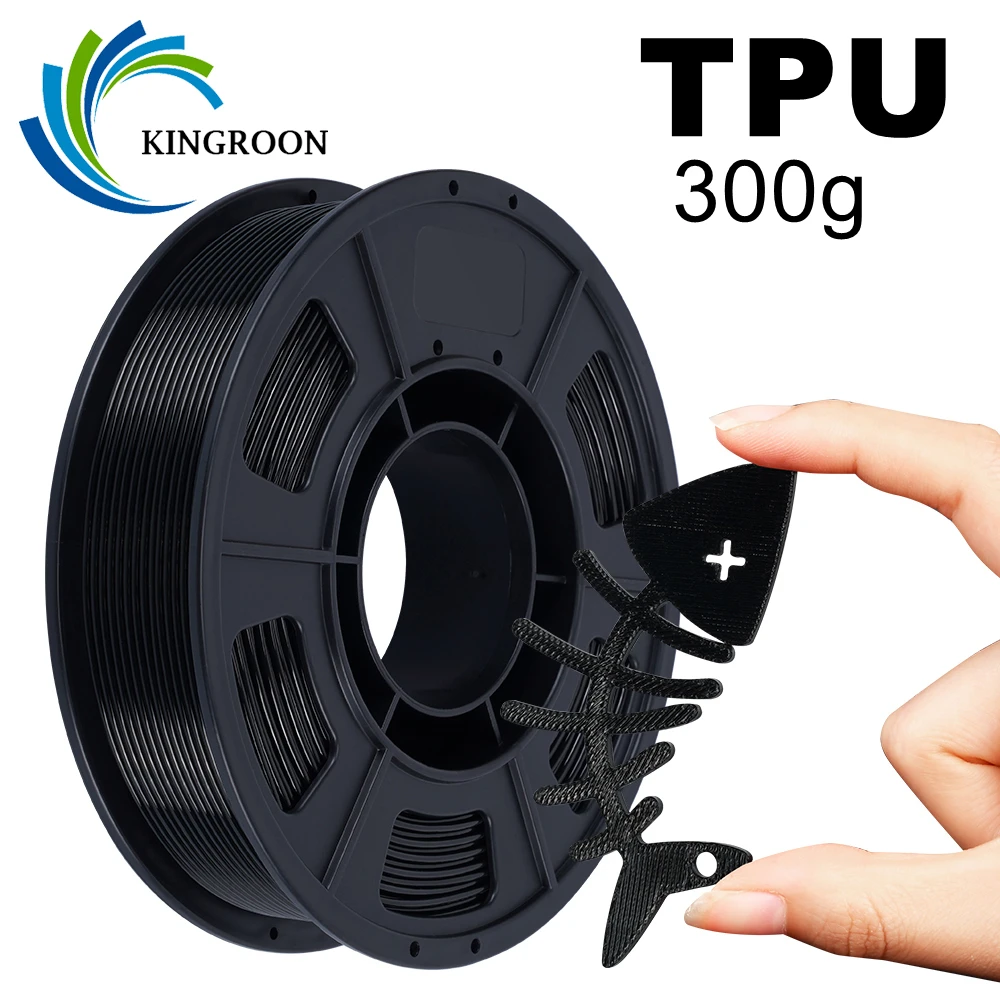
KINGROON TPU Filament 1.75mm 95A (300g)
Official Store Deal
Expert Analysis Overview
The Flexible Frontier: Exploring TPU's Potential
The KINGROON TPU Filament is a specialized, flexible 3D printing material tailored for makers and tinkerers exploring advanced functional prints. This particular offering, a 300g spool of 1.75mm 95A Shore Hardness Thermoplastic Polyurethane, positions itself as an ideal choice for experimental projects and prototypes where material flexibility is paramount. Its formulation aims to provide a reliable printing experience, often a challenge with flexible filaments.
Thermoplastic Polyurethane, or TPU, stands out in the filament landscape due to its unique blend of rubber-like elasticity and thermoplastic processability. Unlike rigid filaments such as PLA or ABS, TPU offers significant elongation at break, making it suitable for parts that require bending, stretching, or impact absorption. The 95A Shore Hardness rating indicates a relatively firm yet highly flexible material. Shore hardness is a measure of a material's resistance to indentation, with 'A' scale typically used for softer plastics and rubbers. A 95A rating means it is comparable to a soft skateboard wheel or a rubber shoe sole. This specific hardness allows for prints that are tough, durable, and can withstand repeated flexing without fracturing. For a maker, this opens up a vast array of possibilities.
Consider the creation of custom gaskets, protective cases for electronics, or even flexible components for robotics. The material's inherent properties enable the production of parts that would be impossible with brittle plastics. This flexibility also contributes to excellent vibration dampening characteristics. The implications for hobbyists working on drones or RC vehicles are clear: reduced wear on components and a quieter operation. The tactile feel of 95A TPU is distinct, offering a grippy, resilient surface. It's a versatile material for demanding applications.
Precision in Motion: Filament Engineering for Reliable Prints
Consistent filament diameter is crucial for successful 3D printing. The KINGROON TPU filament boasts a wire diameter tolerance of 1.75mm ±0.05mm. This tight tolerance minimizes variations in extrusion, which directly translates to more consistent layer lines and overall print quality. Inconsistent filament diameter can lead to under-extrusion, over-extrusion, or even nozzle clogs, especially with flexible materials that are sensitive to feeding issues. Maintaining such precision ensures a smoother material flow through the hotend.
Beyond diameter, the physical winding of the filament on the spool significantly impacts print reliability. This TPU filament is advertised as 'neatly wound' and 'tangle-free'. A well-wound spool prevents knots and overlaps that can cause the filament to snag during printing, potentially leading to failed prints or even damage to the extruder. Flexible filaments are particularly prone to tangling due to their inherent elasticity. A spool that feeds smoothly is essential. This careful winding reflects an understanding of common printing frustrations.
Furthermore, the filament is described as 'bubble-free' and offering 'good liquidity'. Air bubbles within the filament can cause voids and inconsistencies in printed parts, weakening them and marring their surface finish. 'Good liquidity' refers to the filament's ability to melt and flow consistently through the nozzle, which is vital for achieving strong layer adhesion and intricate details. These characteristics, combined with 'no blockage', aim to provide a printing experience that minimizes common issues associated with flexible materials. It simply feeds better. Unlike lower-quality filaments that might exhibit inconsistent flow or frequent jams, this formulation aims for a more forgiving printing process, allowing makers to focus on design rather than constant troubleshooting.
Ecosystem Integration: Designed for Diverse Printer Setups
This KINGROON TPU filament is designed for use with 'most FDM 3D printers'. FDM (Fused Deposition Modeling) technology is the most common type of desktop 3D printer, extruding melted plastic layer by layer. The broad compatibility suggests that typical FDM setups, from entry-level machines to more advanced direct-drive systems, should be able to process this material. However, printing flexible filaments often requires specific considerations, such as slower print speeds and optimized retraction settings.
One notable feature highlighted is its compatibility with the 'AMS Bracket & Dry Box', and visuals show it 'perfectly hung on the AMS Rack'. An AMS, or Automatic Material System (like those found on Bambu Lab printers), allows for multi-material and multi-color printing by automatically switching between different spools. For flexible filaments, this is a significant advantage, as it enables the integration of flexible parts into larger, multi-material assemblies without manual filament changes. The small 300g spool size is particularly well-suited for AMS units, which often have specific dimension requirements for spools. It fits right in.
The ability to integrate seamlessly with advanced material handling systems like the AMS makes this filament attractive to tinkerers who are looking to push the boundaries of their multi-material printing capabilities. While many flexible filaments can be challenging to feed through Bowden extruders (where the motor is separate from the hotend), the properties and careful winding of this filament suggest an effort to improve feeding. Direct drive extruders generally handle flexible filaments more reliably. This filament's design considerations make it a strong candidate for experimentation with complex multi-material projects. It expands creative options for the advanced user.
The Tinkerer's Trove: Value in Targeted Volume
The KINGROON TPU filament is offered in a 300g spool. This smaller volume, explicitly noted as 'NOT 1KG', is a strategic choice that caters to a specific segment of the 3D printing community. For makers and tinkerers, a smaller spool can be incredibly valuable. It reduces the initial cost of acquiring a new material, making experimentation more accessible. Many projects only require a small amount of a specialized filament. This avoids waste.
Often, a maker might need a specific color or material for a single component or a small batch of prototypes. Purchasing a full kilogram spool for such needs can result in significant unused material, which, especially for hygroscopic (moisture-absorbing) filaments like TPU, can degrade over time if not stored perfectly. The 300g size minimizes this risk and allows for a broader palette of materials and colors to be kept on hand without a large inventory investment. It is a cost-effective way to diversify material choices.
This targeted volume also aligns with the iterative nature of design and development. When experimenting with different Shore hardnesses or filament types, a maker can acquire multiple smaller spools to test various options without committing to a large quantity of a single type. This approach fosters innovation and reduces the barrier to entry for trying new things. It promotes a sense of exploration. Compared to purchasing a large, expensive spool that might sit unused for months, the 300g option provides practical value for focused projects and material exploration, preventing material spoilage and reducing upfront costs for specialized applications.
Crafting the Future: Practical Applications and Beyond
Imagine the satisfaction of perfecting a custom drone landing gear that flexes on impact, absorbing shock and protecting delicate electronics. Picture the ideal ergonomic grip for a tool, printed precisely to fit your hand, offering comfort and control. Envision producing a series of small, flexible connectors for a modular robotics project, each one fitting perfectly and enduring repeated stress. This TPU filament enables these creations. It allows for a level of functional integration previously difficult to achieve with standard rigid plastics. Your designs will gain new resilience. The material's properties empower makers to move beyond decorative prints, stepping into the realm of truly functional, durable, and adaptable components. Embrace the possibilities of flexible manufacturing with this robust material.