Kebidumei Dual-Band Wi-Fi Range Extender
Official Store Deal
Expert Analysis Overview
The Kebidumei Dual-Band Wi-Fi Range Extender is a cost-effective network expansion unit targeting users seeking to mitigate dead zones without significant infrastructure investment. This device functions primarily as a repeater, extending an existing wireless signal to areas with poor coverage. Its design prioritizes straightforward deployment over advanced network management capabilities, making it accessible for general home use.
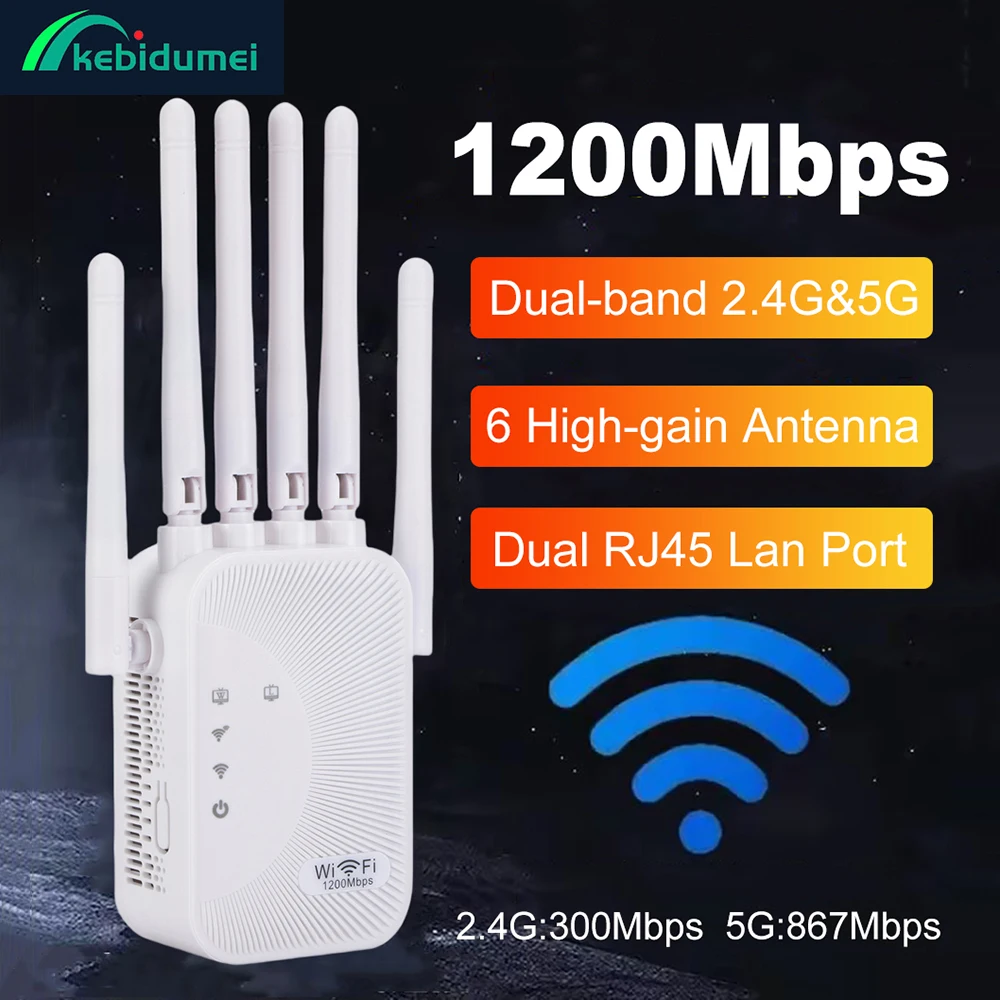
This extender advertises a combined theoretical throughput of 1200Mbps, segmented into 300Mbps on the 2.4GHz band and 867Mbps on the 5GHz band. These figures correspond to the Wi-Fi 4 (802.11n) standard for 2.4GHz and Wi-Fi 5 (802.11ac) for 5GHz, assuming a 2x2 MIMO configuration. The 2.4GHz band operates at 300Mbps, providing stable signal propagation over longer distances and through obstacles. The 5GHz band, rated at 867Mbps, offers higher speeds and reduced interference in less congested environments.
In practical scenarios, the actual throughput will be subject to various environmental factors, including interference, distance from the primary router, and the number of active clients. A repeater inherently halves the bandwidth on the extended segment, as it must receive and retransmit data on the same radio. Users should anticipate real-world speeds significantly lower than the theoretical maximums, particularly when multiple devices are simultaneously streaming high-definition content or engaging in latency-sensitive applications. This device is not a substitute for a dedicated mesh system.
Compared to older 802.11n-only extenders, the inclusion of the 5GHz 802.11ac band represents a substantial upgrade in potential bandwidth and spectral efficiency. While not reaching Wi-Fi 6 (802.11ax) performance, it provides a noticeable improvement for modern devices that support 5GHz connectivity. The dual-band operation allows for intelligent band steering or manual selection, optimizing client connections based on signal strength and required bandwidth.
The unit features six external high-gain antennas. These antennas are designed to enhance both signal transmission and reception, crucial for extending Wi-Fi coverage effectively. High-gain antennas concentrate the radio frequency energy in specific directions, improving signal strength and penetration through walls.
Consider a multi-story dwelling or a large single-floor layout with several internal walls. The 2.4GHz band, with its longer wavelength, exhibits superior wall penetration capabilities. The six antennas work in concert to project this signal more robustly, reducing dead zones in challenging architectural layouts. Signal stability is paramount.
Unlike internal antenna designs found in many compact extenders, the external, adjustable antennas on this Kebidumei unit offer a degree of directional flexibility. This allows users to fine-tune antenna orientation for optimal signal path alignment, potentially improving connectivity in specific problem areas. This is a distinct advantage.
Equipped with dual RJ45 LAN ports, this extender offers flexible integration options. These ports can function in either WAN or LAN mode, depending on the operational configuration. When operating as a repeater, one port can provide a wired connection for a device such as a desktop PC, smart TV, or gaming console, offering a more stable and lower-latency connection than Wi-Fi.
Alternatively, these ports facilitate the device's use as a wireless access point (AP). In AP mode, the extender connects to the main router via an Ethernet cable, creating a new Wi-Fi network. This bypasses the inherent bandwidth reduction of repeater mode, providing full wired backhaul performance. This is a critical distinction.
For network engineers, the presence of dual RJ45 ports suggests basic VLAN pass-through capabilities, though advanced VLAN tagging or management features are unlikely at this price point. The device is intended for simple network expansion, not complex enterprise-grade segmentation. Its primary function is extending reach.
The device presents a matte white plastic enclosure. The material feels reasonably dense, suggesting adequate durability for a stationary Networking component. The six antennas are articulated, allowing for adjustment, and their hinges exhibit sufficient stiffness to maintain position once set. Button presses are tactile.
User interaction is primarily through a web-based interface, accessible via a browser. Setup typically involves connecting to the extender's default SSID, navigating to a specific IP address, and following a wizard-driven configuration process. This approach is standard for consumer-grade networking hardware. The interface is intuitive.
While the firmware is likely proprietary, basic repeater and AP modes are expected. Advanced features such as OpenWRT compatibility, custom DNS, or granular QoS controls are not typically found in devices of this class. The focus remains on core functionality. It is a plug-and-play solution.
This Kebidumei extender is well-suited for residential environments struggling with Wi-Fi dead zones. Its dual-band capability and high-gain antennas provide a noticeable improvement in coverage and speed compared to relying solely on a primary router's signal. It supports up to 15 connected devices, making it suitable for typical household usage.
Consider a scenario where a home office or a smart TV in a distant bedroom experiences intermittent connectivity. Deploying this extender strategically can provide a stable link, enabling uninterrupted video conferencing or 4K streaming. Its compact form factor allows for discreet placement. This improves daily productivity.
Compared to investing in a full mesh Wi-Fi system, which can cost several hundred dollars, this extender offers a significantly more economical solution for targeted signal improvement. While it lacks the seamless roaming and centralized management of mesh networks, its price point makes it an attractive option for budget-conscious consumers. It delivers essential functionality.
The Kebidumei Dual-Band Wi-Fi Range Extender provides a practical and affordable solution for extending wireless network coverage. Its dual-band operation, six high-gain antennas, and dual RJ45 ports offer a solid foundation for improving connectivity in areas with weak signals. The device's straightforward setup and robust signal propagation make it a viable option for addressing common home networking challenges. Imagine a home where every corner enjoys reliable, high-speed internet, enabling seamless streaming, gaming, and productivity without the frustration of dropped connections. This extender brings that vision closer to reality, transforming frustrating dead zones into productive network segments.
Wireless Protocol Adherence and Throughput
This extender advertises a combined theoretical throughput of 1200Mbps, segmented into 300Mbps on the 2.4GHz band and 867Mbps on the 5GHz band. These figures correspond to the Wi-Fi 4 (802.11n) standard for 2.4GHz and Wi-Fi 5 (802.11ac) for 5GHz, assuming a 2x2 MIMO configuration. The 2.4GHz band operates at 300Mbps, providing stable signal propagation over longer distances and through obstacles. The 5GHz band, rated at 867Mbps, offers higher speeds and reduced interference in less congested environments.
In practical scenarios, the actual throughput will be subject to various environmental factors, including interference, distance from the primary router, and the number of active clients. A repeater inherently halves the bandwidth on the extended segment, as it must receive and retransmit data on the same radio. Users should anticipate real-world speeds significantly lower than the theoretical maximums, particularly when multiple devices are simultaneously streaming high-definition content or engaging in latency-sensitive applications. This device is not a substitute for a dedicated mesh system.
Compared to older 802.11n-only extenders, the inclusion of the 5GHz 802.11ac band represents a substantial upgrade in potential bandwidth and spectral efficiency. While not reaching Wi-Fi 6 (802.11ax) performance, it provides a noticeable improvement for modern devices that support 5GHz connectivity. The dual-band operation allows for intelligent band steering or manual selection, optimizing client connections based on signal strength and required bandwidth.
Antenna Configuration and Signal Propagation
The unit features six external high-gain antennas. These antennas are designed to enhance both signal transmission and reception, crucial for extending Wi-Fi coverage effectively. High-gain antennas concentrate the radio frequency energy in specific directions, improving signal strength and penetration through walls.
Consider a multi-story dwelling or a large single-floor layout with several internal walls. The 2.4GHz band, with its longer wavelength, exhibits superior wall penetration capabilities. The six antennas work in concert to project this signal more robustly, reducing dead zones in challenging architectural layouts. Signal stability is paramount.
Unlike internal antenna designs found in many compact extenders, the external, adjustable antennas on this Kebidumei unit offer a degree of directional flexibility. This allows users to fine-tune antenna orientation for optimal signal path alignment, potentially improving connectivity in specific problem areas. This is a distinct advantage.
Physical Connectivity and Network Integration
Equipped with dual RJ45 LAN ports, this extender offers flexible integration options. These ports can function in either WAN or LAN mode, depending on the operational configuration. When operating as a repeater, one port can provide a wired connection for a device such as a desktop PC, smart TV, or gaming console, offering a more stable and lower-latency connection than Wi-Fi.
Alternatively, these ports facilitate the device's use as a wireless access point (AP). In AP mode, the extender connects to the main router via an Ethernet cable, creating a new Wi-Fi network. This bypasses the inherent bandwidth reduction of repeater mode, providing full wired backhaul performance. This is a critical distinction.
For network engineers, the presence of dual RJ45 ports suggests basic VLAN pass-through capabilities, though advanced VLAN tagging or management features are unlikely at this price point. The device is intended for simple network expansion, not complex enterprise-grade segmentation. Its primary function is extending reach.
Build Quality and User Interface
The device presents a matte white plastic enclosure. The material feels reasonably dense, suggesting adequate durability for a stationary Networking component. The six antennas are articulated, allowing for adjustment, and their hinges exhibit sufficient stiffness to maintain position once set. Button presses are tactile.
User interaction is primarily through a web-based interface, accessible via a browser. Setup typically involves connecting to the extender's default SSID, navigating to a specific IP address, and following a wizard-driven configuration process. This approach is standard for consumer-grade networking hardware. The interface is intuitive.
While the firmware is likely proprietary, basic repeater and AP modes are expected. Advanced features such as OpenWRT compatibility, custom DNS, or granular QoS controls are not typically found in devices of this class. The focus remains on core functionality. It is a plug-and-play solution.
Application Scenarios and Value Proposition
This Kebidumei extender is well-suited for residential environments struggling with Wi-Fi dead zones. Its dual-band capability and high-gain antennas provide a noticeable improvement in coverage and speed compared to relying solely on a primary router's signal. It supports up to 15 connected devices, making it suitable for typical household usage.
Consider a scenario where a home office or a smart TV in a distant bedroom experiences intermittent connectivity. Deploying this extender strategically can provide a stable link, enabling uninterrupted video conferencing or 4K streaming. Its compact form factor allows for discreet placement. This improves daily productivity.
Compared to investing in a full mesh Wi-Fi system, which can cost several hundred dollars, this extender offers a significantly more economical solution for targeted signal improvement. While it lacks the seamless roaming and centralized management of mesh networks, its price point makes it an attractive option for budget-conscious consumers. It delivers essential functionality.
Conclusion
The Kebidumei Dual-Band Wi-Fi Range Extender provides a practical and affordable solution for extending wireless network coverage. Its dual-band operation, six high-gain antennas, and dual RJ45 ports offer a solid foundation for improving connectivity in areas with weak signals. The device's straightforward setup and robust signal propagation make it a viable option for addressing common home networking challenges. Imagine a home where every corner enjoys reliable, high-speed internet, enabling seamless streaming, gaming, and productivity without the frustration of dropped connections. This extender brings that vision closer to reality, transforming frustrating dead zones into productive network segments.