KEBIDUMEI 300Mbps Wireless-N WiFi Extender
Official Store Deal
Expert Analysis Overview
Network Infrastructure Augmentation: An Analysis of the KEBIDUMEI 300Mbps Wireless-N Extender
The KEBIDUMEI 300Mbps Wireless-N WiFi Extender is a foundational network utility device, primarily engineered for rudimentary signal amplification in residential or small office environments where existing wireless coverage is insufficient. This unit operates within the established 802.11N standard, offering a theoretical maximum throughput of 300 megabits per second. Its design prioritizes ease of deployment over advanced network management capabilities, positioning it as an entry-level solution for basic connectivity extension.
Throughput and Protocol Adherence
The device advertises a 300Mbps data rate, aligning with the 802.11N specification. This figure represents the theoretical maximum link speed under ideal laboratory conditions. Actual throughput will be significantly lower.
In practical deployment scenarios, environmental factors such as wall attenuation, electromagnetic interference, and the number of active client devices will substantially reduce this figure. Users should anticipate real-world data rates closer to 50-100Mbps for sustained transfers, which is adequate for standard web browsing, email, and basic definition video streaming. High-bandwidth applications like 4K video streaming or large file transfers across the extended network segment may experience considerable latency and buffering.
Compared to contemporary wireless standards such as 802.11AC or 802.11AX (Wi-Fi 5 and Wi-Fi 6, respectively), 802.11N is a legacy protocol. Modern networks often leverage dual-band or tri-band capabilities, operating on both 2.4GHz and 5GHz frequencies to mitigate congestion and enhance speed. This extender is limited to the 2.4GHz band, which is prone to interference from other household devices like microwaves and cordless phones. Its single-band operation restricts its utility in environments saturated with 2.4GHz traffic.
Operational Modalities and Deployment Flexibility
This extender supports two primary operational modes: Repeater Mode and Access Point (AP) Mode. These modes offer distinct functionalities for network expansion.
In Repeater Mode, the device wirelessly connects to an existing router's signal and re-broadcasts it, effectively extending the coverage area. This mode is ideal for situations where running Ethernet cables is impractical or undesirable. The repeater acts as a bridge, forwarding traffic between the main router and client devices in the extended zone. Signal degradation is inherent in repeater operations, as the device must both receive and transmit on the same radio, often halving the available bandwidth.
AP Mode transforms a wired Ethernet connection into a wireless access point. This requires an RJ45 cable connection from a modem or router to the extender, creating a new wireless network segment. This configuration bypasses the signal degradation issues inherent in Repeater Mode, offering a more stable and potentially faster connection to client devices. It is a more robust solution for establishing new wireless coverage in areas with existing wired infrastructure. The device provides a simple method for network expansion.
Configuration and User Interface
Configuration is primarily facilitated via a WPS (Wi-Fi Protected Setup) button or a web-based interface. The WPS method offers a quick, one-touch setup for compatible routers, simplifying the initial pairing process. This is a convenient feature for non-technical users.
For more granular control, the web-based interface provides access to basic network settings. This typically includes SSID configuration, password management, and selection of operational modes. Advanced features such as VLAN tagging, Quality of Service (QoS) prioritization, or detailed traffic monitoring are generally absent from devices in this class. Network engineers seeking enterprise-grade control will find these capabilities lacking. The interface is designed for simplicity, not complexity.
Physical Design and Connectivity
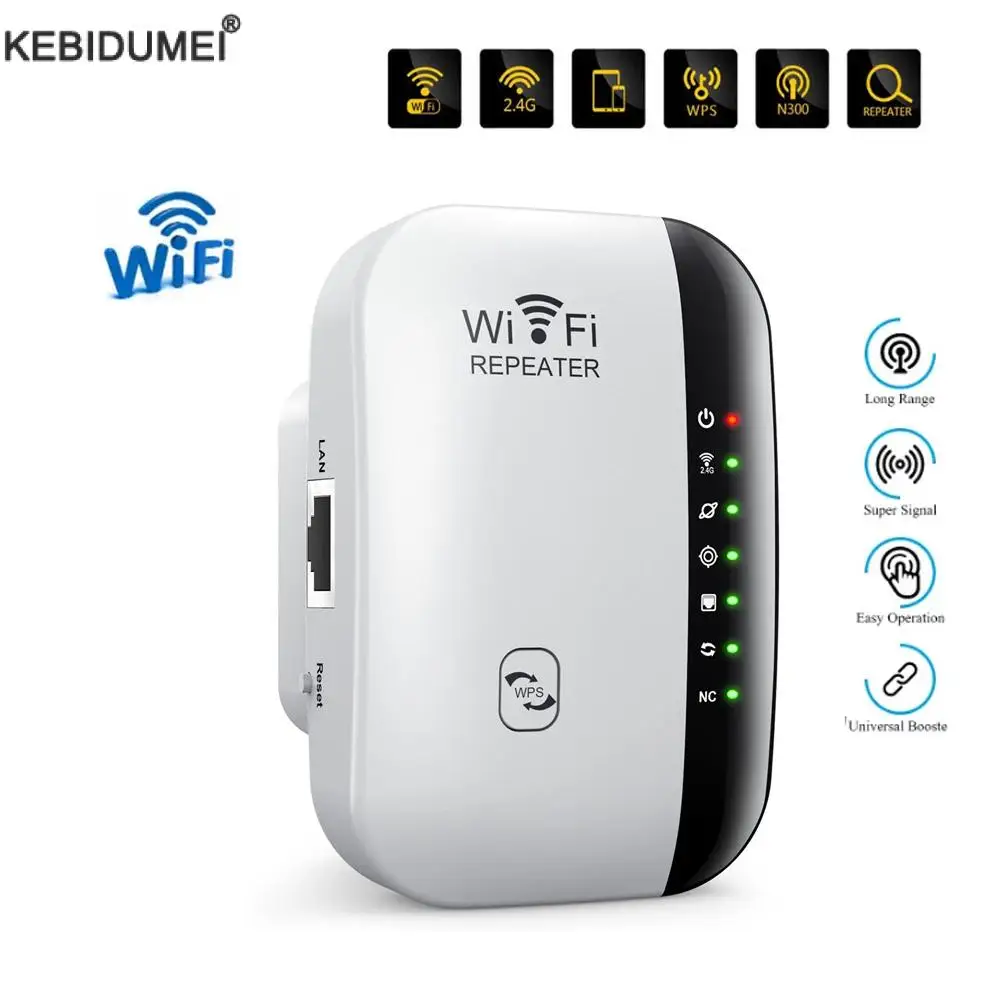
The KEBIDUMEI extender features a compact, wall-plug design, minimizing its physical footprint. This form factor allows for unobtrusive placement in various locations throughout a home or office. Its integrated power supply eliminates the need for an external power brick, contributing to a cleaner installation.
An RJ45 Ethernet port is integrated into the unit, supporting both Repeater and AP modes. This port is likely a 10/100Mbps Fast Ethernet interface, which aligns with the 300Mbps 802.11N wireless standard, as a Gigabit Ethernet port would be bottlenecked by the wireless throughput. The presence of this port enhances its versatility, allowing for a wired backhaul in AP mode or providing a wired connection to a single client device in Repeater mode. This port is a key differentiator.
LED indicators on the front panel provide visual feedback on power status, Wi-Fi signal strength, and network activity. These indicators are crucial for quick diagnostic checks during installation and operation. A clear visual status is provided.
Security Protocols and Firmware Considerations
Security for this class of device typically includes WPA/WPA2-PSK encryption. While WPA2 remains a widely adopted standard, the absence of WPA3 support indicates a reliance on older security protocols. This is a common characteristic of entry-level 802.11N hardware. Users should ensure their main router is also configured for WPA2-PSK for seamless compatibility and adequate security.
Regarding firmware, generic 802.11N repeaters rarely support third-party firmware distributions like OpenWRT or DD-WRT. These advanced firmware options provide extensive customization, enhanced security features, and greater control over network parameters, including VLANs, VPN clients, and advanced routing. The KEBIDUMEI extender's proprietary firmware is expected to offer only basic functionality, limiting its appeal to users requiring deep network customization or advanced security features. This limitation is significant for power users.
Compatibility and Integration
The device boasts universal compatibility with any standard WiFi router and all WiFi-enabled devices. This broad compatibility is a significant advantage for users with mixed network environments or older equipment. It works with laptops, desktops, tablets, smartphones, smart TVs, and TV boxes.
Its 2.4GHz operation ensures compatibility with a vast installed base of client devices, many of which still rely solely on this frequency band. While modern devices increasingly leverage 5GHz for higher speeds, the 2.4GHz band remains essential for broader coverage and compatibility with legacy hardware. This ensures wide device support.
Value Proposition and Target Audience
Positioned at a competitive price point, the KEBIDUMEI 300Mbps Wireless-N WiFi Extender offers a cost-effective solution for addressing basic wireless dead zones. Its primary value lies in its simplicity and affordability, making it accessible to users who require a straightforward method to extend their existing 2.4GHz Wi-Fi coverage without investing in more complex or expensive mesh systems or higher-end access points. This device is an economical choice.
For users with modest bandwidth requirements and a need for basic signal extension, this device presents a viable option. It is not designed for high-performance networking, advanced security, or complex network topologies. Instead, it serves as a functional tool for improving connectivity in areas where the primary router's signal struggles to reach. The device fulfills a specific niche.
Imagine a home where the living room experiences consistent Wi-Fi drops, interrupting streaming or video calls. Deploying this extender in a central location could eliminate those frustrating dead zones, allowing seamless connectivity for everyday tasks. Picture a small office where a single access point struggles to cover all workstations; this extender could provide the necessary boost for reliable internet access across the entire workspace. The frustration of buffering videos and dropped connections becomes a distant memory, replaced by consistent, reliable access to the digital world.