JGINYUE X99M GAMING D4/ARGB Motherboard
Official Store Deal
Expert Analysis Overview
The JGINYUE X99M GAMING D4/ARGB motherboard is a robust, value-oriented platform engineered for builders seeking high core count performance without the premium price of contemporary systems. This Micro-ATX board leverages the proven Intel X99 chipset and LGA 2011-3 socket, offering a compelling foundation for powerful workstations or budget-friendly gaming rigs.
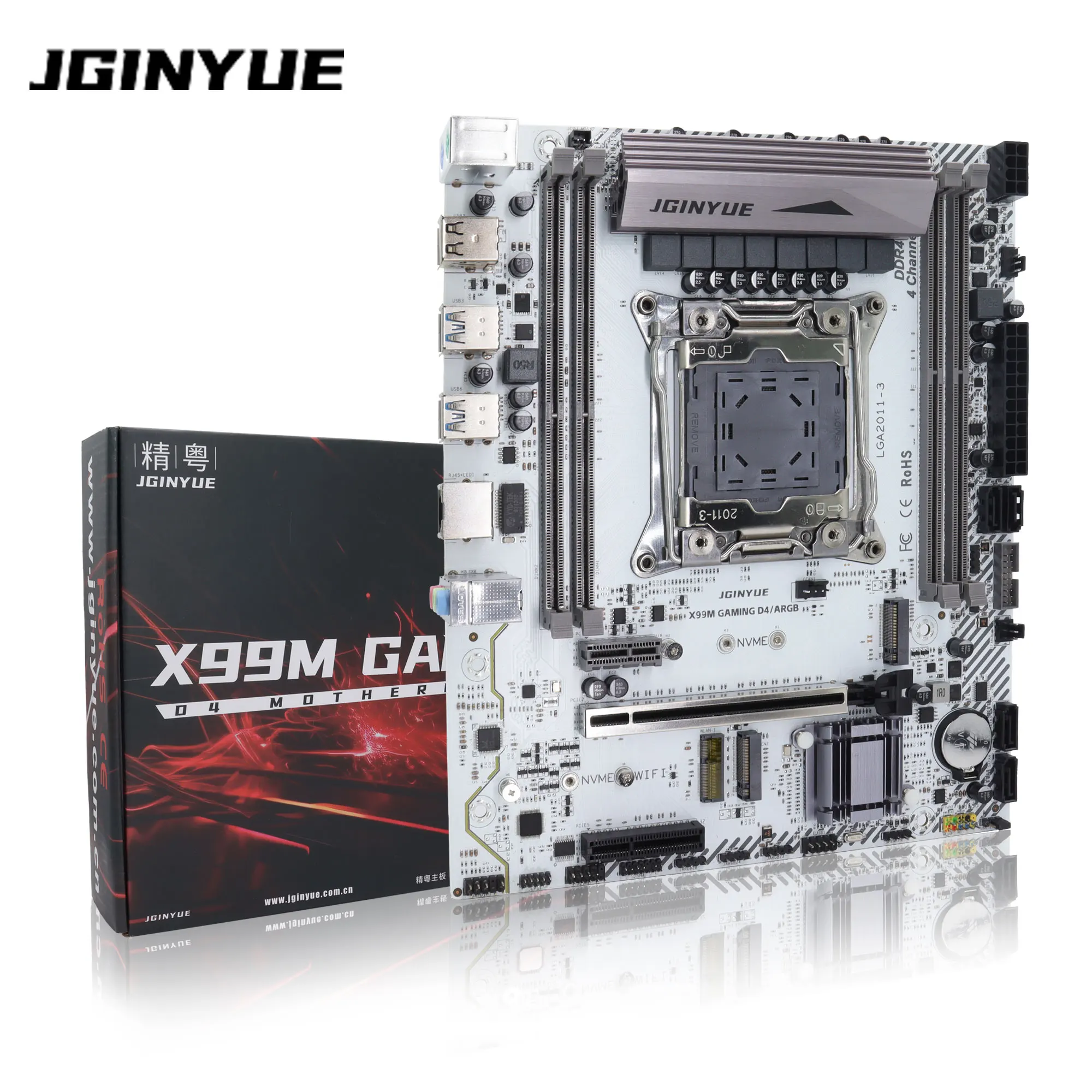
The JGINYUE X99M GAMING D4/ARGB motherboard centers around the Intel LGA 2011-3 socket and the X99 chipset. This configuration is clearly visible on the white PCB, with the large CPU socket dominating the central area. Four DDR4 DIMM slots flank the CPU, indicating significant memory capacity.
This specific socket and chipset combination immediately signals its purpose: supporting Intel Xeon E5 V3 and V4 series processors. These CPUs are renowned for their high core and thread counts, making them ideal for demanding multi-threaded workloads such as video editing, 3D rendering, virtual machine hosting, and complex scientific simulations. Users can achieve workstation-level performance. The platform offers substantial processing power.
Unlike mainstream consumer platforms that often prioritize single-core performance or integrate newer, more expensive technologies, the X99 platform provides a robust, proven foundation. It offers a cost-effective path to high core counts. This makes it a compelling alternative for builders seeking maximum computational density without the premium price tag of current-generation HEDT (High-End Desktop) or server platforms.
Memory support on this motherboard includes four DDR4 DIMM slots, capable of accommodating up to 128GB of RAM. The specifications indicate support for memory frequencies up to 2666MHz. This is a significant amount of memory.
This quad-channel DDR4 configuration is a key advantage for memory-intensive applications. Quad-channel memory effectively doubles the memory bandwidth compared to a dual-channel setup, allowing the CPU to access data much faster. For tasks like large database management, professional content creation, or running multiple virtual machines, this increased bandwidth directly translates to smoother operation and reduced bottlenecks. Data moves quickly.
Compared to typical consumer motherboards that often feature only dual-channel memory, the X99 platform's quad-channel capability provides a distinct performance uplift for specific workloads. This design choice underscores the board's suitability for professional and enthusiast users who prioritize memory throughput. It's a clear upgrade for memory-bound tasks.
The JGINYUE X99M GAMING D4/ARGB motherboard integrates modern storage options, featuring two M.2 NVMe slots alongside four SATA 3.0 ports. These interfaces are strategically placed on the PCB for easy access.
The inclusion of dual M.2 NVMe slots allows for incredibly fast boot times and rapid loading of applications and large game files. NVMe drives utilize the PCIe bus, offering significantly higher read and write speeds than traditional SATA SSDs. Users can configure a primary NVMe drive for the operating system and critical applications, with a secondary NVMe for frequently accessed projects or games. This setup dramatically improves system responsiveness.
While the four SATA 3.0 ports might seem limited compared to some larger ATX boards, they provide ample connectivity for a standard build. Users can connect multiple SATA SSDs or traditional hard drives for mass storage. This combination of high-speed NVMe and versatile SATA ensures a balanced storage ecosystem, catering to both speed and capacity requirements. It's a practical storage mix.
Expansion is handled by a complement of PCIe slots: one full-length PCIe x16 slot, one PCIe x4 slot, and one PCIe x1 slot. These slots are clearly visible on the motherboard, ready for various add-in cards.
The primary PCIe x16 slot is dedicated to a high-performance graphics card, essential for gaming or GPU-accelerated workloads. The presence of additional PCIe x4 and x1 slots allows for further expansion, such as a dedicated sound card, a capture card, or a high-speed network adapter. This flexibility ensures the system can evolve with user needs. More options are available.
Given its Micro-ATX form factor, the board's PCIe lane allocation is efficient. While larger ATX boards might offer more slots, this configuration provides sufficient expansion for most users without unnecessary bulk. Builders should verify the physical length of their chosen expansion cards, especially for the x4 and x1 slots, to ensure they fit within the compact dimensions. Case clearance is important.
The motherboard features an 8-phase power delivery system, supported by 24 MOSFETs. Power input is provided via a standard 24-pin ATX connector and an 8-pin EPS connector for the CPU. This robust design is visually apparent in the VRM area.
This 8-phase VRM (Voltage Regulator Module) is crucial for delivering clean, stable power to the CPU, especially when running demanding Xeon E5 processors. The 24 MOSFETs contribute to efficient power conversion and heat dissipation, which is vital for maintaining system stability under heavy loads or during sustained operation. A stable power supply prevents throttling. This ensures consistent performance from the high core count CPUs.
Compared to entry-level motherboards that might feature fewer power phases, this JGINYUE board's more substantial VRM design indicates a greater capacity for handling powerful CPUs and potentially light overclocking. This design choice provides a solid foundation for reliable, long-term operation, minimizing the risk of power-related instability. It's built for endurance.
Connectivity options include a rear I/O panel with four USB 3.0 ports, two USB 2.0 ports, dual PS/2 ports, a Gigabit LAN port, and three audio jacks. Front panel headers support an additional two USB 3.0 and two USB 2.0 ports. The board also features 5x ARGB 5V3MCU headers and an NGFF slot for a Wi-Fi module.
The array of USB ports provides ample connectivity for peripherals, ensuring users can connect keyboards, mice, external drives, and other devices. The inclusion of PS/2 ports caters to legacy peripherals or specific keyboard/mouse setups that prefer direct input. The Gigabit LAN ensures reliable wired network access. ARGB headers allow for extensive lighting customization, enhancing the visual appeal of any build. This adds visual flair.
While the rear I/O is comprehensive for its class, it lacks modern amenities like USB-C or higher-speed USB 3.2 Gen 2x2 ports found on newer platforms. However, the inclusion of an NGFF slot for a Wi-Fi module offers a convenient pathway to wireless connectivity, which is often a desirable feature for compact builds. This provides wireless flexibility. The ARGB headers are a welcome addition for aesthetic-focused builders.
The JGINYUE X99M GAMING D4/ARGB motherboard adheres to the Micro-ATX (M-ATX) form factor, with dimensions of 23.5cm x 20cm. This compact size is clearly depicted in the product images.
This M-ATX form factor offers significant advantages for system builders. It allows for the construction of smaller, more discreet PCs that can fit into a wider range of cases, from compact desktop towers to HTPC (Home Theater PC) enclosures. Despite its smaller footprint, the board still manages to pack in a powerful CPU socket, quad-channel RAM, and dual NVMe slots, demonstrating efficient space utilization. Small builds are possible.
Compared to full-sized ATX motherboards, M-ATX boards provide a balance between expansion capability and physical size. While an ATX board might offer more PCIe slots or SATA ports, the M-ATX form factor is often preferred for its versatility in case selection and its ability to create a powerful system without consuming excessive desk space. Builders must ensure their chosen case supports the M-ATX standard. Case fitment is critical.
This JGINYUE X99M GAMING D4/ARGB motherboard presents a compelling proposition for those looking to build a high-performance system on a sensible budget. It expertly addresses the common frustration of expensive modern platforms by offering a proven, powerful alternative. Unlike many entry-level boards that compromise on core features, this board provides robust power delivery, quad-channel memory, and dual NVMe support, ensuring a capable and responsive computing experience. Imagine effortlessly rendering complex 3D models or compiling large codebases, all while enjoying the satisfaction of a meticulously crafted, high-value PC. This board empowers users to achieve their computing goals without compromise, delivering a powerful foundation that will serve demanding applications for years to come. The system will perform reliably.
The X99 Foundation: Powering Productivity
The JGINYUE X99M GAMING D4/ARGB motherboard centers around the Intel LGA 2011-3 socket and the X99 chipset. This configuration is clearly visible on the white PCB, with the large CPU socket dominating the central area. Four DDR4 DIMM slots flank the CPU, indicating significant memory capacity.
This specific socket and chipset combination immediately signals its purpose: supporting Intel Xeon E5 V3 and V4 series processors. These CPUs are renowned for their high core and thread counts, making them ideal for demanding multi-threaded workloads such as video editing, 3D rendering, virtual machine hosting, and complex scientific simulations. Users can achieve workstation-level performance. The platform offers substantial processing power.
Unlike mainstream consumer platforms that often prioritize single-core performance or integrate newer, more expensive technologies, the X99 platform provides a robust, proven foundation. It offers a cost-effective path to high core counts. This makes it a compelling alternative for builders seeking maximum computational density without the premium price tag of current-generation HEDT (High-End Desktop) or server platforms.
Memory Architecture: Quad-Channel Dominance
Memory support on this motherboard includes four DDR4 DIMM slots, capable of accommodating up to 128GB of RAM. The specifications indicate support for memory frequencies up to 2666MHz. This is a significant amount of memory.
This quad-channel DDR4 configuration is a key advantage for memory-intensive applications. Quad-channel memory effectively doubles the memory bandwidth compared to a dual-channel setup, allowing the CPU to access data much faster. For tasks like large database management, professional content creation, or running multiple virtual machines, this increased bandwidth directly translates to smoother operation and reduced bottlenecks. Data moves quickly.
Compared to typical consumer motherboards that often feature only dual-channel memory, the X99 platform's quad-channel capability provides a distinct performance uplift for specific workloads. This design choice underscores the board's suitability for professional and enthusiast users who prioritize memory throughput. It's a clear upgrade for memory-bound tasks.
Storage Solutions: NVMe and SATA Flexibility
The JGINYUE X99M GAMING D4/ARGB motherboard integrates modern storage options, featuring two M.2 NVMe slots alongside four SATA 3.0 ports. These interfaces are strategically placed on the PCB for easy access.
The inclusion of dual M.2 NVMe slots allows for incredibly fast boot times and rapid loading of applications and large game files. NVMe drives utilize the PCIe bus, offering significantly higher read and write speeds than traditional SATA SSDs. Users can configure a primary NVMe drive for the operating system and critical applications, with a secondary NVMe for frequently accessed projects or games. This setup dramatically improves system responsiveness.
While the four SATA 3.0 ports might seem limited compared to some larger ATX boards, they provide ample connectivity for a standard build. Users can connect multiple SATA SSDs or traditional hard drives for mass storage. This combination of high-speed NVMe and versatile SATA ensures a balanced storage ecosystem, catering to both speed and capacity requirements. It's a practical storage mix.
Expansion Capabilities: PCIe Lanes for Growth
Expansion is handled by a complement of PCIe slots: one full-length PCIe x16 slot, one PCIe x4 slot, and one PCIe x1 slot. These slots are clearly visible on the motherboard, ready for various add-in cards.
The primary PCIe x16 slot is dedicated to a high-performance graphics card, essential for gaming or GPU-accelerated workloads. The presence of additional PCIe x4 and x1 slots allows for further expansion, such as a dedicated sound card, a capture card, or a high-speed network adapter. This flexibility ensures the system can evolve with user needs. More options are available.
Given its Micro-ATX form factor, the board's PCIe lane allocation is efficient. While larger ATX boards might offer more slots, this configuration provides sufficient expansion for most users without unnecessary bulk. Builders should verify the physical length of their chosen expansion cards, especially for the x4 and x1 slots, to ensure they fit within the compact dimensions. Case clearance is important.
Power Delivery: Stable Foundations for Performance
The motherboard features an 8-phase power delivery system, supported by 24 MOSFETs. Power input is provided via a standard 24-pin ATX connector and an 8-pin EPS connector for the CPU. This robust design is visually apparent in the VRM area.
This 8-phase VRM (Voltage Regulator Module) is crucial for delivering clean, stable power to the CPU, especially when running demanding Xeon E5 processors. The 24 MOSFETs contribute to efficient power conversion and heat dissipation, which is vital for maintaining system stability under heavy loads or during sustained operation. A stable power supply prevents throttling. This ensures consistent performance from the high core count CPUs.
Compared to entry-level motherboards that might feature fewer power phases, this JGINYUE board's more substantial VRM design indicates a greater capacity for handling powerful CPUs and potentially light overclocking. This design choice provides a solid foundation for reliable, long-term operation, minimizing the risk of power-related instability. It's built for endurance.
Connectivity & Aesthetics: Modern Touches
Connectivity options include a rear I/O panel with four USB 3.0 ports, two USB 2.0 ports, dual PS/2 ports, a Gigabit LAN port, and three audio jacks. Front panel headers support an additional two USB 3.0 and two USB 2.0 ports. The board also features 5x ARGB 5V3MCU headers and an NGFF slot for a Wi-Fi module.
The array of USB ports provides ample connectivity for peripherals, ensuring users can connect keyboards, mice, external drives, and other devices. The inclusion of PS/2 ports caters to legacy peripherals or specific keyboard/mouse setups that prefer direct input. The Gigabit LAN ensures reliable wired network access. ARGB headers allow for extensive lighting customization, enhancing the visual appeal of any build. This adds visual flair.
While the rear I/O is comprehensive for its class, it lacks modern amenities like USB-C or higher-speed USB 3.2 Gen 2x2 ports found on newer platforms. However, the inclusion of an NGFF slot for a Wi-Fi module offers a convenient pathway to wireless connectivity, which is often a desirable feature for compact builds. This provides wireless flexibility. The ARGB headers are a welcome addition for aesthetic-focused builders.
Form Factor & Compatibility: The M-ATX Advantage
The JGINYUE X99M GAMING D4/ARGB motherboard adheres to the Micro-ATX (M-ATX) form factor, with dimensions of 23.5cm x 20cm. This compact size is clearly depicted in the product images.
This M-ATX form factor offers significant advantages for system builders. It allows for the construction of smaller, more discreet PCs that can fit into a wider range of cases, from compact desktop towers to HTPC (Home Theater PC) enclosures. Despite its smaller footprint, the board still manages to pack in a powerful CPU socket, quad-channel RAM, and dual NVMe slots, demonstrating efficient space utilization. Small builds are possible.
Compared to full-sized ATX motherboards, M-ATX boards provide a balance between expansion capability and physical size. While an ATX board might offer more PCIe slots or SATA ports, the M-ATX form factor is often preferred for its versatility in case selection and its ability to create a powerful system without consuming excessive desk space. Builders must ensure their chosen case supports the M-ATX standard. Case fitment is critical.
This JGINYUE X99M GAMING D4/ARGB motherboard presents a compelling proposition for those looking to build a high-performance system on a sensible budget. It expertly addresses the common frustration of expensive modern platforms by offering a proven, powerful alternative. Unlike many entry-level boards that compromise on core features, this board provides robust power delivery, quad-channel memory, and dual NVMe support, ensuring a capable and responsive computing experience. Imagine effortlessly rendering complex 3D models or compiling large codebases, all while enjoying the satisfaction of a meticulously crafted, high-value PC. This board empowers users to achieve their computing goals without compromise, delivering a powerful foundation that will serve demanding applications for years to come. The system will perform reliably.