Intel Xeon E5-2690V4 Processor (Used)
Official Store Deal
Expert Analysis Overview
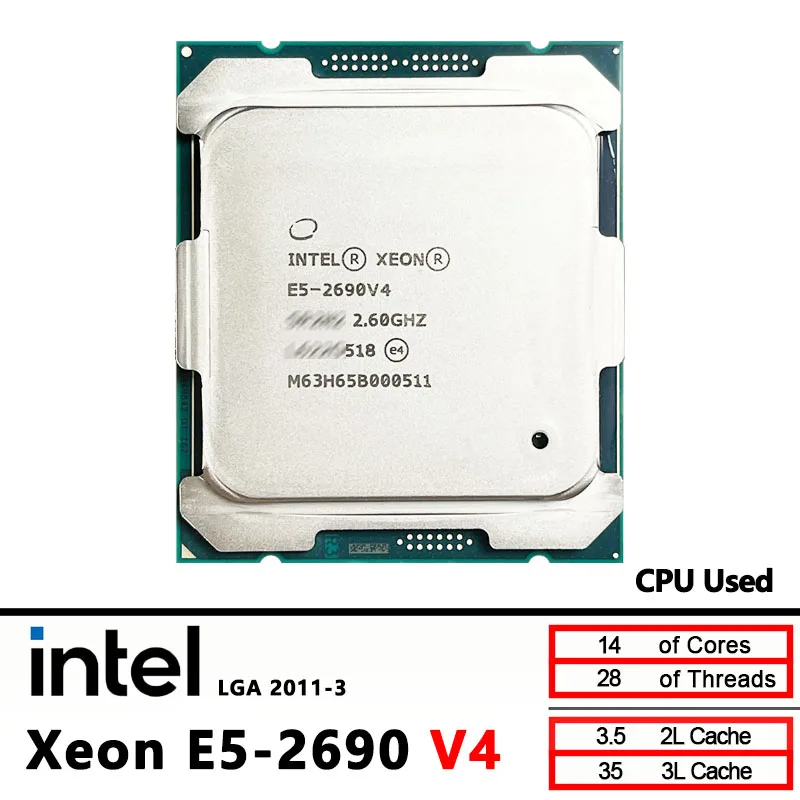
The Intel Xeon E5-2690V4 Processor (Used) is a formidable multi-core workhorse designed for budget-conscious builders seeking significant parallel processing power for server and workstation applications. This Broadwell-EP CPU, with its substantial core and thread count, offers a compelling value proposition for specific demanding workloads. It provides an accessible entry point into high-performance computing without the premium price tag of newer generations.
The E5-2690V4 features a robust 14 cores and 28 threads. This configuration is a significant upgrade for systems previously running lower core count processors. It handles multiple tasks simultaneously with ease. The Broadwell-EP architecture, upon which this processor is based, brought refinements in instruction sets and efficiency over its Haswell predecessor. This means more work per clock cycle. The sheer number of logical processors allows the operating system to distribute intensive workloads across many execution units.
Such a high thread count directly translates into superior performance for applications that are heavily optimized for parallelism. Think virtual machine hosting, complex data analytics, video rendering, or scientific simulations. Unlike consumer CPUs that often prioritize single-core speed, this Xeon is built for sheer computational breadth. It excels in environments where numerous processes or threads need to run concurrently without bottlenecking each other. This is a true workhorse.
Compared to standard quad-core or even eight-core consumer processors, the E5-2690V4 offers a dramatically increased capacity for concurrent operations. This makes it a specialist tool, not a generalist. Its architecture excels where many small tasks need to run in parallel, rather than one very fast single task. For instance, compiling large software projects or running multiple Docker containers will see substantial benefits.
The processor operates at a 2.6 GHz base clock speed. This frequency provides a stable and consistent performance baseline. It ensures reliable execution across all cores. While this base clock might appear modest when compared to the burst frequencies of modern consumer desktop CPUs, it is crucial to understand its context within a server-grade processor. Server CPUs are designed for sustained, continuous operation under heavy load, where stability and consistency are prioritized over fleeting peak speeds.
While not the highest clock speed on the market, this frequency is more than adequate for sustained, multi-threaded operations where consistency is key. For server environments, stability often outweighs peak burst speeds. This clock speed maintains efficiency under continuous load. The absence of aggressive turbo boosting, typical in many consumer CPUs, means predictable performance. This is a reliable performer.
Many modern applications benefit more from a greater number of cores operating at a steady pace than from fewer cores hitting extremely high, but often unsustainable, turbo frequencies. The E5-2690V4 embodies this design philosophy. It is a marathon runner, not a sprinter. For tasks like batch processing or large-scale data transformations, the cumulative power of 28 threads at a stable 2.6 GHz far surpasses fewer threads at higher, fluctuating speeds.
A generous 35MB L3 cache is integrated into the E5-2690V4. This large cache size is critical for performance. It minimizes the time the processor spends waiting for data from slower system memory. The L3 cache acts as a high-speed buffer, storing frequently accessed instructions and data close to the CPU cores. This significantly reduces memory access latency, a common bottleneck in data-intensive applications.
Applications that frequently access large datasets, such as databases, large-scale simulations, or virtual machine environments, will see considerable benefits from this expansive cache. Data can be retrieved much faster. This reduces overall processing time and improves responsiveness, especially when dealing with complex calculations or large file operations. The cache hierarchy is optimized for server workloads.
Compared to processors with smaller cache allocations, the 35MB L3 cache on this Xeon can significantly reduce latency in memory-intensive tasks. This is a clear advantage for professional workloads. It keeps the processing pipeline full. For example, in a virtualized environment, each VM benefits from faster access to shared data, improving the responsiveness of guest operating systems and applications.
The E5-2690V4 utilizes the LGA 2011-3 socket type. This socket is a crucial compatibility factor. It dictates the type of motherboard required for installation. Builders must ensure their existing or planned motherboard supports this specific socket. The LGA 2011-3 platform typically uses Intel's C612 chipset, designed for server and high-end desktop (HEDT) applications. This chipset supports features like quad-channel DDR4 memory.
Compatibility extends beyond the physical socket to the chipset and BIOS version. An outdated BIOS might not recognize the processor. Before attempting installation, it is highly recommended to check the motherboard manufacturer's CPU support list and update the BIOS to the latest version if necessary. This proactive step prevents common boot issues. This is a vital check.
Unlike newer platforms that offer broader compatibility, LGA 2011-3 motherboards are specific to this generation of Xeon processors. Verification is paramount. This socket type is not interchangeable with LGA 1151 or LGA 1200. Furthermore, the platform often supports DDR4 ECC (Error-Correcting Code) memory, which is vital for server stability and data integrity, though some HEDT boards may also support non-ECC DDR4.
This processor is built on a 14nm lithography process. This manufacturing process impacts efficiency and thermal characteristics. It represents a mature and refined technology for its generation. The 14nm process allowed Intel to achieve a balance between transistor density, power consumption, and manufacturing cost for the Broadwell-EP series. It was a leading-edge technology at its introduction.
The 14nm process allowed Intel to pack a significant number of cores onto a single die while maintaining reasonable power consumption for its class. It balances performance with manufacturing feasibility. This was a common standard for its time. This process node, while not the absolute latest, is highly reliable and well-understood, contributing to the processor's stability and longevity.
Newer processors employ smaller lithography nodes, offering greater power efficiency and higher transistor density. However, for a used component, 14nm still delivers robust performance. It is a proven technology. The efficiency gains from smaller nodes are primarily seen in power consumption and heat generation, but the raw computational power of the 14nm E5-2690V4 remains substantial for its intended workloads.
With a 135W Thermal Design Power (TDP), the E5-2690V4 demands adequate cooling. This power rating is not insignificant. It indicates the heat output the cooling solution must manage. The TDP value is a critical metric for selecting an appropriate CPU cooler, as insufficient cooling will lead to thermal throttling, where the CPU automatically reduces its clock speed to prevent damage.
A high-performance CPU cooler is absolutely essential for stable operation. Stock coolers are insufficient. Builders should invest in a robust air cooler with multiple heat pipes and a large fin stack, or an all-in-one (AIO) liquid cooler with at least a 240mm radiator. Proper application of quality thermal paste is also crucial for efficient heat transfer from the CPU's integrated heat spreader (IHS) to the cooler. This ensures optimal contact.
Compared to lower TDP consumer CPUs, the 135W TDP requires careful consideration of case airflow and cooler mounting pressure. Overheating can lead to thermal throttling, reducing performance. Proper cooling ensures sustained peak performance. Ensure your PC case has good ventilation, with intake and exhaust fans strategically placed to move air efficiently across the CPU cooler.
The 135W TDP also necessitates a sufficiently powerful and stable power supply unit (PSU). The PSU must deliver consistent power. It needs to accommodate the CPU's demands alongside other system components. Specifically, the motherboard will require an 8-pin EPS12V connector (or sometimes two, depending on the board) to supply dedicated power to the CPU.
An underpowered PSU can lead to system instability, unexpected shutdowns, or even component damage. Builders should calculate their total system wattage, accounting for the CPU, GPU, RAM, storage drives, and other peripherals. A quality PSU from a reputable brand, with sufficient wattage and 80 PLUS certification, is a critical investment for system stability. Do not cut corners here.
Unlike low-power desktop processors that can run on minimal PSUs, this Xeon requires a PSU with ample headroom. A 650W or 750W PSU from a reputable brand is often a good starting point for a system built around this CPU, especially if a dedicated graphics card is also present. It ensures system longevity. This robust power delivery ensures the CPU receives clean, stable power even under maximum load.
This offering explicitly states it is a used processor. This designation carries both benefits and specific considerations. It represents a significant cost saving. The market for used server-grade components allows enthusiasts and professionals to access hardware that was once prohibitively expensive. This makes high-performance computing more accessible.
The primary advantage of a used processor is the dramatically reduced price point compared to new equivalents. This allows builders to access high-end server-grade performance on a constrained budget. Value is the key driver. For a fraction of the cost of a new consumer CPU with fewer cores, one can acquire a powerful multi-threaded Xeon.
However, the "used" status means potential cosmetic imperfections, such as scratches, are normal. The seller transparently states this. Functionality is the priority. These scratches are typically superficial, affecting the integrated heat spreader (IHS) rather than the critical contacts or internal silicon. They do not impact performance.
The seller also emphasizes that all products undergo strict inspection. This provides a degree of assurance regarding operational integrity. It mitigates some of the inherent risks of buying used hardware. This inspection process typically involves testing for basic functionality, stability under load, and ensuring all cores and threads are operational. It ensures basic operability.
Unlike purchasing a brand-new, retail-boxed CPU, a used unit typically comes without a manufacturer's warranty or bundled accessories like a cooler. Builders must factor this into their decision. The focus is on the core component. The seller's return policy or limited warranty becomes the primary recourse for issues.
The E5-2690V4 excels in scenarios demanding high multi-threaded performance. It is a specialist chip. Its capabilities are best utilized in specific contexts. Its design is inherently geared towards sustained, heavy computational loads rather than bursty, single-threaded tasks.
If you are building a home lab server for virtualization, this processor can host numerous virtual machines concurrently. Each VM can be allocated dedicated threads. This improves resource isolation and overall system responsiveness. Hypervisors like VMware ESXi, Proxmox, or Microsoft Hyper-V will leverage its core count effectively, allowing for a robust virtualized environment. This is ideal for labs.
For content creators involved in video editing, 3D rendering (e.g., Blender, Cinema 4D), or complex audio production, the 28 threads can significantly accelerate render times. Time is money in these fields. It directly impacts productivity. The ability to render complex scenes or transcode high-resolution video quickly is a massive advantage.
Engineers and researchers running computational fluid dynamics (CFD), finite element analysis (FEA), or other scientific simulations will find its core count highly beneficial. These tasks scale well with more threads. The E5-2690V4 provides the raw computational muscle required. Software like ANSYS, Abaqus, or MATLAB can leverage these cores for faster problem-solving. It powers serious calculations.
Compared to consumer CPUs, which might offer higher single-core boost clocks for gaming, this Xeon focuses on sustained, heavy workloads. It is not designed for casual desktop use. Its strength lies in its ability to crunch large datasets. While it can technically run games, its performance in that area would likely be outmatched by a modern consumer CPU at a similar price point.
Investing in a used E5-2690V4 is a strategic move for builders seeking maximum computational power per dollar. It offers an exceptional return on investment for specific applications. The cost-per-core is incredibly low. This makes it an attractive option for small businesses, educational institutions, or enthusiasts who need serious processing power without breaking the bank.
For those upgrading from older LGA 2011 or even lower-end LGA 2011-3 Xeons, this processor represents a substantial performance leap. It breathes new life into existing platforms. The upgrade path is clear. It allows users to extend the lifespan of their current server or workstation infrastructure, delaying the need for a complete system overhaul. This saves significant capital.
Unlike purchasing a brand-new, current-generation server processor, which can cost hundreds or thousands of dollars, this used Xeon provides a fraction of the cost for comparable core counts. This makes high-performance computing accessible. It democratizes power. The value proposition is particularly strong when considering the cost of new CPUs with similar core/thread counts.
The long-term value lies in its durability and reliability, characteristic of Intel Xeon processors. These chips are built for continuous operation. They are designed for demanding enterprise environments. Their robust construction and rigorous testing mean they are often capable of many more years of service, even after initial deployment. They are built to last.
Imagine a scenario where your current system struggles with simultaneous virtual machines, causing frustrating lag and delays. Upgrading to the E5-2690V4 would transform this experience. You could seamlessly run multiple demanding applications. Picture your rendering tasks completing in a fraction of the time, freeing up your workflow and boosting your productivity. Envision a home server effortlessly managing complex data operations, providing reliable service without a hitch. This processor empowers serious builders to achieve professional-grade results without the prohibitive cost, unlocking new levels of computational capability for your most ambitious projects.
Engineering for Extreme Multitasking
The E5-2690V4 features a robust 14 cores and 28 threads. This configuration is a significant upgrade for systems previously running lower core count processors. It handles multiple tasks simultaneously with ease. The Broadwell-EP architecture, upon which this processor is based, brought refinements in instruction sets and efficiency over its Haswell predecessor. This means more work per clock cycle. The sheer number of logical processors allows the operating system to distribute intensive workloads across many execution units.
Such a high thread count directly translates into superior performance for applications that are heavily optimized for parallelism. Think virtual machine hosting, complex data analytics, video rendering, or scientific simulations. Unlike consumer CPUs that often prioritize single-core speed, this Xeon is built for sheer computational breadth. It excels in environments where numerous processes or threads need to run concurrently without bottlenecking each other. This is a true workhorse.
Compared to standard quad-core or even eight-core consumer processors, the E5-2690V4 offers a dramatically increased capacity for concurrent operations. This makes it a specialist tool, not a generalist. Its architecture excels where many small tasks need to run in parallel, rather than one very fast single task. For instance, compiling large software projects or running multiple Docker containers will see substantial benefits.
The processor operates at a 2.6 GHz base clock speed. This frequency provides a stable and consistent performance baseline. It ensures reliable execution across all cores. While this base clock might appear modest when compared to the burst frequencies of modern consumer desktop CPUs, it is crucial to understand its context within a server-grade processor. Server CPUs are designed for sustained, continuous operation under heavy load, where stability and consistency are prioritized over fleeting peak speeds.
While not the highest clock speed on the market, this frequency is more than adequate for sustained, multi-threaded operations where consistency is key. For server environments, stability often outweighs peak burst speeds. This clock speed maintains efficiency under continuous load. The absence of aggressive turbo boosting, typical in many consumer CPUs, means predictable performance. This is a reliable performer.
Many modern applications benefit more from a greater number of cores operating at a steady pace than from fewer cores hitting extremely high, but often unsustainable, turbo frequencies. The E5-2690V4 embodies this design philosophy. It is a marathon runner, not a sprinter. For tasks like batch processing or large-scale data transformations, the cumulative power of 28 threads at a stable 2.6 GHz far surpasses fewer threads at higher, fluctuating speeds.
A generous 35MB L3 cache is integrated into the E5-2690V4. This large cache size is critical for performance. It minimizes the time the processor spends waiting for data from slower system memory. The L3 cache acts as a high-speed buffer, storing frequently accessed instructions and data close to the CPU cores. This significantly reduces memory access latency, a common bottleneck in data-intensive applications.
Applications that frequently access large datasets, such as databases, large-scale simulations, or virtual machine environments, will see considerable benefits from this expansive cache. Data can be retrieved much faster. This reduces overall processing time and improves responsiveness, especially when dealing with complex calculations or large file operations. The cache hierarchy is optimized for server workloads.
Compared to processors with smaller cache allocations, the 35MB L3 cache on this Xeon can significantly reduce latency in memory-intensive tasks. This is a clear advantage for professional workloads. It keeps the processing pipeline full. For example, in a virtualized environment, each VM benefits from faster access to shared data, improving the responsiveness of guest operating systems and applications.
Integrating into the LGA 2011-3 Ecosystem
The E5-2690V4 utilizes the LGA 2011-3 socket type. This socket is a crucial compatibility factor. It dictates the type of motherboard required for installation. Builders must ensure their existing or planned motherboard supports this specific socket. The LGA 2011-3 platform typically uses Intel's C612 chipset, designed for server and high-end desktop (HEDT) applications. This chipset supports features like quad-channel DDR4 memory.
Compatibility extends beyond the physical socket to the chipset and BIOS version. An outdated BIOS might not recognize the processor. Before attempting installation, it is highly recommended to check the motherboard manufacturer's CPU support list and update the BIOS to the latest version if necessary. This proactive step prevents common boot issues. This is a vital check.
Unlike newer platforms that offer broader compatibility, LGA 2011-3 motherboards are specific to this generation of Xeon processors. Verification is paramount. This socket type is not interchangeable with LGA 1151 or LGA 1200. Furthermore, the platform often supports DDR4 ECC (Error-Correcting Code) memory, which is vital for server stability and data integrity, though some HEDT boards may also support non-ECC DDR4.
This processor is built on a 14nm lithography process. This manufacturing process impacts efficiency and thermal characteristics. It represents a mature and refined technology for its generation. The 14nm process allowed Intel to achieve a balance between transistor density, power consumption, and manufacturing cost for the Broadwell-EP series. It was a leading-edge technology at its introduction.
The 14nm process allowed Intel to pack a significant number of cores onto a single die while maintaining reasonable power consumption for its class. It balances performance with manufacturing feasibility. This was a common standard for its time. This process node, while not the absolute latest, is highly reliable and well-understood, contributing to the processor's stability and longevity.
Newer processors employ smaller lithography nodes, offering greater power efficiency and higher transistor density. However, for a used component, 14nm still delivers robust performance. It is a proven technology. The efficiency gains from smaller nodes are primarily seen in power consumption and heat generation, but the raw computational power of the 14nm E5-2690V4 remains substantial for its intended workloads.
Power Delivery and Thermal Management
With a 135W Thermal Design Power (TDP), the E5-2690V4 demands adequate cooling. This power rating is not insignificant. It indicates the heat output the cooling solution must manage. The TDP value is a critical metric for selecting an appropriate CPU cooler, as insufficient cooling will lead to thermal throttling, where the CPU automatically reduces its clock speed to prevent damage.
A high-performance CPU cooler is absolutely essential for stable operation. Stock coolers are insufficient. Builders should invest in a robust air cooler with multiple heat pipes and a large fin stack, or an all-in-one (AIO) liquid cooler with at least a 240mm radiator. Proper application of quality thermal paste is also crucial for efficient heat transfer from the CPU's integrated heat spreader (IHS) to the cooler. This ensures optimal contact.
Compared to lower TDP consumer CPUs, the 135W TDP requires careful consideration of case airflow and cooler mounting pressure. Overheating can lead to thermal throttling, reducing performance. Proper cooling ensures sustained peak performance. Ensure your PC case has good ventilation, with intake and exhaust fans strategically placed to move air efficiently across the CPU cooler.
The 135W TDP also necessitates a sufficiently powerful and stable power supply unit (PSU). The PSU must deliver consistent power. It needs to accommodate the CPU's demands alongside other system components. Specifically, the motherboard will require an 8-pin EPS12V connector (or sometimes two, depending on the board) to supply dedicated power to the CPU.
An underpowered PSU can lead to system instability, unexpected shutdowns, or even component damage. Builders should calculate their total system wattage, accounting for the CPU, GPU, RAM, storage drives, and other peripherals. A quality PSU from a reputable brand, with sufficient wattage and 80 PLUS certification, is a critical investment for system stability. Do not cut corners here.
Unlike low-power desktop processors that can run on minimal PSUs, this Xeon requires a PSU with ample headroom. A 650W or 750W PSU from a reputable brand is often a good starting point for a system built around this CPU, especially if a dedicated graphics card is also present. It ensures system longevity. This robust power delivery ensures the CPU receives clean, stable power even under maximum load.
The "Used" Advantage: Value and Transparency
This offering explicitly states it is a used processor. This designation carries both benefits and specific considerations. It represents a significant cost saving. The market for used server-grade components allows enthusiasts and professionals to access hardware that was once prohibitively expensive. This makes high-performance computing more accessible.
The primary advantage of a used processor is the dramatically reduced price point compared to new equivalents. This allows builders to access high-end server-grade performance on a constrained budget. Value is the key driver. For a fraction of the cost of a new consumer CPU with fewer cores, one can acquire a powerful multi-threaded Xeon.
However, the "used" status means potential cosmetic imperfections, such as scratches, are normal. The seller transparently states this. Functionality is the priority. These scratches are typically superficial, affecting the integrated heat spreader (IHS) rather than the critical contacts or internal silicon. They do not impact performance.
The seller also emphasizes that all products undergo strict inspection. This provides a degree of assurance regarding operational integrity. It mitigates some of the inherent risks of buying used hardware. This inspection process typically involves testing for basic functionality, stability under load, and ensuring all cores and threads are operational. It ensures basic operability.
Unlike purchasing a brand-new, retail-boxed CPU, a used unit typically comes without a manufacturer's warranty or bundled accessories like a cooler. Builders must factor this into their decision. The focus is on the core component. The seller's return policy or limited warranty becomes the primary recourse for issues.
Specialist Applications and Performance Horizons
The E5-2690V4 excels in scenarios demanding high multi-threaded performance. It is a specialist chip. Its capabilities are best utilized in specific contexts. Its design is inherently geared towards sustained, heavy computational loads rather than bursty, single-threaded tasks.
If you are building a home lab server for virtualization, this processor can host numerous virtual machines concurrently. Each VM can be allocated dedicated threads. This improves resource isolation and overall system responsiveness. Hypervisors like VMware ESXi, Proxmox, or Microsoft Hyper-V will leverage its core count effectively, allowing for a robust virtualized environment. This is ideal for labs.
For content creators involved in video editing, 3D rendering (e.g., Blender, Cinema 4D), or complex audio production, the 28 threads can significantly accelerate render times. Time is money in these fields. It directly impacts productivity. The ability to render complex scenes or transcode high-resolution video quickly is a massive advantage.
Engineers and researchers running computational fluid dynamics (CFD), finite element analysis (FEA), or other scientific simulations will find its core count highly beneficial. These tasks scale well with more threads. The E5-2690V4 provides the raw computational muscle required. Software like ANSYS, Abaqus, or MATLAB can leverage these cores for faster problem-solving. It powers serious calculations.
Compared to consumer CPUs, which might offer higher single-core boost clocks for gaming, this Xeon focuses on sustained, heavy workloads. It is not designed for casual desktop use. Its strength lies in its ability to crunch large datasets. While it can technically run games, its performance in that area would likely be outmatched by a modern consumer CPU at a similar price point.
The Strategic Value Proposition
Investing in a used E5-2690V4 is a strategic move for builders seeking maximum computational power per dollar. It offers an exceptional return on investment for specific applications. The cost-per-core is incredibly low. This makes it an attractive option for small businesses, educational institutions, or enthusiasts who need serious processing power without breaking the bank.
For those upgrading from older LGA 2011 or even lower-end LGA 2011-3 Xeons, this processor represents a substantial performance leap. It breathes new life into existing platforms. The upgrade path is clear. It allows users to extend the lifespan of their current server or workstation infrastructure, delaying the need for a complete system overhaul. This saves significant capital.
Unlike purchasing a brand-new, current-generation server processor, which can cost hundreds or thousands of dollars, this used Xeon provides a fraction of the cost for comparable core counts. This makes high-performance computing accessible. It democratizes power. The value proposition is particularly strong when considering the cost of new CPUs with similar core/thread counts.
The long-term value lies in its durability and reliability, characteristic of Intel Xeon processors. These chips are built for continuous operation. They are designed for demanding enterprise environments. Their robust construction and rigorous testing mean they are often capable of many more years of service, even after initial deployment. They are built to last.
Imagine a scenario where your current system struggles with simultaneous virtual machines, causing frustrating lag and delays. Upgrading to the E5-2690V4 would transform this experience. You could seamlessly run multiple demanding applications. Picture your rendering tasks completing in a fraction of the time, freeing up your workflow and boosting your productivity. Envision a home server effortlessly managing complex data operations, providing reliable service without a hitch. This processor empowers serious builders to achieve professional-grade results without the prohibitive cost, unlocking new levels of computational capability for your most ambitious projects.