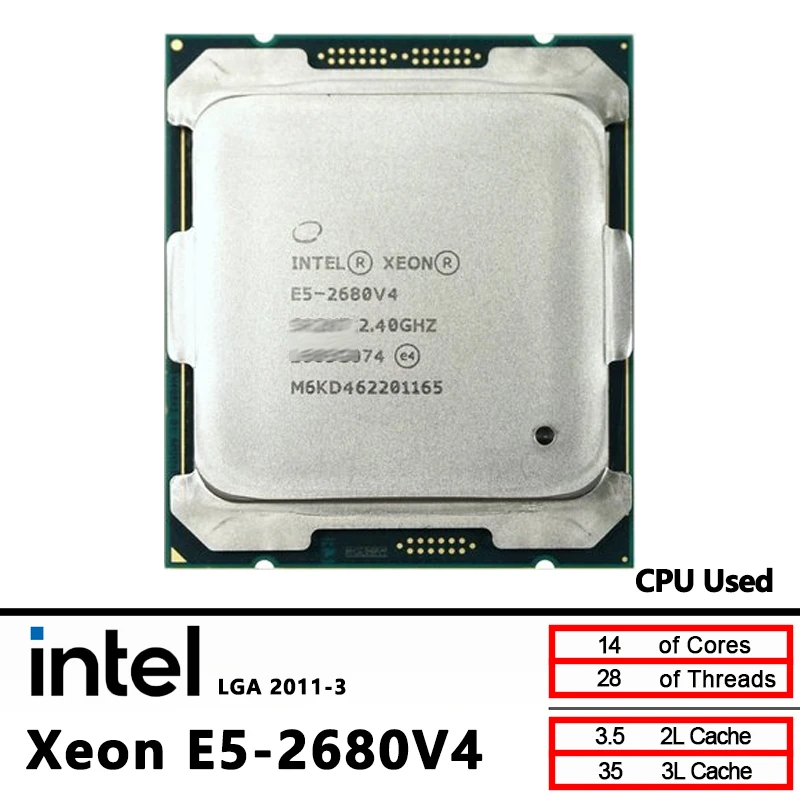
Intel Xeon E5-2680V4 Processor
Official Store Deal
Expert Analysis Overview
The Core of Budget Workstations: Intel Xeon E5-2680V4
The Intel Xeon E5-2680V4 is a formidable, yet budget-conscious, server-grade processor tailored for builders seeking substantial multi-core performance on the LGA 2011-3 platform. This CPU presents an exceptional opportunity for constructing powerful workstations, virtualization hosts, or rendering farms without the prohibitive cost of newer generations. Its architecture prioritizes parallel processing, making it a compelling choice for demanding applications that can effectively utilize numerous threads.Architectural Foundation: Broadwell-EP Power
At its heart, the E5-2680V4 is built on the Broadwell-EP microarchitecture, fabricated on a 14nm process. This generation brought significant improvements in power efficiency and instruction per cycle (IPC) over its Haswell predecessor. The smaller manufacturing process allows for more transistors in a given area, contributing to its robust performance capabilities.The 14nm process technology is a key factor in the processor's thermal profile and efficiency. It enables the CPU to pack considerable processing power into a relatively compact die size. This efficiency is crucial for maintaining stable temperatures under heavy loads, a common scenario for server and workstation environments.
Compared to older 22nm or 32nm architectures, the 14nm Broadwell-EP offers a noticeable leap in performance per watt. This means more computational work can be done with less energy consumption, a vital consideration for systems running continuously. It is a solid foundation.
Multi-Core Dominance: 14 Cores, 28 Threads
This processor features a staggering 14 physical cores and 28 threads thanks to Intel's Hyper-Threading technology. This core count is the primary draw for the E5-2680V4, offering immense parallel processing capabilities.For applications like video rendering, 3D modeling, scientific simulations, or running multiple virtual machines simultaneously, the sheer number of threads translates directly into faster completion times. Each core can handle a separate task or contribute to a larger, multi-threaded workload. This is serious processing power.
Unlike typical consumer-grade processors that often cap at 8 or 10 cores, this Xeon provides a significant advantage for highly parallelized tasks. It excels where raw thread count is king, providing a substantial upgrade for specialized computing needs.
Clock Speed and Cache: Balancing Power and Responsiveness
The base clock speed of the E5-2680V4 is 2.4 GHz. While this might seem modest compared to high-frequency desktop CPUs, it is important to understand that server processors balance clock speed with core count and stability. The processor is designed for sustained, heavy workloads rather than peak single-core bursts.This clock speed, combined with 14 cores, ensures consistent performance across all threads. It provides a stable operational frequency for complex computations. Consistency is key.
Modern desktop CPUs often boast higher single-core boost clocks, which benefit gaming or lightly threaded applications. However, for server-grade tasks, the E5-2680V4's base clock across many cores offers superior aggregate throughput for its intended purpose.
Accompanying the cores is a generous 35MB of Intel Smart Cache. This large cache size is critical for reducing latency when the CPU needs to access data. More cache means the processor can store more frequently used instructions and data closer to the cores, minimizing trips to slower system RAM.
In scenarios involving large datasets or complex algorithms, the 35MB cache significantly improves overall system responsiveness. Data retrieval is faster. This directly impacts the efficiency of memory-intensive applications.
Compared to processors with smaller cache sizes, the E5-2680V4's substantial cache helps maintain high performance even when dealing with demanding workloads. It's a significant performance buffer.
Thermal Design Power (TDP) and Cooling Imperatives
With a Thermal Design Power (TDP) of 120W, the E5-2680V4 demands a robust cooling solution. This power consumption reflects the processor's capability to perform intensive computations across its many cores. Adequate cooling is not optional.Builders must ensure their system includes a high-performance CPU cooler, preferably a tower-style air cooler with multiple heat pipes or a liquid AIO (All-in-One) solution. Insufficient cooling will lead to thermal throttling, reducing performance and potentially shortening the CPU's lifespan. Plan your cooling carefully.
This 120W TDP is higher than many mainstream desktop CPUs, necessitating a power supply unit (PSU) with sufficient wattage and appropriate EPS 8-pin connectors. A stable power delivery system is paramount for the processor to operate at its full potential without stability issues. Do not cut corners here.
Platform Compatibility: The LGA 2011-3 Ecosystem
The Intel Xeon E5-2680V4 utilizes the LGA 2011-3 socket. This is a crucial compatibility detail that dictates the choice of motherboard. Only motherboards designed for the LGA 2011-3 socket will accept this processor.Builders must verify their chosen motherboard explicitly supports the LGA 2011-3 socket and the Broadwell-EP generation of Xeon processors. Compatibility extends beyond just the physical socket; BIOS support is also essential. Check the motherboard manufacturer's CPU support list.
This socket type is commonly found on server and workstation motherboards, often supporting quad-channel DDR4 ECC RAM. This memory configuration further enhances the system's capability for data-intensive tasks. The platform is robust.
The 'Used' Factor: Value and Considerations
This product is explicitly described as a used CPU, which implies it may have some minor cosmetic imperfections like scratches. This is a critical factor in its remarkably accessible price point. The visible images confirm the processor's used status, showing typical wear on the integrated heat spreader (IHS).Opting for a used processor allows builders to access high-end server-grade performance at a fraction of the cost of new components. The performance-to-price ratio becomes exceptionally compelling. This is a smart financial move.
While the cosmetic condition might not be pristine, the internal functionality is typically unaffected if the chip has been properly handled and tested. The trade-off for a significantly lower price is often minor aesthetic wear. Functionality remains key.
Building a High-Performance, Cost-Effective System
Integrating this Xeon E5-2680V4 into a system requires careful consideration of other components. The motherboard must be LGA 2011-3, and the power supply unit must be capable of delivering stable power to the 120W CPU, plus other components. A minimum 650W-750W quality PSU is often recommended for a full workstation build.Case selection is also vital, not just for physical fit but for airflow. A case with good ventilation and space for a substantial CPU cooler will help manage the heat generated by this powerful processor. Proper airflow prevents thermal buildup.
Imagine a system where complex simulations complete in minutes instead of hours, where multiple virtual machines run concurrently without a hitch, or where high-resolution video renders with remarkable speed. This processor makes such capabilities attainable for budget-conscious professionals and enthusiasts. The Intel Xeon E5-2680V4 transforms a modest investment into a powerful computing engine, ready to tackle demanding workloads and redefine what's possible on a budget. It's an opportunity for serious computational power.