Intel Xeon E5-2630 V4 Processor Review
Official Store Deal
Expert Analysis Overview
Silicon Foundation: Microarchitecture and Core Count
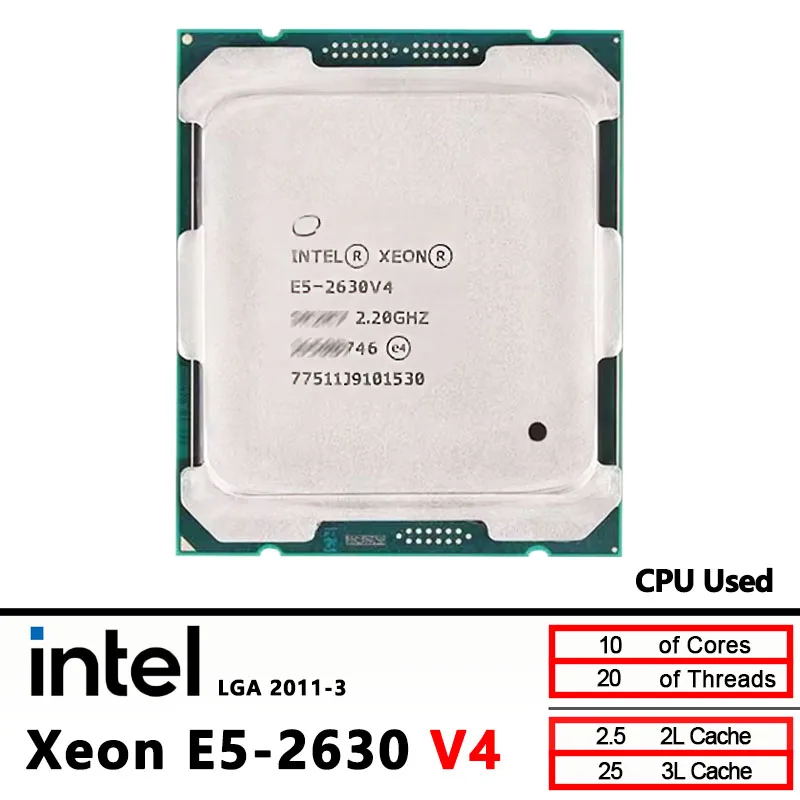
The Intel Xeon E5-2630 V4 is a cost-effective, multi-core workhorse processor tailored for enthusiasts and small businesses seeking significant parallel processing power on a budget. This particular unit, identified as a used 2630V4 model, operates at a base frequency of 2.20 GHz, built upon the Broadwell-EP microarchitecture. This architecture represents Intel's commitment to refining the 14nm process node for server and workstation applications, emphasizing efficiency and core density. The visible markings on the integrated heat spreader (IHS) confirm its identity, providing a clear indication of its lineage and capabilities. It's a formidable piece of silicon.The visible specifications clearly denote a 10-core, 20-thread configuration. These physical cores are the fundamental processing units, each capable of executing instructions independently and concurrently. Intel's Hyper-Threading technology, a sophisticated feature prevalent in its higher-end processor lines, effectively doubles the logical thread count, allowing the operating system to perceive 20 distinct processing pathways. This is crucial for workload distribution. The sheer number of threads allows for an unprecedented level of parallel task execution within its class, especially when considering its value proposition in the used market. This design choice highlights its orientation towards server-grade workloads rather than single-threaded consumer applications.
For real-world usage scenarios, this high core and thread density translates directly into exceptional performance in highly parallelized applications. Tasks such as professional video rendering of complex 4K timelines, intricate scientific simulations requiring massive computational throughput, large-scale data analytics, and the demanding environment of virtual machine hosting benefit immensely from the ability to distribute workloads across numerous threads. A server configured to run multiple virtual machines, for instance, can allocate dedicated logical processors to each guest operating system, ensuring smooth, isolated operation without significant resource contention. It handles heavy lifting. This parallel processing capability is the E5-2630 V4's undeniable strength, making it a compelling choice for compute-intensive environments.
Compared to typical consumer-grade quad-core or even eight-core processors, the E5-2630 V4 offers a substantial, undeniable leap in concurrent processing capability. Mainstream desktop CPUs often prioritize higher single-core boost clocks and gaming performance, where frequency often trumps core count. This Xeon, however, is meticulously engineered for sustained, heavy multi-core loads, a clear and decisive distinction in its intended application. It prioritizes throughput above all else. This focus makes it less of a generalist and more of a specialist, excelling in environments where every thread can be put to work simultaneously, effectively transforming compute bottlenecks into efficient pipelines.
Thermal Management: Sustaining Peak Performance
Maintaining stable operating temperatures is paramount for any high-performance processor, especially one operating in a demanding server or workstation environment where sustained loads are the norm. The E5-2630 V4, with its 10 cores and 20 threads, generates considerable heat under full utilization, necessitating a robust cooling strategy. Effective thermal management is not merely about preventing catastrophic failure; it is absolutely crucial for sustaining peak performance without the processor resorting to thermal throttling. This prevents performance degradation.The processor's integrated heat spreader (IHS) is clearly visible in the imagery, a robust nickel-plated copper lid designed to efficiently transfer heat from the underlying silicon die to the attached cooling solution. This component serves as the primary interface for heat extraction. The quality of the thermal interface material (TIM) applied between the silicon die and the IHS, while not visible, plays a critical role in the overall heat transfer efficiency. For a used processor, the original TIM might have degraded over time, necessitating careful consideration for its replacement with a high-quality aftermarket compound during installation. This is a vital step.
In a scenario where the CPU is subjected to continuous, heavy workloads, such as a 24/7 rendering farm, a high-transaction database server, or an always-on virtualization host, the thermal solution must be exceptionally robust. A high-quality CPU cooler, often a large tower air cooler equipped with multiple heat pipes and dual fans, or a high-capacity all-in-one (AIO) liquid cooler, is not merely recommended but essential. Passive cooling solutions are simply not an option for a processor of this caliber. Without adequate cooling, the processor will inevitably reduce its operating clock speed to prevent damage, a protective mechanism known as thermal throttling. This directly impacts computational throughput and system responsiveness.
Unlike many consumer CPUs where basic stock coolers might suffice for light usage or bursty workloads, the E5-2630 V4 demands a more substantial and dedicated cooling investment. Standard entry-level coolers would quickly be overwhelmed by the sustained heat output of 10 active cores. The emphasis here is on consistent, efficient heat dissipation, ensuring that the processor's 85W Thermal Design Power (TDP) can be managed effectively even during prolonged stress tests. This is not a component for casual fan setups or undersized heat sinks. Overlooking cooling is a critical error. The longevity and consistent performance of the chip hinge on this crucial aspect.
Power Delivery: Fueling the Beast
Stable and sufficient power delivery is absolutely non-negotiable for a server-grade processor like the Xeon E5-2630 V4. The processor draws considerable power, particularly when all 10 cores and 20 threads are fully utilized under heavy load. The motherboard's Voltage Regulator Module (VRM) is the unsung hero in this regard, acting as a sophisticated power conversion system that transforms the power supply unit's (PSU) 12V rail into the precise, stable voltages required by the CPU. Its efficiency is paramount.The LGA 2011-3 socket itself is engineered for robust power delivery, featuring a high density of pins dedicated to power and ground connections. This physical design inherently supports the higher, more consistent power demands typical of multi-core Xeon processors. However, the quality, phase count, and component selection of the motherboard's VRM circuitry are paramount. A motherboard equipped with a weak, undersized, or poorly designed VRM can lead to severe system instability, premature component degradation due to excessive heat, or localized thermal throttling of the VRM components themselves, even before the CPU throttles. This is a silent killer.
For an overclocker or a user intent on pushing this CPU to its maximum stable limits, a thorough understanding of the chosen motherboard's VRM capabilities is critical. If planning to run this CPU in a dual-socket configuration or under constant, prolonged high load, selecting a motherboard with a robust VRM design, often characterized by a higher phase count, high-quality chokes, capacitors, and MOSFETs, and crucially, substantial VRM heatsinks, is highly recommended. Insufficient power delivery can manifest as random system crashes, inexplicable freezes, or a noticeable reduction in performance under sustained load. This is a crucial area for system stability and long-term reliability.
Many consumer-grade motherboards, even those marketed as high-end, are not built with the same VRM robustness and sustained power delivery capabilities as server-grade boards specifically designed for Xeon processors. The continuous, substantial power draw of 10 active cores demands a VRM capable of delivering consistent, clean current without overheating. This represents a key distinction from platforms optimized for bursty, high-frequency single-core loads typical of gaming systems. The E5-2630 V4 requires a foundational power system to truly perform at its best, ensuring every one of its 20 threads receives the necessary juice. Power is everything.
Performance Trajectory: Real-World Workloads
The performance trajectory of the Intel Xeon E5-2630 V4 is unequivocally aimed at demanding, multi-threaded workloads, making it a specialist in its field. Its base clock speed of 2.20 GHz, while not exceptionally high when compared to modern consumer CPUs, ensures a consistent and stable operational frequency across all cores under heavy load. The processor's ability to opportunistically boost to higher frequencies (up to 3.10 GHz for single-core loads) provides a degree of responsiveness when needed, but its true strength and design intent lie in its aggregate computational power across multiple cores. Its consistency is a virtue.With an expansive 25MB of L3 cache, the processor minimizes latency for frequently accessed data, a critical factor in performance. This large cache size is a significant architectural advantage for applications that routinely work with large datasets, such as complex database servers, scientific computing simulations, and virtualization platforms managing multiple guest operating systems. Reduced cache misses mean the CPU spends less time waiting for data from slower main memory, directly improving execution efficiency and overall throughput. It's a data accelerator. This substantial cache helps to bridge the speed gap between the CPU and main memory, ensuring a more fluid data flow.
Consider a practical scenario involving a professional 3D artist rendering a complex scene with intricate textures and lighting. The E5-2630 V4 can distribute the rendering tasks across its 20 threads, drastically reducing render times compared to a CPU with fewer cores or less efficient multi-threading. Similarly, a software developer compiling massive codebases will experience significantly faster compilation speeds, directly impacting development cycles. The processor is purpose-built for grunt work, designed to chew through heavy computational tasks with efficiency. Its parallel muscle is evident.
Unlike gaming processors that prioritize single-core performance and very high clock speeds to maximize frame rates in latency-sensitive applications, the E5-2630 V4 thrives on parallel execution. Its strength is not in achieving the absolute highest frame rates in the latest AAA games, but rather in crushing computational tasks that scale exceptionally well with core count. This distinction is vital for setting accurate performance expectations and understanding the processor's optimal use case. It's a specialist, not a generalist, excelling where concurrent processing power dictates overall system speed.
Value Proposition: Reinvigorating Legacy Platforms
The value proposition of a used Intel Xeon E5-2630 V4 is exceptionally strong for users looking to upgrade an existing system or build a powerful new one on a severely constrained budget. The original retail price of these enterprise-grade processors was significantly higher, placing them firmly within the domain of corporate servers and high-end workstations, often out of reach for individual enthusiasts or small businesses. The robust secondary market, however, makes this server-grade performance remarkably accessible. This is a budget builder's dream scenario.By intelligently utilizing an existing LGA 2011-3 motherboard, which can often be acquired at a fraction of its original cost from the used market, users can construct a highly capable workstation or server without the prohibitive investment required for the latest, often prohibitively expensive, new platforms. This strategy not only provides immense cost savings but also extends the useful lifespan of older, yet still highly capable, hardware, offering a more sustainable and environmentally conscious approach to acquiring computing power. It prevents electronic waste. This approach provides a clear path to high performance without the typical financial barriers.
The cost-per-core ratio of a used E5-2630 V4 is incredibly compelling, arguably unmatched in its performance segment. For the price point of a mid-range new consumer CPU, one gains access to a processor boasting a core count and thread density typically found only in high-end server configurations. This makes it an ideal choice for home labs, small business servers, dedicated rendering machines, or virtualization hosts where raw multi-threaded power and stable operation are prioritized over bleeding-edge features like PCIe Gen 5 or DDR5 memory. It offers significant return on investment.
Compared to purchasing a brand-new equivalent in terms of raw core count and multi-threaded capabilities, the used E5-2630 V4 offers a dramatic and undeniable cost saving. While newer platforms undoubtedly offer benefits like updated I/O standards, improved power efficiency, and support for the latest memory technologies, the pure multi-threaded performance uplift for many core-hungry tasks might not justify the exponential increase in platform cost. This Xeon provides a pragmatic, high-performance alternative, allowing budget-conscious users to achieve professional-grade computational power without compromise. Its efficiency is clear.
The Overclocker's Edge: Pushing the Envelope
For the enthusiast with a dedicated overclocker's mindset, the Intel Xeon E5-2630 V4 presents a unique set of challenges and opportunities. While traditional multiplier-based overclocking, common on consumer "K" series processors, is generally locked on Xeon processors, experienced users can explore base clock (BCLK) adjustments on select, high-end LGA 2011-3 motherboards. This process requires a deep, nuanced understanding of motherboard architecture, power delivery systems, and memory timings. It's not for beginners. This is advanced territory.Pushing the BCLK, even by small, incremental percentages, can yield minor but noticeable frequency gains across all cores simultaneously. This delicate operation requires meticulous tuning of memory timings, system agent voltages, and other platform-specific settings to maintain absolute system stability. The inherent silicon quality, even in a used chip, can sometimes reveal a "golden sample" capable of slightly higher, stable BCLKs, offering a marginal but measurable performance advantage. This is the thrill of discovery for a seasoned tuner. Every MHz counts.
However, the primary focus for maximizing performance on this specific platform is not raw frequency, but rather ensuring sustained high loads without any thermal or power throttling. This means meticulously optimizing cooling solutions, verifying the motherboard's VRM stability under extreme stress, and ensuring impeccable power delivery. An overclocker's true edge here comes from extracting every ounce of stable, multi-threaded performance through meticulous system integration and optimization, rather than just brute-force frequency bumps. It's about unwavering stability.
Unlike consumer CPUs where extreme frequency pushes and record-breaking benchmarks are common, the Xeon's strength lies in its architectural efficiency for parallel tasks and its rock-solid reliability. The "overclocker's edge" for this particular chip is about building a supremely stable, high-throughput system that can run 24/7 without a single hiccup, potentially with those minor BCLK tweaks for a slight, consistent edge. This approach contrasts sharply with the high-stakes, high-voltage consumer CPU overclocking scene. It's a different game, focused on endurance and reliability.