Intel Xeon E3-1270 v3 LGA 1150 Processor
Official Store Deal
Expert Analysis Overview
The Silicon Foundation: A Budget Workstation Powerhouse
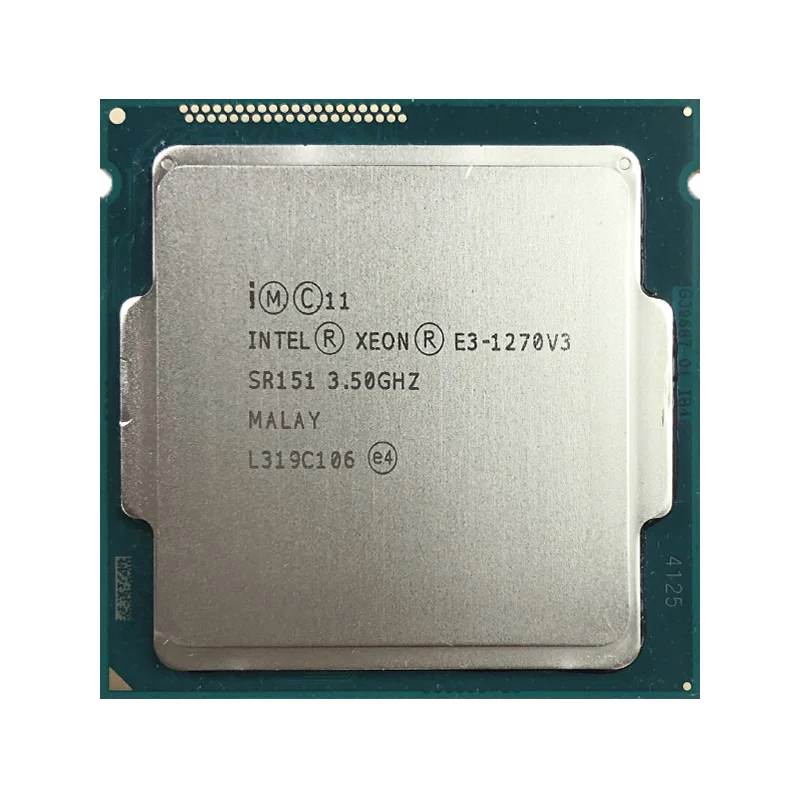
The Intel Xeon E3-1270 v3 is a formidable, budget-conscious workstation processor engineered for users who prioritize multi-core capability and platform stability over bleeding-edge gaming prowess. This CPU, marked SR151, operates at a base clock of 3.5 GHz, featuring a quad-core architecture with eight threads, and is designed for the LGA 1150 socket.Raw specifications reveal a robust foundation. It integrates 1MB of L2 cache and a substantial 8MB of L3 cache, crucial for rapid data access and processing efficiency. With an 80W Thermal Design Power (TDP), this processor demands careful consideration for its cooling solution, ensuring it can perform consistently under heavy loads without thermal throttling. This is a critical factor for sustained operations.
The E3-1270 v3 stands as a compelling upgrade for existing LGA 1150 platforms. Unlike many consumer-grade i5 processors of its generation, this Xeon variant offers Hyper-Threading, doubling its logical core count to eight threads. This capability significantly enhances its performance in multi-threaded applications, making it a superior choice for server, virtualization, or professional workstation environments where concurrent tasks are the norm. It delivers substantial processing power.
Architectural Prowess: Core and Thread Dominance
At its core, the E3-1270 v3 leverages a quad-core physical design. Each core provides dedicated processing muscle. This configuration is the bedrock of its performance profile.However, the true advantage for demanding workloads lies in its eight threads, facilitated by Intel's Hyper-Threading technology. This technology allows each physical core to handle two threads concurrently, significantly boosting the processor's ability to manage parallel computations. For applications such as video rendering, CAD software, or running multiple virtual machines, the increase in logical threads directly translates to smoother operation and faster completion times. It handles concurrent tasks with ease.
When compared to processors lacking Hyper-Threading, especially those with similar core counts, the E3-1270 v3 exhibits a distinct advantage in multi-tasking scenarios. A system running this Xeon can allocate resources more efficiently, preventing bottlenecks that might cripple less capable CPUs. This capability ensures that even when heavily utilized, the system remains responsive, a non-negotiable requirement for professional environments. This is a significant performance uplift.
Clock Speed and Cache Hierarchy: Sustained Throughput Dynamics
Operating at a base clock speed of 3.5 GHz, the E3-1270 v3 provides a strong baseline for computational tasks. This high clock speed ensures that single-threaded applications, while not the primary focus of a Xeon, still benefit from swift execution. Many applications still depend on this.The processor's cache hierarchy is equally vital, featuring 1MB of L2 cache and a generous 8MB of L3 cache. These caches act as high-speed memory buffers, storing frequently accessed data closer to the CPU cores than main system RAM. The larger L3 cache, in particular, significantly reduces memory latency, enabling the processor to access data more quickly and efficiently. This improves overall system responsiveness.
Processors with smaller or less efficient cache designs often suffer from performance bottlenecks, as the CPU spends more time waiting for data from slower main memory. The E3-1270 v3's robust cache configuration minimizes these stalls, ensuring a more consistent and higher throughput, especially in data-intensive applications. Data access is faster. This makes a tangible difference in real-world performance for tasks that repeatedly access the same data sets. It keeps the CPU fed with information.
Power Delivery and Thermal Imperatives: Managing the Beast
An 80W TDP rating for the E3-1270 v3 signifies its power consumption under typical load. This specification is crucial for selecting appropriate cooling solutions and ensuring stable power delivery. An efficient cooler is non-negotiable.For an overclocker, even with a locked multiplier, the focus shifts to maintaining maximum turbo boost clocks without throttling. This requires an exceptionally stable power delivery subsystem, meaning the motherboard's Voltage Regulator Module (VRM) phases must be robust and capable of handling sustained current. Inferior VRMs can lead to instability or premature thermal throttling of the CPU's power stages, even if the CPU core itself is cool. Quality VRMs are essential. A high-quality power supply unit (PSU) with stable voltage rails is also paramount to feed the motherboard's VRM consistently.
Effective thermal management is the other half of the equation. An 80W TDP, while not extreme, necessitates a capable CPU cooler—either a well-designed air cooler with sufficient fin stack and heat pipes or a closed-loop liquid cooler. Proper thermal paste application is also critical. Without adequate heat dissipation, the CPU will reduce its clock speed to prevent damage, negating any performance benefits. System stability depends on it. Ensuring good case airflow further aids in dissipating heat from the VRMs and other components, contributing to overall system longevity and performance consistency.
Socket Compatibility: The LGA 1150 Ecosystem
The LGA 1150 socket defines the E3-1270 v3's compatibility. This socket type was prevalent for Intel's Haswell and Haswell Refresh architectures. Compatibility is a primary concern.This means the processor will integrate with motherboards featuring chipsets like the Intel C222, C224, or C226, which are specifically designed for Xeon E3 processors. Additionally, some consumer-grade Z87 and Z97 chipsets can support this Xeon with the appropriate BIOS update, though ECC memory support might be limited or absent on such boards. Verifying motherboard BIOS support is crucial for proper operation and feature enablement. A compatible board is key.
For users with an existing LGA 1150 system running a lower-tier CPU, this Xeon E3-1270 v3 presents a significant upgrade path. It allows for a substantial performance boost in multi-threaded applications without requiring a complete platform overhaul, saving considerable costs on a new motherboard and RAM. This extends the lifespan of older systems. It's a cost-effective performance injection.
The Refurbished Reality: Risk and Reward
This product is explicitly described as a second-hand processor, carrying the inherent characteristics of used hardware, including potential cosmetic scratches. This transparency is appreciated. Such wear is normal.For the discerning buyer, this