Intel X520-DA2 10GbE SFP+ Network Card
Official Store Deal
Expert Analysis Overview
The Intel X520-DA2 10GbE SFP+ Network Card is a high-performance networking solution designed for server environments and advanced smart home builders requiring robust, low-latency data transmission. This adapter represents a significant upgrade from standard Gigabit Ethernet, addressing the growing demands of data-intensive applications and the proliferation of connected smart devices within modern infrastructures. It ensures that critical data paths remain uncongested, a necessity for smooth operation across complex digital ecosystems.
At its core, the Intel X520-DA2 utilizes the Intel 82599ES chipset. This is a critical component, known for its proven reliability and efficiency in handling high-speed data. The chip manages the dual SFP+ ports, allowing for 10 Gigabit Ethernet (10GbE) connectivity, a tenfold increase over traditional Gigabit speeds. This means substantial bandwidth. Large file transfers complete in moments.
Unlike older network adapters that might struggle under heavy load, the 82599ES chipset is engineered for sustained performance. Its architecture is optimized to offload networking tasks from the CPU, reducing system overhead and freeing up processing power for other applications. This capability is particularly vital in server environments where every CPU cycle counts, or in smart homes managing dozens of simultaneous data streams from cameras, sensors, and media servers. The card’s ability to maintain high throughput is essential for preventing bottlenecks.
Consider a home with over 50 smart devices, each generating or consuming data, from 4K video streams to constant sensor updates. A standard 1GbE connection can quickly become saturated, leading to buffering, slow response times, and even complete network crashes. The 10GbE capacity of the X520-DA2 provides ample headroom, ensuring that all devices communicate seamlessly and without interruption. It is a true enabler for advanced automation.
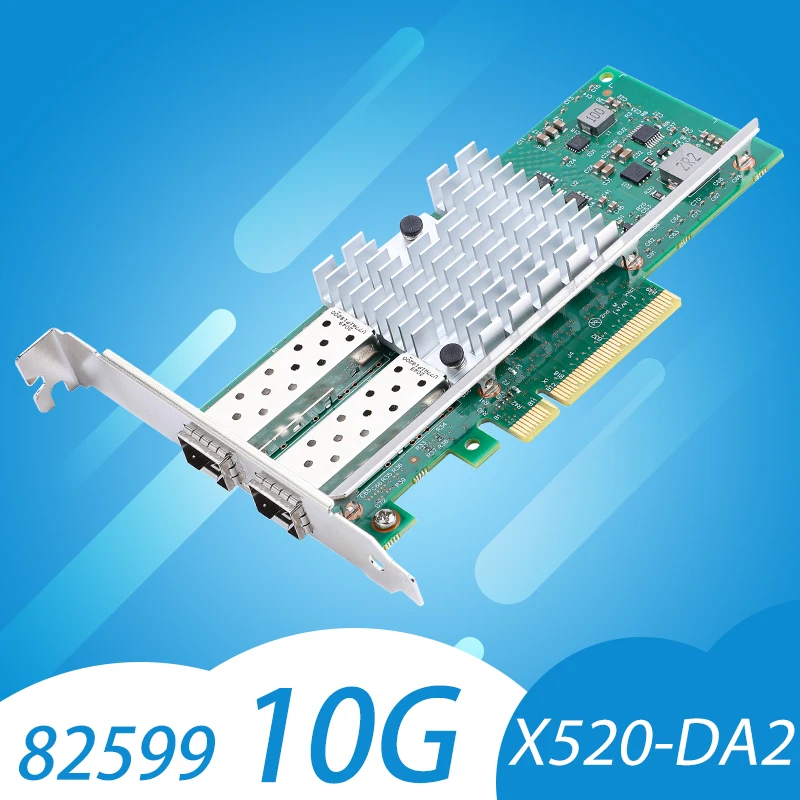
Visual inspection reveals a substantial integrated heatsink covering the main chipset. This is not merely an aesthetic choice; it is a functional necessity for passive cooling. The heatsink effectively dissipates heat generated by the 82599ES chip during continuous high-speed operation, maintaining optimal temperatures without requiring active fans. This design choice contributes to the card's overall reliability and silent operation, making it suitable for noise-sensitive environments like home offices or server closets.
Passive cooling eliminates the potential points of failure associated with active fans, such as dust accumulation, bearing wear, and fan noise. This longevity is a key differentiator. The lack of moving parts reduces maintenance requirements and increases the mean time between failures (MTBF). For critical infrastructure, whether a small business server or a sophisticated smart home control hub, this reliability translates directly into uptime and peace of mind. Network stability is paramount.
Many entry-level network cards omit robust cooling solutions, leading to performance degradation or premature component failure under sustained load. The visible engineering of this card, with its large fin array, suggests a design focused on enduring high-performance demands. This attention to thermal management underscores its suitability for always-on applications where consistent performance is non-negotiable. It is built to last.
The dual SFP+ ports offer flexible and high-speed connectivity options. SFP+ (Small Form-Factor Pluggable Plus) is the industry standard for 10 Gigabit Ethernet optical and direct-attach copper (DAC) connections. This versatility allows users to choose the appropriate cabling for their specific deployment, whether it’s short-range DAC cables for rack-mounted equipment or long-range fiber optic cables for connecting distant network segments. It offers significant adaptability.
Unlike traditional RJ45 Ethernet ports, SFP+ connections are designed specifically for 10GbE and beyond, providing superior performance and lower latency. The dual-port configuration also enables advanced networking features such as link aggregation (LAG) for increased bandwidth and redundancy, or network segmentation for improved security and traffic management. This setup provides resilience. Imagine a scenario where one link fails; the other can take over, preventing service interruption. This is crucial for maintaining continuous operation of smart home systems, where even a brief outage can disrupt automation routines or security monitoring.
Standard home routers typically offer only Gigabit Ethernet via RJ45, which can quickly become a bottleneck when aggregating traffic from multiple high-bandwidth devices. The SFP+ interface on this card bypasses these limitations, providing a dedicated, high-speed pathway directly into the network backbone. This ensures that the core network infrastructure can handle the demands of an expanding smart ecosystem, preventing the router from becoming overwhelmed and crashing. It is a direct route to efficiency.
The card connects via a PCI Express X8 interface. This interface provides the necessary bandwidth to fully utilize the 10GbE capabilities of the card. A PCIe x8 slot, found in most modern servers and many high-end desktop motherboards, ensures that the network card is not bottlenecked by the system bus, allowing for maximum data throughput. It is a wide data highway.
Included with the card are both full-height and low-profile brackets. This thoughtful inclusion ensures broad compatibility with various server and PC chassis form factors. Whether installing into a standard tower server or a compact 2U rackmount server, the correct bracket is available, simplifying the installation process. This flexibility is highly beneficial. Users don't need to source additional hardware.
Driver support is typically robust for Intel chipsets like the 82599ES, with native drivers often available in major operating systems such as Windows Server, Linux distributions, and VMware ESXi. This broad compatibility simplifies integration into existing IT infrastructures, reducing setup time and potential compatibility issues. A quick driver install is usually all that is needed. For smart home enthusiasts building a custom server or NAS, this ease of integration means less time troubleshooting and more time enjoying a high-speed network.
For the smart home builder, this network card is more than just a component; it is a strategic investment in future-proofing. The ability to handle stable connections for 50+ smart devices, prevent router crashes under heavy load, and ensure low latency for critical automation routines cannot be overstated. As homes become increasingly interconnected, the demands on the network grow exponentially. This card offers a proactive solution.
The X520-DA2 provides the necessary bandwidth and processing power to manage complex smart home ecosystems. Imagine a scenario where multiple security cameras are streaming high-definition video, a home theater system is streaming 4K content, and various sensors are constantly reporting data, all while home automation scripts are executing. A robust network card like this ensures that all these operations occur simultaneously without degradation in performance. It truly handles the load.
Beyond just raw speed, the stability provided by the Intel 82599ES chipset translates directly into reliable automation. Low latency is critical for instantaneous responses from smart switches, door locks, and environmental controls. If the network introduces delays, the entire smart home experience suffers. This card minimizes such latency. It ensures commands are executed instantly. This level of responsiveness is what differentiates a truly smart home from a merely connected one.
Consider the long-term value. While the initial investment in 10GbE infrastructure might seem higher than standard Gigabit, the benefits in terms of performance, reliability, and future scalability far outweigh the cost. Avoiding network bottlenecks, preventing system crashes, and ensuring a smooth, responsive smart home experience saves time and frustration. This card is an infrastructure upgrade that pays dividends in operational efficiency and user satisfaction for years to come. It is a wise investment.
Imagine the seamless flow of data across your entire smart home, from instantaneous sensor responses to buffer-free 8K streaming, all powered by an unyielding network backbone. Envision a home where every connected device operates with precision, where automation routines trigger without a hitch, and where network slowdowns are a distant memory. This high-performance network card provides the critical foundation for such an advanced and responsive digital living environment, allowing you to build a truly intelligent and reliable smart home ecosystem that anticipates your needs and performs flawlessly under any demand.
The Foundation of Speed
At its core, the Intel X520-DA2 utilizes the Intel 82599ES chipset. This is a critical component, known for its proven reliability and efficiency in handling high-speed data. The chip manages the dual SFP+ ports, allowing for 10 Gigabit Ethernet (10GbE) connectivity, a tenfold increase over traditional Gigabit speeds. This means substantial bandwidth. Large file transfers complete in moments.
Unlike older network adapters that might struggle under heavy load, the 82599ES chipset is engineered for sustained performance. Its architecture is optimized to offload networking tasks from the CPU, reducing system overhead and freeing up processing power for other applications. This capability is particularly vital in server environments where every CPU cycle counts, or in smart homes managing dozens of simultaneous data streams from cameras, sensors, and media servers. The card’s ability to maintain high throughput is essential for preventing bottlenecks.
Consider a home with over 50 smart devices, each generating or consuming data, from 4K video streams to constant sensor updates. A standard 1GbE connection can quickly become saturated, leading to buffering, slow response times, and even complete network crashes. The 10GbE capacity of the X520-DA2 provides ample headroom, ensuring that all devices communicate seamlessly and without interruption. It is a true enabler for advanced automation.
Engineered for Reliability
Visual inspection reveals a substantial integrated heatsink covering the main chipset. This is not merely an aesthetic choice; it is a functional necessity for passive cooling. The heatsink effectively dissipates heat generated by the 82599ES chip during continuous high-speed operation, maintaining optimal temperatures without requiring active fans. This design choice contributes to the card's overall reliability and silent operation, making it suitable for noise-sensitive environments like home offices or server closets.
Passive cooling eliminates the potential points of failure associated with active fans, such as dust accumulation, bearing wear, and fan noise. This longevity is a key differentiator. The lack of moving parts reduces maintenance requirements and increases the mean time between failures (MTBF). For critical infrastructure, whether a small business server or a sophisticated smart home control hub, this reliability translates directly into uptime and peace of mind. Network stability is paramount.
Many entry-level network cards omit robust cooling solutions, leading to performance degradation or premature component failure under sustained load. The visible engineering of this card, with its large fin array, suggests a design focused on enduring high-performance demands. This attention to thermal management underscores its suitability for always-on applications where consistent performance is non-negotiable. It is built to last.
Connectivity Beyond Standard
The dual SFP+ ports offer flexible and high-speed connectivity options. SFP+ (Small Form-Factor Pluggable Plus) is the industry standard for 10 Gigabit Ethernet optical and direct-attach copper (DAC) connections. This versatility allows users to choose the appropriate cabling for their specific deployment, whether it’s short-range DAC cables for rack-mounted equipment or long-range fiber optic cables for connecting distant network segments. It offers significant adaptability.
Unlike traditional RJ45 Ethernet ports, SFP+ connections are designed specifically for 10GbE and beyond, providing superior performance and lower latency. The dual-port configuration also enables advanced networking features such as link aggregation (LAG) for increased bandwidth and redundancy, or network segmentation for improved security and traffic management. This setup provides resilience. Imagine a scenario where one link fails; the other can take over, preventing service interruption. This is crucial for maintaining continuous operation of smart home systems, where even a brief outage can disrupt automation routines or security monitoring.
Standard home routers typically offer only Gigabit Ethernet via RJ45, which can quickly become a bottleneck when aggregating traffic from multiple high-bandwidth devices. The SFP+ interface on this card bypasses these limitations, providing a dedicated, high-speed pathway directly into the network backbone. This ensures that the core network infrastructure can handle the demands of an expanding smart ecosystem, preventing the router from becoming overwhelmed and crashing. It is a direct route to efficiency.
Installation and Integration
The card connects via a PCI Express X8 interface. This interface provides the necessary bandwidth to fully utilize the 10GbE capabilities of the card. A PCIe x8 slot, found in most modern servers and many high-end desktop motherboards, ensures that the network card is not bottlenecked by the system bus, allowing for maximum data throughput. It is a wide data highway.
Included with the card are both full-height and low-profile brackets. This thoughtful inclusion ensures broad compatibility with various server and PC chassis form factors. Whether installing into a standard tower server or a compact 2U rackmount server, the correct bracket is available, simplifying the installation process. This flexibility is highly beneficial. Users don't need to source additional hardware.
Driver support is typically robust for Intel chipsets like the 82599ES, with native drivers often available in major operating systems such as Windows Server, Linux distributions, and VMware ESXi. This broad compatibility simplifies integration into existing IT infrastructures, reducing setup time and potential compatibility issues. A quick driver install is usually all that is needed. For smart home enthusiasts building a custom server or NAS, this ease of integration means less time troubleshooting and more time enjoying a high-speed network.
The Smart Home Network Backbone
For the smart home builder, this network card is more than just a component; it is a strategic investment in future-proofing. The ability to handle stable connections for 50+ smart devices, prevent router crashes under heavy load, and ensure low latency for critical automation routines cannot be overstated. As homes become increasingly interconnected, the demands on the network grow exponentially. This card offers a proactive solution.
The X520-DA2 provides the necessary bandwidth and processing power to manage complex smart home ecosystems. Imagine a scenario where multiple security cameras are streaming high-definition video, a home theater system is streaming 4K content, and various sensors are constantly reporting data, all while home automation scripts are executing. A robust network card like this ensures that all these operations occur simultaneously without degradation in performance. It truly handles the load.
Beyond just raw speed, the stability provided by the Intel 82599ES chipset translates directly into reliable automation. Low latency is critical for instantaneous responses from smart switches, door locks, and environmental controls. If the network introduces delays, the entire smart home experience suffers. This card minimizes such latency. It ensures commands are executed instantly. This level of responsiveness is what differentiates a truly smart home from a merely connected one.
Consider the long-term value. While the initial investment in 10GbE infrastructure might seem higher than standard Gigabit, the benefits in terms of performance, reliability, and future scalability far outweigh the cost. Avoiding network bottlenecks, preventing system crashes, and ensuring a smooth, responsive smart home experience saves time and frustration. This card is an infrastructure upgrade that pays dividends in operational efficiency and user satisfaction for years to come. It is a wise investment.
Imagine the seamless flow of data across your entire smart home, from instantaneous sensor responses to buffer-free 8K streaming, all powered by an unyielding network backbone. Envision a home where every connected device operates with precision, where automation routines trigger without a hitch, and where network slowdowns are a distant memory. This high-performance network card provides the critical foundation for such an advanced and responsive digital living environment, allowing you to build a truly intelligent and reliable smart home ecosystem that anticipates your needs and performs flawlessly under any demand.