Intel Wireless-AC 8265NGW M.2 WiFi Bluetooth Card
Official Store Deal
Expert Analysis Overview
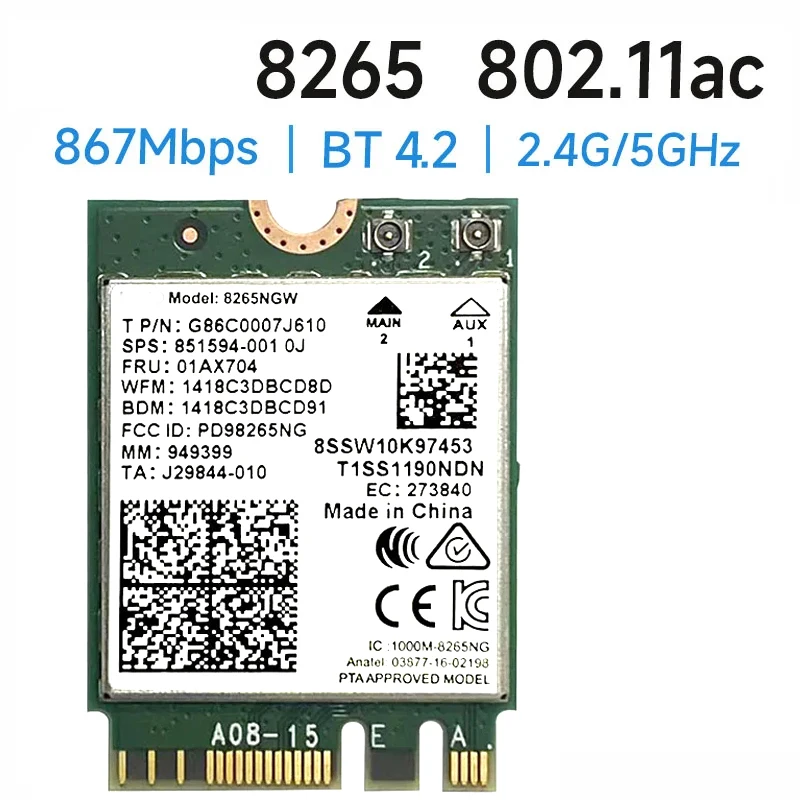
The Intel Wireless-AC 8265NGW is a highly capable M.2 form factor wireless adapter, engineered for systems requiring a robust upgrade to 802.11ac Wi-Fi and integrated Bluetooth 4.2 connectivity. This module targets users seeking enhanced network throughput and reliable peripheral pairing without the complexities of external adapters.
The Intel 8265NGW module operates on the 802.11ac standard, delivering a theoretical maximum throughput of 867Mbps. This specification represents a significant leap over previous 802.11n generations, which typically capped around 300-450Mbps.
For a user streaming high-definition content, engaging in online gaming, or transferring large files across a local network, this throughput capability translates directly into reduced buffering and faster data synchronization. The increased bandwidth ensures a smoother, more responsive digital experience, particularly in environments with multiple active devices.
Compared to older 802.11n cards, the 8265NGW provides a substantial performance uplift, making it an ideal upgrade for systems still reliant on legacy wireless standards. It offers a tangible improvement in network efficiency without necessitating a complete system overhaul.
This wireless card supports dual-band operation, functioning across both the 2.4GHz and 5GHz frequency spectra. The ability to utilize two distinct frequency bands is critical for optimizing wireless performance in varied network conditions.
The 2.4GHz band offers broader coverage and better penetration through obstacles, making it suitable for general browsing and devices located further from the access point. The 5GHz band, conversely, provides higher speeds and lower interference due to fewer devices operating on this frequency, ideal for bandwidth-intensive tasks in closer proximity to the router. Users can select the optimal band based on their immediate needs.
Unlike single-band adapters that are confined to the often-congested 2.4GHz spectrum, the 8265NGW's dual-band capability allows for intelligent traffic steering. This ensures that critical applications can leverage the cleaner 5GHz band, while less demanding tasks can utilize the 2.4GHz band, thereby distributing network load more effectively.
The 8265NGW incorporates 2x2 MU-MIMO (Multi-User, Multiple-Input, Multiple-Output) technology. This advanced feature allows the access point to communicate with multiple compatible devices simultaneously, rather than sequentially.
In a household or office environment with several Wi-Fi devices (smartphones, tablets, laptops) concurrently accessing the network, MU-MIMO significantly enhances overall network efficiency. Each device receives its data stream without waiting for others, reducing latency and improving aggregate throughput. This is a key differentiator for modern wireless performance.
Systems without MU-MIMO support often experience bottlenecks when multiple devices demand bandwidth, leading to a degraded experience for all connected clients. The 8265NGW's MU-MIMO capability mitigates this issue, ensuring a more equitable and efficient distribution of wireless resources across the network.
Beyond its Wi-Fi capabilities, the module integrates Bluetooth 4.2. This version of Bluetooth offers improved data transfer rates and enhanced security features compared to earlier iterations.
The inclusion of Bluetooth 4.2 enables seamless connection to a wide array of wireless peripherals, including headphones, keyboards, mice, and game controllers. This eliminates the need for separate USB dongles, freeing up valuable USB ports and reducing cable clutter. Peripheral connectivity is simplified.
Many older systems either lack integrated Bluetooth or feature an outdated version with limited range and slower speeds. Upgrading to a card with Bluetooth 4.2 provides a modern, reliable wireless ecosystem for connecting essential accessories, enhancing user convenience and system versatility.
The card adheres to the M.2 2230 form factor, specifically designed for compact integration into modern laptops and small form factor PCs. Its dimensions, 22mm by 30mm, make it suitable for systems with limited internal space.
This compact design facilitates straightforward installation into compatible M.2 E-key slots, which are prevalent in contemporary motherboards and laptop designs. The module's small footprint ensures it does not obstruct other components or airflow within a confined chassis. Installation is generally quick.
Unlike older Mini PCIe cards or bulky USB adapters, the M.2 form factor provides a clean, internal solution that maintains the aesthetic and portability of the host system. It represents a streamlined approach to adding advanced wireless capabilities without external protrusions or cumbersome wiring.
As an Intel-based chipset, the 8265NGW generally benefits from broad driver support across various operating systems, including Windows and many Linux distributions. Intel's commitment to driver development ensures consistent performance and feature access.
Users should verify system compatibility, particularly regarding the M.2 slot type (E-key) and BIOS whitelist restrictions that some OEMs implement. While Intel chipsets are widely supported, specific system configurations may require updated drivers or BIOS settings for optimal functionality. A quick check of the system's manual is advisable.
Compared to generic or lesser-known chipsets, Intel's widespread adoption often translates to more stable drivers and better long-term support. This reduces the likelihood of encountering obscure compatibility issues or performance inconsistencies over the module's lifespan.
The compact nature of the M.2 form factor necessitates efficient thermal management. The visible PCB design and component layout suggest a standard approach to heat dissipation for a low-power wireless module. The card operates within typical thermal envelopes for its class.
Reliable operation is paramount for network components. The Intel 8265NGW chipset is known for its stability and consistent performance under sustained load. This ensures that wireless connectivity remains robust even during prolonged periods of high data transfer or continuous streaming.
Unlike some budget alternatives that may experience performance degradation or dropped connections due to thermal throttling, the Intel 8265NGW is engineered for sustained reliability. This contributes to a more consistent and dependable network experience, minimizing frustrating interruptions.
The Intel Wireless-AC 8265NGW M.2 card stands as a compelling solution for enhancing a system's wireless capabilities. Its integration of 802.11ac dual-band Wi-Fi with 867Mbps throughput, 2x2 MU-MIMO, and Bluetooth 4.2 positions it as a significant upgrade for many platforms. The M.2 2230 form factor ensures broad compatibility with modern compact systems, offering an internal, clutter-free installation. This module provides the necessary bandwidth and connectivity features to support demanding applications and a growing ecosystem of wireless peripherals. Imagine seamless 4K streaming, lag-free online gaming, and instantaneous file transfers, all while effortlessly connecting your wireless headset and mouse. This card delivers a foundation for a truly connected and efficient digital workspace or entertainment hub, transforming an ordinary system into a highly capable wireless powerhouse.
Wireless Protocol Efficacy
The Intel 8265NGW module operates on the 802.11ac standard, delivering a theoretical maximum throughput of 867Mbps. This specification represents a significant leap over previous 802.11n generations, which typically capped around 300-450Mbps.
For a user streaming high-definition content, engaging in online gaming, or transferring large files across a local network, this throughput capability translates directly into reduced buffering and faster data synchronization. The increased bandwidth ensures a smoother, more responsive digital experience, particularly in environments with multiple active devices.
Compared to older 802.11n cards, the 8265NGW provides a substantial performance uplift, making it an ideal upgrade for systems still reliant on legacy wireless standards. It offers a tangible improvement in network efficiency without necessitating a complete system overhaul.
Dual-Band Operation and Spectrum Utilization
This wireless card supports dual-band operation, functioning across both the 2.4GHz and 5GHz frequency spectra. The ability to utilize two distinct frequency bands is critical for optimizing wireless performance in varied network conditions.
The 2.4GHz band offers broader coverage and better penetration through obstacles, making it suitable for general browsing and devices located further from the access point. The 5GHz band, conversely, provides higher speeds and lower interference due to fewer devices operating on this frequency, ideal for bandwidth-intensive tasks in closer proximity to the router. Users can select the optimal band based on their immediate needs.
Unlike single-band adapters that are confined to the often-congested 2.4GHz spectrum, the 8265NGW's dual-band capability allows for intelligent traffic steering. This ensures that critical applications can leverage the cleaner 5GHz band, while less demanding tasks can utilize the 2.4GHz band, thereby distributing network load more effectively.
MU-MIMO Implementation
The 8265NGW incorporates 2x2 MU-MIMO (Multi-User, Multiple-Input, Multiple-Output) technology. This advanced feature allows the access point to communicate with multiple compatible devices simultaneously, rather than sequentially.
In a household or office environment with several Wi-Fi devices (smartphones, tablets, laptops) concurrently accessing the network, MU-MIMO significantly enhances overall network efficiency. Each device receives its data stream without waiting for others, reducing latency and improving aggregate throughput. This is a key differentiator for modern wireless performance.
Systems without MU-MIMO support often experience bottlenecks when multiple devices demand bandwidth, leading to a degraded experience for all connected clients. The 8265NGW's MU-MIMO capability mitigates this issue, ensuring a more equitable and efficient distribution of wireless resources across the network.
Integrated Bluetooth 4.2 Connectivity
Beyond its Wi-Fi capabilities, the module integrates Bluetooth 4.2. This version of Bluetooth offers improved data transfer rates and enhanced security features compared to earlier iterations.
The inclusion of Bluetooth 4.2 enables seamless connection to a wide array of wireless peripherals, including headphones, keyboards, mice, and game controllers. This eliminates the need for separate USB dongles, freeing up valuable USB ports and reducing cable clutter. Peripheral connectivity is simplified.
Many older systems either lack integrated Bluetooth or feature an outdated version with limited range and slower speeds. Upgrading to a card with Bluetooth 4.2 provides a modern, reliable wireless ecosystem for connecting essential accessories, enhancing user convenience and system versatility.
Form Factor and System Integration
The card adheres to the M.2 2230 form factor, specifically designed for compact integration into modern laptops and small form factor PCs. Its dimensions, 22mm by 30mm, make it suitable for systems with limited internal space.
This compact design facilitates straightforward installation into compatible M.2 E-key slots, which are prevalent in contemporary motherboards and laptop designs. The module's small footprint ensures it does not obstruct other components or airflow within a confined chassis. Installation is generally quick.
Unlike older Mini PCIe cards or bulky USB adapters, the M.2 form factor provides a clean, internal solution that maintains the aesthetic and portability of the host system. It represents a streamlined approach to adding advanced wireless capabilities without external protrusions or cumbersome wiring.
Driver and Compatibility Considerations
As an Intel-based chipset, the 8265NGW generally benefits from broad driver support across various operating systems, including Windows and many Linux distributions. Intel's commitment to driver development ensures consistent performance and feature access.
Users should verify system compatibility, particularly regarding the M.2 slot type (E-key) and BIOS whitelist restrictions that some OEMs implement. While Intel chipsets are widely supported, specific system configurations may require updated drivers or BIOS settings for optimal functionality. A quick check of the system's manual is advisable.
Compared to generic or lesser-known chipsets, Intel's widespread adoption often translates to more stable drivers and better long-term support. This reduces the likelihood of encountering obscure compatibility issues or performance inconsistencies over the module's lifespan.
Thermal Management and Reliability
The compact nature of the M.2 form factor necessitates efficient thermal management. The visible PCB design and component layout suggest a standard approach to heat dissipation for a low-power wireless module. The card operates within typical thermal envelopes for its class.
Reliable operation is paramount for network components. The Intel 8265NGW chipset is known for its stability and consistent performance under sustained load. This ensures that wireless connectivity remains robust even during prolonged periods of high data transfer or continuous streaming.
Unlike some budget alternatives that may experience performance degradation or dropped connections due to thermal throttling, the Intel 8265NGW is engineered for sustained reliability. This contributes to a more consistent and dependable network experience, minimizing frustrating interruptions.
Conclusion: Elevating Network Capability
The Intel Wireless-AC 8265NGW M.2 card stands as a compelling solution for enhancing a system's wireless capabilities. Its integration of 802.11ac dual-band Wi-Fi with 867Mbps throughput, 2x2 MU-MIMO, and Bluetooth 4.2 positions it as a significant upgrade for many platforms. The M.2 2230 form factor ensures broad compatibility with modern compact systems, offering an internal, clutter-free installation. This module provides the necessary bandwidth and connectivity features to support demanding applications and a growing ecosystem of wireless peripherals. Imagine seamless 4K streaming, lag-free online gaming, and instantaneous file transfers, all while effortlessly connecting your wireless headset and mouse. This card delivers a foundation for a truly connected and efficient digital workspace or entertainment hub, transforming an ordinary system into a highly capable wireless powerhouse.