Intel Core i3-4170 LGA 1150 Processor
Official Store Deal
Expert Analysis Overview
The Intel Core i3-4170 is a capable, budget-friendly dual-core processor designed for reliable performance in entry-level and office productivity systems. This particular CPU, identified by its SR1PL stepping, represents a mature point in Intel's Haswell Refresh architecture, offering a compelling blend of efficiency and sufficient power for its intended niche. Its 3.7GHz clock speed, combined with hyper-threading, provides a responsive user experience that belies its age, making it a smart choice for builders focused on maximizing value without compromising essential functionality.
The Core i3-4170 hails from Intel's Haswell Refresh generation, a refined iteration of the successful Haswell microarchitecture. This specific generation brought incremental improvements over the original Haswell lineup, primarily focusing on enhanced stability, minor clock speed bumps, and optimized power delivery. It operates as a dual-core processor. This means it physically contains two distinct processing units, capable of executing instructions in parallel.
The implication for users translates into a solid and dependable foundation for a wide array of everyday computing tasks. Activities such as extensive web browsing with multiple tabs open, efficient email management, and comprehensive word processing or spreadsheet manipulation execute with commendable speed and fluidity. The chip handles these common workloads with a level of efficiency that prevents frustrating slowdowns, ensuring a smooth operational flow throughout the day.
Compared to the previous Ivy Bridge or even older Sandy Bridge generations, Haswell Refresh offered tangible benefits in terms of better power efficiency and slightly improved IPC (Instructions Per Clock). Unlike some earlier dual-core architectures that could feel sluggish or struggle under the demands of modern operating systems like Windows 10, the i3-4170 provides a more fluid and responsive user experience. It remains a surprisingly viable option for many.
Operating at a robust base clock frequency of 3.7GHz, the Intel Core i3-4170 delivers a remarkably consistent and predictable performance profile. It is important to note that this particular model does not feature Intel's Turbo Boost technology, meaning its operational speed remains fixed at 3.7GHz. This fixed speed, however, ensures predictable operation across various applications and workloads, eliminating performance fluctuations.
This high base clock translates directly into snappy responsiveness, particularly for single-threaded applications and tasks that do not heavily leverage multiple cores. Many common programs, including popular web browsers, comprehensive office suites, and light photo editing tools, benefit significantly from higher clock speeds. Users will immediately notice quick application launches and rapid execution of commands, making daily interactions feel immediate and efficient.
Unlike lower-clocked entry-level processors that might introduce noticeable delays or stuttering during routine operations, the 3.7GHz of the i3-4170 provides a tangible edge in daily interactions. It feels faster. This makes for a significantly more pleasant computing experience than struggling with a slower, less capable chip, especially when navigating complex, script-heavy websites or managing large, intricate documents. The consistent speed is a major advantage.
A critical and foundational aspect for any PC builder is ensuring proper motherboard compatibility, and the i3-4170 processor exclusively utilizes the LGA 1150 socket. This socket type was the standard and prevalent choice for Intel's 4th generation Core processors, encompassing both the original Haswell and the subsequent Haswell Refresh lineups. It is a well-established platform, with a vast array of compatible motherboards still available in the secondary market.
For those undertaking a new system build on a stringent budget or looking to breathe new life into an existing LGA 1150 setup, this processor offers straightforward and hassle-free integration. Motherboards equipped with chipsets such as H81, B85, H87, Z87, H97, or Z97 are all compatible. However, it is absolutely crucial to verify that the motherboard's BIOS firmware supports Haswell Refresh processors, as some older H81/B85 boards might require an update for full compatibility.
Unlike the fragmented and rapidly changing socket landscape seen in newer generations, LGA 1150 offers a relatively stable and mature ecosystem. Finding compatible motherboards, memory, and other components is still quite feasible, often at very attractive price points. This simplifies the component acquisition process for budget builders. This mature platform reduces build complexity.
The Intel Core i3-4170 incorporates Intel HD Graphics 4400, an integrated graphics solution built directly into the processor die. This particular iGPU provides competent basic visual output capabilities, supporting standard display resolutions and offering hardware acceleration for common video codecs. It is perfectly adequate for everyday visual tasks.
This means that for systems primarily intended for general productivity, casual media consumption, or light office work, a dedicated graphics card is not strictly necessary. The integrated GPU handles tasks like streaming high-definition video, displaying web content, and running basic graphical interfaces without any noticeable hitches. It saves system cost, allowing budget reallocation.
Compared to relying on older, less capable integrated solutions found in even earlier generations, or the added expense and power draw of needing to purchase a separate, entry-level discrete GPU, the HD Graphics 4400 offers a convenient and highly cost-effective alternative. It provides adequate visual fidelity and performance for its class, making it a key benefit for truly budget-conscious builds where every dollar counts.
With a Thermal Design Power (TDP) of just 54W, the Core i3-4170 stands out as a remarkably power-efficient processor within its performance segment. This low power draw has several significant beneficial implications for system builders and end-users alike. It runs cool.
Lower TDP directly translates to substantially reduced heat generation, which in turn greatly simplifies cooling requirements. A basic aftermarket cooler, or even a standard Intel stock cooler (if one is included or sourced separately), can effectively and quietly manage its thermal output. This helps maintain system stability over long periods of operation and contributes to a longer component lifespan.
Unlike more powerful, higher-TDP processors that often demand robust, expensive cooling solutions and larger, more capable power supplies, the i3-4170 is incredibly forgiving. It minimizes energy consumption, which is beneficial for utility bills. This makes it an ideal candidate for compact form factor builds (like Mini-ITX systems) or for systems where noise reduction is a paramount priority, as smaller fans can operate at much lower, quieter RPMs.
The i3-4170 processor supports DDR3 memory, specifically operating at speeds up to 1600MHz. This memory standard was the prevailing norm during the processor's release cycle, offering a good balance of performance and cost-effectiveness. It provides sufficient bandwidth for its target applications.
Utilizing a dual-channel DDR3 memory configuration can significantly enhance overall system responsiveness, particularly when the integrated graphics are actively in use, as the iGPU shares system memory. Ensuring an adequate RAM capacity, typically 8GB or 16GB for modern use, ensures smooth multitasking and prevents performance bottlenecks. This directly improves the user experience, making the system feel more fluid.
Compared to single-channel configurations or slower memory modules, optimizing the RAM setup for the i3-4170 can unlock its full potential for daily tasks. It makes a tangible difference. This is a crucial consideration for ensuring the system feels snappy and capable, especially when juggling multiple applications or browser tabs. Investing in good, compatible RAM is key.
In today's dynamic computing market, where cutting-edge processors often command premium prices and rapid obsolescence is a concern, the Intel Core i3-4170 presents an exceptional value proposition. Its current price point, especially on the secondary market, makes it highly attractive for specific, budget-driven use cases. It is very affordable.
For users seeking to revive an older LGA 1150 system that might be struggling with an ancient Celeron or Pentium, or for those looking to construct a new, ultra-budget PC specifically for non-demanding tasks, this chip offers an outstanding return on investment. It provides reliable, consistent performance without requiring a significant financial outlay. This saves money, allowing for investment elsewhere.
Unlike purchasing a brand-new, entry-level CPU and motherboard combination, which often costs considerably more and offers only marginal performance gains for basic tasks, the i3-4170 leverages the inherent affordability of its mature platform. This strategic choice not only extends the lifespan of existing hardware but also minimizes the overall cost of ownership. It is a smart economic move for the discerning builder.
The i3-4170 truly shines brightest when integrated into a cost-effective workstation build. Its blend of a high base clock speed and Intel's Hyper-Threading technology provides ample processing power for standard office applications and productivity suites. Spreadsheets with complex formulas, presentations with rich media, and communication tools like video conferencing run well.
Imagine a scenario where a small business or an educational institution needs to deploy multiple reliable, low-cost computer terminals. This processor fits perfectly into such a requirement. It offers consistent, dependable performance for employees or students, ensuring that daily tasks are completed without frustrating delays. This boosts overall productivity.
Compared to opting for more expensive, over-specced processors for such environments, which would represent an unnecessary expenditure, the i3-4170 allows for significant budget reallocation. This enables investment in other critical components, such as fast solid-state drives (SSDs) for rapid boot times and application loading, or larger, ergonomic monitors for improved user comfort. It optimizes resource allocation effectively.
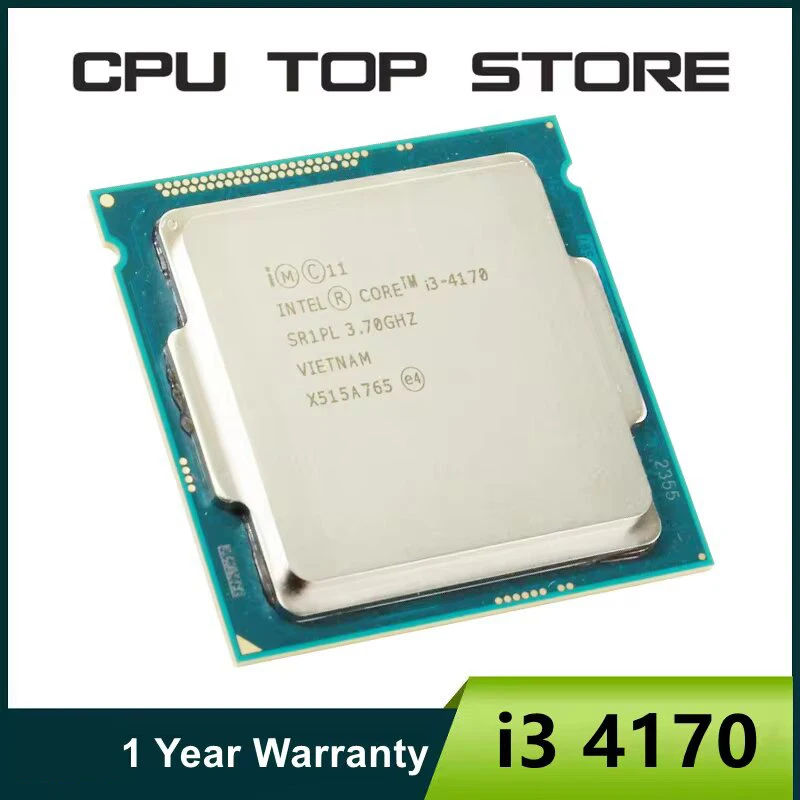
The SR1PL stepping visible on the processor's integrated heat spreader indicates a specific manufacturing revision of the i3-4170. While this detail typically does not translate into a noticeable performance-altering factor for the average end-user, it signifies ongoing manufacturing refinements and optimizations. It ensures stability.
These specific revisions often incorporate minor bug fixes, subtle electrical characteristic improvements, or manufacturing process optimizations that enhance silicon quality and consistency. They contribute to the overall long-term reliability and stability of the chip, ensuring it operates within its specified parameters throughout its lifespan. This provides peace of mind for the builder.
Unlike early production runs of some processors that might occasionally exhibit minor quirks or require more specific motherboard compatibility, later steppings like SR1PL typically represent a more mature and stable product. This is a subtle yet important assurance of quality and robustness, indicating a well-refined component that has undergone iterative improvements.
Despite its classification as an older generation processor, the Intel Core i3-4170 offers surprising longevity for its target applications. Intel processors, across many generations, are renowned for their robust build quality and consistent performance over extended periods. They endure years of use.
For a system dedicated to specific, less demanding tasks—such as a point-of-sale terminal, a dedicated digital signage player, a home automation server, or a family web-browsing station—this processor can continue to deliver consistent and reliable performance for many years to come. Its inherent reliability is a key asset, minimizing maintenance and downtime. It keeps working dependably.
Unlike rapidly evolving high-end components that often become functionally obsolete within a few years due to demanding software advancements, the i3-4170 occupies a niche where its core capabilities remain highly relevant and sufficient. This makes it a sustainable and economical choice for specific, long-term deployments where raw horsepower is less critical than stability and cost-effectiveness. It offers lasting utility.
The i3-4170, critically equipped with Intel's Hyper-Threading technology, functions as a significant performance upgrade over true dual-core processors that lack this feature. By presenting four logical cores to the operating system, even with only two physical cores, it dramatically enhances multitasking capabilities. This boosts efficiency.
Unlike older Celeron or Pentium dual-core chips that can struggle noticeably when attempting to run multiple open applications or handle background processes, the i3-4170 handles concurrent tasks far more gracefully. It significantly reduces system stutter and lag, particularly when switching between demanding applications. This provides a much smoother and more fluid user experience, making the system feel more capable.
This processor effectively bridges the performance gap between basic entry-level computing and more capable quad-core systems for everyday use. It offers a tangible and immediate performance boost for users migrating from older, less capable hardware. It is a smart step up, providing a noticeable improvement in daily computing responsiveness without the cost of a full quad-core solution.
For diligent PC builders, ensuring complete system harmony involves meticulously verifying power supply sufficiency and physical component fitment. The i3-4170's modest 54W TDP is exceptionally easy to manage, making it compatible with almost any modern power supply, even those with lower wattage ratings. It requires minimal power.
Standard ATX, Micro-ATX, and even many Mini-ITX cases will comfortably accommodate the necessary motherboard and CPU cooler for this processor without any clearance issues. The physical dimensions of the chip itself are standard for the LGA 1150 platform, ensuring it fits easily into the socket. This simplifies component selection and assembly.
Unlike high-end components that often demand specialized, bulky cooling solutions, larger cases for airflow, or high-wattage power supplies, the i3-4170 allows for considerable flexibility in system design. This reduces overall build complexity and cost. It is a builder-friendly component, making the assembly process smoother for both novices and experienced enthusiasts.
Imagine a streamlined home office setup, where documents load instantly, video calls are crystal clear, and web pages render without hesitation, all powered by a reliable and quiet system. Picture a dedicated media server, quietly streaming high-definition content to multiple devices with unwavering reliability and minimal power consumption. Envision a student's workstation, providing all the necessary power for research, assignments, and online learning, without a hefty price tag or distracting noise. This processor enables such practical, efficient systems, delivering consistent performance day after day. It is a foundation for productivity and smart computing, offering a tangible upgrade path for older systems and a robust core for new budget-conscious builds.
The Haswell Refresh Foundation: A Glimpse into Core Efficiency
The Core i3-4170 hails from Intel's Haswell Refresh generation, a refined iteration of the successful Haswell microarchitecture. This specific generation brought incremental improvements over the original Haswell lineup, primarily focusing on enhanced stability, minor clock speed bumps, and optimized power delivery. It operates as a dual-core processor. This means it physically contains two distinct processing units, capable of executing instructions in parallel.
The implication for users translates into a solid and dependable foundation for a wide array of everyday computing tasks. Activities such as extensive web browsing with multiple tabs open, efficient email management, and comprehensive word processing or spreadsheet manipulation execute with commendable speed and fluidity. The chip handles these common workloads with a level of efficiency that prevents frustrating slowdowns, ensuring a smooth operational flow throughout the day.
Compared to the previous Ivy Bridge or even older Sandy Bridge generations, Haswell Refresh offered tangible benefits in terms of better power efficiency and slightly improved IPC (Instructions Per Clock). Unlike some earlier dual-core architectures that could feel sluggish or struggle under the demands of modern operating systems like Windows 10, the i3-4170 provides a more fluid and responsive user experience. It remains a surprisingly viable option for many.
Clock Speed and Processing Agility: Delivering Consistent Responsiveness
Operating at a robust base clock frequency of 3.7GHz, the Intel Core i3-4170 delivers a remarkably consistent and predictable performance profile. It is important to note that this particular model does not feature Intel's Turbo Boost technology, meaning its operational speed remains fixed at 3.7GHz. This fixed speed, however, ensures predictable operation across various applications and workloads, eliminating performance fluctuations.
This high base clock translates directly into snappy responsiveness, particularly for single-threaded applications and tasks that do not heavily leverage multiple cores. Many common programs, including popular web browsers, comprehensive office suites, and light photo editing tools, benefit significantly from higher clock speeds. Users will immediately notice quick application launches and rapid execution of commands, making daily interactions feel immediate and efficient.
Unlike lower-clocked entry-level processors that might introduce noticeable delays or stuttering during routine operations, the 3.7GHz of the i3-4170 provides a tangible edge in daily interactions. It feels faster. This makes for a significantly more pleasant computing experience than struggling with a slower, less capable chip, especially when navigating complex, script-heavy websites or managing large, intricate documents. The consistent speed is a major advantage.
Socket Compatibility: Navigating the LGA 1150 Ecosystem
A critical and foundational aspect for any PC builder is ensuring proper motherboard compatibility, and the i3-4170 processor exclusively utilizes the LGA 1150 socket. This socket type was the standard and prevalent choice for Intel's 4th generation Core processors, encompassing both the original Haswell and the subsequent Haswell Refresh lineups. It is a well-established platform, with a vast array of compatible motherboards still available in the secondary market.
For those undertaking a new system build on a stringent budget or looking to breathe new life into an existing LGA 1150 setup, this processor offers straightforward and hassle-free integration. Motherboards equipped with chipsets such as H81, B85, H87, Z87, H97, or Z97 are all compatible. However, it is absolutely crucial to verify that the motherboard's BIOS firmware supports Haswell Refresh processors, as some older H81/B85 boards might require an update for full compatibility.
Unlike the fragmented and rapidly changing socket landscape seen in newer generations, LGA 1150 offers a relatively stable and mature ecosystem. Finding compatible motherboards, memory, and other components is still quite feasible, often at very attractive price points. This simplifies the component acquisition process for budget builders. This mature platform reduces build complexity.
Integrated Graphics: The Capabilities of Intel HD Graphics 4400
The Intel Core i3-4170 incorporates Intel HD Graphics 4400, an integrated graphics solution built directly into the processor die. This particular iGPU provides competent basic visual output capabilities, supporting standard display resolutions and offering hardware acceleration for common video codecs. It is perfectly adequate for everyday visual tasks.
This means that for systems primarily intended for general productivity, casual media consumption, or light office work, a dedicated graphics card is not strictly necessary. The integrated GPU handles tasks like streaming high-definition video, displaying web content, and running basic graphical interfaces without any noticeable hitches. It saves system cost, allowing budget reallocation.
Compared to relying on older, less capable integrated solutions found in even earlier generations, or the added expense and power draw of needing to purchase a separate, entry-level discrete GPU, the HD Graphics 4400 offers a convenient and highly cost-effective alternative. It provides adequate visual fidelity and performance for its class, making it a key benefit for truly budget-conscious builds where every dollar counts.
Power Efficiency and Thermal Management: A Cooler, Quieter System
With a Thermal Design Power (TDP) of just 54W, the Core i3-4170 stands out as a remarkably power-efficient processor within its performance segment. This low power draw has several significant beneficial implications for system builders and end-users alike. It runs cool.
Lower TDP directly translates to substantially reduced heat generation, which in turn greatly simplifies cooling requirements. A basic aftermarket cooler, or even a standard Intel stock cooler (if one is included or sourced separately), can effectively and quietly manage its thermal output. This helps maintain system stability over long periods of operation and contributes to a longer component lifespan.
Unlike more powerful, higher-TDP processors that often demand robust, expensive cooling solutions and larger, more capable power supplies, the i3-4170 is incredibly forgiving. It minimizes energy consumption, which is beneficial for utility bills. This makes it an ideal candidate for compact form factor builds (like Mini-ITX systems) or for systems where noise reduction is a paramount priority, as smaller fans can operate at much lower, quieter RPMs.
Memory Support and System Responsiveness: Optimizing for Smooth Operation
The i3-4170 processor supports DDR3 memory, specifically operating at speeds up to 1600MHz. This memory standard was the prevailing norm during the processor's release cycle, offering a good balance of performance and cost-effectiveness. It provides sufficient bandwidth for its target applications.
Utilizing a dual-channel DDR3 memory configuration can significantly enhance overall system responsiveness, particularly when the integrated graphics are actively in use, as the iGPU shares system memory. Ensuring an adequate RAM capacity, typically 8GB or 16GB for modern use, ensures smooth multitasking and prevents performance bottlenecks. This directly improves the user experience, making the system feel more fluid.
Compared to single-channel configurations or slower memory modules, optimizing the RAM setup for the i3-4170 can unlock its full potential for daily tasks. It makes a tangible difference. This is a crucial consideration for ensuring the system feels snappy and capable, especially when juggling multiple applications or browser tabs. Investing in good, compatible RAM is key.
Value Proposition in the Modern Landscape: Smart Spending for Smart Builds
In today's dynamic computing market, where cutting-edge processors often command premium prices and rapid obsolescence is a concern, the Intel Core i3-4170 presents an exceptional value proposition. Its current price point, especially on the secondary market, makes it highly attractive for specific, budget-driven use cases. It is very affordable.
For users seeking to revive an older LGA 1150 system that might be struggling with an ancient Celeron or Pentium, or for those looking to construct a new, ultra-budget PC specifically for non-demanding tasks, this chip offers an outstanding return on investment. It provides reliable, consistent performance without requiring a significant financial outlay. This saves money, allowing for investment elsewhere.
Unlike purchasing a brand-new, entry-level CPU and motherboard combination, which often costs considerably more and offers only marginal performance gains for basic tasks, the i3-4170 leverages the inherent affordability of its mature platform. This strategic choice not only extends the lifespan of existing hardware but also minimizes the overall cost of ownership. It is a smart economic move for the discerning builder.
Building a Cost-Effective Workstation: Efficiency for Productivity
The i3-4170 truly shines brightest when integrated into a cost-effective workstation build. Its blend of a high base clock speed and Intel's Hyper-Threading technology provides ample processing power for standard office applications and productivity suites. Spreadsheets with complex formulas, presentations with rich media, and communication tools like video conferencing run well.
Imagine a scenario where a small business or an educational institution needs to deploy multiple reliable, low-cost computer terminals. This processor fits perfectly into such a requirement. It offers consistent, dependable performance for employees or students, ensuring that daily tasks are completed without frustrating delays. This boosts overall productivity.
Compared to opting for more expensive, over-specced processors for such environments, which would represent an unnecessary expenditure, the i3-4170 allows for significant budget reallocation. This enables investment in other critical components, such as fast solid-state drives (SSDs) for rapid boot times and application loading, or larger, ergonomic monitors for improved user comfort. It optimizes resource allocation effectively.
The SR1PL Stepping: A Detail of Manufacturing Refinement
The SR1PL stepping visible on the processor's integrated heat spreader indicates a specific manufacturing revision of the i3-4170. While this detail typically does not translate into a noticeable performance-altering factor for the average end-user, it signifies ongoing manufacturing refinements and optimizations. It ensures stability.
These specific revisions often incorporate minor bug fixes, subtle electrical characteristic improvements, or manufacturing process optimizations that enhance silicon quality and consistency. They contribute to the overall long-term reliability and stability of the chip, ensuring it operates within its specified parameters throughout its lifespan. This provides peace of mind for the builder.
Unlike early production runs of some processors that might occasionally exhibit minor quirks or require more specific motherboard compatibility, later steppings like SR1PL typically represent a more mature and stable product. This is a subtle yet important assurance of quality and robustness, indicating a well-refined component that has undergone iterative improvements.
Longevity and Enduring Performance: A Reliable Workhorse
Despite its classification as an older generation processor, the Intel Core i3-4170 offers surprising longevity for its target applications. Intel processors, across many generations, are renowned for their robust build quality and consistent performance over extended periods. They endure years of use.
For a system dedicated to specific, less demanding tasks—such as a point-of-sale terminal, a dedicated digital signage player, a home automation server, or a family web-browsing station—this processor can continue to deliver consistent and reliable performance for many years to come. Its inherent reliability is a key asset, minimizing maintenance and downtime. It keeps working dependably.
Unlike rapidly evolving high-end components that often become functionally obsolete within a few years due to demanding software advancements, the i3-4170 occupies a niche where its core capabilities remain highly relevant and sufficient. This makes it a sustainable and economical choice for specific, long-term deployments where raw horsepower is less critical than stability and cost-effectiveness. It offers lasting utility.
The Upgrade Frame: Stepping Beyond Basic Dual-Cores
The i3-4170, critically equipped with Intel's Hyper-Threading technology, functions as a significant performance upgrade over true dual-core processors that lack this feature. By presenting four logical cores to the operating system, even with only two physical cores, it dramatically enhances multitasking capabilities. This boosts efficiency.
Unlike older Celeron or Pentium dual-core chips that can struggle noticeably when attempting to run multiple open applications or handle background processes, the i3-4170 handles concurrent tasks far more gracefully. It significantly reduces system stutter and lag, particularly when switching between demanding applications. This provides a much smoother and more fluid user experience, making the system feel more capable.
This processor effectively bridges the performance gap between basic entry-level computing and more capable quad-core systems for everyday use. It offers a tangible and immediate performance boost for users migrating from older, less capable hardware. It is a smart step up, providing a noticeable improvement in daily computing responsiveness without the cost of a full quad-core solution.
Ensuring System Harmony: Power, Fitment, and Thermal Considerations
For diligent PC builders, ensuring complete system harmony involves meticulously verifying power supply sufficiency and physical component fitment. The i3-4170's modest 54W TDP is exceptionally easy to manage, making it compatible with almost any modern power supply, even those with lower wattage ratings. It requires minimal power.
Standard ATX, Micro-ATX, and even many Mini-ITX cases will comfortably accommodate the necessary motherboard and CPU cooler for this processor without any clearance issues. The physical dimensions of the chip itself are standard for the LGA 1150 platform, ensuring it fits easily into the socket. This simplifies component selection and assembly.
Unlike high-end components that often demand specialized, bulky cooling solutions, larger cases for airflow, or high-wattage power supplies, the i3-4170 allows for considerable flexibility in system design. This reduces overall build complexity and cost. It is a builder-friendly component, making the assembly process smoother for both novices and experienced enthusiasts.
A Vision for Your Next Efficient Build
Imagine a streamlined home office setup, where documents load instantly, video calls are crystal clear, and web pages render without hesitation, all powered by a reliable and quiet system. Picture a dedicated media server, quietly streaming high-definition content to multiple devices with unwavering reliability and minimal power consumption. Envision a student's workstation, providing all the necessary power for research, assignments, and online learning, without a hefty price tag or distracting noise. This processor enables such practical, efficient systems, delivering consistent performance day after day. It is a foundation for productivity and smart computing, offering a tangible upgrade path for older systems and a robust core for new budget-conscious builds.