Heltec WiFi LoRa 32 V4 Development Board
Official Store Deal
Expert Analysis Overview
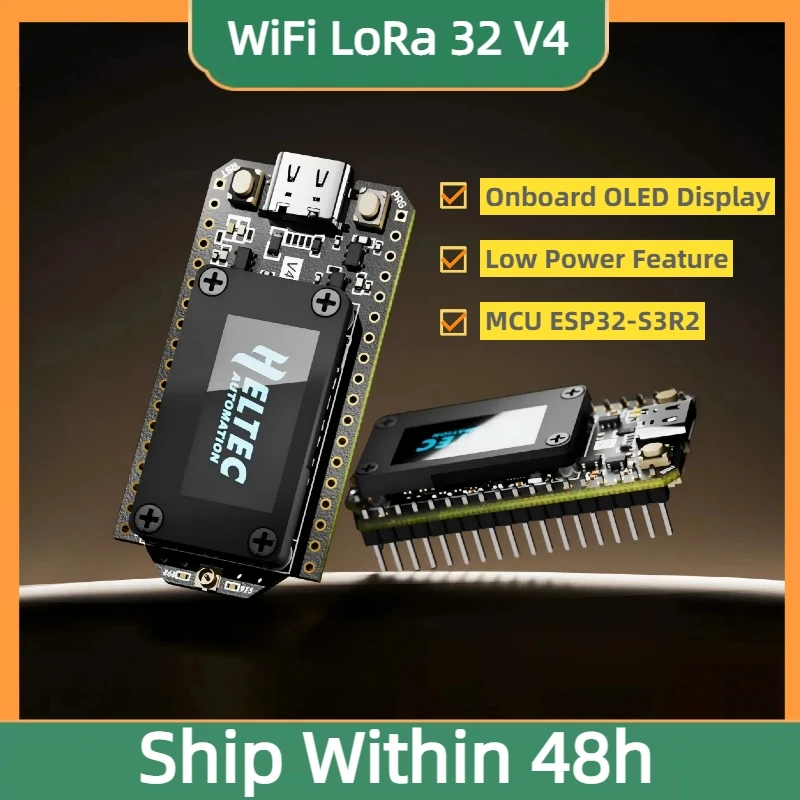
The Heltec WiFi LoRa 32 V4 Development Board is a highly integrated, low-power microcontroller unit designed for advanced IoT and mesh networking applications. It offers a compelling blend of wireless communication protocols, robust processing capabilities, and essential on-board peripherals, making it an ideal choice for developers building resilient, long-range communication projects.
This development board integrates WiFi, Bluetooth Low Energy (BLE), and LoRa capabilities, providing a versatile communication toolkit. The inclusion of the SX1262 LoRa transceiver signifies a commitment to long-range, low-power wireless communication, crucial for remote sensing and off-grid data transmission. This board does not compromise on connectivity.
For developers, this multi-protocol support means fewer external modules and simplified project architectures. Imagine deploying a network of environmental sensors across a large agricultural field; LoRa handles the long-distance data backhaul, while WiFi or BLE could be used for local configuration or data access via a smartphone. This integration streamlines development significantly.
Unlike single-protocol boards that force developers into a specific communication paradigm, the Heltec V4 offers unparalleled flexibility. Standard ESP32 boards often provide WiFi and BLE, but the addition of LoRa, particularly the SX1262, elevates its utility for specialized applications where range and power efficiency are paramount. This is a significant upgrade.
At the heart of the Heltec WiFi LoRa 32 V4 lies the ESP32-S3R2 microcontroller, a powerful dual-core processor from Espressif. This MCU provides ample processing power for complex tasks, including sensor data acquisition, cryptographic operations, and managing multiple communication stacks concurrently. Its architecture supports demanding applications.
This processing capability translates directly into more sophisticated project potential. A developer can implement intricate data logging, real-time analytics, and secure communication protocols without encountering performance bottlenecks. The ESP32-S3R2 ensures smooth operation even under heavy computational loads. It handles tasks efficiently.
Compared to older ESP32 iterations or simpler microcontrollers, the ESP32-S3R2 offers enhanced memory, improved security features, and better AI acceleration capabilities, though the latter is less critical for typical LoRa applications. This modern MCU choice ensures the board remains relevant for future project expansions and evolving IoT standards. It is a forward-looking choice.
An on-board 0.96-inch OLED display is a standout feature, providing immediate visual feedback without requiring external components. This small but effective screen can display sensor readings, network status, battery levels, or even simple messages, making debugging and user interaction significantly easier. Information is readily available.
For field deployments or standalone devices, this integrated display is invaluable. Technicians can quickly verify device operation, check connectivity strength, or view critical data points directly on the unit, reducing the need for a connected computer or smartphone. This enhances operational efficiency considerably.
Many development boards omit an integrated display, forcing developers to either connect an external screen or rely solely on serial output for debugging. The Heltec V4's inclusion of a protected OLED streamlines the development process and enhances the user experience for deployed projects. It is a thoughtful addition.
The Heltec V4 is engineered for low-power operation, boasting consumption figures of less than 20µA in deep sleep mode. This, combined with dedicated interfaces for lithium batteries and solar panels (SH1.25-2P), positions it perfectly for long-term, off-grid applications. Power management is a priority.
This focus on power efficiency and flexible power input means projects can operate autonomously for extended periods in remote locations. Imagine a weather station powered by a small solar panel, transmitting data via LoRa for months or even years without human intervention. The board handles power intelligently.
Unlike many development boards that primarily rely on USB power, the V4's robust power management system and solar charging capabilities provide true independence. This reduces the total cost of ownership for remote deployments by minimizing battery replacement cycles and eliminating the need for constant power grid access. It offers true freedom.
Extensive hardware expansion interfaces are a hallmark of the Heltec V4. It includes a SH1.25-8Pin GNSS interface, allowing for easy integration of GPS or other global navigation satellite system modules. Standard pin headers provide access to GPIOs, I2C, SPI, and UART, facilitating connections to a wide array of sensors and actuators. Connectivity is comprehensive.
These interfaces empower developers to create highly specialized and complex IoT solutions. A project requiring precise location tracking, such as asset monitoring or drone navigation, can seamlessly integrate a GNSS module. The general-purpose I/O ensures compatibility with virtually any sensor or peripheral. This board is highly adaptable.
Many compact development boards sacrifice expansion capabilities for size. The Heltec V4, however, strikes an excellent balance, offering a rich set of interfaces while maintaining a manageable footprint. Its compatibility with V3 form factors ensures a smooth transition for existing Heltec users. It respects prior investments.
The board is explicitly designed for compatibility with the Meshtastic App, a decentralized, off-grid communication platform. This integration allows users to flash and configure the device easily, transforming it into a node in a secure, peer-to-peer mesh network. Communication becomes resilient.
For scenarios where traditional cellular or internet infrastructure is unavailable or compromised, Meshtastic provides a critical communication lifeline. Emergency services, outdoor enthusiasts, or communities seeking independent communication can leverage the Heltec V4 to build robust, local networks. This capability is vital.
Unlike proprietary communication solutions, Meshtastic is open-source and community-driven, offering transparency and flexibility. The Heltec V4's direct support for this platform simplifies the setup process, enabling users to quickly deploy and manage their mesh nodes. It democratizes communication.
The physical design of the Heltec WiFi LoRa 32 V4 emphasizes both compactness and accessibility. It features a USB Type-C port for modern connectivity and programming, along with clearly labeled pin headers for easy prototyping on breadboards. The board's dimensions are suitable for various enclosures. It is well-engineered.
This thoughtful layout ensures that the board can be integrated into a wide range of project enclosures, from small weather-resistant boxes to larger custom-built systems. The USB-C port offers reversible connectivity and higher power delivery capabilities compared to older micro-USB standards. Assembly is straightforward.
Many development boards still rely on outdated micro-USB ports, which can be fragile and inconvenient. The adoption of USB Type-C on the Heltec V4 is a welcome upgrade, reflecting a commitment to modern hardware standards and improved user experience. This board is future-proofed.
For the PC builder or IoT enthusiast, the Heltec WiFi LoRa 32 V4 presents a compelling package. Its compact footprint and standard pin headers mean it will fit comfortably within custom enclosures or integrate seamlessly onto larger project motherboards or breadboards. The board's power efficiency ensures that even with a modest power supply, it can sustain long operational periods, especially when paired with its solar charging capabilities. This is a robust platform.
The ESP32-S3R2 MCU provides more than enough processing headroom for complex tasks, ensuring compatibility with a wide range of sensors and peripherals without performance bottlenecks. This board is not merely a component; it is a foundation for creating advanced, reliable, and self-sufficient IoT devices. Imagine the possibilities: a network of smart traps for wildlife monitoring, a robust emergency communication system for remote areas, or an automated environmental control system for a greenhouse, all powered by this versatile board. The Heltec V4 empowers creators to bring ambitious projects to life with confidence and efficiency, ensuring your innovations are not just functional, but truly resilient.
Connectivity Prowess: Bridging the Wireless Divide
This development board integrates WiFi, Bluetooth Low Energy (BLE), and LoRa capabilities, providing a versatile communication toolkit. The inclusion of the SX1262 LoRa transceiver signifies a commitment to long-range, low-power wireless communication, crucial for remote sensing and off-grid data transmission. This board does not compromise on connectivity.
For developers, this multi-protocol support means fewer external modules and simplified project architectures. Imagine deploying a network of environmental sensors across a large agricultural field; LoRa handles the long-distance data backhaul, while WiFi or BLE could be used for local configuration or data access via a smartphone. This integration streamlines development significantly.
Unlike single-protocol boards that force developers into a specific communication paradigm, the Heltec V4 offers unparalleled flexibility. Standard ESP32 boards often provide WiFi and BLE, but the addition of LoRa, particularly the SX1262, elevates its utility for specialized applications where range and power efficiency are paramount. This is a significant upgrade.
Processing Core: The ESP32-S3R2 Engine
At the heart of the Heltec WiFi LoRa 32 V4 lies the ESP32-S3R2 microcontroller, a powerful dual-core processor from Espressif. This MCU provides ample processing power for complex tasks, including sensor data acquisition, cryptographic operations, and managing multiple communication stacks concurrently. Its architecture supports demanding applications.
This processing capability translates directly into more sophisticated project potential. A developer can implement intricate data logging, real-time analytics, and secure communication protocols without encountering performance bottlenecks. The ESP32-S3R2 ensures smooth operation even under heavy computational loads. It handles tasks efficiently.
Compared to older ESP32 iterations or simpler microcontrollers, the ESP32-S3R2 offers enhanced memory, improved security features, and better AI acceleration capabilities, though the latter is less critical for typical LoRa applications. This modern MCU choice ensures the board remains relevant for future project expansions and evolving IoT standards. It is a forward-looking choice.
Visual Feedback: The Integrated OLED Display
An on-board 0.96-inch OLED display is a standout feature, providing immediate visual feedback without requiring external components. This small but effective screen can display sensor readings, network status, battery levels, or even simple messages, making debugging and user interaction significantly easier. Information is readily available.
For field deployments or standalone devices, this integrated display is invaluable. Technicians can quickly verify device operation, check connectivity strength, or view critical data points directly on the unit, reducing the need for a connected computer or smartphone. This enhances operational efficiency considerably.
Many development boards omit an integrated display, forcing developers to either connect an external screen or rely solely on serial output for debugging. The Heltec V4's inclusion of a protected OLED streamlines the development process and enhances the user experience for deployed projects. It is a thoughtful addition.
Endurance Engineering: Powering Remote Deployments
The Heltec V4 is engineered for low-power operation, boasting consumption figures of less than 20µA in deep sleep mode. This, combined with dedicated interfaces for lithium batteries and solar panels (SH1.25-2P), positions it perfectly for long-term, off-grid applications. Power management is a priority.
This focus on power efficiency and flexible power input means projects can operate autonomously for extended periods in remote locations. Imagine a weather station powered by a small solar panel, transmitting data via LoRa for months or even years without human intervention. The board handles power intelligently.
Unlike many development boards that primarily rely on USB power, the V4's robust power management system and solar charging capabilities provide true independence. This reduces the total cost of ownership for remote deployments by minimizing battery replacement cycles and eliminating the need for constant power grid access. It offers true freedom.
Modular Expansion: The Interface Ecosystem
Extensive hardware expansion interfaces are a hallmark of the Heltec V4. It includes a SH1.25-8Pin GNSS interface, allowing for easy integration of GPS or other global navigation satellite system modules. Standard pin headers provide access to GPIOs, I2C, SPI, and UART, facilitating connections to a wide array of sensors and actuators. Connectivity is comprehensive.
These interfaces empower developers to create highly specialized and complex IoT solutions. A project requiring precise location tracking, such as asset monitoring or drone navigation, can seamlessly integrate a GNSS module. The general-purpose I/O ensures compatibility with virtually any sensor or peripheral. This board is highly adaptable.
Many compact development boards sacrifice expansion capabilities for size. The Heltec V4, however, strikes an excellent balance, offering a rich set of interfaces while maintaining a manageable footprint. Its compatibility with V3 form factors ensures a smooth transition for existing Heltec users. It respects prior investments.
Meshtastic Integration: Decentralized Communication
The board is explicitly designed for compatibility with the Meshtastic App, a decentralized, off-grid communication platform. This integration allows users to flash and configure the device easily, transforming it into a node in a secure, peer-to-peer mesh network. Communication becomes resilient.
For scenarios where traditional cellular or internet infrastructure is unavailable or compromised, Meshtastic provides a critical communication lifeline. Emergency services, outdoor enthusiasts, or communities seeking independent communication can leverage the Heltec V4 to build robust, local networks. This capability is vital.
Unlike proprietary communication solutions, Meshtastic is open-source and community-driven, offering transparency and flexibility. The Heltec V4's direct support for this platform simplifies the setup process, enabling users to quickly deploy and manage their mesh nodes. It democratizes communication.
Physical Design: Compact and Accessible
The physical design of the Heltec WiFi LoRa 32 V4 emphasizes both compactness and accessibility. It features a USB Type-C port for modern connectivity and programming, along with clearly labeled pin headers for easy prototyping on breadboards. The board's dimensions are suitable for various enclosures. It is well-engineered.
This thoughtful layout ensures that the board can be integrated into a wide range of project enclosures, from small weather-resistant boxes to larger custom-built systems. The USB-C port offers reversible connectivity and higher power delivery capabilities compared to older micro-USB standards. Assembly is straightforward.
Many development boards still rely on outdated micro-USB ports, which can be fragile and inconvenient. The adoption of USB Type-C on the Heltec V4 is a welcome upgrade, reflecting a commitment to modern hardware standards and improved user experience. This board is future-proofed.
The Builder's Advantage: Seamless Integration and Performance
For the PC builder or IoT enthusiast, the Heltec WiFi LoRa 32 V4 presents a compelling package. Its compact footprint and standard pin headers mean it will fit comfortably within custom enclosures or integrate seamlessly onto larger project motherboards or breadboards. The board's power efficiency ensures that even with a modest power supply, it can sustain long operational periods, especially when paired with its solar charging capabilities. This is a robust platform.
The ESP32-S3R2 MCU provides more than enough processing headroom for complex tasks, ensuring compatibility with a wide range of sensors and peripherals without performance bottlenecks. This board is not merely a component; it is a foundation for creating advanced, reliable, and self-sufficient IoT devices. Imagine the possibilities: a network of smart traps for wildlife monitoring, a robust emergency communication system for remote areas, or an automated environmental control system for a greenhouse, all powered by this versatile board. The Heltec V4 empowers creators to bring ambitious projects to life with confidence and efficiency, ensuring your innovations are not just functional, but truly resilient.