Heltec LoRa32 V3 ESP32-S3 LoRa Development Board
Official Store Deal
Expert Analysis Overview
The Heltec LoRa32 V3 ESP32-S3 LoRa Development Board is a highly integrated, versatile communication platform engineered for robust long-range IoT and Meshtastic applications. Its dual-core processing power and advanced radio capabilities position it as a superior choice for developers seeking reliable, low-power wireless solutions. This board streamlines complex projects. It offers a compelling blend of computational muscle and expansive connectivity, making it an essential tool for modern embedded systems design. The compact form factor belies its extensive feature set, appealing to both seasoned engineers and enthusiastic hobbyists.
At the heart of the Heltec LoRa32 V3 lies the Espressif ESP32-S3 microcontroller. This is no ordinary chip; it represents a significant leap in embedded processing power and integration. The ESP32-S3 boasts a dual-core Xtensa LX7 processor, capable of clock speeds up to 240 MHz. This formidable processing capability is crucial for handling concurrent tasks that are typical in advanced IoT applications. Imagine simultaneously managing complex LoRa transmissions, processing multiple streams of sensor data, and maintaining active Wi-Fi or Bluetooth connections without a hitch. Many entry-level development boards often feature single-core MCUs, which can quickly become performance bottlenecks when projects scale in complexity or demand real-time responsiveness. The S3 architecture provides a substantial performance uplift, ensuring smooth and reliable operation even under the most demanding workloads. It runs fast, efficiently.
Beyond raw computational speed, the ESP32-S3 integrates a comprehensive suite of wireless capabilities directly onto the silicon. Onboard 2.4 GHz Wi-Fi (802.11 b/g/n) allows for standard internet connectivity, enabling seamless data upload to cloud services, integration with local network control systems, or even serving web-based configuration interfaces. Complementing this robust Wi-Fi is Bluetooth Low Energy (BLE) 5.0, which facilitates short-range communication with mobile devices, smart home hubs, or other BLE peripherals. This dual-mode wireless capability means a single board can serve as a versatile bridge between disparate communication networks—connecting long-range LoRa networks to local IP networks or personal devices. The flexibility for system architects is immense. Compared to its predecessors, such as the original ESP32, the ESP32-S3 also includes dedicated AI acceleration instructions. These can be particularly beneficial for edge computing applications involving lightweight machine learning models, allowing for on-device data analysis and decision-making, albeit within the constraints of an embedded system. Furthermore, it offers enhanced security features, including secure boot and flash encryption, which are critical for deploying secure and tamper-resistant IoT devices in sensitive environments. This chip is a significant upgrade, offering a future-proof foundation for innovative projects.
Consider a hypothetical scenario: a smart city sensor node needs to monitor air quality, report data via LoRa to a central server, and also allow local technicians to connect via Wi-Fi for diagnostics and calibration, while simultaneously broadcasting its presence via Bluetooth for proximity-based services. A less capable MCU would undoubtedly struggle to manage these diverse protocols efficiently, leading to dropped packets, unresponsive interfaces, or system crashes. The ESP32-S3 handles such multifaceted requirements with relative ease, ensuring data integrity, system stability, and a responsive user experience. Its ample memory resources, including 512KB of SRAM and support for external flash, further contribute to this robustness, allowing for more sophisticated firmware, larger data buffers, and even over-the-air (OTA) updates. This truly enhances project viability and longevity. The integration of these features on a single chip simplifies hardware design and reduces the overall component count, which is a boon for compact and cost-effective solutions.
For long-range, ultra-low-power communication, the Heltec LoRa32 V3 integrates the Semtech SX1262 LoRa transceiver. This is a critical component for applications where traditional wireless technologies like Wi-Fi or Bluetooth simply cannot achieve the required range or power efficiency. LoRa, an acronym for Long Range, operates on sub-GHz frequencies, typically in the 433MHz, 863MHz (EU), or 915MHz (US) bands. These lower frequencies allow signals to travel much further and penetrate obstacles like walls, trees, and buildings more effectively than higher frequency bands. The SX1262 module is particularly renowned for its excellent link budget, which quantifies its ability to maintain a reliable connection even with very weak signals. This translates directly into superior range and reliability. Its power efficiency is also a major draw, enabling battery-powered devices to operate for months or even years on a single charge, a crucial factor for remote IoT deployments. This saves energy, significantly.
The board supports multiple frequency bands, including 433MHz, 863MHz, and 915MHz, making it highly adaptable to various regional regulations and application requirements across the globe. This flexibility ensures global deployment potential without needing different hardware variants for each region. The SX1262 is a modern LoRa chip, offering significant improvements in power consumption, sensitivity, and interference rejection compared to older SX127x series transceivers. This translates directly into greater communication range and extended battery life for deployed devices, providing a tangible advantage in the field. For users interested in Meshtastic, an open-source mesh Networking firmware, the SX1262's capabilities mean a more robust and far-reaching mesh network, allowing for off-grid communication over significant distances, even in challenging terrain. The signal travels far, reliably.
Consider a scenario involving a remote environmental monitoring system where sensors are spread across vast agricultural fields or dense forests, reporting vital metrics like soil moisture, temperature, and air pressure. Running power and data cables across such expansive areas is often impractical and prohibitively expensive, and standard Wi-Fi range is simply insufficient. A LoRa-based solution, powered by the Heltec LoRa32 V3, can efficiently collect data from dozens, or even hundreds, of sensors and relay it to a central gateway. This gateway, leveraging the onboard Wi-Fi, can then upload the aggregated data to a cloud platform for analysis and visualization. The SX1262's superior performance ensures that even sensors located at the very edge of the property, potentially several kilometers away, can reliably transmit their data packets. This capability is transformative for precision agriculture, disaster prevention, and wildlife monitoring. It opens up new possibilities for decentralized data collection and control in challenging and expansive environments, where traditional connectivity methods fall short.
A standout feature of the Heltec LoRa32 V3, and a significant convenience for developers, is its integrated 0.96-inch OLED display. This small but mighty screen provides immediate visual feedback, a luxury often missing from more basic or barebones development boards. For developers, this translates into less reliance on serial monitors connected to a computer for debugging and status updates. Critical information such as real-time sensor readings, current network status (Wi-Fi, Bluetooth, LoRa), battery levels, or even simple menu interfaces can be displayed directly on the board itself. Debugging becomes significantly easier and faster. The OLED utilizes a standard I2C interface, making it straightforward to program with common display libraries available in the Arduino or PlatformIO ecosystems. Its monochrome nature contributes to its inherently low power consumption, an important consideration for any battery-operated project where every milliamp-hour counts.
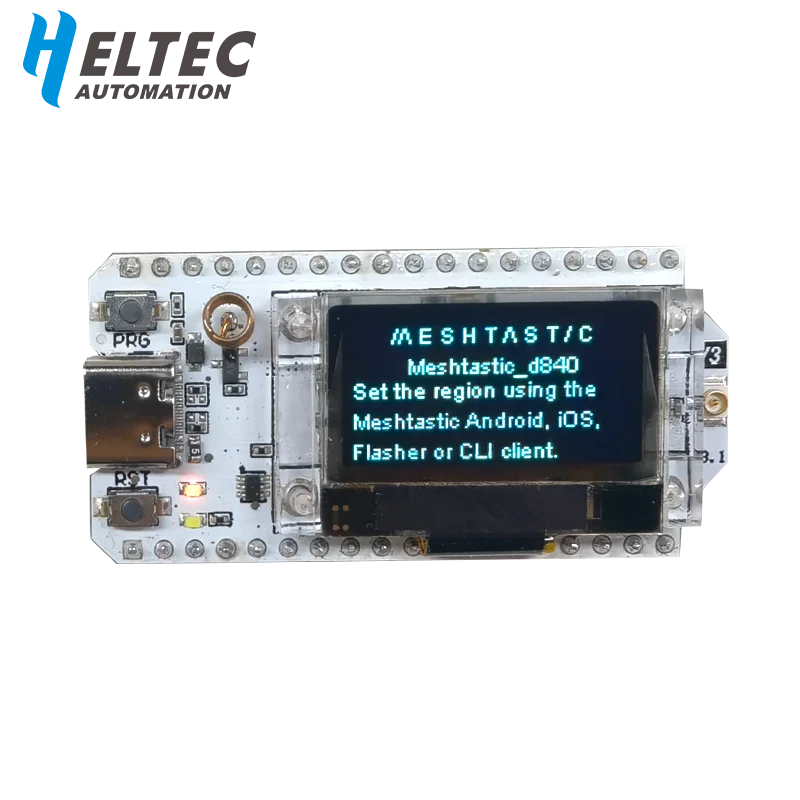
The clarity and contrast of the OLED are surprisingly good given its compact size. Text and simple graphics are sharp, crisp, and highly readable, especially in low-light conditions, thanks to its self-emissive nature. While certainly not suitable for complex graphical user interfaces or high-resolution images, it excels at presenting concise, critical information at a glance. This immediate visual confirmation of device operation, data acquisition, or network connectivity significantly accelerates the development cycle. Imagine flashing new firmware onto the board and instantly seeing a "Meshtastic d840" version number, or real-time environmental data like "20.6°C 37.6%" as depicted in the product images. This instant, on-device feedback is invaluable for rapid prototyping and field testing, reducing the need to constantly connect to a PC.
Compared to traditional development workflows that require connecting to a computer and opening a serial terminal for every piece of feedback, the onboard OLED offers unparalleled convenience. It allows for truly standalone operation during testing or deployment phases, providing crucial insights into the device's state without requiring any external equipment. This is a clear and tangible upgrade over boards that force developers to guess at their device's operational status or rely solely on cryptic blinking LEDs. The ability to quickly verify sensor readings, confirm network connectivity, or check battery status directly on the device saves considerable time and effort, particularly when working in the field or away from a workstation. It truly empowers developers to iterate faster and deploy with greater confidence.
The Heltec LoRa32 V3 is meticulously designed with portability and long-term, autonomous deployment in mind, a philosophy evident in its robust power management features. It includes a dedicated JST 2-pin connector for a 3.7V LiPo battery, providing a direct and secure interface for portable power. Crucially, it also integrates an onboard battery charging circuit. This means the board can be powered directly from a rechargeable LiPo battery, making it an ideal choice for remote, untethered applications where a constant power supply is unavailable. The integrated charging circuit intelligently handles the battery management, allowing the board to be powered and the connected LiPo battery to be charged simultaneously via its USB-C port. This dual functionality is highly convenient, simplifying power infrastructure.
The presence of a USB-C interface is a welcome and modern touch, distinguishing it from many older development boards still relying on legacy connectors. Unlike the often finicky micro-USB or mini-USB connectors, USB-C is inherently reversible, significantly more durable, and capable of higher power delivery. This single port serves multiple essential functions: it reliably powers the board, efficiently charges the connected LiPo battery, and provides a stable serial data interface for programming and debugging. The robust mechanical design of the USB-C connector ensures a reliable physical connection, even with frequent plugging and unplugging during the iterative development process. It's a solid, future-proof connection.
Effective power management is absolutely paramount for IoT devices, especially those intended for long-term deployment where devices often need to operate for extended periods without human intervention or battery replacement. The ESP32-S3, combined with the power-efficient SX1262 LoRa module, is capable of entering various deep sleep modes, significantly reducing power consumption when not actively transmitting data or processing tasks. The integrated charging circuit ensures that when external power is available, the battery remains topped up, providing a seamless transition to battery power if the main supply is interrupted. This ensures continuous, uninterrupted operation, a critical factor for mission-critical applications. For PC builders and system integrators, understanding the power draw characteristics is critical; this board typically operates at 3.3V, with peak current draws occurring during Wi-Fi and LoRa transmission, but its sophisticated low-power modes make it exceptionally suitable for battery-centric designs where energy conservation is a primary concern.
The Heltec LoRa32 V3 thrives within a rich, mature, and highly accessible development ecosystem, making it approachable for a wide range of users, from seasoned embedded engineers to enthusiastic beginners. Its compatibility with the ubiquitous Arduino IDE is a major advantage. Arduino's simplified programming language (based on C++) and its extensive library support allow developers to quickly get projects up and running without needing to delve into complex low-level register manipulation. A vast repository of examples and community-contributed code exists, significantly shortening the learning curve. Many examples exist, ready for adaptation. For those seeking more advanced control, professional project management, and sophisticated debugging capabilities, PlatformIO is fully supported. PlatformIO offers a professional-grade development environment, often integrated with VS Code, providing support for various frameworks, advanced build systems, and in-depth debugging tools. It is a powerful tool for serious development.
Beyond the C/C++ programming paradigm, the board also supports MicroPython, offering an appealing alternative for developers who prefer Python's renowned ease of use, clear syntax, and rapid prototyping capabilities. This broad support means users are not locked into a single programming language or development environment. Whether the goal is to build a simple sensor node with minimal code or a complex mesh network with intricate logic, the necessary tools and resources are readily available. Furthermore, the Heltec community actively provides specific libraries and detailed examples tailored for their boards, further simplifying the integration of LoRa and OLED functionalities into custom applications. This community support is invaluable, offering a collaborative environment for problem-solving and knowledge sharing.
Compared to proprietary development platforms that often come with steep learning curves, limited documentation, and restricted resources, the open-source nature of the ESP32 ecosystem provides a wealth of documentation, tutorials, and active community forums. This collective knowledge base significantly reduces the barrier to entry for new developers and offers readily available solutions for even the most complex challenges. The ability to leverage existing Arduino sketches or Python scripts developed for other ESP32 boards means faster iteration, less time spent reinventing the wheel, and a quicker path from concept to functional prototype. This accelerates innovation, allowing developers to focus on their unique application rather than foundational software development. The sheer volume of available resources ensures that almost any problem encountered has likely been solved or discussed by someone else in the community.
From a PC builder's perspective, the physical design, build quality, and ease of integration are absolutely paramount for any component. The Heltec LoRa32 V3 presents a compact, clean, and remarkably well-organized PCB. The matte white finish of the circuit board exudes a clean, professional aesthetic, suggesting a meticulous attention to detail in the manufacturing process and component sourcing. All critical components, including the powerful ESP32-S3 microcontroller and the efficient SX1262 LoRa transceiver, are neatly laid out and clearly labeled. The inclusion of pre-soldered pin headers is a thoughtful and highly practical feature, allowing for immediate use on standard breadboards or direct integration into custom PCBs without the tedious and time-consuming need for additional soldering. This saves valuable development time and reduces the risk of errors.
The board's physical dimensions are approximately 58 x 23 x 8 mm, making it exceptionally suitable for embedding into small, custom enclosures, wearable devices, or discreet IoT deployments where space is at a premium. Despite its diminutive footprint, the intelligent layout ensures easy accessibility to all essential GPIO pins, which are clearly marked along the edges of the board. The tactile click of the onboard buttons—specifically the PRG (Program) and RST (Reset) buttons—provides reassuring physical feedback, indicating a quality component choice and robust construction. These buttons are essential for programming new firmware and resetting the device, and their durable feel suggests they will withstand repeated use throughout the development and deployment lifecycle.
Unlike some development boards that leave users to figure out antenna connections or rely on suboptimal integrated solutions, the Heltec LoRa32 V3 includes a dedicated U.FL connector for the external LoRa antenna. This crucial design choice ensures optimal signal reception and transmission, allowing users to select an antenna specifically tuned for their chosen frequency band and application environment. The provision of an external antenna is a significant upgrade over boards that feature only a PCB trace antenna, which often compromise on range, signal strength, and overall reliability. This design decision directly impacts the real-world performance of the LoRa communication. The overall build quality, from the precise component placement and clear silkscreening to the choice of robust connectors, suggests a board designed for practical, long-term use in a wide variety of challenging environments. Compatibility with existing mounting solutions or custom enclosures is also simplified by its standard pin spacing.
The true, transformative value of the Heltec LoRa32 V3 becomes strikingly apparent when considering its application to real-world problems and innovative projects. For large-scale environmental monitoring, imagine deploying a network of these boards in remote forests or expansive national parks. Equipped with temperature, humidity, and smoke sensors, they could detect early signs of wildfires, transmitting critical data over many kilometers via LoRa to a central monitoring station. The integrated OLED display provides immediate on-site status and diagnostic information for maintenance crews. For smart agriculture, individual boards can be strategically placed across vast fields to monitor crucial metrics such as soil moisture, nutrient levels, and ambient temperature, optimizing irrigation schedules and crop health. This optimizes resource use, leading to higher yields and reduced waste.
In urban settings, the board can form the backbone of a low-cost, decentralized Meshtastic network, providing essential off-grid communication capabilities for emergency services, disaster relief efforts, or community resilience initiatives when traditional infrastructure fails. Its compact size allows for discreet and flexible deployment in various urban locations, from rooftops to public spaces. For industrial IoT applications, the LoRa32 V3 can be utilized to monitor critical machinery, track assets within large facilities, or manage inventory in sprawling warehouses where conventional Wi-Fi coverage is often spotty or non-existent. Its robust LoRa connectivity ensures data integrity and continuous operation in challenging industrial environments.
The ability to seamlessly integrate Wi-Fi, Bluetooth, and LoRa onto a single, compact board significantly simplifies the architecture of many complex IoT solutions. Instead of requiring multiple discrete modules, complex interconnections, and intricate power management for each, the Heltec LoRa32 V3 provides a unified, all-in-one platform. This integration directly translates into several tangible benefits: it reduces the overall bill of materials (BOM) costs, simplifies the manufacturing and assembly process, and significantly enhances overall system reliability by minimizing points of failure. The inherent flexibility to dynamically switch between communication protocols based on proximity, data volume, or specific application requirements makes it an incredibly adaptable tool for a wide array of projects, ranging from simple home automation tasks to sophisticated industrial deployments. It truly enables innovation, allowing developers to focus on the application layer rather than wrestling with hardware integration challenges.
Picture your next ambitious IoT project, no longer constrained by short-range wireless limitations or cumbersome development setups. Envision seamless, long-range data transmission from remote sensors, instantly viewable on an integrated display, all powered by a compact, efficient board. The Heltec LoRa32 V3 empowers creators to build robust, intelligent, and connected devices with confidence, transforming concepts into tangible, high-performing realities. This board is ready for deployment.
The Core of Connectivity: ESP32-S3's Muscle
At the heart of the Heltec LoRa32 V3 lies the Espressif ESP32-S3 microcontroller. This is no ordinary chip; it represents a significant leap in embedded processing power and integration. The ESP32-S3 boasts a dual-core Xtensa LX7 processor, capable of clock speeds up to 240 MHz. This formidable processing capability is crucial for handling concurrent tasks that are typical in advanced IoT applications. Imagine simultaneously managing complex LoRa transmissions, processing multiple streams of sensor data, and maintaining active Wi-Fi or Bluetooth connections without a hitch. Many entry-level development boards often feature single-core MCUs, which can quickly become performance bottlenecks when projects scale in complexity or demand real-time responsiveness. The S3 architecture provides a substantial performance uplift, ensuring smooth and reliable operation even under the most demanding workloads. It runs fast, efficiently.
Beyond raw computational speed, the ESP32-S3 integrates a comprehensive suite of wireless capabilities directly onto the silicon. Onboard 2.4 GHz Wi-Fi (802.11 b/g/n) allows for standard internet connectivity, enabling seamless data upload to cloud services, integration with local network control systems, or even serving web-based configuration interfaces. Complementing this robust Wi-Fi is Bluetooth Low Energy (BLE) 5.0, which facilitates short-range communication with mobile devices, smart home hubs, or other BLE peripherals. This dual-mode wireless capability means a single board can serve as a versatile bridge between disparate communication networks—connecting long-range LoRa networks to local IP networks or personal devices. The flexibility for system architects is immense. Compared to its predecessors, such as the original ESP32, the ESP32-S3 also includes dedicated AI acceleration instructions. These can be particularly beneficial for edge computing applications involving lightweight machine learning models, allowing for on-device data analysis and decision-making, albeit within the constraints of an embedded system. Furthermore, it offers enhanced security features, including secure boot and flash encryption, which are critical for deploying secure and tamper-resistant IoT devices in sensitive environments. This chip is a significant upgrade, offering a future-proof foundation for innovative projects.
Consider a hypothetical scenario: a smart city sensor node needs to monitor air quality, report data via LoRa to a central server, and also allow local technicians to connect via Wi-Fi for diagnostics and calibration, while simultaneously broadcasting its presence via Bluetooth for proximity-based services. A less capable MCU would undoubtedly struggle to manage these diverse protocols efficiently, leading to dropped packets, unresponsive interfaces, or system crashes. The ESP32-S3 handles such multifaceted requirements with relative ease, ensuring data integrity, system stability, and a responsive user experience. Its ample memory resources, including 512KB of SRAM and support for external flash, further contribute to this robustness, allowing for more sophisticated firmware, larger data buffers, and even over-the-air (OTA) updates. This truly enhances project viability and longevity. The integration of these features on a single chip simplifies hardware design and reduces the overall component count, which is a boon for compact and cost-effective solutions.
Reaching Further: The SX1262 LoRa Advantage
For long-range, ultra-low-power communication, the Heltec LoRa32 V3 integrates the Semtech SX1262 LoRa transceiver. This is a critical component for applications where traditional wireless technologies like Wi-Fi or Bluetooth simply cannot achieve the required range or power efficiency. LoRa, an acronym for Long Range, operates on sub-GHz frequencies, typically in the 433MHz, 863MHz (EU), or 915MHz (US) bands. These lower frequencies allow signals to travel much further and penetrate obstacles like walls, trees, and buildings more effectively than higher frequency bands. The SX1262 module is particularly renowned for its excellent link budget, which quantifies its ability to maintain a reliable connection even with very weak signals. This translates directly into superior range and reliability. Its power efficiency is also a major draw, enabling battery-powered devices to operate for months or even years on a single charge, a crucial factor for remote IoT deployments. This saves energy, significantly.
The board supports multiple frequency bands, including 433MHz, 863MHz, and 915MHz, making it highly adaptable to various regional regulations and application requirements across the globe. This flexibility ensures global deployment potential without needing different hardware variants for each region. The SX1262 is a modern LoRa chip, offering significant improvements in power consumption, sensitivity, and interference rejection compared to older SX127x series transceivers. This translates directly into greater communication range and extended battery life for deployed devices, providing a tangible advantage in the field. For users interested in Meshtastic, an open-source mesh Networking firmware, the SX1262's capabilities mean a more robust and far-reaching mesh network, allowing for off-grid communication over significant distances, even in challenging terrain. The signal travels far, reliably.
Consider a scenario involving a remote environmental monitoring system where sensors are spread across vast agricultural fields or dense forests, reporting vital metrics like soil moisture, temperature, and air pressure. Running power and data cables across such expansive areas is often impractical and prohibitively expensive, and standard Wi-Fi range is simply insufficient. A LoRa-based solution, powered by the Heltec LoRa32 V3, can efficiently collect data from dozens, or even hundreds, of sensors and relay it to a central gateway. This gateway, leveraging the onboard Wi-Fi, can then upload the aggregated data to a cloud platform for analysis and visualization. The SX1262's superior performance ensures that even sensors located at the very edge of the property, potentially several kilometers away, can reliably transmit their data packets. This capability is transformative for precision agriculture, disaster prevention, and wildlife monitoring. It opens up new possibilities for decentralized data collection and control in challenging and expansive environments, where traditional connectivity methods fall short.
Visualizing Data: Integrated OLED Clarity
A standout feature of the Heltec LoRa32 V3, and a significant convenience for developers, is its integrated 0.96-inch OLED display. This small but mighty screen provides immediate visual feedback, a luxury often missing from more basic or barebones development boards. For developers, this translates into less reliance on serial monitors connected to a computer for debugging and status updates. Critical information such as real-time sensor readings, current network status (Wi-Fi, Bluetooth, LoRa), battery levels, or even simple menu interfaces can be displayed directly on the board itself. Debugging becomes significantly easier and faster. The OLED utilizes a standard I2C interface, making it straightforward to program with common display libraries available in the Arduino or PlatformIO ecosystems. Its monochrome nature contributes to its inherently low power consumption, an important consideration for any battery-operated project where every milliamp-hour counts.
The clarity and contrast of the OLED are surprisingly good given its compact size. Text and simple graphics are sharp, crisp, and highly readable, especially in low-light conditions, thanks to its self-emissive nature. While certainly not suitable for complex graphical user interfaces or high-resolution images, it excels at presenting concise, critical information at a glance. This immediate visual confirmation of device operation, data acquisition, or network connectivity significantly accelerates the development cycle. Imagine flashing new firmware onto the board and instantly seeing a "Meshtastic d840" version number, or real-time environmental data like "20.6°C 37.6%" as depicted in the product images. This instant, on-device feedback is invaluable for rapid prototyping and field testing, reducing the need to constantly connect to a PC.
Compared to traditional development workflows that require connecting to a computer and opening a serial terminal for every piece of feedback, the onboard OLED offers unparalleled convenience. It allows for truly standalone operation during testing or deployment phases, providing crucial insights into the device's state without requiring any external equipment. This is a clear and tangible upgrade over boards that force developers to guess at their device's operational status or rely solely on cryptic blinking LEDs. The ability to quickly verify sensor readings, confirm network connectivity, or check battery status directly on the device saves considerable time and effort, particularly when working in the field or away from a workstation. It truly empowers developers to iterate faster and deploy with greater confidence.
Powering Your Projects: Energy Management
The Heltec LoRa32 V3 is meticulously designed with portability and long-term, autonomous deployment in mind, a philosophy evident in its robust power management features. It includes a dedicated JST 2-pin connector for a 3.7V LiPo battery, providing a direct and secure interface for portable power. Crucially, it also integrates an onboard battery charging circuit. This means the board can be powered directly from a rechargeable LiPo battery, making it an ideal choice for remote, untethered applications where a constant power supply is unavailable. The integrated charging circuit intelligently handles the battery management, allowing the board to be powered and the connected LiPo battery to be charged simultaneously via its USB-C port. This dual functionality is highly convenient, simplifying power infrastructure.
The presence of a USB-C interface is a welcome and modern touch, distinguishing it from many older development boards still relying on legacy connectors. Unlike the often finicky micro-USB or mini-USB connectors, USB-C is inherently reversible, significantly more durable, and capable of higher power delivery. This single port serves multiple essential functions: it reliably powers the board, efficiently charges the connected LiPo battery, and provides a stable serial data interface for programming and debugging. The robust mechanical design of the USB-C connector ensures a reliable physical connection, even with frequent plugging and unplugging during the iterative development process. It's a solid, future-proof connection.
Effective power management is absolutely paramount for IoT devices, especially those intended for long-term deployment where devices often need to operate for extended periods without human intervention or battery replacement. The ESP32-S3, combined with the power-efficient SX1262 LoRa module, is capable of entering various deep sleep modes, significantly reducing power consumption when not actively transmitting data or processing tasks. The integrated charging circuit ensures that when external power is available, the battery remains topped up, providing a seamless transition to battery power if the main supply is interrupted. This ensures continuous, uninterrupted operation, a critical factor for mission-critical applications. For PC builders and system integrators, understanding the power draw characteristics is critical; this board typically operates at 3.3V, with peak current draws occurring during Wi-Fi and LoRa transmission, but its sophisticated low-power modes make it exceptionally suitable for battery-centric designs where energy conservation is a primary concern.
Building Blocks for Innovation: The Development Ecosystem
The Heltec LoRa32 V3 thrives within a rich, mature, and highly accessible development ecosystem, making it approachable for a wide range of users, from seasoned embedded engineers to enthusiastic beginners. Its compatibility with the ubiquitous Arduino IDE is a major advantage. Arduino's simplified programming language (based on C++) and its extensive library support allow developers to quickly get projects up and running without needing to delve into complex low-level register manipulation. A vast repository of examples and community-contributed code exists, significantly shortening the learning curve. Many examples exist, ready for adaptation. For those seeking more advanced control, professional project management, and sophisticated debugging capabilities, PlatformIO is fully supported. PlatformIO offers a professional-grade development environment, often integrated with VS Code, providing support for various frameworks, advanced build systems, and in-depth debugging tools. It is a powerful tool for serious development.
Beyond the C/C++ programming paradigm, the board also supports MicroPython, offering an appealing alternative for developers who prefer Python's renowned ease of use, clear syntax, and rapid prototyping capabilities. This broad support means users are not locked into a single programming language or development environment. Whether the goal is to build a simple sensor node with minimal code or a complex mesh network with intricate logic, the necessary tools and resources are readily available. Furthermore, the Heltec community actively provides specific libraries and detailed examples tailored for their boards, further simplifying the integration of LoRa and OLED functionalities into custom applications. This community support is invaluable, offering a collaborative environment for problem-solving and knowledge sharing.
Compared to proprietary development platforms that often come with steep learning curves, limited documentation, and restricted resources, the open-source nature of the ESP32 ecosystem provides a wealth of documentation, tutorials, and active community forums. This collective knowledge base significantly reduces the barrier to entry for new developers and offers readily available solutions for even the most complex challenges. The ability to leverage existing Arduino sketches or Python scripts developed for other ESP32 boards means faster iteration, less time spent reinventing the wheel, and a quicker path from concept to functional prototype. This accelerates innovation, allowing developers to focus on their unique application rather than foundational software development. The sheer volume of available resources ensures that almost any problem encountered has likely been solved or discussed by someone else in the community.
Crafting Robust Solutions: Design and Integration
From a PC builder's perspective, the physical design, build quality, and ease of integration are absolutely paramount for any component. The Heltec LoRa32 V3 presents a compact, clean, and remarkably well-organized PCB. The matte white finish of the circuit board exudes a clean, professional aesthetic, suggesting a meticulous attention to detail in the manufacturing process and component sourcing. All critical components, including the powerful ESP32-S3 microcontroller and the efficient SX1262 LoRa transceiver, are neatly laid out and clearly labeled. The inclusion of pre-soldered pin headers is a thoughtful and highly practical feature, allowing for immediate use on standard breadboards or direct integration into custom PCBs without the tedious and time-consuming need for additional soldering. This saves valuable development time and reduces the risk of errors.
The board's physical dimensions are approximately 58 x 23 x 8 mm, making it exceptionally suitable for embedding into small, custom enclosures, wearable devices, or discreet IoT deployments where space is at a premium. Despite its diminutive footprint, the intelligent layout ensures easy accessibility to all essential GPIO pins, which are clearly marked along the edges of the board. The tactile click of the onboard buttons—specifically the PRG (Program) and RST (Reset) buttons—provides reassuring physical feedback, indicating a quality component choice and robust construction. These buttons are essential for programming new firmware and resetting the device, and their durable feel suggests they will withstand repeated use throughout the development and deployment lifecycle.
Unlike some development boards that leave users to figure out antenna connections or rely on suboptimal integrated solutions, the Heltec LoRa32 V3 includes a dedicated U.FL connector for the external LoRa antenna. This crucial design choice ensures optimal signal reception and transmission, allowing users to select an antenna specifically tuned for their chosen frequency band and application environment. The provision of an external antenna is a significant upgrade over boards that feature only a PCB trace antenna, which often compromise on range, signal strength, and overall reliability. This design decision directly impacts the real-world performance of the LoRa communication. The overall build quality, from the precise component placement and clear silkscreening to the choice of robust connectors, suggests a board designed for practical, long-term use in a wide variety of challenging environments. Compatibility with existing mounting solutions or custom enclosures is also simplified by its standard pin spacing.
Beyond the Bench: Real-World Deployment Scenarios
The true, transformative value of the Heltec LoRa32 V3 becomes strikingly apparent when considering its application to real-world problems and innovative projects. For large-scale environmental monitoring, imagine deploying a network of these boards in remote forests or expansive national parks. Equipped with temperature, humidity, and smoke sensors, they could detect early signs of wildfires, transmitting critical data over many kilometers via LoRa to a central monitoring station. The integrated OLED display provides immediate on-site status and diagnostic information for maintenance crews. For smart agriculture, individual boards can be strategically placed across vast fields to monitor crucial metrics such as soil moisture, nutrient levels, and ambient temperature, optimizing irrigation schedules and crop health. This optimizes resource use, leading to higher yields and reduced waste.
In urban settings, the board can form the backbone of a low-cost, decentralized Meshtastic network, providing essential off-grid communication capabilities for emergency services, disaster relief efforts, or community resilience initiatives when traditional infrastructure fails. Its compact size allows for discreet and flexible deployment in various urban locations, from rooftops to public spaces. For industrial IoT applications, the LoRa32 V3 can be utilized to monitor critical machinery, track assets within large facilities, or manage inventory in sprawling warehouses where conventional Wi-Fi coverage is often spotty or non-existent. Its robust LoRa connectivity ensures data integrity and continuous operation in challenging industrial environments.
The ability to seamlessly integrate Wi-Fi, Bluetooth, and LoRa onto a single, compact board significantly simplifies the architecture of many complex IoT solutions. Instead of requiring multiple discrete modules, complex interconnections, and intricate power management for each, the Heltec LoRa32 V3 provides a unified, all-in-one platform. This integration directly translates into several tangible benefits: it reduces the overall bill of materials (BOM) costs, simplifies the manufacturing and assembly process, and significantly enhances overall system reliability by minimizing points of failure. The inherent flexibility to dynamically switch between communication protocols based on proximity, data volume, or specific application requirements makes it an incredibly adaptable tool for a wide array of projects, ranging from simple home automation tasks to sophisticated industrial deployments. It truly enables innovation, allowing developers to focus on the application layer rather than wrestling with hardware integration challenges.
Picture your next ambitious IoT project, no longer constrained by short-range wireless limitations or cumbersome development setups. Envision seamless, long-range data transmission from remote sensors, instantly viewable on an integrated display, all powered by a compact, efficient board. The Heltec LoRa32 V3 empowers creators to build robust, intelligent, and connected devices with confidence, transforming concepts into tangible, high-performing realities. This board is ready for deployment.