Heltec LoRa 32 V4 Wireless Communication Board
Official Store Deal
Expert Analysis Overview
Pushing the Limits: The Heltec LoRa 32 V4 Performance Deep Dive
The Heltec LoRa 32 V4 is an uncompromising wireless communication development platform engineered for extreme range and robust IoT deployments. This board integrates a powerful ESP32 microcontroller with a high-performance LoRa SX1262 transceiver, providing a formidable foundation for projects demanding long-distance, low-power data transmission. Its design prioritizes operational stability under load, a critical factor for any system pushed to its communication limits.
Core Silicon Architecture: ESP32 and SX1262 Synergy
At its heart, the Heltec LoRa 32 V4 utilizes the ESP32-S3 microcontroller. This dual-core processor, often clocked at up to 240 MHz, offers substantial computational headroom for complex networking protocols and sensor data processing. Its integrated Wi-Fi and Bluetooth capabilities provide versatile connectivity options, allowing for local network integration or direct device interaction.
Operational stability under sustained processing is paramount. The ESP32's architecture supports efficient task scheduling, minimizing latency in time-sensitive applications. Developers can run demanding cryptographic operations or intricate sensor fusion algorithms without compromising the board's responsiveness.
Compared to single-core microcontrollers, the ESP32-S3 offers a significant performance uplift. This enables the board to handle more sophisticated firmware, including advanced Meshtastic features or custom data logging routines, without bottlenecking the LoRa transmission pipeline.
Complementing the ESP32 is the Semtech SX1262 LoRa transceiver. This chip is a cornerstone for long-range, low-power wireless communication, supporting frequencies like 868 MHz. The SX1262 is renowned for its efficiency and robust signal integrity, even in noisy environments. Its capabilities are essential for maintaining reliable links over challenging terrains.
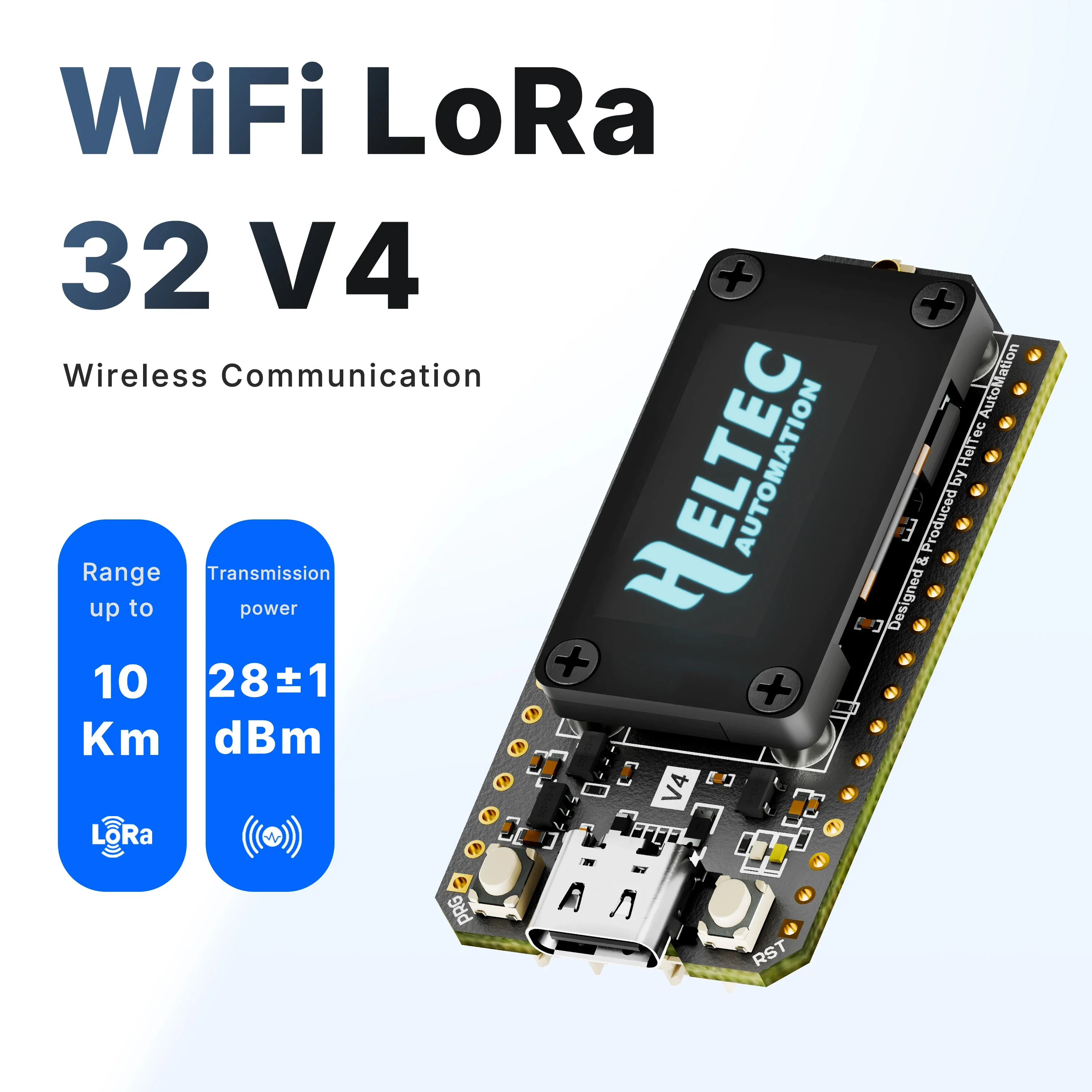
The SX1262's design allows for high transmission power, rated up to 28 ± 1 dBm for this version. Such power output translates directly into extended communication distances, potentially reaching up to 10 kilometers line-of-sight. This is a critical specification for applications like remote environmental monitoring or off-grid communication networks where signal penetration and reach are non-negotiable.
Standard LoRa modules often operate at lower power outputs, limiting their effective range. The Heltec LoRa 32 V4, with its high-power SX1262 implementation, significantly extends this operational envelope. It moves beyond typical short-range wireless solutions, enabling truly distributed sensor networks or resilient mesh communication systems.
Power Delivery and Thermal Management
Stable power delivery is fundamental for pushing any wireless system to its maximum range and throughput. The Heltec LoRa 32 V4 incorporates a USB Type-C port for primary power and data, alongside dedicated connectors for a Li-ion battery and solar power input. This multi-faceted power architecture ensures continuous operation in diverse deployment scenarios.
The presence of a power management IC (PMIC) is a crucial detail. A well-designed PMIC ensures efficient power conversion and stable voltage regulation, even when the ESP32 is under heavy computational load or the LoRa transceiver is transmitting at maximum power. Inconsistent power can lead to brownouts, data corruption, or reduced wireless performance, making robust power management indispensable for reliability.
Many entry-level development boards rely on basic voltage regulators, which can struggle under fluctuating loads or high current draws. The Heltec V4's integrated PMIC and support for multiple power sources provide a superior foundation for sustained, high-performance operation. This design choice safeguards against the instability that often plagues less thoughtfully engineered modules.
Thermal management, while not explicitly detailed with heatsinks, is a consideration for any board running a powerful ESP32 and a high-power LoRa transceiver. The compact form factor necessitates careful power profiling, especially when operating the ESP32 at its highest clock speeds and the LoRa at maximum transmission power. The visible plastic protection bracket offers some physical durability but limited thermal dissipation.
For continuous high-power transmission or CPU-intensive tasks, monitoring the board's temperature is advisable. While the ESP32 is generally robust, sustained high temperatures can impact component longevity and stability. Strategic placement in an enclosure with adequate airflow, or even passive cooling solutions, may be beneficial for deployments in warmer environments or under prolonged heavy use.
Unlike systems with dedicated cooling solutions, this module's thermal design relies on passive dissipation. Users should account for this in their application design, particularly if the board is enclosed. Understanding the thermal envelope ensures the module performs optimally without premature wear.
Display and Connectivity
A 0.96-inch blue OLED display is integrated directly onto the board. This small but clear display provides immediate visual feedback for debugging, status monitoring, or displaying sensor data. Its presence eliminates the need for external display modules in many applications, simplifying project builds.
This integrated display allows for real-time monitoring of critical parameters like signal strength, battery voltage, or environmental readings without requiring a connected computer. For field deployments, this capability is invaluable, offering instant diagnostics and operational insights. It is a practical addition for standalone devices.
Many development boards require an external display, adding complexity and bulk. The integrated OLED streamlines the design process, making the Heltec LoRa 32 V4 a more self-contained and user-friendly solution for rapid prototyping and deployment. It simplifies the user interface aspect of embedded systems.
Connectivity options extend beyond Wi-Fi and LoRa. The board exposes various GPIO pins, I2C, and SPI interfaces. These allow for seamless integration with a wide array of sensors, actuators, and other peripherals. The flexibility of these interfaces enables the creation of complex IoT ecosystems.
This rich set of I/O capabilities means the board is not just a communication device but a central processing unit for an entire system. Developers can connect temperature sensors, motion detectors, relays, or other custom hardware, all managed by the ESP32's processing power and communicated via LoRa or Wi-Fi. It is a true system-on-module for diverse applications.
Generic communication modules often lack comprehensive I/O, forcing developers to integrate additional microcontrollers. The Heltec V4's robust GPIO and serial interface offerings significantly reduce component count and design complexity, accelerating development cycles for integrated solutions.
The Meshtastic Advantage
The Heltec LoRa 32 V4 is inherently compatible with Meshtastic firmware, as evidenced by the display showing "meshtastic.org". Meshtastic transforms LoRa devices into a long-range, off-grid mesh communication network. This allows devices to relay messages, extending the effective communication range far beyond the line-of-sight of a single node.
Utilizing Meshtastic, this board becomes a powerful tool for resilient communication in areas without cellular or Wi-Fi infrastructure. Imagine coordinating search and rescue operations, maintaining contact during outdoor adventures, or establishing a local community network. The mesh capabilities ensure messages find their way through multiple hops.
Unlike traditional point-to-point radio systems, Meshtastic's mesh networking capability offers inherent redundancy and range extension. This makes the Heltec LoRa 32 V4 an ideal choice for emergency communication, remote data collection, or any scenario where infrastructure-independent connectivity is critical. It provides a robust communication backbone.
Unlocking Full Potential
This Heltec LoRa 32 V4 board is a serious contender for projects that demand high-performance wireless communication and robust processing capabilities. The combination of a powerful ESP32-S3, a high-transmission-power SX1262 LoRa chip, and versatile power options positions it as a top-tier choice for pushing the boundaries of IoT and mesh networking. Its integrated OLED and comprehensive GPIO further simplify development, allowing for rapid prototyping and deployment of complex systems. The board's architecture is built for stability, even when operating at the edge of its performance envelope, making it a reliable foundation for mission-critical applications. Imagine deploying a network of these boards, each silently collecting data from remote sensors, transmitting critical information over kilometers, and forming a resilient mesh that adapts to its environment. This platform empowers creators to build the next generation of truly connected, independent devices.