Filajoy3D Glow-in-the-Dark Rainbow PLA Filament
Official Store Deal
Expert Analysis Overview
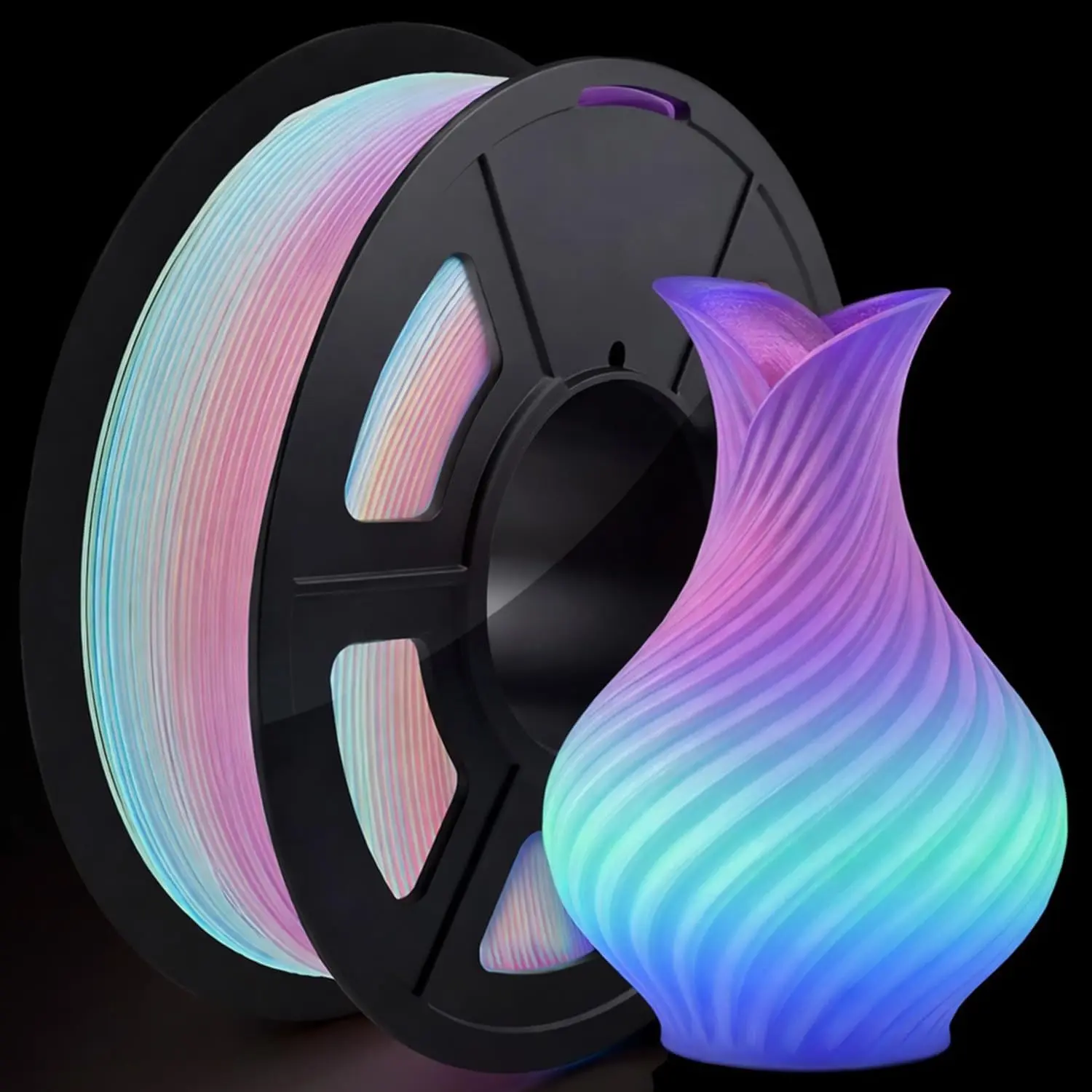
The Filajoy3D Glow-in-the-Dark Rainbow PLA Filament is an engaging and reliable material designed for educational and hobbyist 3D printing. This filament offers a unique blend of vibrant rainbow colors and a captivating glow-in-the-dark effect, making it ideal for projects that require visual impact and a touch of wonder. Its consistent diameter and standard PLA properties ensure a smooth printing experience, even for those new to 3D fabrication.
This filament's primary appeal lies in its dual aesthetic. During daylight or under normal lighting, prints display a smooth transition of rainbow hues. The visual progression is striking. Once lights dim, the magic truly begins. The printed objects emit a soft, ethereal glow, transforming everyday models into captivating nocturnal displays. This glow feature is particularly effective for educational demonstrations, allowing students to observe printed structures in a new light.
Polylactic Acid, or PLA, forms the base of this filament. PLA is a biodegradable thermoplastic derived from renewable resources like corn starch or sugarcane. It is a popular choice for 3D printing due to its ease of use and minimal warping. The material prints at relatively lower temperatures compared to other plastics, reducing the risk of burns for younger users in a classroom setting. Its low odor during printing also contributes to a more pleasant environment. This material simplifies the printing process.
Compared to more advanced engineering plastics, PLA is significantly more forgiving. It requires less stringent bed adhesion techniques and often performs well without an enclosed printer. This makes it an excellent starting point for beginners. The material's inherent stiffness allows for crisp details in printed models.
Dimensional accuracy is paramount in 3D printing. This Filajoy3D filament boasts a diameter of 1.75mm with a tolerance of +/0.03mm. This tight tolerance ensures the filament feeds smoothly and consistently through the printer's extruder. Inconsistent filament diameter often leads to frustrating print failures, such as under-extrusion or nozzle clogging. Precise filament prevents these issues.
Such consistent feeding is crucial for maintaining print quality. It directly influences the uniformity of extruded lines and the structural integrity of the final model. For STEM educators, this reliability translates to fewer failed prints during student projects. Less time is spent troubleshooting, more time is dedicated to learning.
Many generic filaments on the market offer wider tolerances, sometimes up to +/0.05mm or even higher. While seemingly small, this difference can significantly impact print outcomes, especially on detailed models. The tighter tolerance of this filament positions it as a more dependable option for critical applications.
The filament comes on a spool designed for broad compatibility. Its dimensions—150mm (5.9 inches) diameter, 52mm (2.04 inches) width, and a 38mm (1.49 inches) central hole—are standard for most FDM (Fused Deposition Modeling) 3D printers. This ensures it fits a vast majority of desktop machines without requiring special adapters. Universal fit is a key advantage.
A perfectly sized spool prevents tangles and ensures smooth unwinding during long prints. The 250g (8.8oz) weight is suitable for smaller projects or for users who wish to experiment with different colors without committing to a full kilogram spool. This smaller quantity is also practical for classroom environments where multiple students might share filament resources.
Unlike oversized or undersized spools that can cause feeding issues or not fit a printer's spool holder, this design prioritizes seamless integration. It reduces the likelihood of filament getting snagged or falling off the holder. This thoughtful design minimizes potential print interruptions.
The filament arrives shrink-wrapped and encased in a sturdy box. Proper packaging is vital for preserving filament quality. Filaments, especially PLA, are hygroscopic, meaning they absorb moisture from the air. Moisture absorption can lead to poor print quality, including bubbling, stringing, and weaker layers. This packaging protects the material.
The shrink wrap creates an airtight seal, preventing moisture ingress during storage and transit. The sturdy box offers protection against physical damage. This dual layer of protection ensures the filament reaches the user in optimal condition, ready for immediate use. Dry filament prints best.
Many budget filaments might skimp on packaging, leading to degraded material upon arrival. This product's attention to detail in packaging reflects a commitment to quality. It ensures that the dimensional accuracy and material properties are maintained until the spool is opened. This prevents common print quality issues.
Working with this filament integrates smoothly into standard slicing workflows. Users can utilize popular slicing software like Cura, PrusaSlicer, or Simplify3D. The default PLA settings in most slicers serve as an excellent starting point. Typical print temperatures for PLA range from 190°C to 220°C, with a heated bed temperature of 50°C to 60°C. These settings are widely accessible.
Adjustments might be necessary to optimize the glow effect or rainbow transition. Slightly slower print speeds can allow the filament to cool more evenly, enhancing color separation and luminescence. Experimentation with infill patterns can also influence the glow's intensity, as denser prints often glow brighter. Simple adjustments yield better results.
Compared to specialized or exotic filaments that demand complex print profiles and significant calibration, this PLA filament is remarkably straightforward. Its ease of integration into existing software and hardware setups reduces the learning curve for new users. This simplifies the entire process for educators and students alike.
This filament offers immense educational value, particularly in STEM fields. Students can learn about material science by observing the glow-in-the-dark properties, exploring photoluminescence. The rainbow color transition introduces concepts of color theory and gradient design. It provides a tangible way to understand abstract concepts. Practical learning is enhanced.
Creating visually appealing projects with this filament can boost student engagement and motivation. Imagine students designing and printing models that light up their desks at night. This hands-on experience reinforces design principles, problem-solving skills, and the iterative nature of engineering. It makes learning fun and memorable.
Unlike single-color filaments that offer limited visual feedback, the rainbow and glow features provide immediate, striking results. This instant gratification can be a powerful tool for maintaining student interest in longer projects. The filament encourages creativity and exploration.
PLA prints are generally durable for display and light handling. While not as strong as ABS or PETG, its mechanical properties are sufficient for most decorative and educational models. The material is relatively rigid. Post-processing is straightforward; prints can be sanded, painted, or glued if desired. The smooth finish of the filament lends itself well to minimal post-processing.
For enhanced durability, users can consider applying a clear coat or sealant to the finished prints. This can protect the surface from scratches and minor impacts. The glow-in-the-dark pigments are embedded within the material, so the luminescence remains even after light sanding. This maintains the aesthetic integrity.
Compared to resin prints, which often require extensive post-curing and cleaning, PLA prints are ready for use almost immediately after removal from the print bed. This efficiency is beneficial in educational settings where time is often limited. It allows for quicker project completion.
Safety is a paramount concern in any educational environment. PLA filament is generally considered non-toxic and produces minimal fumes during printing, making it a safer option for classroom use. The relatively low printing temperatures also reduce the risk of accidental burns compared to higher-temperature filaments. Safe operation is critical.
However, proper ventilation is always recommended for any 3D printing setup. Students should be supervised, especially when handling hot printer components or sharp tools. The filament itself is inert and poses no direct hazard. Emphasizing safety protocols ensures a secure learning environment.
Unlike some industrial filaments that require specialized ventilation systems and personal protective equipment, PLA's benign nature simplifies safety management. This makes it an accessible material for introducing students to additive manufacturing without undue risk. It promotes responsible technology use.
This filament is more than just a printing material; it is a catalyst for creativity. The rainbow colors inspire artistic expression, while the glow-in-the-dark feature adds an element of surprise and wonder. Students can design functional objects, artistic sculptures, or even educational aids that demonstrate scientific principles. Imagination takes flight.
Imagine a classroom where students are not just consuming information but actively creating it. This filament empowers them to bring their ideas to life in a tangible, visually stunning way. It fosters an innovative mindset and encourages experimentation. The possibilities are endless.
By providing a material that is both easy to use and visually captivating, educators can inspire a new generation of makers and innovators. This filament serves as an excellent tool for bridging the gap between theoretical knowledge and practical application. It transforms learning into an exciting adventure.
Imagine the satisfaction of watching a student's eyes light up as their rainbow-colored, glowing creation emerges from the printer, a tangible testament to their ingenuity and the power of additive manufacturing. This filament allows for the creation of truly unique and memorable projects, fostering a deeper connection to the principles of design and engineering. Consider the vibrant, glowing models that will populate your classroom or home, sparking conversations and inspiring further exploration into the fascinating world of 3D printing. This is not just filament; it is the raw material for innovation and wonder.
The Allure of Luminescent Creations
This filament's primary appeal lies in its dual aesthetic. During daylight or under normal lighting, prints display a smooth transition of rainbow hues. The visual progression is striking. Once lights dim, the magic truly begins. The printed objects emit a soft, ethereal glow, transforming everyday models into captivating nocturnal displays. This glow feature is particularly effective for educational demonstrations, allowing students to observe printed structures in a new light.
Material Composition and Handling
Polylactic Acid, or PLA, forms the base of this filament. PLA is a biodegradable thermoplastic derived from renewable resources like corn starch or sugarcane. It is a popular choice for 3D printing due to its ease of use and minimal warping. The material prints at relatively lower temperatures compared to other plastics, reducing the risk of burns for younger users in a classroom setting. Its low odor during printing also contributes to a more pleasant environment. This material simplifies the printing process.
Compared to more advanced engineering plastics, PLA is significantly more forgiving. It requires less stringent bed adhesion techniques and often performs well without an enclosed printer. This makes it an excellent starting point for beginners. The material's inherent stiffness allows for crisp details in printed models.
Precision Engineering for Consistent Results
Dimensional accuracy is paramount in 3D printing. This Filajoy3D filament boasts a diameter of 1.75mm with a tolerance of +/
Such consistent feeding is crucial for maintaining print quality. It directly influences the uniformity of extruded lines and the structural integrity of the final model. For STEM educators, this reliability translates to fewer failed prints during student projects. Less time is spent troubleshooting, more time is dedicated to learning.
Many generic filaments on the market offer wider tolerances, sometimes up to +/
Spool Design and Printer Compatibility
The filament comes on a spool designed for broad compatibility. Its dimensions—150mm (5.9 inches) diameter, 52mm (2.04 inches) width, and a 38mm (1.49 inches) central hole—are standard for most FDM (Fused Deposition Modeling) 3D printers. This ensures it fits a vast majority of desktop machines without requiring special adapters. Universal fit is a key advantage.
A perfectly sized spool prevents tangles and ensures smooth unwinding during long prints. The 250g (8.8oz) weight is suitable for smaller projects or for users who wish to experiment with different colors without committing to a full kilogram spool. This smaller quantity is also practical for classroom environments where multiple students might share filament resources.
Unlike oversized or undersized spools that can cause feeding issues or not fit a printer's spool holder, this design prioritizes seamless integration. It reduces the likelihood of filament getting snagged or falling off the holder. This thoughtful design minimizes potential print interruptions.
Packaging for Optimal Filament Preservation
The filament arrives shrink-wrapped and encased in a sturdy box. Proper packaging is vital for preserving filament quality. Filaments, especially PLA, are hygroscopic, meaning they absorb moisture from the air. Moisture absorption can lead to poor print quality, including bubbling, stringing, and weaker layers. This packaging protects the material.
The shrink wrap creates an airtight seal, preventing moisture ingress during storage and transit. The sturdy box offers protection against physical damage. This dual layer of protection ensures the filament reaches the user in optimal condition, ready for immediate use. Dry filament prints best.
Many budget filaments might skimp on packaging, leading to degraded material upon arrival. This product's attention to detail in packaging reflects a commitment to quality. It ensures that the dimensional accuracy and material properties are maintained until the spool is opened. This prevents common print quality issues.
Slicing Software Integration and Print Settings
Working with this filament integrates smoothly into standard slicing workflows. Users can utilize popular slicing software like Cura, PrusaSlicer, or Simplify3D. The default PLA settings in most slicers serve as an excellent starting point. Typical print temperatures for PLA range from 190°C to 220°C, with a heated bed temperature of 50°C to 60°C. These settings are widely accessible.
Adjustments might be necessary to optimize the glow effect or rainbow transition. Slightly slower print speeds can allow the filament to cool more evenly, enhancing color separation and luminescence. Experimentation with infill patterns can also influence the glow's intensity, as denser prints often glow brighter. Simple adjustments yield better results.
Compared to specialized or exotic filaments that demand complex print profiles and significant calibration, this PLA filament is remarkably straightforward. Its ease of integration into existing software and hardware setups reduces the learning curve for new users. This simplifies the entire process for educators and students alike.
Classroom Applications and Educational Value
This filament offers immense educational value, particularly in STEM fields. Students can learn about material science by observing the glow-in-the-dark properties, exploring photoluminescence. The rainbow color transition introduces concepts of color theory and gradient design. It provides a tangible way to understand abstract concepts. Practical learning is enhanced.
Creating visually appealing projects with this filament can boost student engagement and motivation. Imagine students designing and printing models that light up their desks at night. This hands-on experience reinforces design principles, problem-solving skills, and the iterative nature of engineering. It makes learning fun and memorable.
Unlike single-color filaments that offer limited visual feedback, the rainbow and glow features provide immediate, striking results. This instant gratification can be a powerful tool for maintaining student interest in longer projects. The filament encourages creativity and exploration.
Durability and Post-Processing
PLA prints are generally durable for display and light handling. While not as strong as ABS or PETG, its mechanical properties are sufficient for most decorative and educational models. The material is relatively rigid. Post-processing is straightforward; prints can be sanded, painted, or glued if desired. The smooth finish of the filament lends itself well to minimal post-processing.
For enhanced durability, users can consider applying a clear coat or sealant to the finished prints. This can protect the surface from scratches and minor impacts. The glow-in-the-dark pigments are embedded within the material, so the luminescence remains even after light sanding. This maintains the aesthetic integrity.
Compared to resin prints, which often require extensive post-curing and cleaning, PLA prints are ready for use almost immediately after removal from the print bed. This efficiency is beneficial in educational settings where time is often limited. It allows for quicker project completion.
The Role of Safety in 3D Printing Education
Safety is a paramount concern in any educational environment. PLA filament is generally considered non-toxic and produces minimal fumes during printing, making it a safer option for classroom use. The relatively low printing temperatures also reduce the risk of accidental burns compared to higher-temperature filaments. Safe operation is critical.
However, proper ventilation is always recommended for any 3D printing setup. Students should be supervised, especially when handling hot printer components or sharp tools. The filament itself is inert and poses no direct hazard. Emphasizing safety protocols ensures a secure learning environment.
Unlike some industrial filaments that require specialized ventilation systems and personal protective equipment, PLA's benign nature simplifies safety management. This makes it an accessible material for introducing students to additive manufacturing without undue risk. It promotes responsible technology use.
Cultivating Creativity and Innovation
This filament is more than just a printing material; it is a catalyst for creativity. The rainbow colors inspire artistic expression, while the glow-in-the-dark feature adds an element of surprise and wonder. Students can design functional objects, artistic sculptures, or even educational aids that demonstrate scientific principles. Imagination takes flight.
Imagine a classroom where students are not just consuming information but actively creating it. This filament empowers them to bring their ideas to life in a tangible, visually stunning way. It fosters an innovative mindset and encourages experimentation. The possibilities are endless.
By providing a material that is both easy to use and visually captivating, educators can inspire a new generation of makers and innovators. This filament serves as an excellent tool for bridging the gap between theoretical knowledge and practical application. It transforms learning into an exciting adventure.
Imagine the satisfaction of watching a student's eyes light up as their rainbow-colored, glowing creation emerges from the printer, a tangible testament to their ingenuity and the power of additive manufacturing. This filament allows for the creation of truly unique and memorable projects, fostering a deeper connection to the principles of design and engineering. Consider the vibrant, glowing models that will populate your classroom or home, sparking conversations and inspiring further exploration into the fascinating world of 3D printing. This is not just filament; it is the raw material for innovation and wonder.