Fenvi WiFi 6 AX200 PCIe Adapter with Bluetooth 5.2
Official Store Deal
Expert Analysis Overview
The Fenvi 2974Mbps WiFi6 AX200 PCIE Adapter is a formidable wireless Networking solution engineered for desktop users demanding high-throughput, low-latency connectivity in modern computing environments. This adapter integrates the advanced Intel AX200 chipset, providing a substantial upgrade path for systems still relying on older Wi-Fi standards. Its design focuses on delivering robust wireless performance, making it a critical component for any user aiming to build a resilient and high-speed home network infrastructure.
This adapter operates on the 802.11ax (WiFi 6) standard, a significant leap from its predecessors. WiFi 6 introduces several key technologies that fundamentally alter how wireless networks manage traffic and deliver data. The theoretical maximum throughput of 2974Mbps is achieved through a combination of 2400Mbps on the 5GHz band and 574Mbps on the 2.4GHz band, providing ample bandwidth for even the most data-intensive applications.
When operating in a congested network environment, the benefits of WiFi 6 become immediately apparent. Unlike older 802.11ac (WiFi 5) networks that struggle with multiple devices simultaneously transmitting, WiFi 6 utilizes OFDMA (Orthogonal Frequency-Division Multiple Access). This technology allows a single transmission to carry data for multiple clients concurrently, akin to a multi-lane highway where different vehicles can occupy different lanes at the same time. This dramatically improves efficiency and reduces latency, especially in homes with numerous connected smart devices, streaming boxes, and gaming consoles.
Compared to a standard 802.11ac adapter, which typically maxes out at 1733Mbps on the 5GHz band and lacks OFDMA, this AX200-based card offers a substantial increase in both raw speed and network efficiency. The upgrade ensures that even during peak network usage, individual devices experience less buffering and faster response times, creating a smoother overall user experience across the entire network.
The adapter supports 160MHz channel width on the 5GHz band. This wider channel allows for a significantly larger data pipeline, directly translating to higher potential speeds. A wider channel means more data can be transmitted in the same amount of time.
Consider a scenario where multiple high-bandwidth applications are running concurrently, such as 4K video streaming, large file transfers, and online gaming. With 160MHz channels, the adapter can handle these simultaneous demands with greater ease, preventing bottlenecks that would cripple older 80MHz or 40MHz channel setups. The increased bandwidth capacity ensures that each application receives the necessary data throughput without compromising the performance of others.
In contrast to many mainstream WiFi 5 adapters that are limited to 80MHz channels, the 160MHz capability of the AX200 chipset effectively doubles the potential data rate under optimal conditions. This is not merely a theoretical gain; in environments with compatible WiFi 6 routers, the real-world difference in file transfer speeds and overall network responsiveness is palpable, making it an essential feature for power users and content creators.
MU-MIMO (Multi-User, Multiple-Input, Multiple-Output) technology is another cornerstone of WiFi 6, and the AX200 chipset fully leverages it. This allows the router to communicate with multiple devices simultaneously, rather than sequentially. It's like having multiple dedicated data streams for different clients.
Imagine a household where one user is downloading a large game update, another is video conferencing, and a third is streaming a high-definition movie. Without MU-MIMO, the router would have to serve each device one after another, leading to delays. With MU-MIMO, the router can address all three devices concurrently, optimizing the use of available wireless spectrum and reducing wait times for each client.
Previous generations of Wi-Fi often featured SU-MIMO (Single-User MIMO), which only allowed the router to communicate with one device at a time, even if it had multiple antennas. The transition to MU-MIMO in WiFi 6, as implemented by this adapter, represents a fundamental shift towards more efficient and less congested wireless communication, particularly beneficial in dense network environments where multiple devices are actively competing for bandwidth.
Beyond its robust Wi-Fi capabilities, this adapter incorporates Bluetooth 5.2. This is a significant upgrade over older Bluetooth standards, offering enhanced speed, range, and energy efficiency. Bluetooth 5.2 includes LE Audio, which provides higher quality audio with lower power consumption, and Enhanced Attribute Protocol (EATT), improving data transfer efficiency.
Connecting wireless peripherals such as headphones, speakers, game controllers, or keyboards becomes a far more reliable and responsive experience. The increased range of Bluetooth 5.2 means devices can maintain a stable connection further away from the PC, reducing dropouts and signal degradation. The improved speed facilitates quicker pairing and more fluid data exchange, which is particularly noticeable with high-bandwidth audio devices or during file transfers between devices.
Compared to systems with older Bluetooth 4.x modules, the Bluetooth 5.2 integration offers a tangible improvement in connectivity stability and performance. Users will experience fewer audio stutters, more responsive input from wireless controllers, and a generally more seamless interaction with their Bluetooth ecosystem. This dual-functionality eliminates the need for a separate Bluetooth dongle, freeing up a USB port and simplifying system configuration.
The adapter utilizes a PCIe (Peripheral Component Interconnect Express) interface. This direct connection to the motherboard's high-speed bus ensures maximum bandwidth and minimal latency for wireless communication. Unlike external USB Wi-Fi adapters, which can be limited by USB bus speeds and introduce additional latency, a PCIe card offers a dedicated, high-throughput pathway.
Installation involves simply inserting the card into an available PCIe x1 slot on the motherboard and connecting the internal USB header cable for Bluetooth functionality. The physical connection is secure, preventing accidental disconnections that can plague external dongles. This direct integration also typically results in more stable driver performance and better power management, as the card draws power directly from the motherboard.
Many entry-level systems or older desktops might rely on slower USB 2.0 or 3.0 Wi-Fi adapters, which often cannot sustain the speeds offered by modern Wi-Fi standards. The PCIe x1 interface of this Fenvi adapter ensures that the full potential of the Intel AX200 chipset is realized, providing a bottleneck-free connection that is crucial for maintaining high speeds and low ping in demanding applications like online gaming or real-time data analysis.
This adapter is designed for Windows 10 and Windows 11 operating systems. Driver support is robust, typically available directly from Intel's website for the AX200 chipset, ensuring access to the latest performance optimizations and security patches. While some systems might offer basic functionality out-of-the-box, installing the official Intel drivers is highly recommended for optimal performance and access to all features.
Proper driver installation is paramount for unlocking the full capabilities of the WiFi 6 and Bluetooth 5.2 standards. The driver package often includes management utilities that allow for fine-tuning of wireless settings, monitoring signal strength, and diagnosing connectivity issues. This level of control is essential for network engineers or advanced users who require precise management over their wireless connections.
Unlike generic, unbranded adapters that often rely on outdated or poorly optimized drivers, the use of the Intel AX200 chipset ensures long-term driver support and compatibility with future Windows updates. This commitment to ongoing support provides peace of mind, knowing that the adapter will continue to perform reliably and securely throughout its lifespan, a distinct advantage over less reputable alternatives.
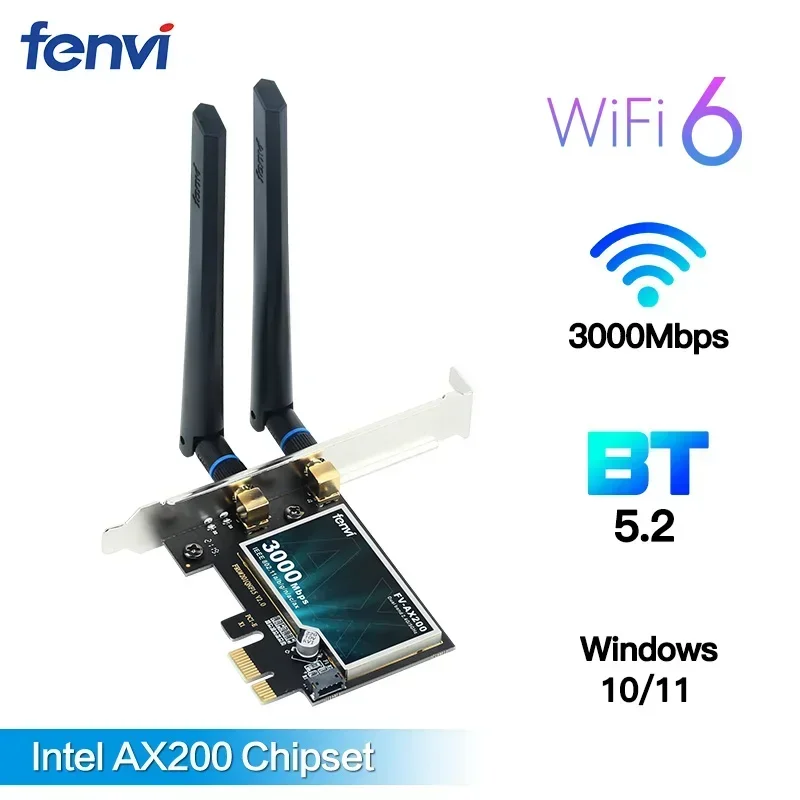
The adapter features a compact PCIe x1 form factor, making it compatible with a wide range of desktop motherboards. It includes two external, detachable antennas. These antennas connect via standard RP-SMA connectors, allowing for potential upgrades to higher-gain antennas if specific signal coverage requirements arise. The matte black finish of the antennas and the precision molding of the PCIe bracket indicate a focus on functional aesthetics and durability.
The external antenna design is crucial for optimal signal reception and transmission. Unlike internal laptop Wi-Fi cards or compact USB dongles with integrated antennas, the ability to position external antennas away from the PC case's metal chassis significantly reduces signal obstruction and interference. This results in stronger, more stable wireless connections, particularly in environments with physical barriers or distant access points.
Compared to internal antenna solutions, the external antennas provide superior flexibility in optimizing signal strength. Users can adjust the angle and orientation of the antennas to achieve the best possible signal quality, a critical factor in maintaining high throughput and low latency. This design choice underscores the adapter's commitment to delivering uncompromising wireless performance.
From a network engineering perspective, the Fenvi AX200 adapter represents a strategic investment for any desktop system requiring a modern, high-performance wireless interface. Its adherence to the WiFi 6 standard, coupled with the robust Intel AX200 chipset, provides a solid foundation for efficient traffic management and high-speed data transfer. The inclusion of Bluetooth 5.2 further enhances its utility, consolidating wireless connectivity into a single, reliable PCIe solution. This adapter is not merely a component; it is an enabler for building a truly responsive and capable personal network node within a larger, well-architected home or small office network. Imagine a home network where every device, from the gaming rig to the smart thermostat, communicates with unparalleled efficiency, free from the bottlenecks of outdated wireless protocols. This adapter makes that vision a tangible reality, ensuring a future-proof foundation for all your wireless demands.
Wireless Protocol Evolution: Embracing WiFi 6
This adapter operates on the 802.11ax (WiFi 6) standard, a significant leap from its predecessors. WiFi 6 introduces several key technologies that fundamentally alter how wireless networks manage traffic and deliver data. The theoretical maximum throughput of 2974Mbps is achieved through a combination of 2400Mbps on the 5GHz band and 574Mbps on the 2.4GHz band, providing ample bandwidth for even the most data-intensive applications.
When operating in a congested network environment, the benefits of WiFi 6 become immediately apparent. Unlike older 802.11ac (WiFi 5) networks that struggle with multiple devices simultaneously transmitting, WiFi 6 utilizes OFDMA (Orthogonal Frequency-Division Multiple Access). This technology allows a single transmission to carry data for multiple clients concurrently, akin to a multi-lane highway where different vehicles can occupy different lanes at the same time. This dramatically improves efficiency and reduces latency, especially in homes with numerous connected smart devices, streaming boxes, and gaming consoles.
Compared to a standard 802.11ac adapter, which typically maxes out at 1733Mbps on the 5GHz band and lacks OFDMA, this AX200-based card offers a substantial increase in both raw speed and network efficiency. The upgrade ensures that even during peak network usage, individual devices experience less buffering and faster response times, creating a smoother overall user experience across the entire network.
Bandwidth Mastery: 160MHz Channel Support
The adapter supports 160MHz channel width on the 5GHz band. This wider channel allows for a significantly larger data pipeline, directly translating to higher potential speeds. A wider channel means more data can be transmitted in the same amount of time.
Consider a scenario where multiple high-bandwidth applications are running concurrently, such as 4K video streaming, large file transfers, and online gaming. With 160MHz channels, the adapter can handle these simultaneous demands with greater ease, preventing bottlenecks that would cripple older 80MHz or 40MHz channel setups. The increased bandwidth capacity ensures that each application receives the necessary data throughput without compromising the performance of others.
In contrast to many mainstream WiFi 5 adapters that are limited to 80MHz channels, the 160MHz capability of the AX200 chipset effectively doubles the potential data rate under optimal conditions. This is not merely a theoretical gain; in environments with compatible WiFi 6 routers, the real-world difference in file transfer speeds and overall network responsiveness is palpable, making it an essential feature for power users and content creators.
Multi-User Efficiency: MU-MIMO Integration
MU-MIMO (Multi-User, Multiple-Input, Multiple-Output) technology is another cornerstone of WiFi 6, and the AX200 chipset fully leverages it. This allows the router to communicate with multiple devices simultaneously, rather than sequentially. It's like having multiple dedicated data streams for different clients.
Imagine a household where one user is downloading a large game update, another is video conferencing, and a third is streaming a high-definition movie. Without MU-MIMO, the router would have to serve each device one after another, leading to delays. With MU-MIMO, the router can address all three devices concurrently, optimizing the use of available wireless spectrum and reducing wait times for each client.
Previous generations of Wi-Fi often featured SU-MIMO (Single-User MIMO), which only allowed the router to communicate with one device at a time, even if it had multiple antennas. The transition to MU-MIMO in WiFi 6, as implemented by this adapter, represents a fundamental shift towards more efficient and less congested wireless communication, particularly beneficial in dense network environments where multiple devices are actively competing for bandwidth.
Seamless Peripheral Integration: Bluetooth 5.2
Beyond its robust Wi-Fi capabilities, this adapter incorporates Bluetooth 5.2. This is a significant upgrade over older Bluetooth standards, offering enhanced speed, range, and energy efficiency. Bluetooth 5.2 includes LE Audio, which provides higher quality audio with lower power consumption, and Enhanced Attribute Protocol (EATT), improving data transfer efficiency.
Connecting wireless peripherals such as headphones, speakers, game controllers, or keyboards becomes a far more reliable and responsive experience. The increased range of Bluetooth 5.2 means devices can maintain a stable connection further away from the PC, reducing dropouts and signal degradation. The improved speed facilitates quicker pairing and more fluid data exchange, which is particularly noticeable with high-bandwidth audio devices or during file transfers between devices.
Compared to systems with older Bluetooth 4.x modules, the Bluetooth 5.2 integration offers a tangible improvement in connectivity stability and performance. Users will experience fewer audio stutters, more responsive input from wireless controllers, and a generally more seamless interaction with their Bluetooth ecosystem. This dual-functionality eliminates the need for a separate Bluetooth dongle, freeing up a USB port and simplifying system configuration.
System Integration: PCIe Interface
The adapter utilizes a PCIe (Peripheral Component Interconnect Express) interface. This direct connection to the motherboard's high-speed bus ensures maximum bandwidth and minimal latency for wireless communication. Unlike external USB Wi-Fi adapters, which can be limited by USB bus speeds and introduce additional latency, a PCIe card offers a dedicated, high-throughput pathway.
Installation involves simply inserting the card into an available PCIe x1 slot on the motherboard and connecting the internal USB header cable for Bluetooth functionality. The physical connection is secure, preventing accidental disconnections that can plague external dongles. This direct integration also typically results in more stable driver performance and better power management, as the card draws power directly from the motherboard.
Many entry-level systems or older desktops might rely on slower USB 2.0 or 3.0 Wi-Fi adapters, which often cannot sustain the speeds offered by modern Wi-Fi standards. The PCIe x1 interface of this Fenvi adapter ensures that the full potential of the Intel AX200 chipset is realized, providing a bottleneck-free connection that is crucial for maintaining high speeds and low ping in demanding applications like online gaming or real-time data analysis.
Operating System Compatibility and Driver Management
This adapter is designed for Windows 10 and Windows 11 operating systems. Driver support is robust, typically available directly from Intel's website for the AX200 chipset, ensuring access to the latest performance optimizations and security patches. While some systems might offer basic functionality out-of-the-box, installing the official Intel drivers is highly recommended for optimal performance and access to all features.
Proper driver installation is paramount for unlocking the full capabilities of the WiFi 6 and Bluetooth 5.2 standards. The driver package often includes management utilities that allow for fine-tuning of wireless settings, monitoring signal strength, and diagnosing connectivity issues. This level of control is essential for network engineers or advanced users who require precise management over their wireless connections.
Unlike generic, unbranded adapters that often rely on outdated or poorly optimized drivers, the use of the Intel AX200 chipset ensures long-term driver support and compatibility with future Windows updates. This commitment to ongoing support provides peace of mind, knowing that the adapter will continue to perform reliably and securely throughout its lifespan, a distinct advantage over less reputable alternatives.
Physical Design and Antenna Configuration
The adapter features a compact PCIe x1 form factor, making it compatible with a wide range of desktop motherboards. It includes two external, detachable antennas. These antennas connect via standard RP-SMA connectors, allowing for potential upgrades to higher-gain antennas if specific signal coverage requirements arise. The matte black finish of the antennas and the precision molding of the PCIe bracket indicate a focus on functional aesthetics and durability.
The external antenna design is crucial for optimal signal reception and transmission. Unlike internal laptop Wi-Fi cards or compact USB dongles with integrated antennas, the ability to position external antennas away from the PC case's metal chassis significantly reduces signal obstruction and interference. This results in stronger, more stable wireless connections, particularly in environments with physical barriers or distant access points.
Compared to internal antenna solutions, the external antennas provide superior flexibility in optimizing signal strength. Users can adjust the angle and orientation of the antennas to achieve the best possible signal quality, a critical factor in maintaining high throughput and low latency. This design choice underscores the adapter's commitment to delivering uncompromising wireless performance.
The Verdict on Network Engineering
From a network engineering perspective, the Fenvi AX200 adapter represents a strategic investment for any desktop system requiring a modern, high-performance wireless interface. Its adherence to the WiFi 6 standard, coupled with the robust Intel AX200 chipset, provides a solid foundation for efficient traffic management and high-speed data transfer. The inclusion of Bluetooth 5.2 further enhances its utility, consolidating wireless connectivity into a single, reliable PCIe solution. This adapter is not merely a component; it is an enabler for building a truly responsive and capable personal network node within a larger, well-architected home or small office network. Imagine a home network where every device, from the gaming rig to the smart thermostat, communicates with unparalleled efficiency, free from the bottlenecks of outdated wireless protocols. This adapter makes that vision a tangible reality, ensuring a future-proof foundation for all your wireless demands.