FENVI M.2 A+E Key to M-Key Adapter for WiFi/BT Modules
Official Store Deal
Expert Analysis Overview
Bridging Wireless Standards: The FENVI M.2 A+E Key to M-Key Adapter
The FENVI M.2 A+E Key to M-Key Adapter (F-C228NV) is a specialized interface converter engineered for integrating modern wireless communication modules into systems primarily equipped with M.2 M-Key slots. This adapter facilitates the deployment of advanced Wi-Fi and Bluetooth capabilities, specifically enabling M.2 A+E Key wireless cards, such as the Intel AX200, AX210, 8265, or 7260AC series, within a motherboard's M.2 M-Key interface. It is a critical component for system builders and network administrators aiming to upgrade or provision wireless connectivity in platforms that lack native A+E Key support but offer available M-Key slots, often designated for NVMe solid-state drives.
This adapter addresses a common hardware compatibility challenge. Many contemporary motherboards prioritize M.2 M-Key slots for high-speed NVMe storage, sometimes omitting or limiting the availability of M.2 A+E Key slots required by Wi-Fi and Bluetooth modules. The F-C228NV provides a direct, physical bridge, ensuring that the electrical and mechanical interfaces align. This is a simple solution.
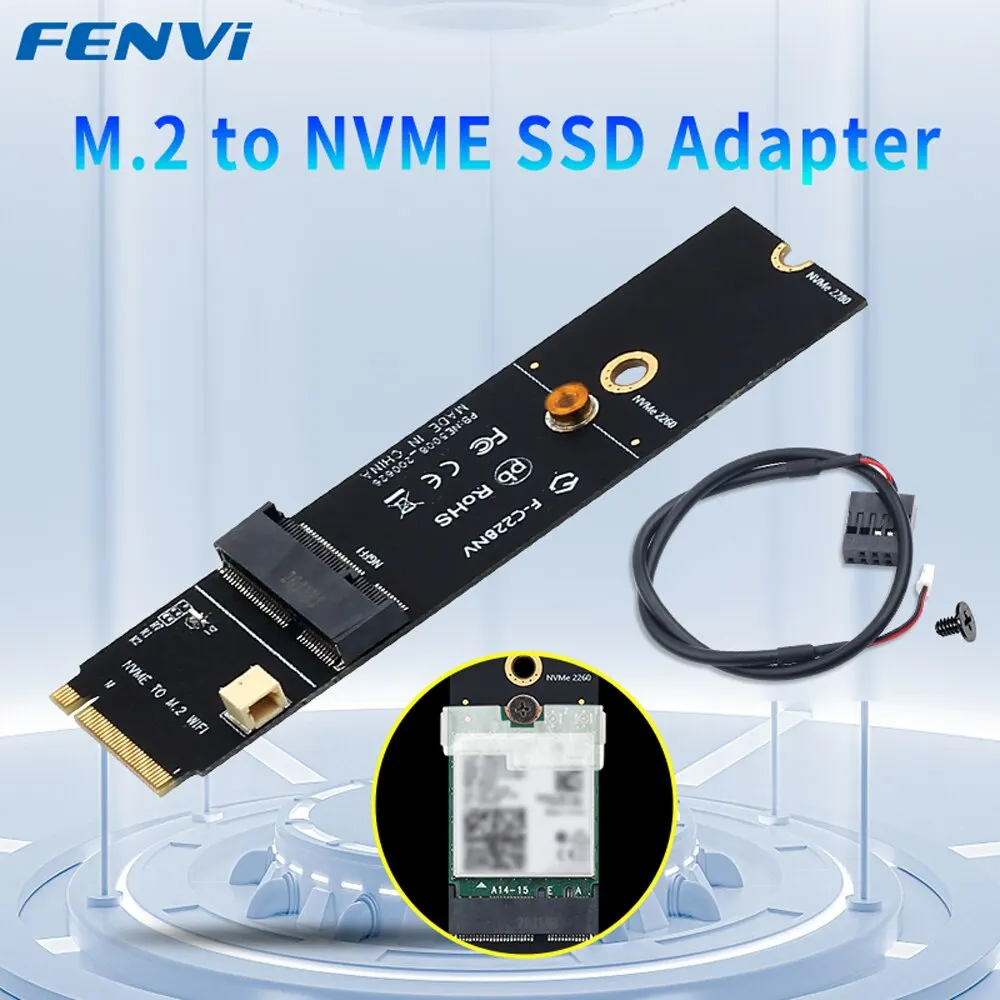
The design of the adapter is a straightforward PCB, measuring 22mm by 80mm, consistent with standard M.2 form factors. The board features an M.2 A+E Key slot on one end, into which the wireless module is inserted, and an M.2 M-Key connector on the other, which plugs into the motherboard. A crucial addition is the included Bluetooth cable, which connects from a dedicated header on the adapter to a USB header on the motherboard. This connection is essential for the Bluetooth functionality of the wireless module, as the M.2 M-Key interface typically does not route USB signals required for Bluetooth operation, unlike the A+E Key standard.
Interface Bridging and Signal Integrity
The M.2 specification defines various keying mechanisms, each dictating the types of modules and interfaces supported. The A+E Key, commonly found on Wi-Fi and Bluetooth modules, supports PCIe x1, USB 2.0, I2C, and DP signals. Conversely, the M-Key is primarily designed for PCIe x4 (NVMe SSDs) and SATA interfaces. The FENVI adapter's primary function is to translate the physical form factor and route the necessary PCIe x1 lanes from the M-Key slot to the A+E Key module, while also providing the necessary power. This ensures the Wi-Fi component of the wireless card operates at its full potential.
Signal integrity is paramount for high-speed wireless communication. The adapter's passive design minimizes signal degradation. The short trace lengths on the PCB contribute to maintaining signal quality for both PCIe data and the USB signals routed via the external cable. This is a direct connection.
Compared to alternative solutions, such as PCIe x1 expansion cards that house M.2 wireless modules, this adapter offers a more compact and integrated solution, particularly for systems with limited PCIe slot availability or those prioritizing a cleaner internal aesthetic. It leverages existing M.2 infrastructure on the motherboard, optimizing space utilization within the chassis.
Performance Uplift and Network Capabilities
Integrating a modern Wi-Fi 6 or Wi-Fi 6E module via this adapter can significantly enhance a system's wireless networking capabilities. Modules like the Intel AX200 or AX210 support 802.11ax (Wi-Fi 6/6E) standards, offering multi-gigabit throughput, lower latency, and improved efficiency in dense network environments. The adapter ensures that the PCIe x1 interface provides sufficient bandwidth for these modules to operate at their rated speeds.
For a network engineer, the ability to deploy Wi-Fi 6/6E is a substantial upgrade. This enables higher data rates and better performance in congested wireless spectrums. The module's performance directly impacts the overall network experience, from streaming high-definition content to real-time online gaming and large file transfers. The adapter facilitates this critical upgrade.
Unlike older Wi-Fi standards that often struggled with interference and limited bandwidth, Wi-Fi 6/6E, when enabled by compatible hardware like the modules supported by this adapter, provides robust and stable connections. This translates into a more reliable and faster wireless experience, reducing bottlenecks often associated with legacy wireless adapters. The system gains significant capability.
Installation Dynamics and System Integration
The installation process involves several straightforward steps, as depicted in the product imagery. First, the M.2 A+E Key wireless card is securely inserted into the adapter's slot. A small screw typically fastens the wireless card to the adapter, preventing movement. Next, the combined adapter and wireless card assembly is inserted into an available M.2 M-Key slot on the motherboard. This physical fit is precise.
The final, critical step is connecting the included Bluetooth cable. This cable typically features a small 4-pin connector that plugs into a corresponding header on the adapter and a standard USB 2.0 header on the motherboard. Without this connection, the Bluetooth functionality of the wireless module will not be active. Proper driver installation for the specific Wi-Fi and Bluetooth module (e.g., Intel drivers) is then required within the operating system to ensure full functionality. This ensures full feature set.
Compared to installing a dedicated PCIe Wi-Fi card, this M.2 adapter solution can be more discreet, especially in compact builds or systems where full-size PCIe slots are scarce. It integrates seamlessly into the M.2 ecosystem, maintaining a clean internal layout. The system's internal cabling remains manageable.
Operational Considerations and Value Proposition
While the FENVI adapter provides an excellent solution for integrating A+E Key wireless modules into M-Key slots, certain operational considerations are relevant. The adapter occupies an M.2 M-Key slot, which might otherwise be used for an NVMe SSD. System builders must assess their storage and connectivity needs to determine the optimal allocation of these valuable motherboard resources. This is a resource allocation decision.
The value proposition of this adapter is clear: it offers a cost-effective and efficient pathway to upgrade or add advanced wireless capabilities to a system without requiring a new motherboard or a bulky PCIe expansion card. For users with an existing M.2 A+E Key wireless module or those planning to purchase one for a system with only M-Key slots, this adapter is an indispensable component. It extends hardware longevity.
This adapter is an essential tool for network engineers and enthusiasts seeking to optimize wireless performance and ensure compatibility with the latest Wi-Fi standards. It enables the creation of a robust, enterprise-grade network at home by leveraging high-performance wireless modules. The ability to manage traffic efficiently and potentially customize firmware settings (if the wireless module supports it) is directly enhanced by the reliable hardware foundation this adapter provides. Imagine a system where wireless bottlenecks are eliminated, and high-speed data transfer is a given, allowing for seamless connectivity across all devices. This adapter makes that vision a reality, ensuring your network infrastructure is ready for the demands of modern digital life.