FENVI BCM94360CD PCIe Wireless Adapter
Official Store Deal
Expert Analysis Overview
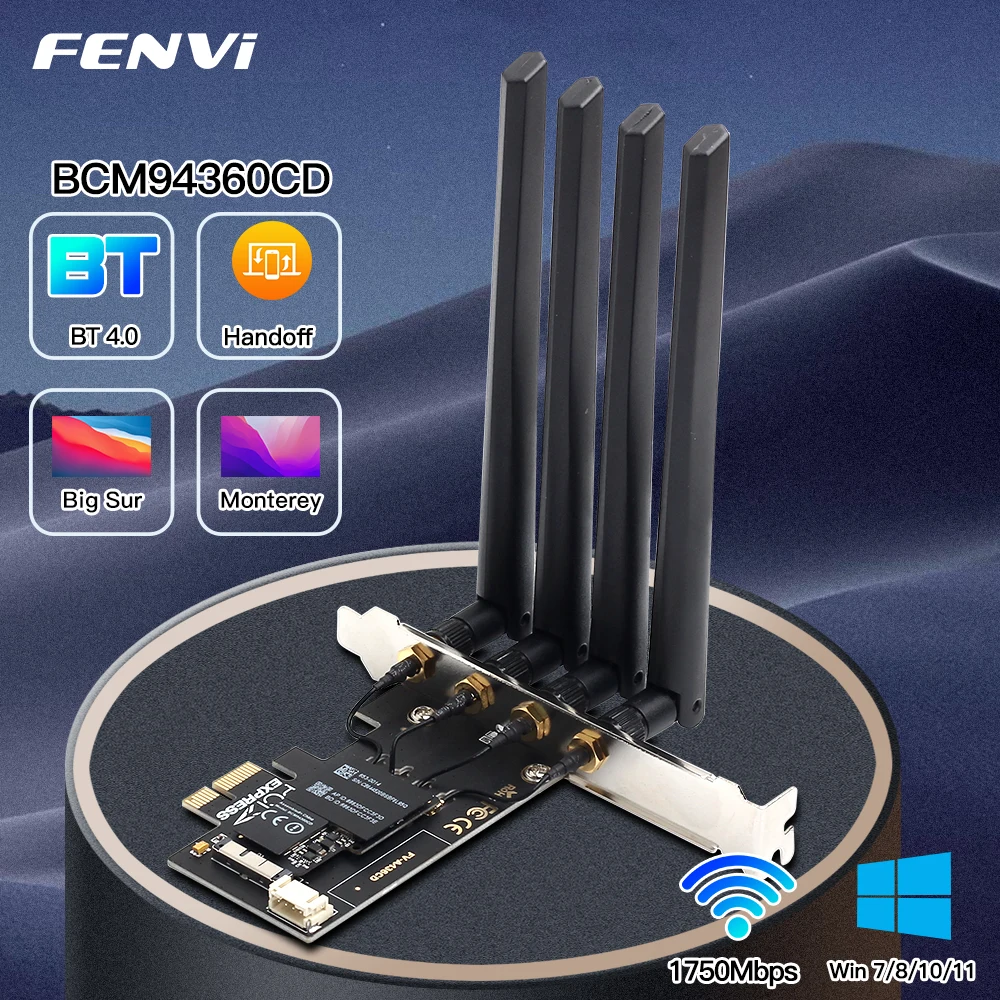
The FENVI BCM94360CD PCIe Wireless Adapter is a specialized network interface card engineered for seamless integration within Hackintosh and Windows environments, primarily targeting users who demand native macOS feature parity on non-Apple hardware. This adapter leverages the Broadcom BCM94360CD chipset, a critical component for achieving full AirDrop, Handoff, and Continuity functionality outside of Apple's ecosystem. Its dual-band 802.11ac Wi-Fi capabilities, combined with Bluetooth 4.0, position it as a robust solution for advanced wireless networking requirements.
This adapter's core functionality is predicated on the Broadcom BCM94360CD chipset. This specific silicon is renowned within the Hackintosh community for its near-native compatibility with macOS, a significant differentiator from generic Wi-Fi solutions. The chipset's inherent design allows for the direct utilization of macOS's built-in drivers, circumventing the often-complex and unstable third-party driver installations typically associated with non-Apple wireless hardware. This native driver support is paramount for system stability.
Unlike many standard PCIe wireless cards that rely on chipsets requiring extensive kext modifications or patched drivers, the BCM94360CD offers a more 'plug-and-play' experience for macOS. This simplifies the Hackintosh build process considerably. The implications for system integrators are profound, reducing troubleshooting overhead and enhancing long-term reliability. For users seeking to replicate the full Apple experience, this chipset is non-negotiable.
The FENVI BCM94360CD adapter is rated for a combined throughput of 1750Mbps. This aggregate speed is distributed across its dual-band operation: 1300Mbps on the 5GHz frequency band and 450Mbps on the 2.4GHz band. These figures are indicative of an 802.11ac Wave 1 implementation, providing substantial bandwidth for demanding network tasks. High-definition video streaming benefits significantly.
Such throughput capabilities translate directly into a superior user experience for bandwidth-intensive applications. On the 5GHz band, the 1300Mbps capacity, typically achieved through a 3x3 or 4x4 Multiple-Input Multiple-Output (MIMO) configuration, ensures low-latency online gaming and buffer-free 4K video streaming. The reduced congestion on the 5GHz spectrum further enhances performance in dense wireless environments. This is a critical advantage.
Compared to older 802.11n adapters, which typically max out at 300Mbps or 450Mbps on a single band, this 802.11ac solution offers a substantial upgrade in raw data transfer rates. The 2.4GHz band, while slower at 450Mbps, provides greater range and wall penetration, making it suitable for general web browsing and IoT device connectivity across larger areas. This dual-band approach optimizes network resource allocation.
Integrated Bluetooth 4.0 functionality complements the Wi-Fi capabilities. Bluetooth 4.0, also known as Bluetooth Low Energy (BLE), offers improved power efficiency compared to earlier versions, making it ideal for connecting a wide array of wireless peripherals. This includes keyboards, mice, headphones, and game controllers. Device pairing is generally straightforward.
For Hackintosh users, the inclusion of Bluetooth 4.0 is particularly vital for enabling macOS Continuity features. AirDrop, Handoff, Universal Clipboard, and Instant Hotspot all rely heavily on a functional and properly recognized Bluetooth module. Without this, the seamless integration that defines the Apple ecosystem would be absent. The adapter facilitates this critical link.
Many generic wireless adapters either omit Bluetooth entirely or provide an older, less compatible version. The BCM94360CD's integrated Bluetooth 4.0, when properly configured, ensures that these macOS-specific features operate as intended, bridging the gap between a custom-built PC and a genuine Mac. This level of integration is a key selling point.
The adapter utilizes a PCIe interface for connection to the motherboard. PCIe (Peripheral Component Interconnect Express) offers a high-bandwidth, low-latency connection directly to the system's bus, which is superior to external USB-based Wi-Fi adapters. This direct connection minimizes potential bottlenecks and ensures consistent performance. Data transfer is efficient.
The use of a PCIe x1 slot, as is common for wireless cards, ensures broad compatibility with most modern motherboards, even those with limited full-sized PCIe slots. The physical installation involves seating the card into an available PCIe slot and connecting the internal USB header cable to a motherboard USB 2.0 header for Bluetooth functionality. This dual connection is standard for such integrated solutions.
Unlike USB dongles that can suffer from signal degradation over longer cables or interference from other USB devices, a PCIe card provides a more stable and dedicated pathway for network traffic. The four external antennas, visibly attached to the card, further enhance signal reception and transmission, crucial for maintaining robust wireless links in challenging environments. Signal integrity is paramount.
This FENVI adapter explicitly supports a broad range of operating systems, including Windows 7, 8, 10, and 11, alongside macOS (Hackintosh). The emphasis on Hackintosh compatibility is a primary design consideration, allowing users to build powerful custom PCs that can run Apple's operating system with a high degree of native functionality. Driver availability is key.
For Windows users, the adapter functions as a high-performance dual-band Wi-Fi and Bluetooth card, providing a significant upgrade over older integrated solutions or basic USB adapters. The installation process typically involves installing the card, connecting the USB header, and then installing the appropriate drivers, which are usually provided or readily available online. System recognition is generally automatic.
However, the true value proposition lies in its Hackintosh capabilities. The BCM94360CD chipset is specifically chosen for its ability to enable macOS features like AirDrop and Handoff, which are notoriously difficult to implement on non-Apple hardware. This allows a Hackintosh system to behave almost identically to a genuine Mac in terms of wireless ecosystem integration. This is a significant achievement for custom builds.
The ability to utilize AirDrop and Handoff is a cornerstone of the Apple ecosystem, facilitating seamless file sharing and workflow continuity between devices. This adapter, by incorporating the BCM94360CD chipset, directly addresses the technical requirements for these features on a Hackintosh. File transfers become effortless.
AirDrop allows for quick, peer-to-peer file sharing between macOS and iOS devices without relying on a central server or internet connection. Handoff enables users to start a task on one Apple device and seamlessly continue it on another, such as drafting an email on an iPhone and finishing it on a Mac. These features are often cited as reasons users prefer Apple hardware.
Achieving these functionalities on a Hackintosh typically requires specific hardware that macOS can natively recognize and utilize for both Wi-Fi and Bluetooth. Generic adapters often fail to provide the necessary hardware identifiers or firmware support. The FENVI BCM94360CD adapter fills this critical gap, allowing Hackintosh users to experience a truly integrated Apple workflow. This enhances productivity significantly.
This FENVI BCM94360CD PCIe Wireless Adapter represents a strategic investment for users aiming to construct a high-performance Hackintosh system with full macOS feature parity. Its Broadcom chipset, dual-band 802.11ac Wi-Fi, and Bluetooth 4.0 combine to deliver robust wireless connectivity and essential Apple ecosystem functionalities. The PCIe interface ensures stable, high-bandwidth communication, surpassing the limitations of external USB solutions. For those building or upgrading a system where native macOS features are paramount, this adapter provides the necessary hardware foundation. Imagine effortlessly AirDropping files from your iPhone to your custom-built desktop, or seamlessly continuing a browsing session from your iPad, all powered by a network adapter designed for precision integration. This is the capability this hardware unlocks, transforming a custom PC into a fully functional macOS workstation.
Architectural Foundations: The BCM94360CD Chipset
This adapter's core functionality is predicated on the Broadcom BCM94360CD chipset. This specific silicon is renowned within the Hackintosh community for its near-native compatibility with macOS, a significant differentiator from generic Wi-Fi solutions. The chipset's inherent design allows for the direct utilization of macOS's built-in drivers, circumventing the often-complex and unstable third-party driver installations typically associated with non-Apple wireless hardware. This native driver support is paramount for system stability.
Unlike many standard PCIe wireless cards that rely on chipsets requiring extensive kext modifications or patched drivers, the BCM94360CD offers a more 'plug-and-play' experience for macOS. This simplifies the Hackintosh build process considerably. The implications for system integrators are profound, reducing troubleshooting overhead and enhancing long-term reliability. For users seeking to replicate the full Apple experience, this chipset is non-negotiable.
Wireless Data Pipelines: Throughput and Standards
The FENVI BCM94360CD adapter is rated for a combined throughput of 1750Mbps. This aggregate speed is distributed across its dual-band operation: 1300Mbps on the 5GHz frequency band and 450Mbps on the 2.4GHz band. These figures are indicative of an 802.11ac Wave 1 implementation, providing substantial bandwidth for demanding network tasks. High-definition video streaming benefits significantly.
Such throughput capabilities translate directly into a superior user experience for bandwidth-intensive applications. On the 5GHz band, the 1300Mbps capacity, typically achieved through a 3x3 or 4x4 Multiple-Input Multiple-Output (MIMO) configuration, ensures low-latency online gaming and buffer-free 4K video streaming. The reduced congestion on the 5GHz spectrum further enhances performance in dense wireless environments. This is a critical advantage.
Compared to older 802.11n adapters, which typically max out at 300Mbps or 450Mbps on a single band, this 802.11ac solution offers a substantial upgrade in raw data transfer rates. The 2.4GHz band, while slower at 450Mbps, provides greater range and wall penetration, making it suitable for general web browsing and IoT device connectivity across larger areas. This dual-band approach optimizes network resource allocation.
Bluetooth Interoperability: BT 4.0 Integration
Integrated Bluetooth 4.0 functionality complements the Wi-Fi capabilities. Bluetooth 4.0, also known as Bluetooth Low Energy (BLE), offers improved power efficiency compared to earlier versions, making it ideal for connecting a wide array of wireless peripherals. This includes keyboards, mice, headphones, and game controllers. Device pairing is generally straightforward.
For Hackintosh users, the inclusion of Bluetooth 4.0 is particularly vital for enabling macOS Continuity features. AirDrop, Handoff, Universal Clipboard, and Instant Hotspot all rely heavily on a functional and properly recognized Bluetooth module. Without this, the seamless integration that defines the Apple ecosystem would be absent. The adapter facilitates this critical link.
Many generic wireless adapters either omit Bluetooth entirely or provide an older, less compatible version. The BCM94360CD's integrated Bluetooth 4.0, when properly configured, ensures that these macOS-specific features operate as intended, bridging the gap between a custom-built PC and a genuine Mac. This level of integration is a key selling point.
Physical Layer and Connectivity: PCIe Interface
The adapter utilizes a PCIe interface for connection to the motherboard. PCIe (Peripheral Component Interconnect Express) offers a high-bandwidth, low-latency connection directly to the system's bus, which is superior to external USB-based Wi-Fi adapters. This direct connection minimizes potential bottlenecks and ensures consistent performance. Data transfer is efficient.
The use of a PCIe x1 slot, as is common for wireless cards, ensures broad compatibility with most modern motherboards, even those with limited full-sized PCIe slots. The physical installation involves seating the card into an available PCIe slot and connecting the internal USB header cable to a motherboard USB 2.0 header for Bluetooth functionality. This dual connection is standard for such integrated solutions.
Unlike USB dongles that can suffer from signal degradation over longer cables or interference from other USB devices, a PCIe card provides a more stable and dedicated pathway for network traffic. The four external antennas, visibly attached to the card, further enhance signal reception and transmission, crucial for maintaining robust wireless links in challenging environments. Signal integrity is paramount.
Operating System Interoperability Frameworks
This FENVI adapter explicitly supports a broad range of operating systems, including Windows 7, 8, 10, and 11, alongside macOS (Hackintosh). The emphasis on Hackintosh compatibility is a primary design consideration, allowing users to build powerful custom PCs that can run Apple's operating system with a high degree of native functionality. Driver availability is key.
For Windows users, the adapter functions as a high-performance dual-band Wi-Fi and Bluetooth card, providing a significant upgrade over older integrated solutions or basic USB adapters. The installation process typically involves installing the card, connecting the USB header, and then installing the appropriate drivers, which are usually provided or readily available online. System recognition is generally automatic.
However, the true value proposition lies in its Hackintosh capabilities. The BCM94360CD chipset is specifically chosen for its ability to enable macOS features like AirDrop and Handoff, which are notoriously difficult to implement on non-Apple hardware. This allows a Hackintosh system to behave almost identically to a genuine Mac in terms of wireless ecosystem integration. This is a significant achievement for custom builds.
Advanced Feature Set: AirDrop and Handoff
The ability to utilize AirDrop and Handoff is a cornerstone of the Apple ecosystem, facilitating seamless file sharing and workflow continuity between devices. This adapter, by incorporating the BCM94360CD chipset, directly addresses the technical requirements for these features on a Hackintosh. File transfers become effortless.
AirDrop allows for quick, peer-to-peer file sharing between macOS and iOS devices without relying on a central server or internet connection. Handoff enables users to start a task on one Apple device and seamlessly continue it on another, such as drafting an email on an iPhone and finishing it on a Mac. These features are often cited as reasons users prefer Apple hardware.
Achieving these functionalities on a Hackintosh typically requires specific hardware that macOS can natively recognize and utilize for both Wi-Fi and Bluetooth. Generic adapters often fail to provide the necessary hardware identifiers or firmware support. The FENVI BCM94360CD adapter fills this critical gap, allowing Hackintosh users to experience a truly integrated Apple workflow. This enhances productivity significantly.
Concluding Network Integration
This FENVI BCM94360CD PCIe Wireless Adapter represents a strategic investment for users aiming to construct a high-performance Hackintosh system with full macOS feature parity. Its Broadcom chipset, dual-band 802.11ac Wi-Fi, and Bluetooth 4.0 combine to deliver robust wireless connectivity and essential Apple ecosystem functionalities. The PCIe interface ensures stable, high-bandwidth communication, surpassing the limitations of external USB solutions. For those building or upgrading a system where native macOS features are paramount, this adapter provides the necessary hardware foundation. Imagine effortlessly AirDropping files from your iPhone to your custom-built desktop, or seamlessly continuing a browsing session from your iPad, all powered by a network adapter designed for precision integration. This is the capability this hardware unlocks, transforming a custom PC into a fully functional macOS workstation.